

A Michigan land contract is a written agreement in which the buyer pays the seller in installments and the seller keeps the deed until the price is paid. The buyer lives in the home and carries most of the costs of owning it. If the buyer defaults, the seller can only take the property back through the process the contract and Michigan law allow. This guide covers the rules that matter most: what the contract must say, who pays what, and how forfeiture works. It also covers what to weigh if you want to sell a house on a land contract.
TL;DR
- A land contract must be in writing. The seller holds legal title until the debt is paid, and the buyer gets equitable title, which includes the right to possess and use the home.
- Michigan caps land contract interest at an average of 11%, according to Michigan Legal Help.
- In most contracts the buyer pays property taxes, insurance and upkeep, but the written terms control.
- Forfeiture is allowed only if the contract says so. It starts with written notice and a 15-day cure period, and the buyer may have 90 days or six months to redeem after a court judgment.
- Both sides should talk to a Michigan real estate attorney before signing, and sellers should understand their exit options before they start.
Table of Contents
- How a land contract works in Michigan
- Why buyers and sellers use land contracts
- What a Michigan land contract must include
- Who pays taxes, insurance and repairs
- Default and forfeiture: how it works
- Selling a house on a land contract
- Protecting yourself before you sign
- Our perspective
- Compare your options in Metro Detroit
- FAQ
- Sources
How a land contract works in Michigan
The City of Detroit describes a land contract as a transaction where the buyer pays the seller over time while the seller holds the deed until the purchase is fully paid. In the meantime the buyer has partial ownership and most of the rights and responsibilities of an owner.
Lawyers split that ownership into two pieces:
- Legal title stays with the seller. The seller remains on the deed until the final payment.
- Equitable title goes to the buyer. A Michigan House of Representatives analysis explains that this gives the buyer the right to possess and use the property, and the right to receive legal title once the debt is paid in full.
The same analysis notes that Michigan is unusual in recognizing land contract sales of both improved and unimproved real estate. That is one reason land contracts are a familiar tool here, from older Detroit neighborhoods to rural parcels.
In practice, a buyer moves in, makes monthly payments to the seller, and receives a deed when the balance is paid or refinanced. Many contracts end early with a balloon payment, which means the buyer must pay off the remaining balance or refinance by a set date.
Why buyers and sellers use land contracts
The buyer’s side
Buyers often turn to land contracts when they cannot qualify for a mortgage or pay cash. The City of Detroit also notes they are used when a bank might not approve a mortgage because of low property value or repair problems.
The appeal is speed and cost. A Federal Reserve Bank of Minneapolis article says land contracts can be faster and cheaper to execute than a conventional mortgage, with no origination fees, formal application or heavy closing costs.
The seller’s side
Sellers use land contracts to reach buyers a bank would turn away, to avoid some of the usual repair and listing steps, and to collect payments with interest over time rather than one lump sum. The tradeoff is that you stay tied to the property and the buyer’s payment record until the contract ends.
The same Minneapolis Fed article points out that land contracts lack many protections of traditional mortgages and carry uncertainties for both parties. That is why the written terms matter so much, and why the rest of this guide spends time on them.
What a Michigan land contract must include
It has to be in writing
Michigan treats a land contract as a legally binding written agreement. A township guide on land contracts explains that it must be in writing and satisfy the Statute of Frauds, and that a well-crafted one addresses payment terms, possession, taxes, insurance and maintenance. A handshake deal on a house is not a land contract you can rely on.
The terms to spell out
The same guide says a well-drafted contract states:
- The down payment
- The remaining balance
- The installment amount
- The interest rate
- The number of years
- Any balloon payment date
Beyond those numbers, you want the contract to say who insures the home, who pays for major repairs, what counts as a default, and exactly what happens if a payment is late. Vague wording tends to surface at the worst moment.
The interest rate cap
Michigan Legal Help reports that the maximum interest rate for land contracts in Michigan is 11%, and the rate can vary over time as long as the average does not exceed 11%. If you are comparing a land contract to a mortgage, put the contract rate next to current offers from lenders. Our ranking of mortgage lenders in Metro Detroit is a good place to see what lenders in the area offer.
Who pays taxes, insurance and repairs
Michigan Legal Help says that in most land contracts the buyer pays property taxes, keeps the property in good condition and carries homeowners insurance, though the specific agreement can differ.
That has practical consequences for both sides:
| Responsibility | Typical arrangement | What to confirm in writing |
|---|---|---|
| Property taxes | Buyer | Who pays the bill, and whether the seller gets proof of payment |
| Homeowners insurance | Buyer | Coverage amount and whether the seller is named on the policy |
| Maintenance and repairs | Buyer | Who handles major systems such as the roof or furnace |
| Possession | Buyer | The date the buyer takes possession |
Sellers have a strong reason to ask for proof that taxes are paid and insurance is active. The seller is still on the deed, so an unpaid tax bill or a lapsed policy can become the seller’s problem too. Buyers should keep their own records of every payment.
Default and forfeiture: how it works
Forfeiture is the process that worries buyers most and the one sellers need to follow exactly. The Michigan State Housing Development Authority publishes a land contract forfeiture timeline (December 2022) that lays out these steps:
- The contract must allow it. Forfeiture is permitted only if the contract explicitly gives the seller the right to declare forfeiture on default.
- Written notice. The seller serves written notice of the default.
- 15 days to cure. The buyer generally has 15 days to fix the default.
- Court. If the buyer does not cure, the seller may seek possession in district court.
- Redemption period. After a judgment of possession, the buyer has 90 days to redeem if less than 50% of the price was paid, or six months if 50% or more was paid.
What this means if you are the seller
Sellers cannot simply change the locks. The process runs through written notice and the court, and skipping steps can set the whole effort back. If your contract does not contain a forfeiture clause, that route is not available to you. Talk to a Michigan real estate attorney before you serve any notice.
What this means if you are the buyer
A missed payment is not the end if you act within the cure window. Pay attention to every notice and respond right away. The redemption periods depend on how much of the price you have already paid, so keep records of every installment. If you receive a notice, a housing counselor or attorney can review your options.
Selling a house on a land contract
People searching for how to sell a land contract house usually mean one of three things. Here is how each looks.
You want to sell your home using a land contract
As the seller, you keep legal title while the buyer holds equitable title and lives in the home. You are choosing to finance the buyer yourself. Before you list on those terms:
- Decide on the down payment, rate (within the 11% average cap), term and any balloon date.
- Put taxes, insurance and repairs in writing.
- Include a forfeiture clause if you want that remedy, since the process only applies when the contract grants it.
- Check the state of your title. If it has problems, see our guide to selling a house with a clouded title.
It also helps to know what a conventional sale would net you. Our breakdown of Michigan seller closing costs shows what a traditional closing costs, so you can compare it with the long-run income from a contract.
You are the seller on an existing land contract and want out
If you hold a contract and want to stop collecting payments, review the contract language first, because it controls what you can do. A written agreement, a conversation with your attorney and, where relevant, a title review come before any sale or transfer. Our title insurance guide for Michigan explains how coverage and title work at closing.
You are the buyer and want to sell the home
As a buyer you hold equitable title, not the deed. That means selling usually involves your seller, since legal title is still in their name until the contract is paid. Get the contract reviewed before you list the home, and be ready to pay off or refinance the balance. If the home needs work, our guide to selling a Michigan house as is covers the legal steps and expected net proceeds.
If you are under financial pressure, other routes may fit better. Short sales and a deed in lieu of foreclosure are options for owners who owe more than the home is worth or cannot keep up with payments.

Protecting yourself before you sign
The City of Detroit says that land contract buyers carry a greater burden to educate themselves, because they often lack the protections and oversight that come with traditional lenders, title companies or real estate agents. The State Bar of Michigan’s Real Property Law Section brochure on buying a home also advises that a buyer considering a land contract consult an attorney before signing.
A short checklist for either side:
- Read the whole contract, including every default and forfeiture clause.
- Confirm the interest rate and total cost over the full term.
- Know the balloon date and how you will meet it.
- Verify who pays taxes and insurance, and how you will prove it.
- Get a title review so you know who owns what and whether liens exist.
- Keep copies of every payment, notice and message.
If you are a first-time buyer, also look at what financing help exists before settling on a land contract. Our first-time home buyer programs guide and the piece on free down payment money Michigan buyers miss show what is available, and our overview of home loans in Metro Detroit shows how mortgage financing compares.
Our perspective
Land contracts come up often when we talk about Metro Detroit sales. They tend to appear when a buyer cannot get a bank loan, when a house needs work a lender will not finance, or when a seller wants a way out that does not depend on the traditional market. The rules are clear on paper: written terms, an 11% average interest cap, and a defined forfeiture process with cure and redemption periods.
What we see is that the result depends on how well each side understands those rules before signing. That is why we publish plain-language guides and independent rankings rather than paid listings. We do not accept payment for placement, and we update our rankings quarterly with a transparent methodology focused on Wayne, Oakland and Macomb counties.
If you are choosing how to finance a purchase or how to sell, compare the full set of options: a land contract, a traditional sale with an agent, a cash buyer, or a mortgage lender. Each fits a different timeline and situation, and we built our rankings so you can see them side by side.
Bryan
Compare your options in Metro Detroit
If you own a home in Wayne, Oakland or Macomb county and need to sell on a short timeline, a land contract is one path. Another is a direct sale to a cash buyer, which can close without a mortgage approval. We rank local providers on research and customer sentiment, and providers cannot pay for placement. Start with our 10 best cash home buyers in Metro Detroit, or see our real estate agent rankings if you prefer a traditional listing.
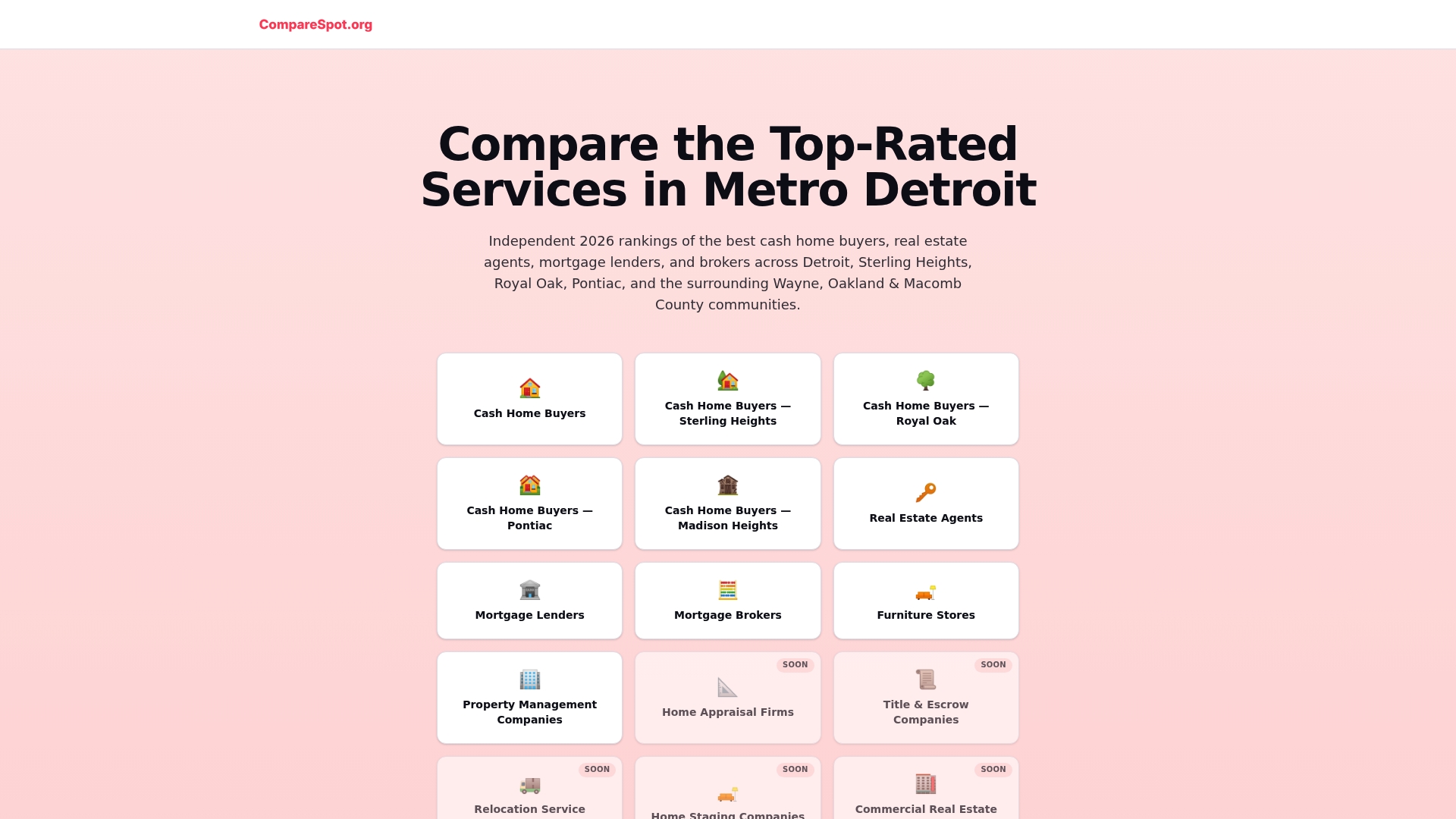
You can also browse everything we publish on CompareSpot, including city-level rankings and guides for time-sensitive sales such as foreclosures and inheritances.
FAQ
Does a land contract have to be in writing in Michigan?
Yes. A Michigan land contract must be in writing and satisfy the Statute of Frauds, according to a township land contract guide. It should also state the payment terms and address possession, taxes, insurance and maintenance.
What is the maximum interest rate on a Michigan land contract?
Michigan Legal Help reports that the maximum rate is 11%. The rate can change over the life of the contract as long as the average does not exceed 11%.
Who pays property taxes on a land contract?
In most Michigan land contracts the buyer pays property taxes, keeps the home in good condition and carries insurance, per Michigan Legal Help. The written agreement can assign these differently, so check the contract itself.
How does forfeiture work if the buyer stops paying?
Forfeiture is allowed only when the contract expressly permits it. The seller serves written notice, the buyer generally has 15 days to cure, and then the seller may seek possession in district court, as the state housing authority’s timeline explains. After judgment the buyer has 90 days to redeem if less than 50% was paid, or six months if 50% or more was paid.
Why would a buyer choose a land contract?
Often because they cannot qualify for a mortgage or pay cash, or because the home’s condition or low value makes bank financing hard, per the City of Detroit. Land contracts can also be quicker and cheaper to set up, though they lack many mortgage protections.
Sources
- Land Contract Information, City of Detroit
- Land Contract Guide, Muskegon Township
- Michigan House Legislative Analysis, 1997-1998
- Risks and realities of the contract for deed, Federal Reserve Bank of Minneapolis
- An Overview of Land Contracts, Michigan Legal Help
- Land Contracts: Forfeiture Process, MSHDA
- Purchase and Sale of a Home, State Bar of Michigan Real Property Law Section