

Yes, in most cases the personal representative can sell the estate’s real property right now without waiting for the entire probate case to close. Under MCL 700.3715, a personal representative acting under unsupervised administration generally has authority to sell, mortgage, or lease estate real estate when it serves the interests of the heirs and creditors. The exceptions: the will explicitly restricts the sale, or the court has placed the estate under supervised administration.
Before you list the house or field an offer, get these three things in hand:
- Letters of Authority from the probate court, the document title companies and buyers will require to confirm you can legally sign
- A certified death certificate and your probate case number, both needed for nearly every filing and closing step
- The property itself secured, meaning locks changed, insurance updated, and utilities kept active
Fast fact: Michigan’s probate courts track case timeliness by county, and the data shows real gaps in how fast filings move depending on where the estate sits, a point worth checking before you promise anyone a closing date.
Key Takeaways
Selling a Michigan probate property comes down to securing Letters of Authority fast, respecting the four-month creditor floor, and matching the sale method to the estate’s cash and time constraints.
| Point | Details |
|---|---|
| Confirm your authority first | Check MCL 700.3715 and the will for restrictions before listing or accepting any offer. |
| Get the appraisal early | File the required inventory within 91 days using a professional valuation, not the tax assessment. |
| Plan around the creditor window | Debts and expenses must be settled before distribution, and four months is the statutory minimum. |
| Match the sale route to the estate | Choose MLS, an as-is cash sale, or family transfer based on repair budget and heir alignment. |
| Watch county-level friction | Wayne and Oakland often demand more documentation and longer hearing delays than smaller counties. |
| Use a vetted local shortlist | Comparespot ranks Metro Detroit cash buyers and agents by data and customer sentiment, a faster way to find a trustworthy provider than an open search. |
This article is general information, not a substitute for advice from a qualified lawyer. Consult a qualified legal professional about your own circumstances before acting on anything here.
Table of Contents
- What Authority and Documents Do You Need to Sell Probate Real Estate in Michigan?
- How Long Does Probate Take in Michigan Before You Can Sell?
- MLS, Cash Sale, or Family Transfer: Which Route Fits This Estate?
- Does Wayne, Oakland, or Macomb County Change the Timeline?
- Why Local Market Knowledge Changes the Math
- What Are the Filing Steps to Open Probate for Real Estate in Michigan?
- How Do You Handle Will Contests or Creditor Disputes During a Sale?
- What Taxes Do Heirs Owe Beyond Property Tax Uncapping?
- What Court Hearings Are Required Before a Probate Property Sale?
- What if Heirs or the Personal Representative Live Out of State?
- When Should You Bring in a Probate Attorney or Specialized Agent?
- Where Comparespot Fits Into Your Sale
- Sources
- FAQ
What Authority and Documents Do You Need to Sell Probate Real Estate in Michigan?
Once the probate court appoints you, MCL 700.3715 gives you broad statutory power over estate real property, provided you act reasonably and in the interest of heirs and creditors. That authority has limits. If the will names a restriction on selling real estate, or if the court has ordered supervised administration, you need a judge’s approval before signing anything. Supervised administration is the exception, not the rule, but it shows up more often when heirs disagree or the estate carries complicated debts.
Separately from your authority to sell, Michigan’s Estates and Protected Individuals Code requires you to file an inventory within 91 days of your appointment, listing every estate asset at fair market value. For real estate, that almost always means a professional appraisal rather than the county’s tax-assessed value or a quick online estimate, since assessed values frequently lag well behind market prices.
Pro Tip: Order the appraisal before you list the property. Buyers and title companies will ask for it, and having it ready shaves days off closing instead of scrambling once you have an accepted offer.
Here’s what to gather before you talk to a title company:
- Certified copies of your Letters of Authority
- A certified death certificate
- Your probate case number and relevant court filings
- A deed signed by you as personal representative, not by the deceased
- The filed inventory showing the appraised value of the property
Missing even one of these will stall a closing, sometimes for weeks.
How Long Does Probate Take in Michigan Before You Can Sell?
Michigan law requires a minimum four-month creditor notice period before an estate can be closed and property distributed, according to the State Bar of Michigan. That four-month window doesn’t necessarily stop you from selling the house. It does set a floor on when the estate can finish paying debts and distribute the proceeds to heirs.
For unsupervised administration, expect the sale process itself, listing to closing, to take anywhere from a few weeks to a few months once you have Letters of Authority. Supervised administration adds time: court hearings, petitions for permission to sell, and judge sign-off can tack on additional weeks or months. Full probate administration in Michigan commonly runs six to twelve months from filing to closing the estate.
Budget for these costs before you calculate net proceeds:
- Michigan real estate transfer tax on the sale price
- Agent commissions if you list on the MLS
- Repairs or cleanup to make the property marketable
- Insurance and utility costs while the property sits vacant
- Attorney and administration fees
- A possible property tax uncapping under MCL 211.27a, which can raise the taxable value once ownership transfers
That last item catches a lot of executors off guard. A home that’s been under a capped assessment for twenty years can see its tax bill jump significantly the year after transfer, which matters if you’re holding the property for months before selling.
MLS, Cash Sale, or Family Transfer: Which Route Fits This Estate?
Three paths lead to a closed sale, and the right one depends less on what sounds best and more on what the estate can afford to wait for.
Listing on the MLS with a real estate agent typically nets the highest sale price, especially if the home is in decent shape and heirs can manage showings without friction. The trade-off is time and cash: you’re paying commissions (usually 5 to 6% of the sale price), plus whatever repairs the home needs to compete with move-in-ready listings nearby. If the estate has no cash reserve to cover those repairs or months of carrying costs, this route can quietly drain the very proceeds you’re trying to maximize.
An as-is cash sale skips repairs and shortens the timeline dramatically, often to a couple of weeks. You give up some sale price in exchange for certainty and speed. This route makes the most sense when the property needs work the estate can’t fund, when heirs live out of state and can’t coordinate showings, or when carrying costs (taxes, insurance, utilities) are eating into the estate faster than a slower sale would recover.
Intra-family transfer, selling or gifting the property to an heir who wants to keep it, avoids the open market entirely but still requires the same documentation: a deed from the personal representative, court approval if administration is supervised, and careful attention to whether the transfer triggers property tax uncapping.
Whichever route you choose, ask specific questions before committing:
- If a cash buyer, request proof of funds and a written net-proceeds estimate, not just a headline offer number
- If listing traditionally, ask the agent for comparable sales in the same condition, not the same neighborhood
- If transferring within the family, confirm in writing how the buying heir will settle with co-heirs
Pro Tip: Run the numbers both ways, cash offer versus MLS net proceeds after commissions and repairs, before deciding. The higher number on paper isn’t always the higher number in the estate’s bank account three months later.
Does Wayne, Oakland, or Macomb County Change the Timeline?
County practice matters more than most executors expect. Michigan courts publish case-age and timeliness statistics showing real variation in how fast probate matters move county to county. Higher-volume counties like Wayne and Oakland tend to demand more thorough documentation and can carry longer calendar delays for any hearing that requires a judge’s signature. Smaller counties often move faster simply because there’s less docket congestion.
Title issues and outstanding liens are the most frequent reason a straightforward sale turns into a supervised one, particularly in urban counties where older housing stock means more back taxes, water liens, or contested title history.
Use this checklist regardless of county:
- Change the locks the day you’re appointed personal representative
- Convert the homeowner’s policy to a vacant-property or landlord policy, standard coverage often lapses on unoccupied homes
- Order the appraisal required for your inventory filing
- File the inventory with the court within 91 days
- Publish creditor notice if the estate requires it
- Run a title search to catch liens, back taxes, or water bill judgments before they surprise a buyer
- Notify the mortgage servicer and utility companies of the ownership change
Hidden costs pile up fast on a vacant probate property: a burst pipe in an unheated house, a lapsed insurance policy, a municipal water lien nobody knew about. Securing the property in week one, not month three, is the cheapest insurance you’ll buy during this entire process.
Pro Tip: Winterize immediately if the death occurs between October and March. A frozen and burst pipe can cost more in repairs than the property tax bill for the entire holding period.
Why Local Market Knowledge Changes the Math
Statutes tell you what you’re allowed to do. They don’t tell you which cash buyer in Wayne County actually closes on time, or which agent has handled a probate sale in Oakland County before and knows what documentation the title company will demand. That gap between legal permission and practical execution is where most executors lose money, usually through a bad buyer relationship or an agent who underprices the repair budget.
Comparespot built its Metro Detroit rankings around that gap: independently researched lists of cash buyers, agents, and lenders, scored on customer sentiment and actual transaction data rather than who paid for placement. For an executor juggling a court deadline and a house that needs a new roof, a vetted shortlist beats a generic web search every time.
Most probate sale disputes trace back to one thing: the personal representative picked a buyer or agent based on a phone call instead of verified track record. The paperwork is rarely the hard part. Choosing who to trust with the sale is.
Before signing with anyone, request proof of funds, at least two references, and a written net-proceeds estimate that itemizes commissions, repairs, and fees.
What Are the Filing Steps to Open Probate for Real Estate in Michigan?
Probate starts with filing a petition in the probate court of the county where the deceased lived. You’ll need the original will if one exists, a certified death certificate, and a filing fee that varies by county. The court schedules a hearing, typically several weeks out, to appoint a personal representative and issue Letters of Authority.
If there’s no will, the court follows Michigan’s intestacy statute to determine heirs, which can add time if the family tree is complicated or a relative contests who should serve as personal representative. Most straightforward estates move through unsupervised administration, where you file the initial petition, get appointed, and then handle inventory, creditor notice, and eventual distribution without returning to court for every decision.
Real estate adds one more filing step: once appointed, you must include the property in your inventory with its appraised value, filed within 91 days. If the property needs to be sold before the estate closes, you don’t file a separate petition for unsupervised administration unless the will restricts your authority or a creditor or heir formally objects. Supervised administration requires a specific court order and turns every major decision, including the sale itself, into a matter requiring judicial sign-off. Filing errors, wrong court, missing certified documents, an incomplete inventory, are the most common reason estates stall for months before a single showing happens.
How Do You Handle Will Contests or Creditor Disputes During a Sale?
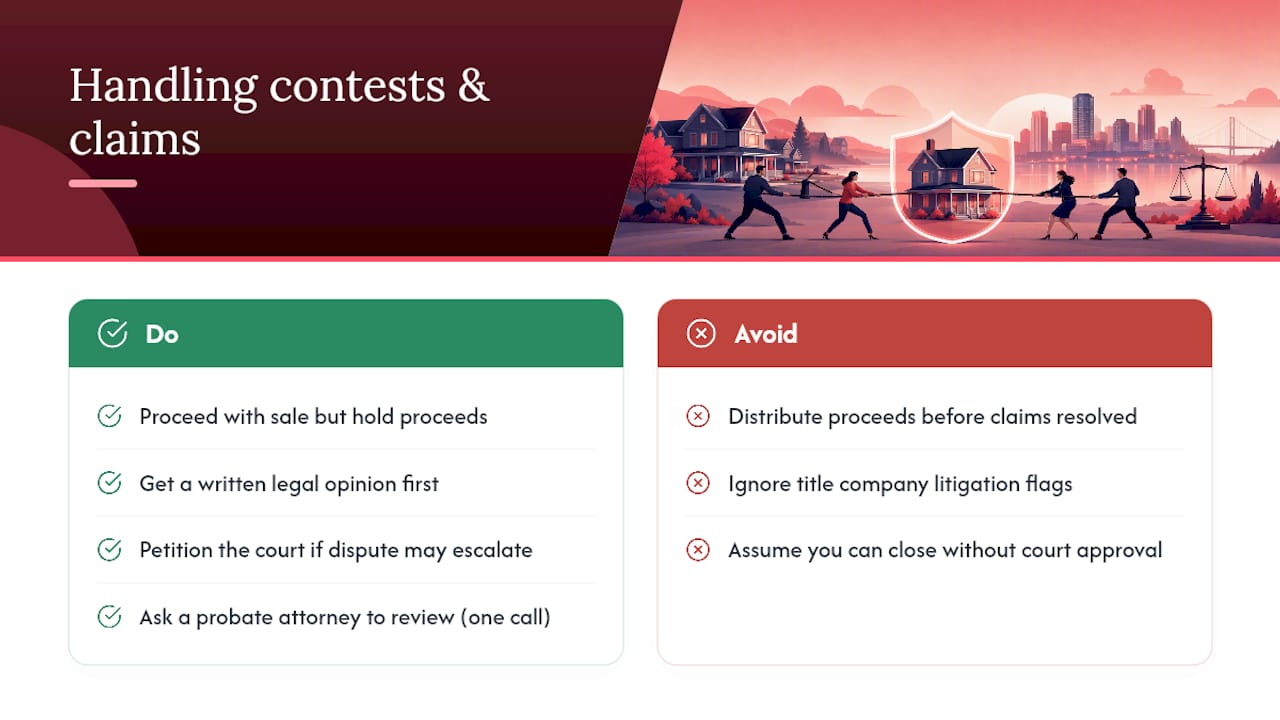
A will contest or creditor claim doesn’t automatically stop a real estate sale, but it can freeze your ability to distribute proceeds until the dispute resolves. If an heir challenges the will’s validity, the probate court typically pauses major estate actions, including property sales, until a judge rules on the contest. Selling into that uncertainty risks a title problem down the line if the contest succeeds and changes who legally owns the proceeds.
Creditor claims work differently. Michigan requires a four-month notice period for creditors to file claims against the estate. You can often still sell the property during this window, but you can’t safely distribute the proceeds to heirs until debts are resolved or the claim period expires. A creditor with a valid claim against the estate has priority over heir distributions, so premature payouts can expose you to personal liability.
If a dispute looks likely to escalate, get a written legal opinion before you accept an offer, not after. Title companies will also flag pending litigation during a title search, which can delay or kill a closing regardless of what you intended. The safest move when facing a contest or a large creditor claim is to petition the court for guidance rather than assume your unsupervised authority still covers the sale. A probate attorney can tell you within a single conversation whether your specific dispute requires court approval before you move forward.
What Taxes Do Heirs Owe Beyond Property Tax Uncapping?
Property tax uncapping under MCL 211.27a gets the most attention, but it’s not the only tax consequence heirs should plan for. Inherited property generally receives a “stepped-up basis,” meaning its value for capital gains purposes resets to fair market value at the date of death rather than what the deceased originally paid. That matters enormously if the home has appreciated for decades: an heir who sells shortly after inheriting typically owes little or no capital gains tax, since the sale price and the stepped-up basis are close together.
The math changes if the estate holds the property for a long stretch before selling and the market keeps climbing. Any appreciation between the date of death and the sale date is taxable as a capital gain. This is one more argument for getting that professional appraisal early: it establishes the stepped-up basis on record, which protects heirs if the IRS ever questions the reported value.
Michigan does not impose a state inheritance or estate tax, so heirs generally don’t owe Michigan-specific tax on the inheritance itself. Federal estate tax only applies to estates well above most home values, so it rarely touches a typical inherited house. The tax exposure heirs actually face comes from capital gains on appreciation after death and, for landlords among the heirs, potential depreciation recapture if the property was ever a rental.
What Court Hearings Are Required Before a Probate Property Sale?
Unsupervised administration, the path most Michigan probate real estate sales follow, requires no hearing to authorize the sale itself. Once the court issues Letters of Authority at the initial appointment hearing, MCL 700.3715 lets you act without returning for permission on every transaction.
Supervised administration flips that. If the court orders supervised administration, either because the will requests it or because an heir petitioned for closer oversight, you must file a petition specifically asking permission to sell the real estate. The court schedules a hearing, notifies interested parties, and a judge reviews the terms of the sale before authorizing it. This process commonly adds several weeks to a couple of months depending on the county’s calendar.
Even under unsupervised administration, certain triggers can force a hearing: an heir objecting to the sale terms, a dispute over the appraised value, or a creditor claim large enough to threaten the estate’s solvency. Wayne and Oakland counties, given higher case volume, tend to schedule these hearings with more lead time than smaller counties. If your estate is running under unsupervised administration and nobody has objected, plan on zero mandatory hearings tied to the sale itself, just the paperwork trail: inventory filing, notice to creditors, and the closing documents.
What if Heirs or the Personal Representative Live Out of State?
Out-of-state heirs and absentee personal representatives are common in Michigan probate, especially with Metro Detroit families scattered across the country. Michigan law doesn’t require the personal representative to reside in the state, but it does require a registered agent or a Michigan address for service of process in many cases, so an out-of-state PR typically needs to name a Michigan-based agent to receive court correspondence.
For signing documents, most closings can accommodate an absentee personal representative through a mobile notary or remote online notarization, both increasingly standard for probate closings. Letters of Authority and the deed still need to be properly executed and often notarized, but physical presence in Michigan for the closing itself is rarely required anymore.
Out-of-state heirs create a different challenge: coordinating showings, repairs, and decision-making across time zones and travel schedules. This is frequently the strongest argument for an as-is cash sale, since it removes the need for heirs to fly in for staging, open houses, or repair walkthroughs. If heirs disagree on price or timing from a distance, get agreement in writing before listing, a phone consensus that falls apart after an offer comes in is one of the most common reasons a probate sale collapses at the last minute.
When Should You Bring in a Probate Attorney or Specialized Agent?
Hire an attorney the moment you see a contested will, a title cloud, a supervised administration order, a pending foreclosure, or a creditor claim large enough to threaten solvency. A real estate agent or property manager earns their fee when the home is market-ready and someone locally can coordinate showings and repairs. Skipping legal counsel on a genuinely disputed estate risks personal liability for the personal representative, since fiduciary duty doesn’t forgive an honest mistake made without advice.
Where Comparespot Fits Into Your Sale
Comparespot exists for exactly the moment you’re in: choosing a buyer or agent fast, without months of vetting, while a probate deadline sits on the calendar. Instead of a generic search that surfaces whoever spent the most on ads, Comparespot ranks Metro Detroit’s cash buyers, agents, and lenders using customer sentiment and transaction research, and providers can’t pay for a better spot on the list.

Start with the 10 Best Cash Home Buyers in Metro Detroit list if the estate needs a fast, as-is sale, or the 10 Best Real Estate Agents in Metro Detroit ranking if the property is in shape for the open market. Whichever you choose, request proof of funds from any cash buyer and an itemized net-proceeds estimate from any agent before you sign. If the estate needs a mortgage payoff resolved or a refinance during the process, the 10 Best Mortgage Lenders in Metro Detroit rankings cover that too. Pick a shortlist, make three calls, and compare answers side by side before committing to anyone.
Sources
- MCL - Section 700.3715 - Michigan Legislature
- Probate information: When can I distribute property and close the estate — State Bar of Michigan
- Michigan Courts — Probate court timeliness / case age report
FAQ
Can a personal representative sell a house during probate in Michigan?
Yes, under MCL 700.3715 a personal representative can generally sell estate real property without a court hearing, unless the will restricts the sale or the court has ordered supervised administration.
How long does probate take in Michigan before you can sell the house?
The sale itself can often happen within weeks of getting Letters of Authority, but the statutory creditor notice period runs a minimum of four months, and full estate closing commonly takes six to twelve months.
Does selling an inherited house in Detroit trigger a property tax increase?
Often yes. Ownership transfer through probate can uncap the property’s taxable value under MCL 211.27a, which can raise the annual tax bill starting the year after transfer.

Is a cash sale or an MLS listing better for a probate house sale in Michigan?
An MLS listing generally nets a higher sale price if the property is in good condition and heirs can manage showings, while an as-is cash sale suits estates that can’t afford repairs or months of carrying costs.
Where can Michigan executors find vetted cash buyers or agents?
Comparespot publishes independently researched rankings of cash home buyers, real estate agents, and mortgage lenders across Wayne, Oakland, and Macomb counties, based on customer sentiment rather than paid placement.