
TL;DR
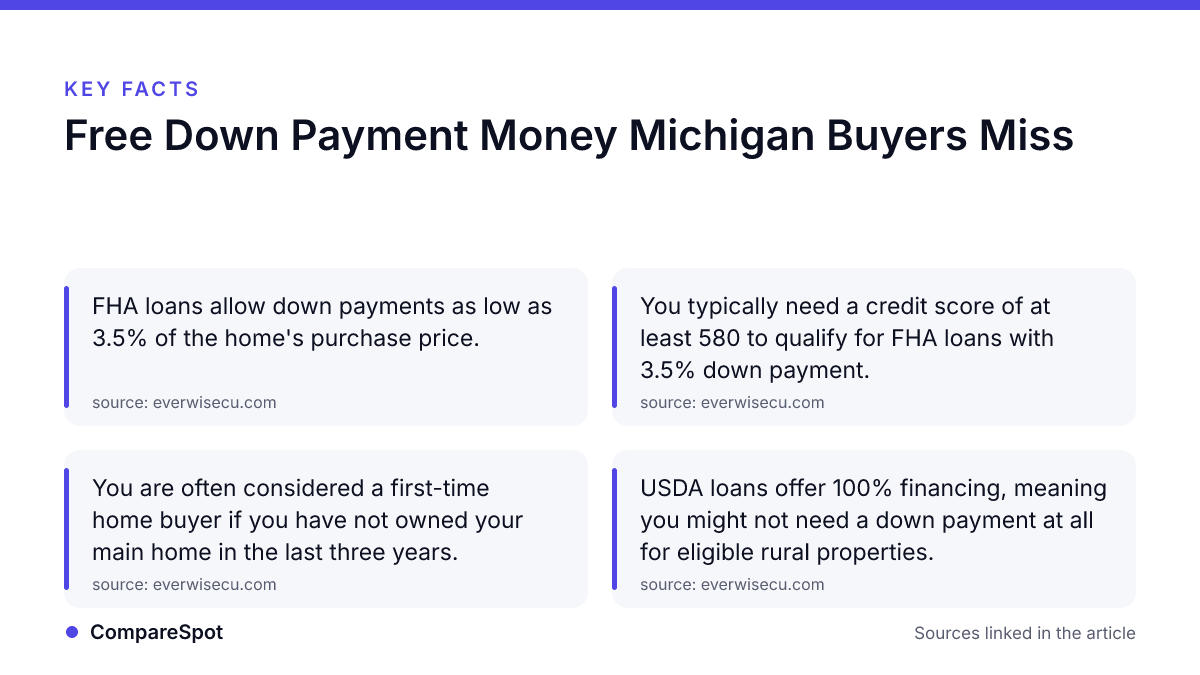
- FHA loans need 3.5% down with a credit score of at least 580. VA and USDA loans can require nothing down for eligible buyers and properties, and VA carries no private mortgage insurance.
- Michigan's MI Home Loan program through MSHDA adds up to $10,000 in down payment assistance (the "MI 10K DPA"), which covers all but $500 of the FHA down payment on a $300,000 house.
- MSHDA also runs a first-generation homebuyer program worth up to $25,000 statewide, including Detroit. It's funding-limited, so confirm availability with a participating lender before you budget around it.
- You're generally a "first-time" buyer if you haven't owned and occupied your main home in the past three years, even if you owned one before that.
- Most Michigan down payment assistance is a deferred second loan repaid when you sell or refinance, not free cash.
The most expensive mistake we see first-time buyers in Metro Detroit make happens before they ever tour a house. They get pre-approved by whichever lender their cousin used, that lender doesn't participate in MSHDA, and $10,000 in assistance quietly evaporates. Nobody tells them. The loan closes, the buyer never knows what they missed.
So here's the short version. A first-time buyer in Michigan can put as little as 3.5% down with an FHA loan, or nothing down with a VA or USDA loan if they qualify, then stack state assistance through the MI Home Loan program on top. Buyers in Oakland County can often add a county grant as well. On a modestly priced Detroit home, that combination doesn't just shrink the down payment. It can erase it.
Table of Contents
- How much of a down payment do you need for a $300,000 house?
- How much do you need to make to afford a $300,000 house in Michigan?
- Is Detroit's $25,000 down payment assistance program still active?
- What down payment assistance programs can Metro Detroit buyers actually stack?
- Who counts as a first-time home buyer in Michigan?
- What's the actual application process and timeline?
- Which loan type actually fits your situation?
- Frequently asked questions
How much of a down payment do you need for a $300,000 house?
At $300,000, a price point you'll hit fast in Royal Oak, Ferndale, or Sterling Heights, an FHA loan at 3.5% down means $10,500 upfront and $289,500 financed. A conventional loan at 5% down would run $15,000. A qualifying borrower using a VA or USDA loan could close with $0 down, since both allow 100% financing for eligible buyers and properties.
Now stack the assistance. If you're approved for the full $10,000 MI 10K DPA, it covers all but $500 of that $10,500 FHA down payment. You've gone from writing a five-figure check to writing one for a few hundred dollars.
Pro tip: Ask your lender to run the DPA math before you start touring houses, and ask specifically whether the assistance can be applied to closing costs once the down payment is covered. On a lower-priced Detroit house where the 3.5% requirement is small, the leftover DPA dollars are often the difference between closing and coming up short at the table.
How much do you need to make to afford a $300,000 house in Michigan?
There's no fixed statewide number, because your rate, your property tax bill, and your car payment all move it. But you can build the estimate yourself in four steps. Every figure below is illustrative, so swap in your own.
- Loan amount: $300,000 minus the 3.5% FHA down payment ($10,500) leaves $289,500 financed.
- Principal and interest: At an illustrative 7% on a 30-year term, $289,500 works out to roughly $1,926 a month.
- Taxes and insurance: Budget an illustrative $400 a month. Total housing payment (PITI) is about $2,326.
- Apply the 31% front-end guideline: Lenders generally want housing at or below roughly 31% of gross monthly income. $2,326 ÷ 0.31 ≈ $7,503 a month, or about $90,000 a year.
The rule of thumb that falls out of that: you need annual income of a bit over three times your annual housing payment. Divide your target monthly payment by 0.31 and multiply by 12, and you've got your income target in ten seconds.
One thing that step 3 leaves out: FHA's monthly mortgage insurance premium. Whatever number your lender quotes, every $100 of monthly MIP raises the income you need by roughly $3,900 a year ($100 ÷ 0.31 × 12 = $3,871). That's why we push buyers with solid credit and 5% saved to price out a conventional loan side by side instead of assuming FHA wins.
The picture changes completely in Detroit proper, where sale prices sit at a fraction of suburban levels and the required income drops with them. That's the whole premise behind our pillar guide on what $200K buys you in Detroit right now.
Pro tip: Michigan taxes you on taxable value, which is roughly half of market value, not the sale price. Detroit's homestead millage is high enough that property taxes are a genuine affordability problem here. Run it yourself: a $100,000 home with a $50,000 taxable value at roughly 68 mills is $50,000 × 0.068 = $3,400 a year, about $283 a month before insurance. Get the actual figure for the specific parcel, because the city average will mislead you, and a recent sale can uncap the taxable value and jump your bill the year after you buy.
Is Detroit's $25,000 down payment assistance program still active?
It exists, but it isn't a Detroit program. It's a statewide MSHDA offering for first-generation homebuyers worth up to $25,000 in down payment assistance, available in Detroit, Pontiac, Madison Heights, and everywhere else in Michigan.
Two things to understand about it. First, "first-generation" turns on your parents' housing history, not just yours, so gather what you can about whether they ever owned a home before you assume you're out. Second, programs like this run on a finite appropriation. Rounds open, lenders reserve funds file by file, the money runs out, and the program goes quiet until it's refunded. Availability can change between the day you read an article and the day you write an offer.
Call an MSHDA-approved lender and ask one question: "Can you reserve first-generation DPA funds for a file today?" That answer is worth more than any blog post's snapshot, including this one.
What down payment assistance programs can Metro Detroit buyers actually stack?
Most "first-time buyer programs" articles list programs one by one and never tell you which ones combine. That's the part that matters.
| Program | What it offers | Best for |
|---|---|---|
| MI Home Loan (MI 10K DPA) | Up to $10,000 toward down payment and closing costs | Any qualifying first-time buyer statewide |
| MSHDA first-generation program | Up to $25,000 in down payment assistance | First-generation buyers, while funding lasts |
| Oakland County Homebuyer Assistance | County grant, recently around $5,000 | First-time buyers purchasing in Oakland County |
| FHA loan | 3.5% down, 580 minimum credit score | Buyers with thin savings or lower credit |
| VA loan | Often $0 down, no PMI | Eligible veterans and service members |
| USDA loan | 100% financing on eligible properties | Buyers in qualifying rural areas |
- MI 10K DPA plus an FHA loan: the workhorse combination in Metro Detroit. Minimum down payment, assistance that covers most or all of it.
- Oakland County grant plus MI Home Loan: in Oakland County, this pairing can wipe out the down payment entirely on a moderately priced house. Confirm the current grant amount and stacking rules with your lender, since county allocations move year to year.
- VA or USDA with zero down: if you're eligible, you may not need assistance for the down payment at all. Point the DPA conversation at closing costs and prepaids instead.
Pro tip: Michigan DPA is usually a deferred second loan, due when you sell, refinance, or pay off the first mortgage. That has a practical consequence nobody mentions at the closing table: if you refinance in three years to drop your rate, the assistance comes due right then. Ask what triggers repayment before you treat it as money you keep.
Who counts as a first-time home buyer in Michigan?
You generally qualify if you haven't owned and occupied your main home in the past three years. Owning a house in 2009 doesn't disqualify you in 2026.
That three-year window catches more people than they expect. Divorced homeowners who signed over the deed. Renters who sold and never bought again. Heirs who inherited a house in Macomb or Oakland County, sold it, and assumed the ownership was permanent on their record. If the sale was more than three years ago and you've been renting since, run your eligibility past a lender rather than counting yourself out.
What's the actual application process and timeline?
- Get pre-approved with an MSHDA-approved lender first. Not every lender participates. Ask by name: "Do you originate MI Home Loan with the MI 10K DPA?" A vague yes is a no.
- Apply for the assistance alongside the mortgage, not after. DPA is underwritten and reserved inside your loan file. It can't be bolted on once you're under contract.
- Finish homebuyer education early. Some MSHDA programs require a course before closing, and the certificate is a classic last-week delay.
- Shop, offer, get under contract. In Ferndale and Royal Oak you need your pre-approval and your DPA reservation already in hand to compete.
- Inspection and appraisal. Detroit's housing stock skews old and heavily single-family. Budget for both inspections, and expect knob-and-tube, galvanized supply lines, or a roof at the end of its life to surface on the report.
- Underwriting and closing. In our experience, accepted offer to keys runs four to six weeks, longer when DPA paperwork or FHA-required repairs enter the picture.
Pro tip: Write the assistance into the offer correctly. A listing agent who has never seen a DPA deal may read it as a weak buyer and steer the seller elsewhere, when the file is actually fully underwritten. Our breakdown of agent versus broker roles helps you figure out who to call first.
Which loan type actually fits your situation?
Here's our honest ranking for a first-time buyer in Metro Detroit.
If you're VA-eligible, use VA. No down payment and no private mortgage insurance beats every other option on the board, and it isn't close. If you're buying in an outlying township, pull up the USDA eligibility map for the exact address before ruling it out; the built-up core of Wayne, Oakland, and Macomb won't qualify, but the edges sometimes do, and 100% financing is worth five minutes of checking.
FHA is the default, not the winner by default. It's the right call when your credit sits in the 580s to low 600s or your savings are thin. With decent credit and 5% down, conventional often costs less over the years you actually hold the loan, mostly because of how long FHA's mortgage insurance sticks around at the minimum down payment. Our FHA vs. conventional comparison runs the thresholds and the insurance math. If you're still deciding whether to buy at all, our rent vs. buy in Detroit piece works through that comparison.
Frequently asked questions
Do I have to pay back Michigan's down payment assistance?
Usually, yes. Michigan DPA is typically a deferred second loan with little or no interest, due when you sell, refinance, or pay off the first mortgage. Get the exact repayment trigger in writing before you treat the money as a gift.
Can I combine the MI Home Loan with Oakland County's grant?
Often yes, if you meet both sets of eligibility rules and your lender participates in both programs. Stacking rules and funding levels change, so confirm with an MSHDA-approved lender before you build a closing budget on both.
What if my credit score is below 580?
You won't hit FHA's 3.5% down option, since 580 is generally the minimum for that down payment. Some lenders will approve FHA at lower scores with a larger down payment. VA and USDA credit minimums are set by individual lenders rather than a single national number, so shop at least three participating lenders before you conclude you can't buy.
Your next move is one phone call. Ask three Michigan lenders whether they can reserve MI 10K DPA, Oakland County assistance, or first-generation funds today, and how much is left in each pot. The ones who answer with specifics are the ones to work with.