

Yes, a short sale works in Michigan, and it’s usually a better outcome than foreclosure for both your credit and your finances. The catch is that your lender controls the timeline and the terms, not you, and they must sign off on the deal before it closes. Get that lender’s written deficiency waiver, and you walk away without a foreclosure on your record and without owing the difference between what you sold for and what you owed.
TL;DR:
- A short sale often leaves you with less credit damage than foreclosure and allows more control over sale terms and timing.
- The lender’s approval process can take 30 to 120 days or longer, especially if a second lien holder is involved, and must include a written deficiency waiver.
- Successful short sale documentation requires a hardship letter, proof of income and assets, and a net sheet showing what the lender will recover.
- Without a written waiver of deficiency, lenders in Michigan can still pursue deficiency judgments and tax implications may arise if debt is forgiven.
- Prioritize securing lender approval for the deficiency waiver and working with experienced agents or attorneys to navigate the process efficiently.
Table of Contents
- What Is a Short Sale in Michigan and How Does It Differ From Foreclosure?
- Quick Checklist: Is a Short Sale Right for You?
- How Does the Michigan Short Sale Process Work Step by Step?
- What Do Lenders Look for in a Short Sale Package?
- What Risks and Costs Come With a Michigan Short Sale?
- Where Can You Find Short Sale Listings and Avoid Scams?
- How Comparespot Helps You Find Vetted Local Professionals
- Why the Standard Short-Sale Advice Falls Short for Michigan Sellers
- Sources
- FAQ
What Is a Short Sale in Michigan and How Does It Differ From Foreclosure?
A short sale happens when your lender agrees to let you sell your house for less than the remaining mortgage balance, then accepts that reduced amount as payment in full, ideally with your deficiency forgiven in writing. “Short” refers to the shortfall in the payoff amount, not to how fast it happens. That’s the most common misunderstanding sellers bring to this process, and it can lead to frustration when a deal that should close in a month drags into its third.
Compared with foreclosure, a short sale gives you more control. You choose the agent, negotiate with the buyer, and stay in the home until closing instead of being forced out by a sheriff’s sale.
- You keep some say in price and timing, unlike a foreclosure auction.
- Credit damage from a short sale is typically less severe than from a completed foreclosure.
- Every short sale requires lender sign-off, which is what separates it from an ordinary listing.
That last point is the one sellers underestimate most. Your buyer isn’t just buying from you. They’re waiting on your lender’s loss mitigation department to approve the whole transaction.
Quick Checklist: Is a Short Sale Right for You?
Before you call your lender, run through this self-assessment. It takes ten minutes and can save you weeks of wasted effort.
- Confirm you’re underwater. Compare your current mortgage payoff against a realistic market value from a local agent, not a Zestimate.
- Document your hardship. Job loss, medical bills, divorce, or a death in the family all qualify; a vague “I’d rather not pay this” does not.
- Check your foreclosure clock. If a sheriff’s sale date is already set, a short sale may still be possible, but the window is tighter than most homeowners assume.
- Decide on representation. An agent or attorney with actual short-sale experience in Michigan is worth the fee if your equity position is thin or your lender is difficult.
If you check all four boxes, you’re a reasonable candidate. If not, a deed-in-lieu of foreclosure, a cash sale, or a loan modification might fit your situation better.
How Does the Michigan Short Sale Process Work Step by Step?
The Michigan short sale process runs on your lender’s clock more than yours. Here’s the realistic sequence.
- Call your loss mitigation department. Ask for the short-sale package and explain your hardship before you list the house.
- Assemble your documents. You’ll need a hardship letter, recent pay stubs, bank statements, and tax returns before the lender will even consider your case.
- List the property and secure an offer. A cash offer with no financing contingency moves through underwriting faster than a financed one.
- Submit the full package to your lender. Expect them to order a valuation or appraisal, then sit in review for anywhere from 30 to 120 days or longer, depending on your servicer and whether a second lien holder is involved.
- Close, or respond to a denial. If approved, you close under the lender’s terms. If denied, ask why, and consider a deed-in-lieu, a direct cash sale, or bankruptcy protection depending on your circumstances.
Michigan’s foreclosure timeline through MSHDA lays out the statutory deadlines you’re racing against if foreclosure proceedings have already started, and it’s worth reading before you assume you have more time than you do.
Pro Tip: Ask your lender in writing, not just over the phone, whether they’ll waive the deficiency balance. A verbal promise from a call center representative means nothing if the loan gets sold before closing.
What Do Lenders Look for in a Short Sale Package?
Lenders approve or deny short sales based on one calculation: does this recover more money, faster, than taking the house back through foreclosure? Your job is to make that math obvious.
Your package needs to include:
- A detailed hardship letter explaining why you can no longer afford the payment.
- Your current mortgage statement showing the exact payoff amount.
- Recent pay stubs and two to three months of bank statements.
- The last two years of tax returns.
- A clean net sheet showing exactly what the lender will receive after closing costs and fees.
A buyer who’s already secured financing, or better yet paying cash, strengthens your case because it removes the risk of a deal collapsing mid-review. According to the North Carolina Real Estate Commission’s short sale bulletin, buyers can and do walk away when lender approval drags on, so a committed buyer with no financing contingency is worth prioritizing. This is also where an attorney or an experienced agent earns their keep, particularly when negotiating the deficiency waiver language before you sign anything.
What Risks and Costs Come With a Michigan Short Sale?
A short sale isn’t a clean escape from financial pressure. It carries real risk, and the biggest one is walking away without a written deficiency waiver.
- Credit impact: Generally less damaging than foreclosure, though both appear on your credit report and affect your score for years.
- Re-eligibility for a new mortgage: Fannie Mae and FHA both offer shorter waiting periods after a short sale than after a foreclosure, sometimes with exceptions for documented extenuating circumstances, according to Michigan-based legal analysis comparing the two outcomes.
- Deficiency judgment exposure: Michigan law permits creditors to pursue deficiency judgments)/mileg.aspx?page=getObject&objectName=mcl-600-3280&highlight=deficiency) after foreclosure, and the same exposure can follow a short sale without a written waiver.
- Tax consequences: Forgiven debt can trigger a Form 1099-C, so talk to a tax professional before you close, not after.
The CFPB’s short sale guidance is blunt about this: in some states, lenders can still come after you for the deficiency unless you get a waiver in writing. Practitioners who handle these deals regularly treat that written waiver as non-negotiable, not a nice-to-have you ask for if there’s time.
Where Can You Find Short Sale Listings and Avoid Scams?
Short-sale and foreclosure listings in Michigan show up through a handful of reliable channels, and a few unreliable ones worth avoiding entirely.
- MLS through a licensed agent remains the most accurate source, since agents see status updates before public sites do.
- Zillow’s Michigan short sale filter is a solid starting point, but verify anything you find there against county records or an agent.
- County recorder and register of deeds offices show official filing status for free.
- MSHDA’s counseling network can point distressed homeowners toward vetted resources instead of predatory ones.
Watch for red flags: anyone demanding an upfront “rescue fee,” pressuring you to sign over your deed to a stranger, or claiming to be affiliated with the government without proof. HUD and MSHDA-approved housing counselors offer free guidance and won’t ask for money before helping you.
How Comparespot Helps You Find Vetted Local Professionals
Finding an agent who’s actually closed a short sale in Wayne, Oakland, or Macomb County, rather than one who just says they can, matters more than most homeowners realize. Comparespot ranks local providers using independent research and customer sentiment data rather than paid placements, so the agents listed for Metro Detroit reflect actual performance, not marketing budgets.
If your timeline is tight and a short sale isn’t moving fast enough, Comparespot’s cash home buyer rankings for Metro Detroit give you a vetted alternative for an as-is sale. Either path starts the same way: knowing which local providers have actually handled a distressed sale before, not just claimed to.

Why the Standard Short-Sale Advice Falls Short for Michigan Sellers
Most short-sale advice online is generic enough to apply to any state, and that’s exactly the problem. Michigan sellers get told to “request a deficiency waiver” as if it’s a formality, when the state’s own MSHDA guidance treats it as a make-or-break negotiating point, not boilerplate. I’d argue the industry undersells how much leverage a seller loses by skipping that step, or by trusting a verbal assurance instead of a signed document.
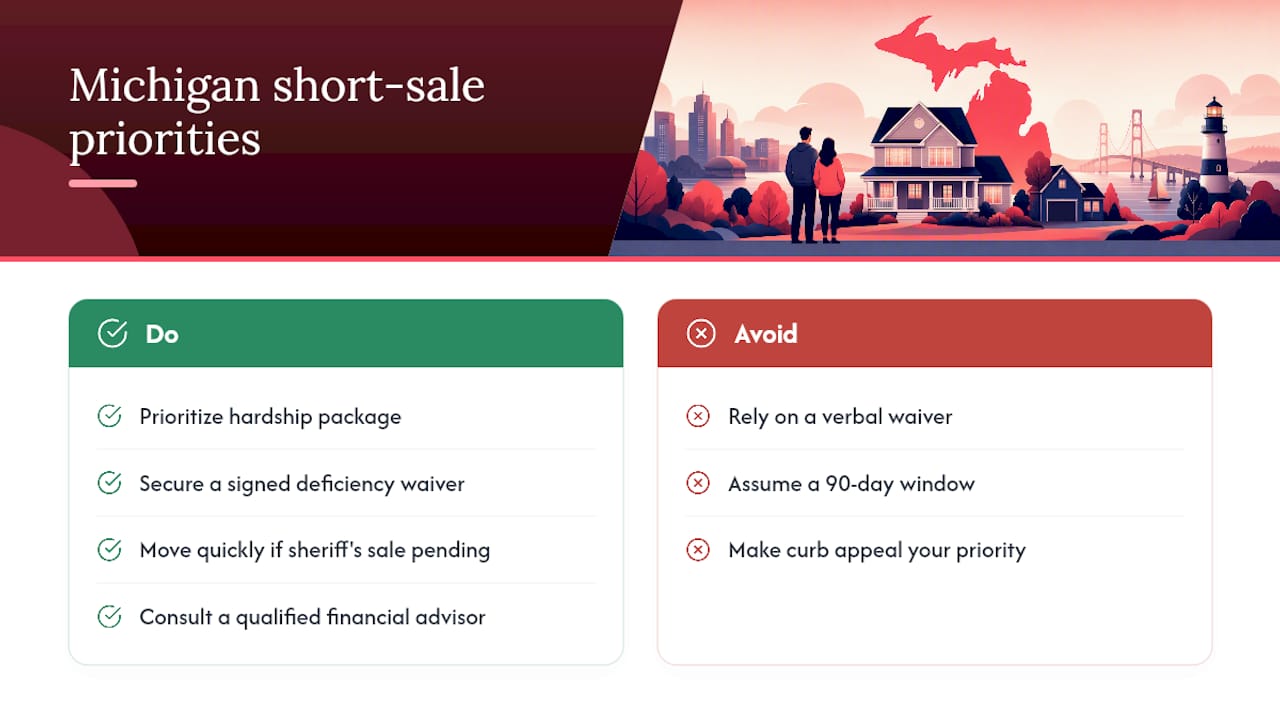
The other gap: too much advice frames the timeline as a formality (“it takes a few months”) without acknowledging that a pending sheriff’s sale date changes everything. If foreclosure proceedings are already underway, your actual window to complete a short sale might be measured in weeks, not the 90 days most guides casually cite.
My honest read is that the homeowners who come out ahead are the ones who treat the hardship package and the deficiency waiver as the two things worth fighting for, and treat everything else, staging, listing price tweaks, marketing, as secondary. Lenders don’t care about curb appeal. They care about net recovery and paperwork completeness. Prioritize accordingly.
— Bryan
This article is general information, not a substitute for advice from a qualified financial advisor. Consult a qualified financial professional about your own circumstances before acting on anything here.
Sources
Before you sign anything, cross-check your situation against these primary sources:
- Basic short sale issues (North Carolina Real Estate Commission bulletin)
- Stages of foreclosure (MSHDA)
- Michigan short sale homes & houses (Zillow)
FAQ
Who Pays Closing Costs in a Short Sale?
The lender typically pays closing costs out of the sale proceeds since they’re accepting less than the full payoff, though this varies by servicer and gets negotiated as part of the approval package.
Can a Buyer Back Out of a Short Sale?
Yes. Buyers can withdraw if lender approval takes too long or if the lender imposes new terms during review, which is why a written timeline expectation matters for both sides before signing a purchase agreement.
Where Can I Find Free Foreclosure Listings in Michigan?
County recorder and register of deeds offices post foreclosure filings for free, and MSHDA’s counseling network can direct you to additional public resources at no cost.
Are There Abandoned Towns for Sale in Michigan?
Michigan doesn’t have entire abandoned towns on the market in the way that phrase sometimes suggests online, but distressed and foreclosed properties, including short sales, are common in specific neighborhoods across Wayne, Oakland, and Macomb counties.
Does a Short Sale Hurt My Credit as Much as Foreclosure?
Generally no. A short sale tends to cause less credit damage than a completed foreclosure, and Fannie Mae and FHA both allow for shorter waiting periods before you can qualify for a new mortgage afterward.