

Michigan’s best starting point for first-time buyers is a four-program stack from the Michigan State Housing Development Authority (MSHDA): the MI Home Loan as your base mortgage, the MI 10K Down Payment Assistance loan available, the First-Generation DPA pilot if you qualify, and the Mortgage Credit Certificate (MCC) for potential federal tax savings. Your single most important next step is contacting an MSHDA Experienced Participating Lender to confirm which combination fits your income, credit, and target purchase price.
Here is a quick read on who each program typically helps:
- MI Home Loan: Any first-time buyer statewide with a 640+ credit score who needs a competitive 30-year mortgage.
- MI 10K DPA: Buyers who need up to ten thousand dollars cash-to-close and can complete a housing education course.
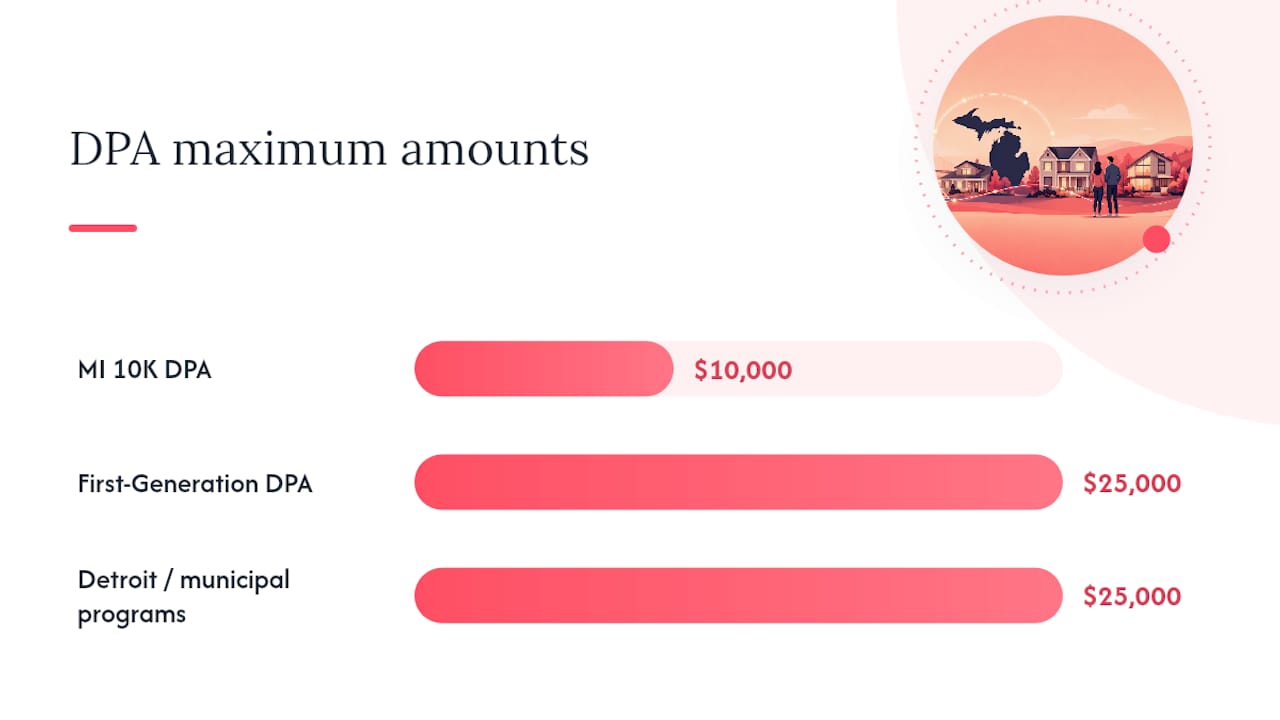
- First-Generation DPA (pilot): Buyers whose parents never owned a home and who can document that status; provides up to $twenty-five thousand dollars.
- MCC: Buyers who want to reduce their federal tax bill every year for up to thirty years.
- Detroit/municipal programs: City residents who may qualify for up to $twenty-five thousand dollars from local sources, sometimes on top of state assistance.
Pro Tip: Before you call any lender, ask specifically how many MSHDA MI Home Loan files they closed in the past 12 months. A lender who cannot answer that question quickly is probably not the right fit for a state DPA transaction.
Key Takeaways
Michigan’s first-time buyer programs through MSHDA give qualified buyers up to $twenty-five thousand dollars in down payment assistance, a 20% annual mortgage interest tax credit, and a statewide sales-price cap of $566,355 — but every program requires an MSHDA Experienced Participating Lender to access.
| Point | Details |
|---|---|
| Start with MI Home Loan | The 640 minimum credit score and $566,355 sales-price cap (June 1, 2026) are the baseline eligibility gates for all MSHDA DPAs. |
| Choose one DPA | First-Generation DPA ($twenty-five thousand dollars) and MI 10K DPA (up to ten thousand dollars) cannot be combined; pick the one that fits your family history and documentation capacity. |
| Apply for MCC before closing | The 20% annual interest tax credit must be approved before purchase and can reduce your federal tax bill for up to thirty years. |
| Lender selection is the highest-leverage decision | Lenders unfamiliar with MSHDA workflows cause most delays; verify NMLS licensing and ask for recent MSHDA closing volume before committing. |
| Comparespot speeds lender selection | Comparespot’s Metro Detroit mortgage lender rankings surface MSHDA-experienced lenders based on research, not paid listings. |
Table of Contents
- What first-time home buyer programs in Michigan should you know about?
- Program-by-program details: amounts, caps, and repayment rules
- Who qualifies? Eligibility rules, income limits, and credit requirements
- How to apply: step-by-step from pre-qualification to closing
- What does assistance actually cover, and what are the repayment rules?
- Common application pitfalls and questions to ask your MSHDA lender
- How to find and verify an MSHDA-experienced lender
- Why lender verification matters more than most guides admit
- Find a vetted MSHDA lender faster with Comparespot
- Sources
- FAQ
What first-time home buyer programs in Michigan should you know about?
The Pathway to Housing portal is MSHDA’s central hub, and it houses four products that cover most first-time buyer situations. Below is a quick-reference table, followed by notes on municipal programs that can push assistance even higher.
| Program | Assistance Type | Max Amount | Must Pair With |
|---|---|---|---|
| MI Home Loan | 30-yr fixed mortgage | Statewide (see sales-price cap) | N/A (base product) |
| MI 10K DPA | 0% deferred second loan | up to ten thousand dollars | MI Home Loan |
| First-Generation DPA (pilot) | Forgivable/deferred loan | $up to twenty-five thousand dollars | MI Home Loan (not stackable with MI 10K) |
| Mortgage Credit Certificate (MCC) | Federal tax credit (20% of annual interest) | Varies by loan size | Approved MCC lender |
All four products require you to work through an MSHDA Experienced Participating Lender. You cannot apply directly to MSHDA.
Municipal programs worth knowing:
- Detroit: Up to $up to twenty-five thousand dollars for qualifying city residents through the Detroit Down Payment Assistance Program, which requires residency documentation and housing counseling.
- Grand Rapids: The Grand Rapids Homebuyer Assistance Fund offers local assistance with its own residency and income rules.
- Oakland County, Genesee County: County-level programs that can supplement state DPAs, each with distinct eligibility criteria.
Municipal programs often require 12 months of city residency and additional documentation. A lender experienced with both MSHDA and your specific municipality saves significant rework.
Program-by-program details: amounts, caps, and repayment rules
MI Home Loan
The MI Home Loan is available statewide to first-time buyers and to repeat buyers purchasing in MSHDA-designated targeted areas. The minimum credit score is 640, and the statewide maximum sales price is $the sales-price cap effective June 1, 2026. Income limits vary by county and household size. The loan is a standard 30-year fixed-rate mortgage, and it is the required base product for every MSHDA DPA.
MI 10K Down Payment Assistance
The MI 10K DPA provides up to ten thousand dollars as a 0% interest second loan. No monthly payments are required, but the full balance becomes due when you sell, refinance, or transfer the property. Completing a MSHDA-approved housing education course is mandatory before closing. The loan must be paired with an MI Home Loan and processed by an Experienced Participating Lender.
First-Generation Down Payment Assistance (pilot)
Announced in February 2025, the First-Generation DPA pilot offers up to $twenty-five thousand dollars to buyers who are the first in their family to purchase a home. The National Council of State Housing Agencies confirmed the pilot and its funding context in 2025. Critically, this program cannot be combined with the MI 10K DPA — you choose one or the other. Documentation requirements are stricter: you must certify that neither parent owned a home at the time of your birth, which is often the longest lead-time item in the approval process. Confirm current forgivable versus deferred terms directly with MSHDA, as pilot terms can be updated.
$twenty-five thousand dollars maximum assistance available through the First-Generation DPA pilot, announced February 2025 — the largest single MSHDA DPA currently offered to eligible first-generation buyers.
Mortgage Credit Certificate (MCC)
The MCC program converts a portion of annual mortgage interest into a direct federal tax credit, not just a deduction. On a $200,000 loan at 7% interest, that is roughly $2,800 in first-year interest savings converted to a $560 tax credit. The credit is available for up to thirty years as long as the home remains your primary residence. The MCC must be applied for and approved before you close on the home through an approved MCC lender.
| Program | Assistance Amount/Type | Best For | Min Credit Score | Max Sales Price | Repayment | Required Steps |
|---|---|---|---|---|---|---|
| MI Home Loan | 30-yr fixed mortgage | All first-time buyers statewide | 640 | $566,355 effective June 1, 2026 | Standard monthly payments | Experienced Participating Lender |
| MI 10K DPA | up to ten thousand dollars / 0% second loan | Buyers needing cash-to-close | 640 | $566,355 (June 1, 2026) | Due on sale/refi | Housing education + MI Home Loan |
| First-Gen DPA (pilot) | $up to twenty-five thousand dollars / forgivable/deferred | First-generation buyers | 640 | $566,355 (June 1, 2026) | Confirm with MSHDA | First-gen docs + MI Home Loan |
| MCC | percentage of annual interest as a tax credit | Buyers with federal tax liability | Per MCC lender | Per MCC lender | N/A (tax credit, not a loan) | Pre-closing approval, MCC lender |
Who qualifies? Eligibility rules, income limits, and credit requirements
The first-time buyer definition
Michigan defines a first-time homebuyer as someone who has not held a marketable interest in a principal residence during the previous three years. That three-year look-back resets eligibility for many people who owned a home years ago. Repeat buyers can also qualify if they purchase in an MSHDA-designated targeted area, which covers specific census tracts across the state.
Credit score and income limits
The MI Home Loan generally requires a minimum credit score. Income limits are set by county and household size, so a two-person household in Wayne County faces a different cap than a four-person household in Washtenaw County. MSHDA publishes current income-limit tables on its program pages; the figures below are illustrative examples based on MSHDA guidance and should be confirmed at the time of application.
| Household Size | Example Income Limit (Non-Targeted Area) |
|---|---|
| 1–2 persons | Varies by county (confirm with MSHDA) |
| 3+ persons | Higher limit applies (confirm with MSHDA) |
Because income limits shift annually and differ by county, the most reliable approach is to pull the current table directly from MSHDA or ask your lender to run the numbers for your specific county.
Sales-price caps
The statewide maximum sales price under the MI Home Loan is $the sales-price cap effective June 1, 2026. Some county-level or targeted-area caps may differ.
Pro Tip: Confirm the exact sales-price cap for your county before you start shopping. In fast-moving Metro Detroit markets, a home that looks affordable can cross a program cap mid-negotiation.
Housing education requirement
Buyers using MI 10K DPA must complete a MSHDA-approved homebuyer education course before closing. The course is not just a formality. It covers property taxes, HOA fees, and maintenance costs that routinely catch new owners off guard in their first two years. Budget two to four hours for the online version.
- Minimum 640 credit score required for MI Home Loan
- No ownership interest in a primary residence in the past three years (or purchase in a targeted area)
- Household income within county-specific MSHDA limits
- Purchase price at or below the statewide cap ($566,355 after June 1, 2026)
- Completed housing education for DPA programs
- First-generation status documentation for the pilot DPA
How to apply: step-by-step from pre-qualification to closing
The application sequence
- Find an MSHDA Experienced Participating Lender. This is the non-negotiable first step. MSHDA maintains an official lender list, and only lenders on that list can process MI Home Loan and DPA files.
- Get pre-qualified. The lender reviews your credit, income, and debt-to-income ratio to confirm which MI Home Loan product and DPA you can access.
- Select your MI Home Loan product. Confirm whether MI 10K DPA or First-Generation DPA is the right pairing for your situation.
- Complete housing education. Required for DPA programs; schedule this early since some providers have wait times.
- Apply for DPA and/or MCC. Submit the formal DPA application and, if pursuing the MCC, apply through an approved MCC lender before closing.
- Underwriting. The lender processes your full file. First-generation DPA documentation often extends this stage.
- Clear-to-close. All conditions are met; closing is scheduled.
- Closing. Sign documents, pay any remaining cash-to-close, and receive keys.
Documents to have ready
- Government-issued photo ID
- Two most recent pay stubs
- Two years of W-2s and federal tax returns
- Two to three months of bank statements
- Proof of any additional income sources
- Signed purchase agreement
- HOA documents (if applicable)
- For First-Generation DPA: parental non-ownership certifications and any supporting documentation your lender specifies
Timeline expectations
A standard MI Home Loan with MI 10K DPA typically closes in 30–45 days from a complete application. First-Generation DPA files run longer because parental certification documents are the most common bottleneck. If you are pursuing the pilot, start gathering those documents the day you begin lender conversations.
What does assistance actually cover, and what are the repayment rules?
What DPA pays for
Down payment assistance from MSHDA programs covers the down payment and allowable closing costs. Some programs also permit prepaid escrow items (homeowners insurance, property tax prepayments). What counts as an allowable line item varies by program, so confirm the exact list with your lender before assuming a specific cost is covered.
DPAs fill the cash-to-close gap. They do not replace standard mortgage underwriting. Your debt-to-income ratio, credit profile, and employment history still drive the approval decision.
Repayment rules by program
- MI 10K DPA: 0% interest, no monthly payments. The full balance is due when you sell, refinance, or transfer title. Think of it as a silent second mortgage that stays invisible until you exit the home.
- First-Generation DPA pilot: Terms include forgivable and deferred components; confirm the current structure with MSHDA directly, as pilot terms can be updated. The program cannot be combined with MI 10K DPA.
How the MCC reduces your federal taxes
The Mortgage Credit Certificate converts a portion of annual mortgage interest into a dollar-for-dollar federal tax credit. On a $250,000 loan at 7%, your first-year interest is approximately $17,500. Twenty percent of that is $3,500 credited directly against your federal tax bill, not just deducted from income. That benefit compounds over up to up to thirty years.
The MCC’s 20% annual interest credit is available for up to thirty years, making it one of the longest-running financial benefits in any Michigan first-time buyer program.
Pro Tip: The MCC interacts with your standard mortgage interest deduction. The IRS requires you to reduce your deductible interest by the credit amount. Talk to a tax advisor before filing your first return as an MCC holder to avoid an error that could trigger a recapture.
Understanding the hidden costs of selling with a Realtor in Michigan is also worth a read before you buy, because the costs you face when you eventually sell affect how you should think about DPA repayment timing.
Common application pitfalls and questions to ask your MSHDA lender
Pitfalls that slow or kill approvals
- Assuming DPAs can be stacked. First-Generation DPA and MI 10K DPA are mutually exclusive. Choosing the wrong one early wastes weeks.
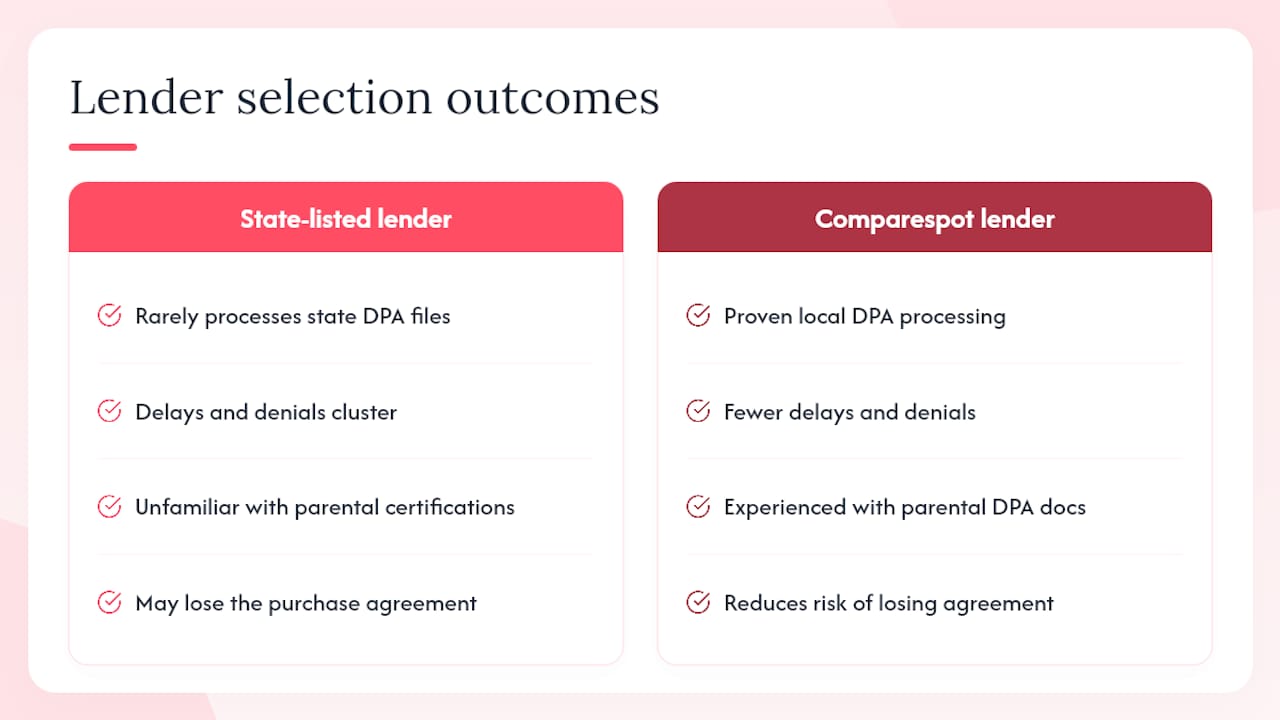
- Using a lender unfamiliar with MSHDA workflows. Lenders who rarely process MSHDA files generate most of the avoidable delays and denials. This is the single most preventable mistake.
- Underestimating non-obvious costs. Property taxes, HOA fees, and maintenance costs are not covered by DPAs. New owners who skip housing education often discover these costs the hard way in year one.
- Slow first-generation documentation. Parental non-ownership certifications can require contacting county records offices, deceased parents’ estates, or foreign records. Start this process immediately.
Questions to ask before you commit to a lender
- Are you currently on MSHDA’s Experienced Participating Lender list?
- How many MSHDA MI Home Loan files did your team close in the past 12 months?
- Do you process First-Generation DPA and MI 10K DPA in-house, or do you refer out?
- Which documents cause the most delays in your MSHDA files?
- What is your average time from pre-qualification to clear-to-close on an MSHDA file?
Pro Tip: Ask the lender for a sample intake checklist and a recent closing timeline from an MSHDA file. A lender who can hand you both within 24 hours has done this enough times to be worth your trust. Also verify their NMLS ID through NMLS Consumer Access to confirm active licensing before sharing any financial documents.
How to find and verify an MSHDA-experienced lender
Lender selection is where most Michigan DPA transactions succeed or fail. MSHDA publishes an official lender locator on its website; start there and filter for lenders active in your county. The list is the floor, not the ceiling. Being on the list means the lender is approved, not that they are experienced.
Verification steps
- Check the MSHDA lender locator for approved lenders in your county.
- Pull the lender’s NMLS profile via NMLS Consumer Access to confirm active licensing, any disciplinary history, and the states where they are licensed.
- Ask for recent MSHDA closing volume. Ten or more MSHDA MI Home Loan closings in the past year is a reasonable baseline for confidence.
- Confirm DPA and MCC capability. Some lenders handle MI Home Loan but rarely process DPA or MCC files. Confirm that the specific staff member handling your file has done it before.
- Request a sample intake checklist. Experienced lenders have one ready. It tells you exactly what documents to gather and in what format.
For Metro Detroit buyers, Comparespot’s ranked list of mortgage lenders in Metro Detroit and mortgage brokers in Metro Detroit are built around local market experience, including MSHDA familiarity. The rankings are based on research and customer sentiment, not paid placement, so the lenders at the top have earned their position.
Pro Tip: Ask your lender for the name and direct contact of the loan officer who will handle your file, then verify that person’s NMLS ID individually. Lender-level approval does not guarantee that every loan officer at the firm has MSHDA experience.
Why lender verification matters more than most guides admit
Most articles about Michigan first-time buyer programs spend their energy explaining program amounts and eligibility rules. Those details matter, but they are not where transactions break down. The real failure point is lender selection.
MSHDA’s own guidance flags that delays and denials cluster around lenders who rarely process state DPA files. That is not a bureaucratic footnote. It means a buyer who qualifies perfectly on paper can lose a purchase agreement because their lender did not know how to sequence the DPA documentation. In a competitive Metro Detroit market, that is a real cost.
The First-Generation DPA pilot makes this even more acute. Parental non-ownership certifications are not a standard mortgage document. A lender who has never processed one will not know which county records to request, how to handle a deceased parent’s estate records, or what format MSHDA accepts. That uncertainty adds weeks to a file.
Comparespot’s approach to this is straightforward: rank lenders based on actual local performance data, not on who paid for placement. When a buyer in Wayne, Oakland, or Macomb County uses a Comparespot-ranked lender, they are starting with a provider who has been evaluated against real transaction outcomes in that market. That is a different starting point than picking a name off a state-approved list.
Find a vetted MSHDA lender faster with Comparespot
Sorting through Michigan’s DPA programs is the easy part. Finding a lender who actually closes MSHDA files efficiently in Metro Detroit is where most buyers lose time. Comparespot solves that problem directly: the platform ranks top mortgage lenders in Metro Detroit based on independent research and customer sentiment, so you are not starting from a cold state-approved list with no performance signal.
If you prefer working through a broker who can shop multiple MSHDA-approved lenders on your behalf, Comparespot’s mortgage broker rankings for Metro Detroit apply the same editorial standard. No paid placements, no guesswork about who has actually closed MSHDA files in your county. Check the rankings, pick a lender or broker with a verified track record, and start your pre-qualification conversation today.
Sources
Official program pages and resources to verify current rules and begin applications:
- MI Home Loan
- Pathway to Housing
- New MSHDA Program Offers $25,000 in Down Payment Assistance to Aspiring, First-Generation Homebuyers
- Detroit Down Payment Assistance Program | City of Detroit
- Grand Rapids Homebuyer Assistance Fund
- NMLS Consumer Access
FAQ
What is the minimum down payment for a first-time buyer in Michigan?
With MSHDA’s MI 10K DPA or First-Generation DPA, your required cash-to-close can be reduced significantly, since the DPA covers the down payment and allowable closing costs. The MI Home Loan itself is a conventional or government-backed mortgage, so the underlying down payment requirement depends on the loan type (FHA and conventional loan down payment requirements vary by loan type).
Who is eligible for the first-time home buyer grant in Detroit?
Detroit’s Down Payment Assistance Program provides up to $up to twenty-five thousand dollars to qualifying Detroit residents who meet income limits, complete housing counseling, and satisfy the city’s residency requirements. Eligibility is separate from MSHDA state programs, so Detroit buyers may be able to access both.
What is the income limit for MSHDA’s MI Home Loan?
Income limits vary by county and household size; MSHDA publishes current tables on its MI Home Loan program page. There is no single statewide figure because limits are set at the county level, so confirm the specific cap for your county with an Experienced Participating Lender.
How much do you need to earn to afford a $300,000 house in Michigan?
General mortgage guidelines suggest your total monthly housing costs (principal, interest, taxes, insurance) should not exceed 28–31% of gross monthly income. At current rates, a $300,000 purchase with a standard down payment typically requires a gross household income in the range of $70,000–$90,000 annually, though your actual number depends on your credit score, debt load, and the specific loan product. An MSHDA lender can run a precise calculation for your situation.
Can you combine the MI 10K DPA and the First-Generation DPA?
No. The First-Generation DPA pilot and the MI 10K DPA are mutually exclusive per MSHDA program rules. Eligible first-generation buyers must choose one or the other; the $up to twenty-five thousand dollars First-Generation DPA is the larger benefit for those who qualify and can meet the documentation requirements.