

Michigan title insurance comes in two forms: an owner’s policy that protects your ownership interest for as long as you hold the property, and a lender’s policy that protects your mortgage lender until the loan is paid off. Michigan law does not require you to buy an owner’s policy, but virtually every lender will require a lender’s policy before funding your loan. According to the MILTA consumer guide, both policies guard against title defects that existed before closing, such as unpaid liens, recording errors, and undisclosed heirs.
Here is what you need to know before you get to the closing table:
- Owner’s policy: One-time premium, covers you indefinitely, optional under Michigan law, but strongly recommended.
- Lender’s policy: Required by nearly all mortgage lenders, covers only the lender’s interest, and expires when the loan is paid off.
- Cost ballpark: Michigan title insurance rates typically run $3.50–$6.50 per $1,000 of coverage, with a commonly cited average near $4.15 per $1,000. On a typical mid-range purchase, the owner’s policy cost can range from low to moderate amounts before endorsements.
- Who oversees rates: The Michigan Department of Insurance & Financial Services (DIFS) regulates title insurers and maintains the state rate filing system.
Jump to the calculator section below for a step-by-step worked example.
Key Takeaways
Michigan title insurance requires one upfront premium for the owner’s policy and a separate lender’s policy premium, with the simultaneous-issue discount making combined purchase the most cost-effective approach for financed buyers.
| Point | Details |
|---|---|
| Owner’s policy is optional | Michigan law does not require it, but it protects your ownership interest indefinitely for a one-time premium. |
| Lender’s policy is lender-required | Nearly every mortgage lender requires a lender’s policy; it covers only the lender’s interest, not yours. |
| Rates run $3.50–$6.50 per $1,000 | On a $400,000 purchase, expect an owner’s premium roughly in the $1,600–$1,700 range before endorsements. |
| Sellers commonly pay in Metro Detroit | Local custom in Wayne, Oakland, and Macomb counties puts the owner’s policy cost on the seller. |
| Verify your final number on the Closing Disclosure | Calculator estimates exclude endorsements and recording fees; the Closing Disclosure is the binding figure. |
Table of Contents
- How does title insurance work in Michigan?
- What types of title insurance policies are available in Michigan?
- How are Michigan title insurance premiums calculated?
- How to estimate your premium with a Michigan title insurance calculator
- Who typically pays for title insurance in Michigan?
- How do you choose a title company in Michigan?
- What other fees appear on a Michigan closing statement?
- Common myths about Michigan title insurance
- CompareSpot’s take on title insurance for Metro Detroit buyers
- Find vetted Metro Detroit real estate services on Comparespot
- Useful Michigan title insurance resources
- Sources
- FAQ
How does title insurance work in Michigan?
The process runs from the moment your purchase offer is accepted through post-closing, and each step has a clear owner.
-
Title search (Days 1–5 after contract). A title company or closing attorney searches public records, including deeds, mortgages, tax records, court judgments, and easements. The title search looks for liens, recording errors, forgery, boundary disputes, and any undisclosed heirs who might have a claim on the property.
-
Title commitment issued (Days 5–10). The insurer issues a title commitment, which is a promise to insure subject to listed exceptions. Common exceptions include current-year property taxes, easements of record, and any matters a survey would reveal.
-
Exceptions and endorsements reviewed (Days 10–14). Your agent or attorney reviews the commitment. If an exception creates a real risk, you can request an endorsement to cover it or ask the seller to clear the defect before closing.
-
Closing (Day of settlement). Both policies are issued simultaneously at closing. The premiums appear as line items on your Closing Disclosure.
-
Post-closing coverage. The owner’s policy stays active indefinitely. If a claim surfaces years later, say a forged deed in the chain of title, the insurer defends your ownership and covers losses up to the policy amount.
Common title defects the search may miss include:
- Forged signatures on prior deeds
- Undisclosed heirs from an estate sale
- Clerical errors in county recording offices
- Unpaid contractor liens filed after the search date
Pro Tip: Ask your title company whether a simultaneous-issue discount applies when you buy both the owner’s and lender’s policies at the same closing. The lender’s policy is often issued at a steep discount, sometimes just a few hundred dollars, when paired with an owner’s policy purchased at the same time.
What types of title insurance policies are available in Michigan?
Owner’s policy vs. lender’s policy
| Feature | Owner’s Policy | Lender’s Policy |
|---|---|---|
| Who it protects | The buyer/homeowner | The mortgage lender |
| Duration | As long as you own the property | Until the loan is paid off |
| Required by law | No | No, but lenders require it |
| Premium structure | One-time payment at closing | One-time payment at closing |
| Coverage amount | Purchase price | Loan balance (decreases over time) |
Standard vs. expanded coverage
A standard policy covers defects in the public record and the specific risks listed in the policy form. An expanded or enhanced policy adds protection for post-policy risks like encroachments discovered after closing, building permit violations, and certain zoning issues. Expanded forms cost more but are worth considering on older properties or lots with irregular boundaries.
Common endorsements in Michigan
Endorsements modify or extend base coverage. The ones that come up most often in Michigan residential transactions include:
- Survey endorsement: Covers boundary disputes and encroachments not caught in the title search.
- Tax lien endorsement: Adds protection against certain tax-related claims.
- Mechanics lien endorsement: Protects against contractor liens filed after closing on work done before closing.
- Condominium endorsement: Addresses condo-specific risks like HOA assessment liens.
When both policies are issued at the same closing, the lender’s policy is typically priced at a fraction of its standalone rate. That simultaneous-issue structure is one of the most practical cost-saving moves available to Michigan buyers.
How are Michigan title insurance premiums calculated?
Michigan’s file-and-use rate system
Michigan is a file-and-use state, meaning title insurers submit their rate schedules to DIFS and can begin charging those rates immediately upon filing, without waiting for state approval. That differs from promulgated-rate states like Texas, where a single statewide rate applies to everyone. In Michigan, rates vary by underwriter, so price-shopping among title companies can produce real savings.
The Michigan residential rate manual sets out tranche-based pricing, meaning the per-thousand rate changes as the property value crosses certain thresholds. The first $100,000 of value is typically priced at a higher per-thousand rate than amounts above that threshold.
Sample rate tiers (representative, based on Michigan rate manual)
| Value tranche | Representative rate per $1,000 |
|---|---|
| First $100,000 | ~$5.75 per $1,000 |
| $100,000–$400,000 | ~$3.50 per $1,000 |
| — | $3.50 per $1,000 |
Rates vary by underwriter. Use these as a planning benchmark, not a final quote.
Worked example: $400,000 purchase
Using a representative blended rate near $4.15 per $1,000:
- First $100,000 × $5.75 = $575
- Next $300,000 × $3.50 = $1,050
- Owner’s policy subtotal: $1,625
- Lender’s policy (simultaneous issue on a $320,000 loan): often $200–$400 with the discount applied
- Total estimated premium: roughly $1,825–$2,025
Endorsements, recording fees, and settlement charges are added on top of these figures.
How to estimate your premium with a Michigan title insurance calculator
A title insurance calculator converts the tranche-based rate schedule into a dollar figure before you get to closing. To run an accurate estimate, you need four inputs:
- Sale price (for the owner’s policy amount)
- Loan amount (for the lender’s policy amount)
- Whether both policies are purchased simultaneously (triggers the simultaneous-issue discount)
- County (county-specific recording fees and any local transfer taxes affect total closing costs)
Most online calculators apply the tiered rate schedule automatically. You enter the purchase price, and the tool multiplies each tranche by its corresponding rate, then sums them. For the $400,000 example above, that math produces an owner’s premium in the $1,600–$1,700 range at representative rates, before endorsements.
What calculators do not capture: endorsement costs, wire transfer fees, document preparation charges, and county recording fees. The final premium on your Closing Disclosure is the only binding number. Treat any calculator output as a planning estimate, not a guarantee.
Quick benchmark: Independent pricing analysis flags rates above $8.00 per $1,000 as a potential red flag worth questioning with your title company.
Who typically pays for title insurance in Michigan?
The short answer: sellers commonly pay for the owner’s policy; buyers typically pay for the lender’s policy. That local custom holds across most of Metro Detroit, including Wayne, Oakland, and Macomb counties, and it is often written into the standard purchase agreement as a default.
A few scenarios shift that allocation:
- Seller’s market: Buyers may agree to cover the owner’s policy to make their offer more competitive.
- Buyer concessions: A seller offering closing cost credits might include the owner’s policy in the credit package.
- New construction: Builders sometimes require buyers to pay both policies.
- Cash transactions: No lender’s policy is required. The buyer decides independently whether to purchase an owner’s policy. For cash home buyers in Metro Detroit, skipping the owner’s policy saves money upfront but leaves ownership unprotected against prior title defects.
- Refinances: Only a new lender’s policy is needed. The original owner’s policy remains in force.
In Washtenaw County (Ann Arbor area), customs can lean slightly more toward negotiated splits, particularly in higher-price transactions. Your real estate agent will know the prevailing local norm and can advise on whether to push back on the default allocation.
Pro Tip: If you are a buyer in a competitive Metro Detroit market, ask your agent whether the seller’s payment of the owner’s policy is already baked into the standard purchase agreement form. In many Wayne County transactions, it is, which means you may not need to negotiate it separately.
How do you choose a title company in Michigan?
What to look for
A title company handles escrow, coordinates the closing, issues the policies, and records the deed. The criteria that matter most:
- Experience with your specific county’s recording office and local customs
- Turnaround time on the title commitment (10 business days is reasonable; more than 15 is slow)
- Clear, itemized fee disclosure before you commit
- Escrow trust accounting practices and error-and-omissions insurance
- Underwriter affiliation (major underwriters include Fidelity, First American, Old Republic, and Stewart)
Questions to ask at first contact
| Question | Why it matters |
|---|---|
| What is your fee for the settlement/escrow service? | Settlement fees are separate from the premium and vary widely |
| Do you apply a simultaneous-issue discount? | Can save $200–$400 on the lender’s policy |
| Who handles recording, and what is the turnaround? | Delayed recording creates a gap in coverage |
| Which underwriter backs your policies? | Underwriter financial strength affects claims handling |
| Can you provide a sample Closing Disclosure? | Shows all fees upfront, no surprises |
Red flags
- Unusually low headline rate paired with vague “administrative” or “processing” fees that inflate the total
- Inability to provide a written fee estimate before closing
- No clear escrow trust accounting or refusal to explain how funds are held
- Slow title commitment (more than 15 business days without explanation)
To verify a Michigan title company’s licensing, check the DIFS license lookup and cross-reference with NMLS Consumer Access for any mortgage-related registration. Understanding what a title company actually does before your first call makes those conversations much more productive.
Pro Tip: Ask your mortgage lender which title companies they work with regularly. Lenders flag companies with slow commitments or escrow problems quickly, and their informal list is often more useful than online reviews.
What other fees appear on a Michigan closing statement?
The title insurance premium is one line item. A typical Michigan Closing Disclosure also includes:
- Title search fee: $150–$300, sometimes bundled into the settlement fee
- Settlement/escrow fee: $300–$600, paid to the title company or closing attorney for coordinating the closing
- Recording fees: Set by the county; Michigan counties typically charge per page recorded
- Document preparation fee: $50–$150 for deed and mortgage preparation
- Wire transfer fee: $25–$50 per wire
- Endorsement fees: Vary by type; survey endorsements often run $50–$150
- Michigan transfer tax: State transfer tax is $3.75 per $500 of value; county transfer tax is $0.55 per $500 (sellers typically pay both)
Note: The title premium and the settlement fee are almost always separate line items. A low quoted premium does not mean a low total title-related cost if the settlement fee is inflated to compensate.
Common myths about Michigan title insurance
Myth: Title insurance is required by Michigan law. Fact: Michigan law does not require an owner’s policy. Lenders require a lender’s policy as a condition of financing, but that is a lender’s contractual requirement, not a state mandate.
Myth: The title search guarantees a clean title. Fact: A thorough search reduces risk significantly, but it cannot catch every defect. Forged documents, undisclosed heirs, and clerical errors in county records can survive even a careful search. That gap is exactly what the insurance covers.
Myth: Title insurance is too expensive to be worth it. Fact: The owner’s premium is a one-time charge, typically $1,500–$2,500 on a mid-range Michigan home. A single title dispute, even a minor one, can cost far more in legal fees alone. The simultaneous-issue discount also makes the lender’s policy relatively inexpensive when both are purchased together.
Myth: You only need title insurance on older homes. Fact: New construction carries its own title risks, including mechanic’s liens from unpaid subcontractors and errors in the subdivision plat. An owner’s policy on a new build is just as relevant as on a 1960s ranch.
CompareSpot’s take on title insurance for Metro Detroit buyers
There is a version of this conversation that goes: “Title insurance is just another closing cost, pay it and move on.” That framing is not wrong, but it misses something Metro Detroit buyers should actually think about.

Wayne County’s older housing stock, the volume of estate sales in Oakland County, and the number of distressed transactions across Macomb mean that title defects are not theoretical here. They show up. Undisclosed liens from prior owners, recording errors at the county level, and contractor disputes on flipped properties are real patterns in this market. An owner’s policy is not a formality; it is the one closing cost that keeps paying for itself if something surfaces five years after you close.
At Comparespot, the way we evaluate closing-related service providers mirrors how we rank agents and lenders: experience in the specific county, transparency on fees before closing, and a track record on claims handling. A title company that quotes a low premium but buries fees in the settlement line is not a bargain. The providers worth recommending are the ones who hand you an itemized estimate on day one and can explain every line.
The practical takeaway: run the calculator, compare at least two title company quotes, and confirm that the simultaneous-issue discount is applied if you are financing. Then verify the final numbers on your Closing Disclosure before you sign.
Find vetted Metro Detroit real estate services on Comparespot
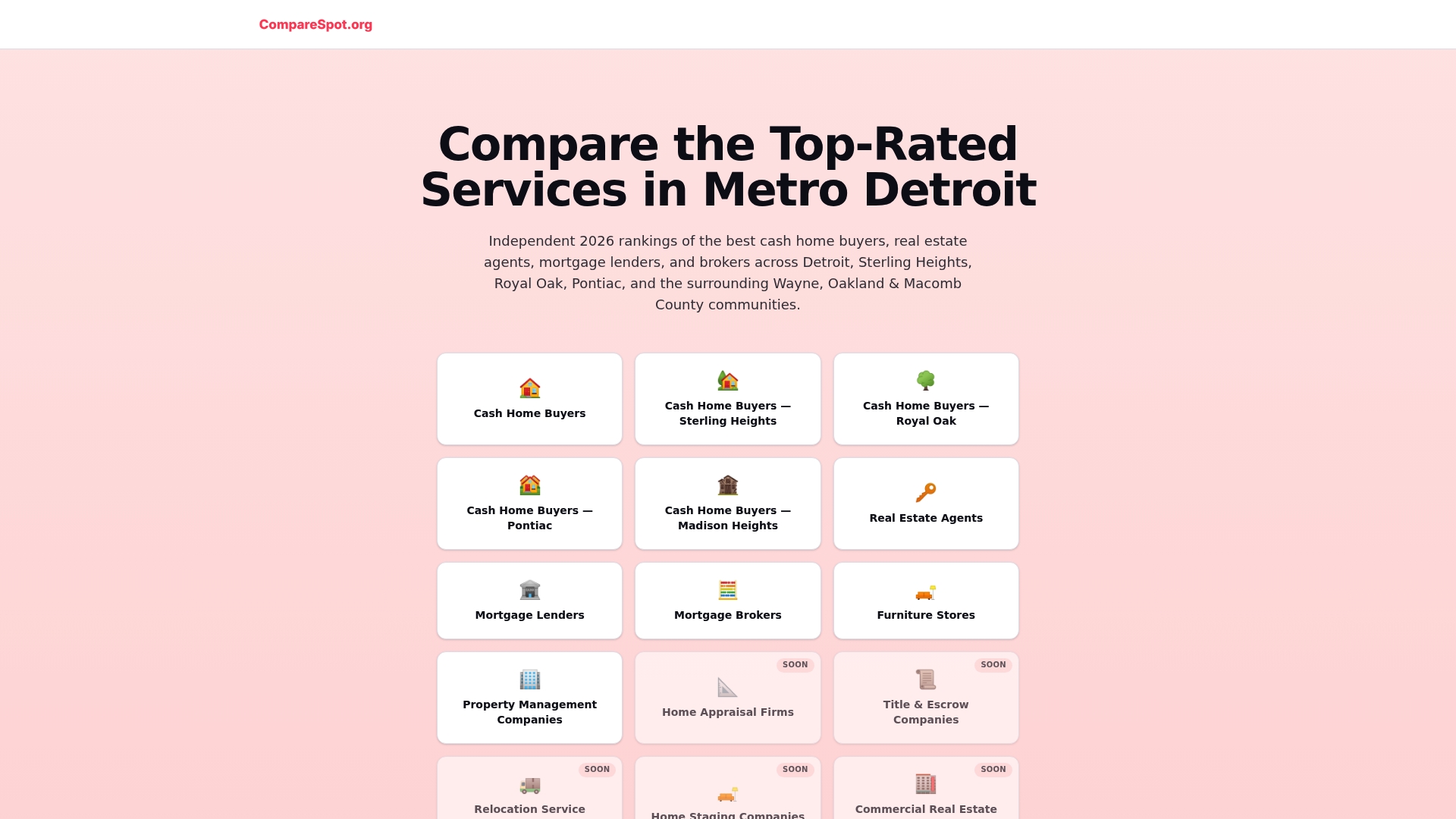
Comparespot independently ranks the top real estate agents, mortgage lenders, and cash home buyers across Wayne, Oakland, and Macomb counties. No paid placements. No sponsored rankings. Just data-driven lists built for Metro Detroit buyers and sellers.
Browse top-rated Metro Detroit real estate agents, compare local mortgage lenders, or explore cash home buyers in Metro Detroit if you are weighing a cash sale. Start at Comparespot for the full local rankings.
Useful Michigan title insurance resources
The following official and authoritative sources are worth bookmarking before you close:
- Michigan DIFS: Verify title company licenses, file complaints, and access consumer guides on insurance products regulated in Michigan.
- Michigan Residential Rate Manual: The official Schedule of Charges filed with DIFS. Use it to look up tranche rates, find simultaneous-issue discount rules, and check underwriter-specific filings.
- MILTA Consumer Guide: Plain-English explanation of owner vs. lender policies, common exceptions, and consumer rights under Michigan title insurance law.
- NMLS Consumer Access: Cross-check any closing agent or mortgage-related entity for licensing and registration status.
When using the rate manual, locate the tranche table for residential policies, apply the per-thousand rate to each value band in sequence, and sum the results. Then check whether your underwriter has filed a simultaneous-issue discount schedule, which is listed separately. The final premium on your Closing Disclosure should match that math within a few dollars; if it does not, ask for an itemized breakdown before signing.
This article is general information, not a substitute for advice from a qualified financial advisor. Consult a qualified financial professional about your own circumstances before acting on anything here.
Sources
- Michigan
- SCHEDULE OF CHARGES FOR TITLE INSURANCE IN … (Michigan residential rate manual)
- How Much Is Title Insurance in Michigan? 2026 Rates & Costs
- A Consumers Guide to Title Insurance - with corrections
- Michigan Title Insurance: Rate & Who Pays (2026)
FAQ
How does title insurance work in Michigan?
A title company searches public records for defects, then issues a commitment to insure. At closing, the insurer issues the policy, and coverage begins immediately for any defects that existed before that date.
How much is title insurance on a $400,000 house in Michigan?
Using representative tranche rates, an owner’s policy on a $400,000 purchase runs roughly $1,600–$1,700 before endorsements. Adding a simultaneously issued lender’s policy typically brings the combined total to around $1,825–$2,025.
Who usually pays for title insurance in Michigan?
By local custom across most of Metro Detroit, the seller pays for the owner’s policy and the buyer pays for the lender’s policy, though both are negotiable and can be adjusted in the purchase agreement.
Is title insurance required in Michigan?
An owner’s policy is not required by Michigan law. A lender’s policy is not legally mandated either, but virtually every mortgage lender requires one as a condition of funding the loan.
What is the difference between a title company and a closing attorney in Michigan?
Both can handle closings in Michigan. A title company is a licensed insurer or agent that issues policies and manages escrow; a closing attorney provides legal counsel and can also issue policies if affiliated with an underwriter. Either can serve as the settlement agent, and the choice often comes down to local custom and lender preference.