

TL;DR
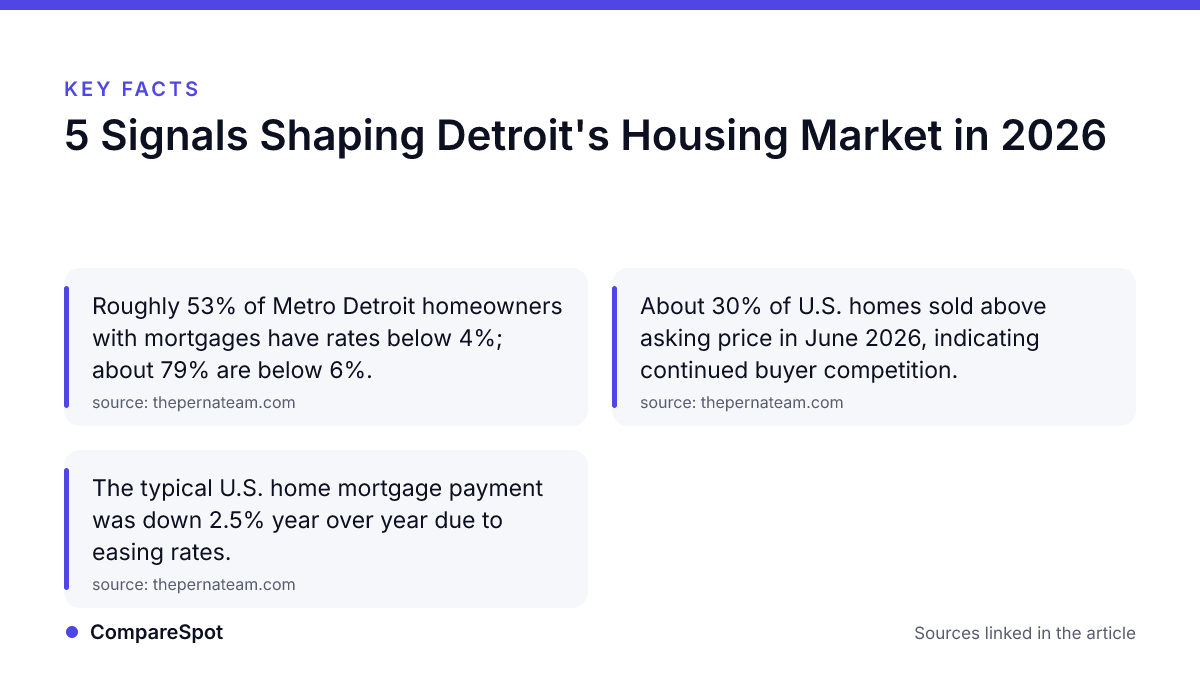
- Rates, not prices, are locking up inventory. Roughly 53% of Metro Detroit mortgage holders have rates below 4% and about 79% are below 6%, so most owners have little financial reason to sell and re-buy today.
- Competition hasn't disappeared. About 30% of U.S. homes sold above asking price in June 2026, and well-priced, move-in-ready houses in Royal Oak, Sterling Heights, and Ferndale still draw multiple offers.
- Monthly payments are easing slightly. The typical U.S. mortgage payment was down 2.5% year over year as rates cooled. Small, but real, for first-time buyers.
- Cash home buyers trade price for speed. In our experience, as-is offers in Metro Detroit land in the 65–80% of after-repair-value range in exchange for a two- to three-week close with no repairs, showings, or financing contingency.
- A crash isn't what's driving this market. Too little inventory is the problem, which is the opposite of the oversupply conditions that precede a price collapse.
If you're trying to figure out whether to sell, buy, or sit tight, here's the honest answer: the Detroit housing market in 2026 is a standoff, not a boom or a bust. Owners with cheap mortgages aren't selling. Buyers who can stomach today's rates are fighting over what little hits the market. That standoff changes the math for anyone facing foreclosure, inheriting a house, or trying to buy their first home in Wayne, Oakland, or Macomb County.
Table of Contents
- How is the US housing market doing right now?
- What's actually happening in Metro Detroit's housing market this year?
- How do Detroit home prices and inventory compare to five years ago?
- Should you sell fast for cash or list traditionally?
- What do first-time buyers need to qualify for a mortgage in Wayne County?
- Is the Detroit housing market headed for a crash?
- What should you actually do with this information?
- Frequently asked questions
How is the US housing market doing right now?
Tight, but not frozen. Inventory is thin, prices are holding, and prepared buyers are still winning bids. About 30% of homes nationally sold above their asking price in June 2026, which tells you competition for good listings never really went away. Meanwhile the typical mortgage payment nationally slipped 2.5% year over year as rates backed off their peak.
Fewer homes for sale, steady demand. That's the story almost everywhere, and Metro Detroit is no exception. It isn't the crash the Reddit threads keep predicting, and it's nothing like 2021. It's a market where a clean, updated house in a desirable ZIP code still has leverage and buyers need real financial preparation to compete.
What's actually happening in Metro Detroit's housing market this year?
One force explains most of it: the rate lock-in effect. Homeowners who bought or refinanced near the bottom aren't listing, because moving means giving up a cheap mortgage for an expensive one. With roughly 53% of local mortgage holders under 4% and 79% under 6%, that's most of Wayne, Oakland, and Macomb County sitting still.
Run the numbers and you see why nobody's moving. Take a $250,000 loan. At 3.5% over 30 years, principal and interest run about $1,123 a month. At 6.75%, the same balance costs about $1,622. That's roughly a $499 monthly difference, close to $6,000 a year, for the exact same amount of borrowed money. (Illustrative scenario. Plug in your own balance and rate quote.) Until that gap narrows, the seller who "should" move up from a Warren ranch to a Troy colonial keeps remodeling the basement instead.
What that looks like county by county:
- Oakland County: Higher-end inventory in Birmingham and Rochester Hills stays scarce, and well-maintained homes under $400K still move in days when they do list.
- Wayne County: Detroit proper and inner-ring suburbs like Dearborn and Redford see more turnover from investors, cash buyers, and estate sales than from traditional move-up sellers.
- Macomb County: Starter homes in Sterling Heights and Warren stay competitive with first-time buyers who've been priced out of Oakland's suburbs.
If you're weighing whether to list now or wait, our breakdown of when to sell in Detroit walks through the seasonal and rate-driven timing questions in more depth. Curious what your budget actually buys? What $200K buys you in Detroit right now breaks it down block by block.
Pro tip: Pull comps from the last 60 days, not the last six months. Pricing an October listing off April data is how sellers in this market either leave money on the table or sit for 45 days wondering why the phone stopped ringing.
How do Detroit home prices and inventory compare to five years ago?
Inventory is meaningfully lower and prices are higher, and the rate environment explains most of it. In 2020 and 2021, cheap borrowing pushed listings onto the market as owners refinanced, upsized, or cashed out equity. Today that same low rate is the reason they stay. It's simply too expensive to trade a 3% mortgage for a 7% one on a comparable house.
For buyers, that means shorter search results and harder competition for the good ones, especially in walkable pockets like Royal Oak, Ferndale, Midtown, and Corktown. For sellers, a well-priced, updated home in a strong school district can still pull multiple offers in a market nobody would call hot.
Price trends aren't uniform, though, and Detroit has always been hyper-local to a degree that surprises out-of-state buyers. Two blocks can swing a value by tens of thousands depending on school assignment, how many vacant lots sit on the street, and whether anyone nearby has renovated recently. We've seen appraisals come in $20,000 apart on near-identical brick bungalows because one sat across from a maintained park and the other backed a tax-foreclosed vacant. County-wide averages won't catch that. Recent comps within a half mile will.
Should you sell fast for cash or list traditionally?
If you need certainty and speed more than top dollar, take the cash sale. If you can wait 30 to 90 days and the house shows well, a traditional listing almost always nets more. The tradeoff comes down to three things: how much repair work the house needs, how much time you have, and how much risk you can carry.
Here's how the paths typically compare for a distressed or inherited property in Metro Detroit, based on the offers we see locally:
| Factor | Traditional listing (agent) | Cash home buyer | iBuyer |
|---|---|---|---|
| Typical timeline | 30–90 days to close | 7–21 days to close | 14–30 days to close |
| Repairs required | Usually yes, or the price drops | None, sold as-is | Minor repairs often required |
| Sale price vs. market value | 95–100%+ of market value | 65–80% of after-repair value | 85–95% of market value, minus fee |
| Closing cost burden | Seller pays commission plus closing costs | Buyer typically covers closing costs | Seller pays a service fee, often 5–8% |
| Best for | Move-in-ready homes, price-maximizing sellers | Inherited houses, foreclosure clocks, big repairs | Solid-condition homes, speed without the full cash discount |
Show the math. Say you inherit a house in Oakland County worth $180,000 fixed up, but it needs a roof, updated electrical, and cosmetics you price at $35,000. A cash buyer working the standard formula (after-repair value × 70%, minus repairs) offers ($180,000 × 0.70) − $35,000 = $126,000 − $35,000 = $91,000.
That stings next to $180,000. But you're not fronting $35,000, you're not carrying taxes, insurance, and utilities for 60 to 90 days, and you're not risking an inspection blowing up the deal after a buyer's roofer climbs up there. Do the repairs yourself and list, and you'd likely net somewhere around $145,000 to $155,000 after commission and closing costs. Call it a $50,000 to $60,000 gap. That's the price of speed and certainty. Run it with your own repair bid and decide whether the trade is worth it to you.
Heirs and homeowners in foreclosure face this calculation constantly, which is why we built comparisons like iBuyer vs. cash buyer and we buy houses scams. Not every cash offer is legitimate, and the discount you accept should buy you real speed, not just a lowball. Behind on payments? Understand how a short sale works in Michigan before you assume a cash sale is your only exit.
Pro tip: Get two cash offers and one agent's comparative market analysis before signing anything. A real buyer will wait a few days for that. The ones pushing a same-day signature, or who "reassign" your contract to a third party at closing, are the ones to walk away from.
What do first-time buyers need to qualify for a mortgage in Wayne County?
You'll need steady documented income, a debt-to-income ratio your lender is comfortable with, and a credit score that clears your loan program's floor. FHA loans stay popular with first-time Detroit buyers because they allow a 3.5% down payment and a lower credit minimum than most conventional programs. Conventional loans can go as low as 3% down for qualified first-time buyers, but expect stronger credit requirements and private mortgage insurance until you reach 20% equity.
Four things Wayne County buyers specifically should know:
- Local down payment assistance exists. Detroit and several Wayne County municipalities run assistance programs for qualifying buyers. Ask every lender you interview whether they can layer one into your loan, because not all of them are approved to.
- Debt-to-income trips people up more than credit score. Most lenders want total monthly debts, including the new mortgage, in the low-to-mid 40s as a percentage of gross income. A $550 truck payment can cost you $80,000 of buying power.
- Rate shopping is worth real money. The typical mortgage payment nationally is already down 2.5% year over year. Picking the wrong lender can erase that savings before you've unpacked.
- Pre-approval isn't optional. With about 30% of homes selling above asking, listing agents in competitive Wayne County neighborhoods routinely set aside offers without a solid pre-approval letter attached. Bring a lender who'll answer the phone on a Sunday.
Choosing between FHA and conventional is the biggest early call most first-time buyers make, and our FHA vs. conventional comparison lays out when each wins. If you're still deciding whether to buy at all, rent vs. buy in Detroit runs that math on local prices and rents.
Pro tip: Get pre-approved by two lenders before you tour a single house. Rate quotes and closing cost estimates routinely differ by thousands for the identical borrower profile. Compare the Loan Estimate forms side by side, section by section, not just the rate.
Is the Detroit housing market headed for a crash?
Nothing in the current data points to one. This market is tight because there's too little inventory, which is the reverse of the conditions that cause price collapses. Crashes happen when supply overwhelms demand, usually thanks to overbuilding, loose lending, or an unemployment spike that forces people to sell at once. Metro Detroit has a supply shortage and steady demand.
That's not a promise every neighborhood keeps appreciating. Areas that ran up hardest during the cheap-money years have the most room to give back if rates stay high and buyer fatigue sets in. A true regional crash would take something structurally different: a sharp jobs shock, a foreclosure wave hitting the market simultaneously, or lenders reverting to pre-2008 underwriting. None of that is in play right now.
One caveat worth saying plainly. If you're selling because you're behind on payments, market timing is beside the point. Equity and options both shrink the longer a default runs, and a short sale gets harder to execute cleanly after the sheriff's sale date is set.
What should you actually do with this information?
- Selling a move-in-ready house: price against the last 60 days of comps and expect competition, especially under $400,000.
- Selling an inherited or distressed house: get a real cash offer in writing and compare it against your repair bid plus 90 days of carrying costs before you assume listing wins.
- Buying your first home: pre-approve with two lenders, settle the FHA vs. conventional question early, and budget for a bidding war on anything priced right.
- Facing foreclosure: move now. Every option you have gets worse the further behind you fall.
- Comparing agents: know the difference between a listing agent and a broker before you sign, because it affects your leverage and your commission. Our agent vs. broker guide and realtor vs. FSBO comparison cover ground most sellers skip.
Don't make any of these calls off a headline. Pull your own neighborhood's recent sales, get real numbers from at least two providers, and decide based on your actual timeline and equity position.
Frequently asked questions
Are home prices dropping in Detroit right now?
Not broadly. Tight inventory from the rate lock-in effect is keeping most Metro Detroit prices stable to rising. Individual neighborhoods that gained the most during the low-rate years are the likeliest to go flat or soften.
How long does it typically take to close on a house for sale in Metro Detroit?
A traditional financed sale usually takes 30 to 45 days from accepted offer to closing, mostly waiting on underwriting and the appraisal. Cash sales can close in as little as 7 to 14 days because there's no lender in the chain.
Do I need a real estate agent to sell my house in Michigan?
No. Michigan allows for-sale-by-owner. But you'll handle pricing, marketing, negotiation, and the seller's disclosure paperwork yourself, which is why most sellers still hire someone for anything more complicated than a straightforward cash sale.
Before you list, sell, or sign a mortgage application, compare your options against real local data. Browse CompareSpot's Metro Detroit rankings for cash home buyers, agents, and lenders vetted for Wayne, Oakland, and Macomb counties. No paid placements, just what actually checks out.