
If you need speed and certainty, an iBuyer or a vetted cash buyer will both get you to a fast close, usually inside two to three weeks. iBuyers run everything through an automated valuation model, so the process is faster to start but comes with service fees around 5% and offers that industry analysis pegs at roughly 10 to 11% below market value before those fees. Cash buyers negotiate person to person and often net you more on distressed or unusual properties. The right pick depends on your home’s condition and how much certainty is worth to you.
TL;DR:
- iBuyers charge around 5% in service fees and offer about 10 to 11% below market value before deductions, which can significantly cut net proceeds.
- Cash buyers often close within 7 to 10 days and accept homes in poor condition, typically without extra fees or repair credits.
- iBuyers operate in limited metro areas and mainly prefer move-in-ready homes, whereas cash buyers are available in almost all markets and handle distressed properties.
- When comparing offers, sellers should focus on net proceeds after all fees and repairs rather than headline prices to avoid overestimating their gains.
- Verification of proof of funds, independent title checks, and awareness of red flags are crucial to avoiding scams when dealing with cash buyers or iBuyers.
Table of Contents
- iBuyer vs Cash Buyer: A Side-by-Side Comparison
- How Do iBuyer and Cash Buyer Sales Actually Work?
- What Fees Should You Expect, and What’s Your Net Proceeds?
- Weighing the Pros and Cons of Each Option
- Which Option Fits Your Situation?
- How Do You Compare Offers Without Getting Burned?
- Why CompareSpot Built Local Rankings Instead of a National List
- Get a Vetted Cash Buyer List for Your Michigan Zip Code
- Sources
- FAQ
iBuyer vs Cash Buyer: A Side-by-Side Comparison
The core “ibuyer vs traditional buyer” question boils down to five things: how fast you close, what it costs you, how much of market value you actually keep, whether your house needs to be pretty already, and whether the option even exists where you live.
- Closing time: iBuyers typically close in 1 to 3 weeks after an accepted offer; cash buyers often match that timeline and sometimes beat it, closing in as little as 7 to 10 days.
- Fees and service charges: iBuyers charge a convenience/service fee, commonly starting around 5% of the sale price, on top of possible repair deductions. Cash buyers rarely charge a service fee directly. They build their margin into the offer price instead.
- Offer as a percent of market value: iBuyers have landed roughly 10 to 11% below traditional market sale prices before fees; cash buyer offers vary more widely by property condition and local competition.
- Condition flexibility: iBuyers want standardized, move-in-ready homes; cash buyers regularly take on fire damage, hoarding situations, deferred maintenance, and inherited properties nobody has touched in years.
- Market availability: iBuyers operate in a limited set of metro areas and states; local cash buyers operate almost everywhere, including smaller Michigan markets iBuyers skip entirely.
For a move-in-ready suburban home in a metro where iBuyers operate, the iBuyer route is worth a quote. For anything that needs work, or sits outside a major iBuyer market, a local cash buyer is usually your faster path to a real offer.
How Do iBuyer and Cash Buyer Sales Actually Work?
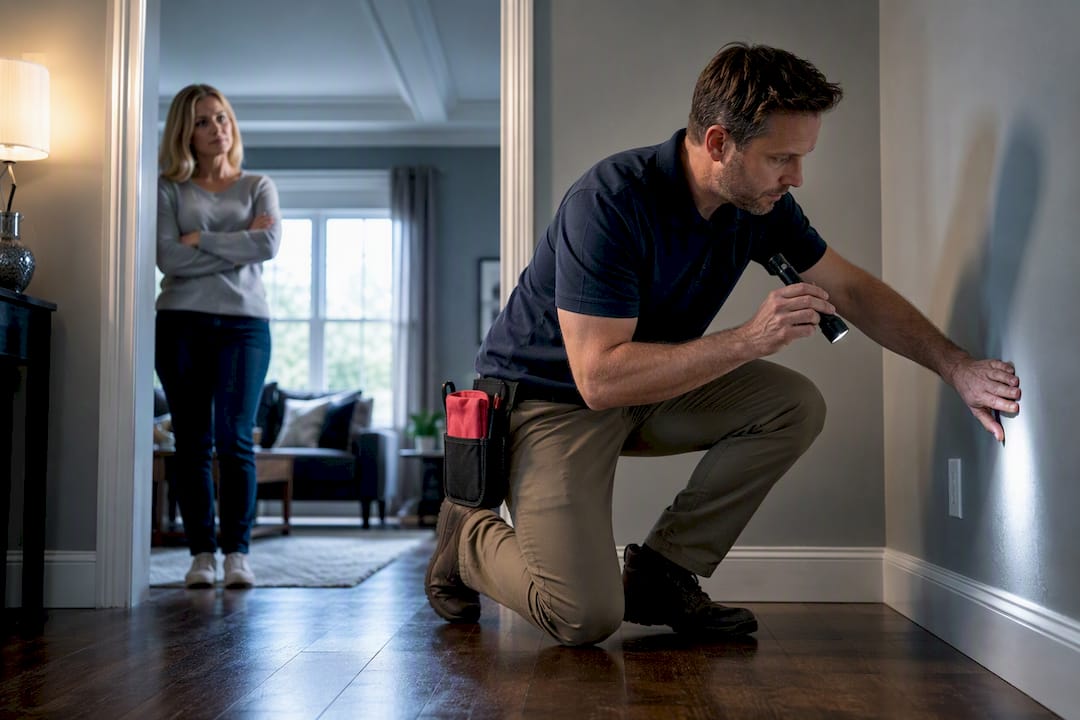
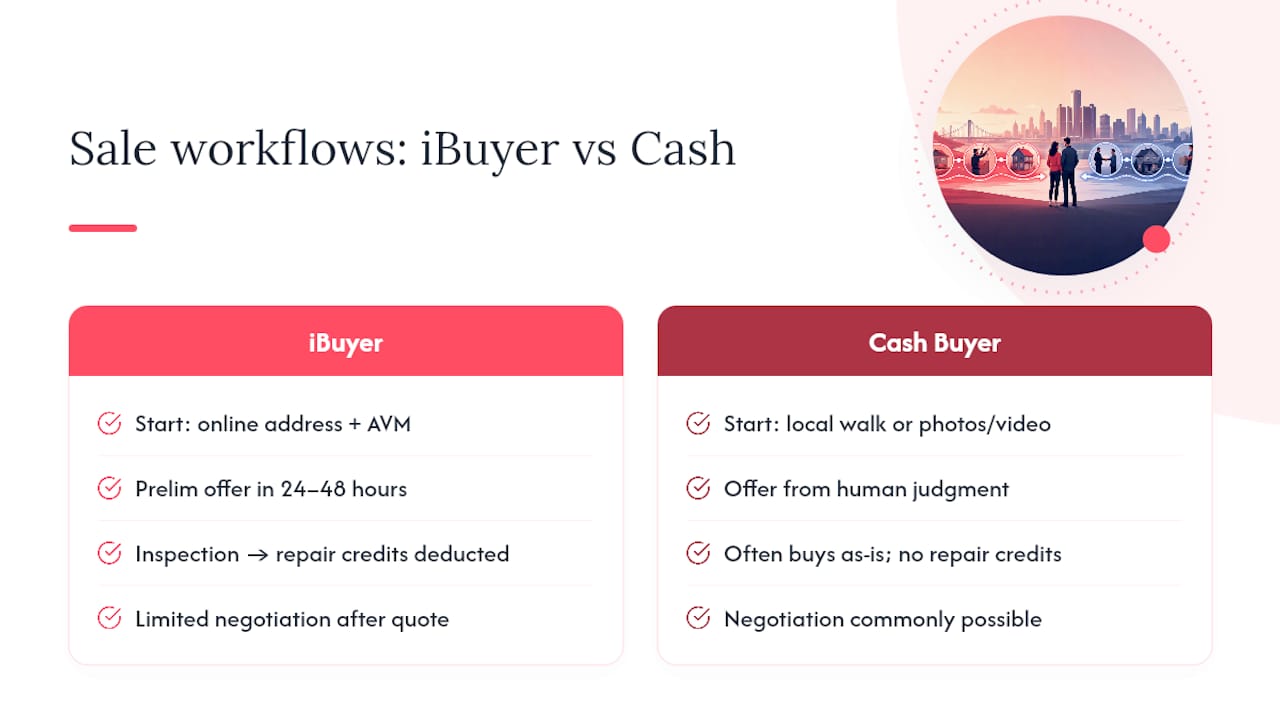
An iBuyer sale starts online. You enter your address, the platform’s AVM pulls comparable sales and public records, and you get a preliminary offer within 24 to 48 hours. That speed is the whole pitch, but it comes with a catch: the number you see first isn’t final. After you accept, the iBuyer sends an inspector to your home, and any issues found there. A cracked foundation, an aging roof, outdated wiring, get converted into repair credits subtracted from your payout. Then you get a revised offer, sign, and close on a date you largely control, often within a couple of weeks. The iBuyer then resells the house, sometimes after light renovation, through its own retail channel.
A cash buyer sale runs on human judgment instead of an algorithm. A local investor or house-buying company walks the property, or reviews photos and a video call for very fast deals, and makes an offer based on what they think they can do with the house. Negotiation is often possible here in a way it isn’t with an automated iBuyer quote. Legitimate cash buyers will provide proof of funds on request, skip financing contingencies entirely, and frequently close on the house as-is, no repair credits, no renegotiation after a home inspection.
Both models have real geographic limits. iBuyers concentrate in Sun Belt and fast-growing metros with lots of comparable, easy-to-price homes. Some larger real estate brokerages also offer trade-in or bridge products that combine an iBuyer-style guaranteed offer with the option to list traditionally if a better offer comes in, worth asking about if you’re not in a rush.
What Fees Should You Expect, and What’s Your Net Proceeds?
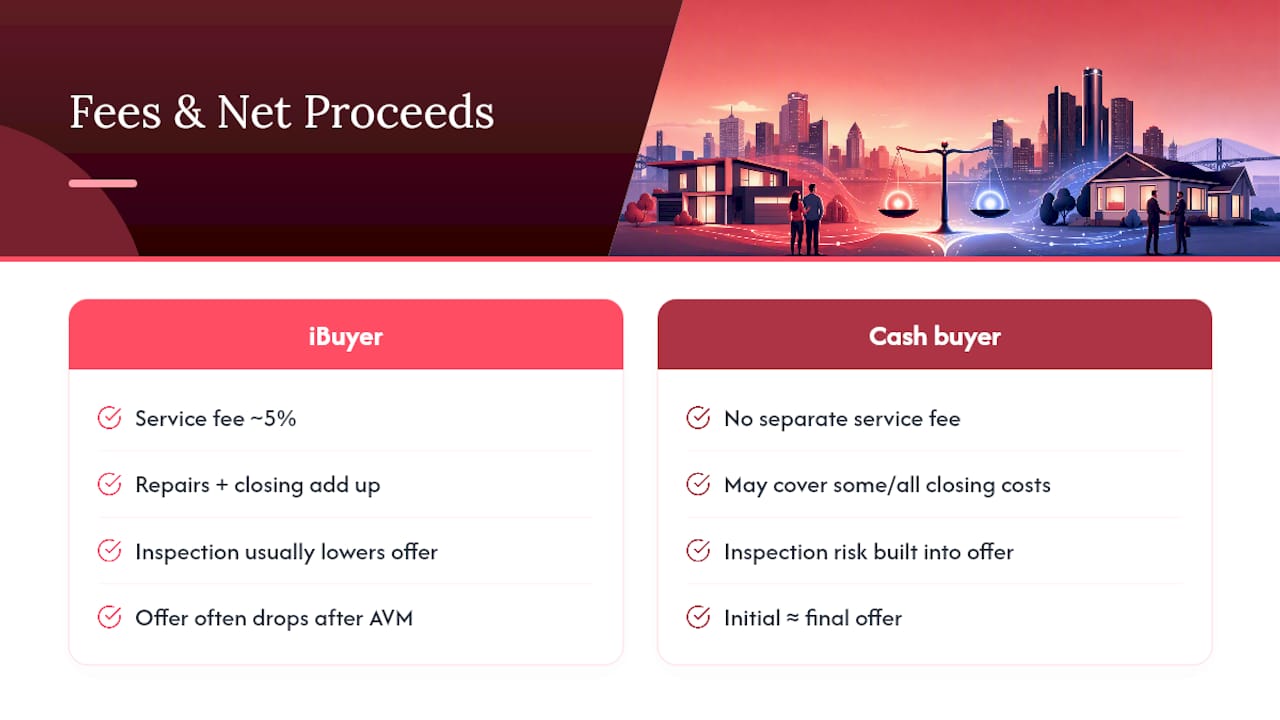
The gap between the price you’re quoted and the check you actually receive is where iBuyers and cash buyers really diverge. iBuyer service fees commonly start around 5% of the sale price, and when you stack repair deductions and closing costs on top, total costs can land in the mid-teens percentage-wise for homes that need meaningful work. Cash buyers structure things differently: most don’t charge a separate service fee, and many will cover some or all closing costs, but their initial offer already reflects the profit margin they need after resale or rental.
Here’s how that plays out on a representative $300,000 Metro Detroit home in decent but not pristine condition.
That’s a real gap, and it’s why market analysis treats the iBuyer discount and the cash buyer’s as-is pricing as two different math problems, not two versions of the same offer.
The inspection revision is the part sellers underestimate most. That first AVM-generated number is a marketing hook, not a final figure. Once an inspector walks the property, the offer almost always drops, sometimes by thousands of dollars, and you’ve already spent a week or two expecting the original figure. Cash buyers front-load that risk assessment into their initial number instead, which is why their first offer often ends up closer to their last one. When you’re comparing “who pays more, iBuyer or cash buyer,” always compare projected net proceeds after every deduction, not the headline number either side leads with.
Weighing the Pros and Cons of Each Option
Neither model wins outright. Each solves a different seller problem.
iBuyer advantages: a fully online process, a predictable closing date you pick, and no need to stage or show the house to strangers.
iBuyer drawbacks: service fees on top of a below-market offer, eligibility limited to fairly standard homes, and an offer that can shrink after inspection, sometimes enough to make the deal feel less appealing than it did on day one.
Cash buyer advantages: they’ll take houses in rough shape, terms are often negotiable, and many close in a week or two with proof of funds ready to show.
Cash buyer drawbacks: gross offer prices tend to run lower than a retail sale, and quality varies wildly between operators. Some are established local companies; others are undercapitalized flippers who can’t actually close.
That variance is exactly why verification matters before you sign anything. Wire fraud and “we buy houses” scams have cost homeowners real money nationally, and the warning signs are consistent: pressure to sign fast, refusal to show proof of funds, and title work that never seems to get scheduled. Ask for proof of funds, confirm the title company independently, and don’t wire anything without escrow involved.
Which Option Fits Your Situation?
Match your circumstances to the model built for it.
Relocating for a job with a hard start date: an iBuyer works if your home is standard and move-in ready. Get quotes from multiple sources before you commit.
Inherited a house full of decades of belongings and deferred repairs: skip the iBuyer entirely. Most won’t touch it, and a cash buyer will still make an offer without asking you to clean or repair anything.
Facing foreclosure with weeks, not months, to act: a local cash buyer is usually faster to a signed contract and closes on your timeline, not a corporate one.
Downsizing from a well-maintained suburban home: compare an iBuyer offer against a couple of cash offers and a quick market analysis from an agent. This is the scenario where all three routes are genuinely competitive.
Divorce requiring a fast, clean split of proceeds: a cash buyer’s speed and as-is terms usually simplify things faster than repairs and showings would.
Property with tenants or a partial rental unit: cash buyers deal with occupied and complicated properties far more often than iBuyers do.
No time pressure and a genuinely move-in-ready home: don’t rush into either quick-sale option. Compare a cash offer against a traditional listing first, since a full market sale often nets more once you factor in time.
Uncertain which local cash buyers are legitimate: start with a vetted local list rather than the first postcard in your mailbox.
How Do You Compare Offers Without Getting Burned?
Comparing headline offer numbers is how sellers get tricked into a worse deal. Compare net proceeds instead.
- Take each offer’s stated price and subtract every disclosed fee: service charges, estimated repair deductions, and any closing costs you’re responsible for.
- Ask each buyer for a written, itemized fee breakdown before you sign anything, not a verbal estimate.
- Confirm how and when the inspection happens, and whether the offer can change afterward, and by how much historically.
- Request proof of funds or verified financing, and confirm the title or escrow company independently rather than trusting a name the buyer gives you.
- Watch for red flags: pressure to close within days, resistance to a third-party title company, or an offer that seems too high with vague fine print attached.
Pro Tip: Ask every buyer the same direct question: “What’s my net check, in writing, after every fee and deduction?” A buyer who hesitates to answer that in writing is telling you something about how the rest of the deal will go.
Normalizing every offer to net proceeds after fees and repairs is the single best protection a seller has, according to consumer guidance on all-cash transactions. It turns three different pitches into one comparable number.
Why CompareSpot Built Local Rankings Instead of a National List
Most quick-sale comparisons treat every U.S. market the same way, and that’s a mistake. A cash buyer that performs well in Phoenix may not even operate in Wayne County. A ranked list of cash home buyers, agents, and lenders specifically for Wayne, Oakland, and Macomb counties, weighing factors like customer sentiment, responsiveness, and closing history rather than paid placement. Nobody buys a spot on these lists.
If you’re selling in Metro Detroit, that local specificity matters more than any national iBuyer’s marketing. If you’re elsewhere, the framework still applies: check state-specific licensing, read recent reviews, and confirm a buyer has closed deals in your exact market before you sign anything.
— Bryan
Get a Vetted Cash Buyer List for Your Michigan Zip Code
Comparing a national iBuyer quote against a random postcard offer is a losing setup. Comparespot’s ranked local guides exist to close that gap. Each of the 10 Best Cash Home Buyers in Metro Detroit rankings is built from customer sentiment, closing track record, and how each company handles fees and inspections, not paid placement.
If your home sits in Oakland County, the Royal Oak cash buyer rankings narrow the list to companies with a presence there. Selling near Sterling Heights instead? The Sterling Heights list does the same for Macomb County. And if your house is genuinely move-in ready with no time pressure, it’s worth pulling a comparison quote from a top-ranked Metro Detroit agent before you commit to any quick-sale route. Start by pulling your zip code’s ranked list and requesting two or three offers side by side.
Sources
This article drew on Mortgagecalculator, Business Insider’s iBuyer fee breakdown, CNBC Select’s iBuyer pricing analysis, and HomeLight’s all-cash offer guide, plus a regional net-proceeds comparison from San Diego Cash For Houses.
- Mortgagecalculator
- What Is an iBuyer? — Business Insider — 2024
- Why iBuyer offers differ from cash buyers — CNBC Select — 2025
FAQ
Who is the best iBuyer?
There’s no single best iBuyer for every seller. The right one depends on whether it operates in your market and whether your home fits its standardized, move-in-ready criteria. Comparing multiple quotes, iBuyer and local cash buyer alike, protects you far more than picking based on brand recognition alone.
What is the 3-3-3 rule in real estate?
The 3-3-3 rule is informal guidance some agents use: price a home to attract offers within 3 days, get to contract within 3 weeks, and close within 3 months. It’s a general benchmark for a healthy traditional listing timeline, not a fixed legal standard, and quick-sale routes like iBuyers and cash buyers can beat it substantially.
Is Zillow an iBuyer?
Zillow operated an iBuying program called Zillow Offers but has since exited the market. Zillow now functions as a listing and research platform rather than a direct home buyer, so it’s not an active iBuyer today.
Does Dave Ramsey say to buy a house in cash?
Dave Ramsey generally advises buying a home with cash when possible to avoid mortgage debt, though he acknowledges most buyers use a mortgage. On the selling side, cash offers appeal to sellers mainly because they close faster and skip financing contingencies, not because of any specific debt philosophy.