

If your credit score is relatively high, conventional loans usually cost less. If your score is lower, FHA loans often have a lower total monthly cost. In the middle score range, it’s necessary to compare both options before deciding.
The reason comes down to mortgage insurance. FHA charges a flat rate regardless of your credit score, while conventional private mortgage insurance (PMI) gets cheaper as your score climbs. That single structural difference is what drives most FHA vs conventional decisions.
Quick-match guide:
- FHA fits you if your credit score is below 680, your down payment is 3.5% or less, or your debt-to-income ratio is on the higher side
- Conventional fits you if your score is 720 or above, you can put 10–20% down, or you want the option to cancel mortgage insurance without refinancing
- In the middle? Get quotes for both — the arithmetic, not the label, tells you which one is cheaper for your exact file
Table of Contents
- What is an FHA loan, and who does it actually help?
- What is a conventional loan, and when does it beat FHA?
- FHA vs conventional: side-by-side on the dimensions that matter
- FHA MIP vs conventional PMI: the cost mechanics that drive the decision
- Why sellers sometimes prefer conventional offers
- What the numbers look like for common borrower profiles
- How to choose between FHA and conventional: a practical checklist
- Comparespot’s recommendation: get dual pre-approvals before you decide
- Key Takeaways
- The case for FHA is stronger than most conventional-loan advocates admit
- Find vetted Metro Detroit lenders who can quote both loan types today
- Authoritative sources and further reading
- FAQ
What is an FHA loan, and who does it actually help?
An FHA loan is a mortgage insured by the Federal Housing Administration, which operates under the U.S. Department of Housing and Urban Development (HUD). The insurance protects the lender, not you — but because lenders carry less risk, they’re willing to approve borrowers who wouldn’t qualify for a conventional loan.

Eligibility basics
FHA credit-score rules allow a minimum score of 580 with a 3.5% down payment. Scores between 500 and 579 are technically eligible with 10% down, though finding a lender willing to go that low is harder in practice. Conventional loans typically require a minimum score of 620. FHA also tends to be more forgiving on debt-to-income ratios, which matters if you’re carrying student loans or car payments alongside your housing costs.
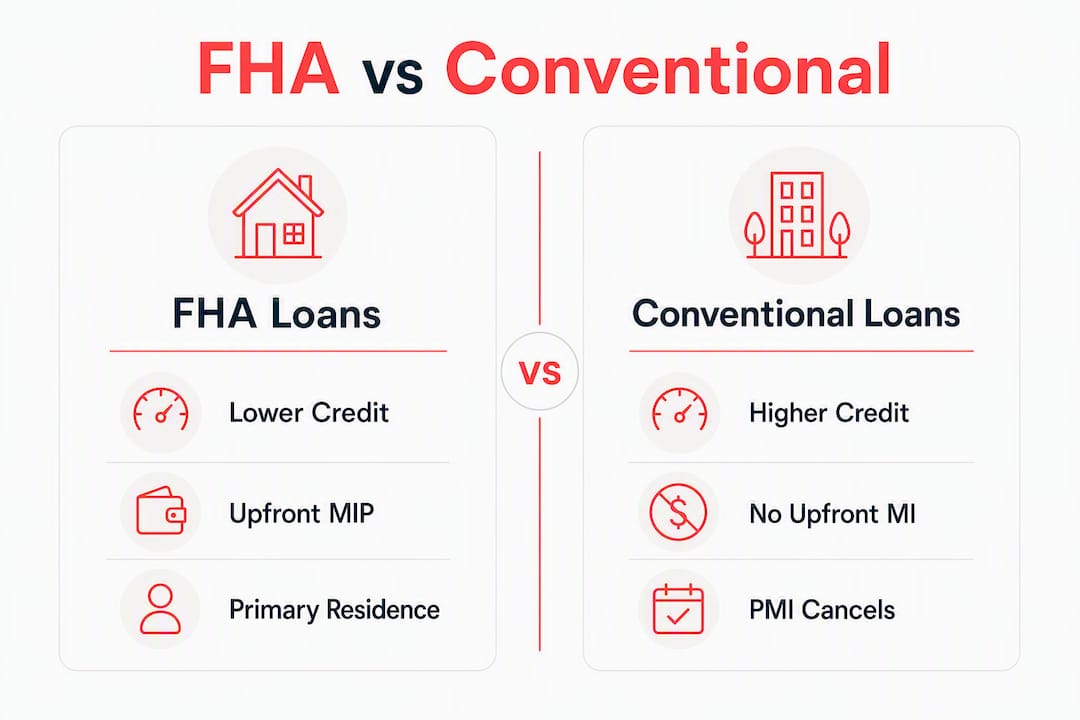
One occupancy rule worth knowing: FHA loans require the property to be your primary residence. You can’t use one to buy a vacation home or a pure investment property.
FHA mortgage insurance: the real cost
FHA charges two layers of mortgage insurance. The upfront mortgage insurance premium (UFMIP) is typically a percentage of the loan amount, paid at closing or rolled into the loan. Then there is an annual MIP charged at a certain rate divided into monthly installments.
The harder pill: if your down payment is under 10%, that annual MIP stays for the life of the loan. You can’t request its removal the way you can with conventional PMI. The only exit is refinancing into a conventional loan once you’ve built enough equity and improved your credit profile.
FHA pros and cons at a glance
Advantages:
- Lower credit-score floor (580 with 3.5% down)
- More flexible DTI allowances
- Gift funds accepted more broadly for down payment and closing costs
- Competitive interest rates, often slightly lower than conventional at similar credit tiers
Drawbacks:
- Upfront UFMIP adds to your loan balance immediately
- Annual MIP can be permanent for low-down-payment borrowers
- Stricter appraisal standards can complicate offers on older or distressed properties
- Sellers in competitive markets sometimes view FHA offers less favorably
What is a conventional loan, and when does it beat FHA?
A conventional loan is simply a mortgage that isn’t insured by a government agency. Most conventional loans are “conforming,” meaning they follow guidelines set by Fannie Mae and Freddie Mac and stay within county-level loan limits. As the CFPB explains, conventional loans typically cost less over time but can be harder to qualify for.
Eligibility and documentation
The typical credit floor for a conforming conventional loan is 620, though lenders often want to see 660 or higher to offer competitive pricing. Down payment options start at 3% for some programs (Fannie Mae’s HomeReady, for example) and scale up to 20% to avoid PMI entirely. Documentation requirements tend to be thorough: two years of tax returns, W-2s, pay stubs, and bank statements are standard.
How conventional PMI actually works
PMI on a conventional loan is priced by risk, which means your credit score and loan-to-value ratio directly determine your monthly cost. A borrower with a 760 score pays meaningfully less in PMI than one with a 640 score on the same loan. That credit-sensitivity is what makes conventional cheaper for high-score borrowers.

The exit is cleaner than FHA’s. Under the Homeowners Protection Act, your lender must automatically cancel PMI when your loan balance reaches 78% of the original purchase price. You can also request cancellation at 80% LTV, which could come years earlier if you make extra payments or your home appreciates.
Conventional pros and cons
Advantages:
- PMI is cancelable — no refinance required
- No upfront mortgage insurance premium
- Often cheaper total cost for borrowers with scores above 720
- Faster closings in many cases; fewer property-condition hurdles
Drawbacks:
- Stricter credit and income documentation requirements
- PMI can be expensive for borrowers in the 620–680 range
- Less flexibility on DTI and compensating factors
FHA vs conventional: side-by-side on the dimensions that matter
| Dimension | FHA Loan | Conventional Loan |
|---|---|---|
| Minimum down payment | Low single-digit percentage (with credit score thresholds) | Low single-digit percentage (some programs) |
| Typical credit score range | Lower minimum credit score with flexible terms | Higher minimum credit score with preferred stronger scores |
| Mortgage insurance type | Upfront mortgage insurance premium plus annual mortgage insurance | Private mortgage insurance without upfront premium |
| Mortgage insurance duration | May last the life of the loan depending on down payment | Usually cancellable upon reaching a certain equity threshold |
| Rate sensitivity | Less dependent on credit score | Rates and mortgage insurance costs typically improve with higher credit scores |
| Loan limits | Set according to county guidelines | Set according to county guidelines, generally higher than FHA limits |
| Seller friendliness | Often perceived as less favorable due to stricter appraisal standards | Often more favorable with fewer repair contingencies |
| Typical upfront fees | Higher due to upfront mortgage insurance premium | Lower, generally no upfront mortgage insurance premium |
What these dimensions tell you in plain English:
- Down payment is rarely the deciding factor alone. Both programs offer low-down-payment paths.
- Credit score is the real fork in the road. Below 680, FHA’s flat MI pricing usually wins. Above 720, conventional PMI drops enough to flip the math.
- MI duration is where FHA borrowers get surprised. Permanent MIP on a 30-year loan is a significant long-term cost that doesn’t show up in the monthly payment comparison alone.
- Seller preference matters most in competitive markets. In Metro Detroit’s tighter neighborhoods, a conventional offer can move faster and face fewer contingencies.
Pro Tip: Ask your lender to run a “same-house” quote for both loan types using your actual credit score, down payment, and purchase price. Request the total monthly payment including MI, and ask how long MI lasts under each scenario. That single comparison usually makes the decision obvious.
FHA MIP vs conventional PMI: the cost mechanics that drive the decision
Mortgage insurance is where most FHA vs conventional decisions actually get made, so it’s worth understanding the mechanics precisely.
FHA MIP structure
FHA charges the UFMIP at 1.75% of the base loan amount. On a $280,000 loan, that’s $4,900 rolled into your balance at closing. The annual MIP on a 30-year loan with less than 10% down runs approximately 0.55% of the outstanding balance annually, divided across 12 monthly payments. For that same $280,000 loan, that’s roughly $128 per month at origination.
The critical rule: if your down payment is under 10%, MIP stays for the life of the loan. Most FHA buyers put down 3.5%, which means they’re locked into MIP unless they refinance.
Conventional PMI structure
PMI on a conventional loan has no upfront component. Monthly cost varies by credit score and LTV. A borrower with a 760 score and 5% down might pay around 0.2–0.5% annually; the same loan with a 640 score could run 1.0–1.5% annually. That spread is substantial over a 5–7 year holding period.
The exit is straightforward: reach 80% LTV and request cancellation in writing. Your lender is legally required to drop it automatically at 78% under the Homeowners Protection Act.
Two quick scenarios
Scenario A — 650 credit score, 3.5% down, $280,000 purchase: FHA annual mortgage insurance adds a certain amount monthly; conventional PMI at this credit score level can be higher monthly, and the rate itself may be higher. FHA wins on monthly cost here, though the UFMIP adds $4,900 to the loan balance upfront.
Scenario B — 740 credit score, 5% down, $280,000 purchase: Conventional PMI at this score drops to roughly $65–$90/month with no upfront premium. FHA MIP stays at ~$128/month plus the UFMIP. Conventional wins clearly, and the PMI can be canceled once equity reaches 20%.
These are illustrative figures. Your lender’s actual quotes will reflect current MI pricing, your specific score, and the loan amount. Always price both.
Refinancing as the FHA exit strategy
Many FHA buyers plan from day one to refinance into a conventional loan once their credit improves and they’ve built equity. The math works when the savings from dropping MIP exceed the closing costs of the refinance, typically in the range of 2–3% of the loan amount. If you plan to stay in the home fewer than five years, run the numbers carefully before assuming a refinance will pay off.
Why sellers sometimes prefer conventional offers
FHA appraisals do more than establish value. They also flag safety and habitability issues — peeling paint, missing handrails, roof condition, exposed wiring — that a standard conventional appraisal might note but not require to be fixed before closing. When an FHA appraiser flags a repair item, the seller typically must address it before the loan can close.
In a multiple-offer situation, that extra layer of uncertainty can push a seller toward a conventional buyer, even at a slightly lower price. FHA appraisal standards effectively function as a mini-inspection, and sellers of older homes in particular are aware of the risk.
Timeline is the other factor. Conventional loans can often close in 21–30 days with a prepared buyer. FHA loans, especially when repair items surface, can stretch to 45 days or longer. In a market where a seller has already bought their next home, that difference matters.
What FHA buyers can do about it:
- Get a pre-inspection before making an offer so you know what the FHA appraiser is likely to flag
- Offer stronger earnest money to signal commitment
- Get dual pre-approvals (FHA and conventional) so you can pivot if the seller pushes back
- Ask your agent to communicate your lender’s track record with FHA closings — experienced lenders move faster
Pro Tip: In Metro Detroit’s older housing stock — think mid-century homes in Wayne and Oakland counties — FHA appraisal repair requests are more common than buyers expect. If the home was built before 1978, lead paint disclosure and condition items are almost guaranteed to come up. Factor that into your offer strategy.
What the numbers look like for common borrower profiles
These scenarios use illustrative figures to show how the loan choice plays out. Actual rates and MI costs vary by lender, market conditions, and your specific file.
Profile 1: Score 640, 3.5% down, $260,000 purchase FHA UFMIP adds $4,550 to the loan. Monthly MIP at ~0.55% runs about $119. At this credit level, conventional PMI would likely cost $160–$200/month with no upfront premium, but the conventional interest rate itself may also be higher for a 640 score. FHA typically wins on total monthly cost here, though the permanent MIP is a long-term drag.
Profile 2: Score 740, 5% down, $300,000 purchase Conventional PMI at this score is modest, roughly $60–$100/month, and cancellable once equity hits 20%. No UFMIP. FHA MIP would run about $137/month plus $5,250 upfront. Conventional wins on both monthly cost and long-term total.
Profile 3: Score 680, 3% down, $275,000 purchase This is the genuinely ambiguous case. FHA MIP and conventional PMI are close enough that the interest rate difference becomes the deciding factor. A lender who prices conventional aggressively for a 680 score might beat FHA; another lender’s overlay might push the conventional rate high enough that FHA wins. You need actual quotes from at least two lenders to know.
The consistent takeaway across all three: pricing both options with your real numbers is the only reliable way to find the cheaper loan.
How to choose between FHA and conventional: a practical checklist
Work through these steps before you commit to either loan type.
- Pull your credit report. Know your middle score across all three bureaus. The lender uses the middle score, not the highest.
- Identify your down payment amount. Under 5% and below 680 in credit? FHA is likely your starting point. Above 10% with a 720+ score? Conventional is probably cheaper.
- Check FHA loan limits for your county. HUD publishes county-level FHA limits at entp.hud.gov. If your purchase price exceeds the FHA limit, conventional is your only conforming option.
- Request quotes for both loan types. Use the same purchase price, down payment, and lock period so the comparison is apples-to-apples.
- Ask about MI cost and duration specifically. Don’t just compare the interest rate. Get the full monthly payment including MI, and ask how long MI lasts under each scenario.
- Evaluate the property. Older home with deferred maintenance? FHA appraisal risk is real. Factor in whether the seller is likely to accept repair requests.
- Think about your timeline. Planning to sell or refinance within three years? The UFMIP on FHA may not amortize favorably. Planning to stay 10 years? Permanent MIP becomes a much bigger number.
Questions to ask every lender:
- What is your lender overlay on minimum credit score for FHA and conventional?
- What is the APR (not just the rate) for each loan type?
- How long does your FHA closing typically take?
- At what LTV can I request PMI removal on the conventional loan?
- Do you have any overlays that would affect my DTI on either program?
Red flags to watch for:
- A lender who quotes only one loan type without explaining why
- PMI quotes that seem unusually high — get a second opinion
- FHA appraisal repair lists that exceed what the seller is willing to address before closing
- Overlays that raise the effective minimum score well above program guidelines
Comparespot’s recommendation: get dual pre-approvals before you decide
The single most useful thing you can do before choosing between FHA and conventional is get pre-approved for both at the same time. Lender overlays — the internal rules lenders layer on top of FHA and conventional program guidelines — can change how your file is priced in ways that aren’t obvious from published guidelines alone. One lender might price your 670-score conventional file aggressively; another might decline it entirely and push you toward FHA.
Overlays affect both availability and cost, which is exactly why comparing lenders matters as much as comparing loan types.
To get dual pre-approvals efficiently:
- Gather your last two years of tax returns, W-2s, two months of bank statements, and recent pay stubs before you call anyone
- Ask each lender to run both FHA and conventional scenarios using the same purchase price and down payment
- Request the Loan Estimate for each scenario — it’s a standardized form that makes side-by-side comparison straightforward
- Expect the process to take 1–3 business days per lender once your documents are submitted
Pro Tip: In Metro Detroit, lender experience with FHA loans on older housing stock varies significantly. A lender who regularly closes FHA loans in Wayne County knows which appraisal issues are routine and which are deal-breakers. That local knowledge can save a transaction.
Comparespot’s Metro Detroit mortgage lender rankings list vetted local lenders with experience across both FHA and conventional programs in Wayne, Oakland, and Macomb counties — a faster starting point than cold-calling lenders from a national directory.
Key Takeaways
For most borrowers, the FHA vs conventional decision comes down to credit score, mortgage insurance cost, and how long you plan to stay in the home before refinancing or selling.
| Point | Details |
|---|---|
| Credit score drives the choice | Scores below 680 typically favor FHA; scores above 720 typically favor conventional due to lower PMI costs. |
| Mortgage insurance is the pivot | FHA MIP (1.75% upfront + ~0.55% annual) can last the life of the loan; conventional PMI is cancellable at 80% LTV. |
| Price both loan types | Small changes in credit score or down payment can flip which loan is cheaper — always get quotes for both. |
| Seller preference is real | In competitive markets, conventional offers face fewer appraisal contingencies and often close faster. |
| Comparespot speeds up the search | Comparespot’s vetted Metro Detroit mortgage lender rankings connect you with local lenders who handle both FHA and conventional loans. |
The case for FHA is stronger than most conventional-loan advocates admit
Most mortgage content frames FHA as the “starter” loan you graduate from — a consolation prize for borrowers who can’t qualify for conventional. That framing misses something.
For a buyer in the mid-600s with limited savings, FHA isn’t a compromise. It’s often the arithmetically correct choice, full stop. The flat MIP pricing means a 640-score borrower pays the same mortgage insurance rate as a 700-score borrower. Conventional PMI at 640 is punishing by comparison. The question isn’t which loan sounds better — it’s which one costs less for your specific numbers over your specific holding period.
Where I think buyers go wrong is treating the FHA-to-conventional refinance as automatic. It only makes sense when the equity is there, the credit has improved, and the closing costs of the refinance are recovered within a reasonable timeframe. Buying with FHA and refinancing in 18 months sounds clean in theory; in practice, if rates have moved or your equity is thin, you may be paying two sets of closing costs for a modest monthly savings.
The other underappreciated factor is local lender experience. In Metro Detroit’s older housing stock, an FHA lender who has closed dozens of loans in Dearborn or Hamtramck knows how to navigate appraisal issues that would derail a less experienced shop. That operational knowledge is worth more than a rate that’s 0.125% lower from a lender who’s never touched a 1960s brick ranch.
Find vetted Metro Detroit lenders who can quote both loan types today
Choosing between FHA and conventional is easier when you’re comparing real numbers from lenders who know your market. Comparespot’s independently researched mortgage lender rankings for Metro Detroit list providers with documented experience across FHA and conventional programs in Wayne, Oakland, and Macomb counties — ranked by customer sentiment and local track record, not by who paid for placement.
Use the rankings to contact two or three lenders, request dual pre-approvals, and get Loan Estimates for both FHA and conventional scenarios side by side. You’ll have the numbers you need to make a confident decision, usually within a few business days. If you also need a buyer’s agent experienced with FHA offers in competitive Metro Detroit neighborhoods, Comparespot’s real estate agent rankings cover that too.
Authoritative sources and further reading
- HUD — Buying a Home: Loans: Official HUD overview of FHA loan programs, eligibility, and lender requirements
- HUD FHA Loan Limits by County: County-level FHA loan limit lookup tool used for limit verification in this article
- CFPB — Conventional Loans: Official CFPB definitions of conforming conventional loans and loan-limit context
- The Mortgage Reports — FHA vs Conventional: Credit-score threshold comparisons and down-payment program details
- Valley West Mortgage — FHA vs Conventional: MIP and PMI cost mechanics, crossover credit-score analysis, and scenario illustrations used in this article
- 360 Mortgage — FHA vs Conventional: Appraisal standards, overlay guidance, and timeline differences referenced in seller and lender sections
- 360 Mortgage — FHA vs Conventional for Low Down Payment: Gift-fund flexibility and cash-to-close tradeoffs for FHA buyers
FAQ
Does FHA cost more than conventional overall?
Often yes, especially long-term. FHA adds a 1.75% upfront premium and annual MIP that can last the life of the loan, while conventional PMI is cancellable at 80% LTV with no upfront charge — making conventional cheaper for borrowers with strong credit and a longer time horizon.
What’s the main downside of an FHA loan?
The mortgage insurance structure. FHA borrowers who put less than 10% down pay annual MIP for the entire loan term, and the only way to remove it is to refinance into a conventional loan once equity and credit allow.
Why do sellers sometimes avoid FHA offers?
FHA appraisals enforce safety and habitability standards that can trigger repair requests, delay closings, or complicate negotiations on older properties. In a multiple-offer situation, sellers often prefer conventional buyers to avoid that uncertainty.
Is FHA harder to get approved for than conventional?
No — FHA is generally easier to qualify for. It accepts credit scores as low as 580 with 3.5% down and allows more flexibility on debt-to-income ratios than most conventional programs, which typically require a minimum score of 620 with stricter income documentation.
How do I know which loan is actually cheaper for my situation?
Ask a lender to run both scenarios using your exact credit score, down payment, and purchase price, then compare the full monthly payment including mortgage insurance. Comparespot’s Metro Detroit mortgage lender rankings can connect you with local lenders who regularly handle both loan types.