

Buying beats renting for most Metro Detroit households willing to stay put for at least three to five years, largely because home prices remain low relative to rent. The math flips fast if you’re likely to move for a job, a relationship, or anything else within that window. Detroit’s price-to-rent ratio sits in the mid-teens, a level that most calculators treat as a buy signal, but only once you’ve priced in taxes, maintenance, and a realistic move-out horizon.
TL;DR:
- When staying in Detroit for three or more years, homeownership becomes more advantageous despite higher upfront costs, especially with down payment assistance programs.
- The effective property tax rate near 1.6% significantly increases annual costs, which should be factored into the decision to buy.
- Running personalized calculations with local tools and stress-testing assumptions helps determine if buying remains the better option amid rising rents and stable mortgage payments.
- Neighborhood-specific price-to-rent ratios can vary widely, impacting whether a property is a sound buy or better rented based on local market trends.
- Sufficient reserves, stable income, and a clear long-term plan are crucial for enabling ownership in Detroit, particularly when leveraging city aid and carefully assessing neighborhood conditions.
Table of Contents
- Rent vs Buy in Detroit: The Local Numbers
- How Do You Know If You Should Buy or Rent in Detroit?
- What Does Owning a Home in Detroit Actually Cost Each Month?
- How Does Detroit’s Down Payment Assistance Program Work?
- Which Calculator Should You Use to Run Your Own Numbers?
- Why Does the Right Block Matter More Than the Citywide Average?
- How Metro Detroit Cases Usually Play Out
- How Comparespot Helps You Act on These Numbers
- Where This Data Comes From
- Sources
- FAQ
Rent vs Buy in Detroit: The Local Numbers
The median home in Detroit runs around $254,000 to $263,000, while median rent is about $1,450 to $1,470 a month, according to rent-vs-buy data for Metro Detroit. Divide the two and you get a price-to-rent ratio near 15, close to the 14.9 figure CalcFi publishes for the metro area.
Real estate analysts generally treat a ratio under 15 as favoring ownership, assuming you can qualify for a mortgage and plan to stay several years. Detroit sits comfortably in that range, which is why most local calculators default to “buy” for a typical household. The complication is Detroit’s effective property tax rate runs near 1.6%, higher than the national average. On a typical home, that results in several thousand dollars of property taxes annually, before insurance or maintenance enters the picture.
| Metric | Detroit figure |
|---|---|
| Median home price | $254,000–$263,000 |
| Median monthly rent | $1,450–$1,470 |
| Price-to-rent ratio | ~14.6–14.9 |
| Effective property tax rate | ~1.6% |
Pro Tip: A price-to-rent ratio under 15 is a citywide average. Pull the specific ratio for the ZIP code you’re considering; some Detroit neighborhoods run closer to 10, others closer to 20, and that gap changes the entire calculation.
How Do You Know If You Should Buy or Rent in Detroit?
Five questions determine most of this decision before you ever open a calculator. Answer them honestly and the math tends to sort itself out.
- How long will you realistically stay? Under three years, renting almost always wins once you account for closing costs and agent commissions eating into any appreciation. Three to seven years is the gray zone where Detroit’s low price-to-rent ratio starts tipping toward buying. Past seven years, ownership usually wins outright, even with a mediocre mortgage rate.
- Can you cover the down payment without draining your reserves? If a 3% to 5% down payment plus closing costs would leave you with less than three months of expenses in savings, that’s a warning sign, not a reason to skip buying. Detroit’s Downpayment Assistance Program exists specifically to close that gap for qualifying buyers.
- Is your income stable enough for a lender to like you? Underwriters want two years of consistent income, a debt-to-income ratio generally under 43%, and a credit score that clears 620 for most conventional products. If you’re between jobs or expecting a big income swing, wait.
- How much cushion do you have after the mortgage closes? Lenders check your ability to make the payment. You should also check your ability to survive a broken furnace or a new roof without going into debt for it.
- Does your life actually want a fixed address right now? A pending relocation, an unsettled relationship, or a job search that might take you out of state should outweigh a favorable price-to-rent ratio every time.
Score yourself loosely: three or more “buy-leaning” answers, especially on time horizon and reserves, and ownership is probably the right call. Two or fewer, and renting protects you better than a good interest rate ever could.
What Does Owning a Home in Detroit Actually Cost Each Month?
The mortgage payment is the number everyone fixates on, but it’s rarely the whole story. A complete ownership cost includes principal, interest, taxes, and insurance, commonly bundled as PITI, plus the expenses that don’t show up on a loan estimate.
- Maintenance and reserves: budget 1% to 2% of the home’s value annually for repairs and upkeep, more if the home is older housing stock, which describes much of Detroit’s inventory.
- HOA fees: rare outside condo developments and a handful of planned communities, but confirm before you offer.
- Closing costs when buying: typically 2% to 5% of the purchase price.
- Selling costs down the road: agent commissions and closing costs can run 6% to 8% combined, which is the real reason a short time horizon punishes buyers.
- Opportunity cost of your down payment: money tied up in equity isn’t earning returns elsewhere, though it’s also not exposed to rent increases.
Here’s a rough worked example using Detroit’s medians. A $260,000 home with 5% down ($13,000) at a typical rate produces a monthly PITI in the ballpark of $1,700 to $1,850 once you add the 1.6% effective property tax rate and standard homeowners’ insurance. Compare that to the metro’s median rent near $1,465, and the monthly gap looks like it favors renting at first glance. That gap closes over time because rent typically rises 3% to 5% a year while a fixed-rate mortgage payment doesn’t move, and it can close a lot faster with down payment assistance reducing the loan amount from day one. Detroit’s property tax rules also include exemptions worth checking before you assume the worst-case number.
How Does Detroit’s Down Payment Assistance Program Work?
The City of Detroit’s Downpayment Assistance Program can award qualifying buyers up to $25,000 toward a down payment, closing costs, or an interest rate buy-down, according to the program’s official guidelines. That single grant can turn a marginal buy-vs-rent decision into an easy one.
Eligibility hinges on a few core rules:
- No marketable ownership interest in a home during the past three years.
- Household income under 80% of the area median income.
- Occupancy as your primary residence for at least three years, or the assistance converts to a prorated repayment obligation.
The application process follows a set sequence, outlined on the city’s own readiness page:
- Complete a homebuyer education course through an approved provider.
- Get pre-qualified with a participating lender from the city’s approved list.
- Sign a purchase agreement on an eligible Detroit property.
- Submit your DPA application before closing.
Plug a $25,000 award into your own numbers and the effect is dramatic: it can cut your loan amount enough to erase years off the break-even timeline. Michigan buyers priced out of Detroit-specific funds should also check statewide first-time buyer programs through MSHDA, which layer on top of city assistance in many cases. First-time buyers unsure where to start on the lending side can also review mortgage readiness basics for Detroit before applying anywhere.
Which Calculator Should You Use to Run Your Own Numbers?
A citywide median tells you the general direction, not your specific answer. Running your own address through a calculator takes ten minutes and changes the conversation entirely.
- CalcFi’s Detroit rent-vs-buy tool is built specifically around metro medians and the 14.9 price-to-rent ratio, useful as a fast sanity check.
- RentOrBuyToday’s Michigan calculator breaks out Detroit-specific tax and insurance assumptions, which matters given the 1.6% effective rate.
- Michigan First Credit Union’s mortgage calculator is worth a look once you’ve settled on a target price and want a real payment estimate from a Michigan-based lender.
Run a baseline scenario first, then stress-test it three ways: raise your mortgage rate by one point, drop expected appreciation by one point, and shorten your holding period by two years. If buying still wins after all three adjustments, you’ve got a decision that can survive a bad year, not just a good one.
Why Does the Right Block Matter More Than the Citywide Average?
Detroit’s revitalizing corridors, think parts of Corktown, West Village, or areas near new development, have seen rents climb 5% to 10% annually in recent years, according to local reporting on the Detroit housing market. That kind of rent growth is exactly what makes buying attractive in a hot corridor and exactly what makes renting there feel like a moving target.
Buyers should watch for red flags such as title issues on older parcels, deferred maintenance underestimated in inspections, and potential tax reassessments increasing costs faster than budgeted. Insurance can also get difficult to secure or expensive in blocks with a history of vacancy or fire damage.
Renters face their own version of due diligence. Opaque property management, no visible lease history for the unit, and high tenant turnover are all signs the building isn’t stable, whatever the listed rent implies. A tool like DWELR, which aggregates tenant and landlord reviews, can surface that history before you sign anything.
- Check commute time and car dependence before comparing rent to a mortgage; Detroit’s transit gaps mean a cheaper unit ten miles out can cost more once you add fuel and a second car payment.
- Compare rent ranges by neighborhood, not citywide, since studios run $700 to $1,100 and two-bedrooms swing from $1,100 to $1,800 depending on the block.
Pro Tip: Before buying in any Detroit neighborhood, pull the last three years of tax assessment history on the specific parcel. A pattern of steep reassessments is a better predictor of your future costs than the current listed tax rate.
How Metro Detroit Cases Usually Play Out
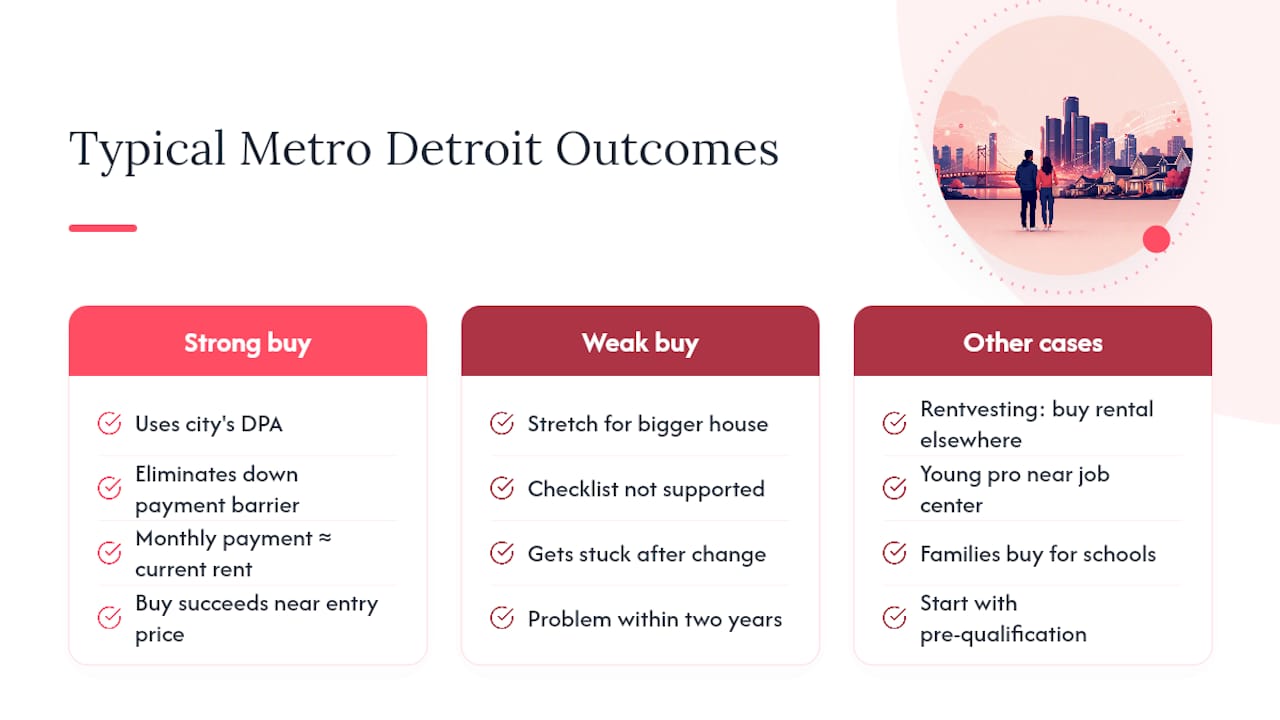
Most of the strongest buy cases I’ve seen involve someone using the city’s DPA to eliminate the down payment barrier entirely, then locking in a payment close to what they were already paying in rent. The weakest buy cases involve someone stretching for a bigger house than the checklist above supports, then getting stuck when a job or relationship changes within two years.
A young professional renting near a job center while buying a rental property elsewhere, often called rentvesting, comes up more in Detroit than people expect, since entry prices are low enough to make it work on a modest income. Families anchoring a decision around school districts tend to buy regardless of the math, and that’s a legitimate reason to override a spreadsheet. Start by getting pre-qualified, not pre-approved on a whim, and let a lender tell you your real number before you fall for a listing.
— Bryan
How Comparespot Helps You Act on These Numbers
Running the math is only half the job. Once you know whether you’re buying or renting, you still need a lender, an agent, or in some cases a fast cash sale, and picking the wrong one costs more than a bad mortgage rate ever will. Comparespot publishes independently researched rankings of local providers to help Metro Detroit households with their next steps in real estate.
If you’ve run the numbers and you’re leaning toward buying, start with Comparespot’s ranked list of mortgage lenders in Metro Detroit to compare rates and fees before you apply anywhere. Working with an agent who knows Detroit’s block-by-block variation matters just as much; the top-rated real estate agents in Metro Detroit list is built around exactly that kind of local knowledge. Homeowners facing a time crunch, an inheritance, foreclosure, or a fast relocation, can instead review the best cash home buyers in Metro Detroit to compare offers without listing on the open market. Whichever path fits your numbers, start at Comparespot’s Metro Detroit rankings and pick the category that matches your next move.
Where This Data Comes From
The price-to-rent ratios, median home prices, and median rents cited throughout this guide come from CalcFi’s Detroit rent-vs-buy calculator and RentOrBuyToday’s Michigan data page, both of which update their local inputs regularly. Down payment assistance rules and application steps come directly from the City of Detroit’s housing department. Readers who want to verify appreciation trends or local income data independently can check the Census Bureau’s American Community Survey, which underlies most of the demographic assumptions local calculators use. Context on how local experts frame the buy-versus-rent tradeoff comes from the Michigan Chronicle’s coverage of the Detroit housing market.
Sources
- Detroit Down Payment Assistance Program
- Rent vs Buy Detroit 2026 | CalcFi
- Rent vs Buy in Detroit, Michigan (2026 Calculator)
FAQ
Is It Cheaper to Rent or Buy in Detroit?
Renting is usually cheaper month to month in Detroit, since median rent runs around $1,465 versus a PITI closer to $1,700 to $1,850 on a median-priced home. Buying tends to win over a multi-year horizon because rent rises annually while a fixed mortgage payment doesn’t.
What Is the 2% Rule for Rentals?
The 2% rule suggests a rental property’s monthly rent should equal roughly 2% of its purchase price to generate strong cash flow for an investor. Detroit’s price-to-rent ratio of about 14.6, which implies rent near 6.8% of home value annually, or roughly 0.57% monthly, falls short of that threshold, which is why most Detroit rentals are held for appreciation and steady demand rather than pure cash-flow yield.
Can I Afford $1,000 Rent Making $20 an Hour?
At $20 an hour full time, gross income runs around $3,467 a month, and $1,000 in rent equals about 29% of that, close to the standard 30% affordability guideline. It’s workable but leaves a tight margin once utilities, groceries, and transportation enter the budget.
How Much Do You Need to Make to Afford a $300,000 House in Michigan?
Comparespot’s mortgage broker rankings for Metro Detroit can connect you with a lender to run your exact numbers.