

Spring, roughly late April through early June, is the strongest window to list a home in Metro Detroit, with a smaller secondary bump some years in early autumn. The right method depends on your goal: a full-service agent for the highest net proceeds, a vetted cash buyer when speed or a difficult property matters more than price, or flat-fee MLS if you’re comfortable managing showings yourself to save on commission. The sections below break down local market signals, neighborhood variation, and a five-minute checklist to help you pick your exact week.
TL;DR:
- Listing in late April through early June capitalizes on high buyer demand and shorter market times, especially when neighborhood inventory is declining.
- Local market signals, including decreasing active listings, rising pending sales, and falling days on market, strengthen the case for listing sooner rather than later.
- Hyper-local data, such as recent comps and active inventory within a half-mile radius, is crucial to set realistic prices and avoid over- or under-pricing.
- Choosing between an agent, flat-fee MLS, or cash buyer depends on your timeline, desired net proceeds, and willingness to handle showings or negotiations yourself.
- Immediate red flags like foreclosure deadlines or hazard issues favor quick cash sales, while soft comps and rising inventory suggest delaying listing for better pricing opportunities.
Table of Contents
- When Is the Best Time to Sell a House in Detroit?
- Why Your Block Matters More Than the Metro Average
- Should You Use an Agent, Flat-Fee MLS, or a Cash Buyer?
- Your Five-Minute Decision Checklist
- How Long Will It Take, and What Will It Cost?
- Why a Checklist Beats a Guessing Game
- Find a Vetted Local Provider Match for Your Timeline
- Sources
- FAQ
When Is the Best Time to Sell a House in Detroit?
Spring drives the calendar in Metro Detroit for a simple reason: buyers with kids want to close before the next school year, and nobody wants to house hunt in a February whiteout. Listings that hit the market in late April through early June tend to draw more showings in a shorter span, which usually means less time sitting and stronger offers. A smaller secondary window sometimes opens in September, after summer vacations end but before holiday distractions set in, though it’s less reliable year to year.
Local coverage backs this up. A ClickOnDetroit report on Metro Detroit selling trends pointed to a specific week in April 2026 as the year’s top window, citing Realtor.com and RE/MAX Southeastern Michigan data showing a jump in pending sales and a median price around $305,000 across the metro area.
Pro Tip: Don’t just trust a headline that says “this week is the year’s top window.” Check the underlying trend, not the snapshot, before you commit to a listing date.
Before you set a date, watch these signals:
- Inventory trend: Fewer active listings than last month usually means less competition for your home.
- Days on market: A shrinking average signals buyers are moving faster, a good sign to list soon.
- Pending sales: A rising count suggests real buyer demand, not just curiosity.
- Median sale price: Climbing prices in your area point to a seller-friendly window.
- Months of supply: Below four to five months typically favors sellers; above six tends to favor buyers.
You can track these through your agent’s MLS access, local reporting, or a summary of current provider rankings. When multiple signals point the same direction, that’s a stronger case to move than a single splashy headline.
Why Your Block Matters More Than the Metro Average
Citywide timing data is a starting point, not a verdict. Detroit’s neighborhoods swing wildly in price tier, housing age, and recent investment, so what’s true for Grosse Pointe Park may not hold three miles away in a different ZIP code. A metro-wide “top window” claim can mask a slow-moving pocket market right on your street.
Here’s how to check your own numbers before trusting the broader trend:
- Pull 90-day comps for your exact ZIP code, not the whole city or county.
- Filter for true comparables: similar square footage, age of construction, and condition, since a fully renovated colonial skews the average for a block of untouched originals.
- Check nearby pending sales to see if buyer interest is active right now, not three months ago.
- Track price per square foot over the last quarter to spot whether your immediate area is heating up or cooling off.
- Count active inventory within a half-mile radius to gauge how much you’ll be competing against.
This kind of hyper-local digging is exactly what a good pricing strategy depends on. Skipping it is how sellers end up either underpricing a strong block or overpricing a soft one.
Should You Use an Agent, Flat-Fee MLS, or a Cash Buyer?
Each path solves a different problem, and picking the wrong one usually costs you either money or time. A full-service agent lists your home on the MLS, handles marketing, negotiates offers, and manages the closing process. Flat-fee MLS gets your listing the same MLS exposure for a fraction of a traditional commission, but you handle showings, negotiations, and paperwork yourself. Cash buyers skip the open market entirely, making a direct offer, often within days, in exchange for a lower price than you’d get through a traditional listing.
Match the method to your actual situation:
- Relocating for a job with a two-month deadline? An agent’s marketing reach usually gets you a stronger offer than you’d find on your own, and most sales still close inside that window.
- Inherited a property that needs work and you want it gone? A cash buyer skips inspections, repairs, and showings, which matters more than squeezing out top dollar.
- Comfortable handling calls and paperwork to save on commission? Flat-fee MLS, as outlined in this Detroit FSBO guide, puts your listing in front of the same buyers an agent would reach.
The trade-offs come down to three things: timeline, net proceeds, and workload. Agent sales typically take longer to close but net more after fees. Cash sales close fast but at a lower price. FSBO and flat-fee routes save on commission but put disclosures, inspections, and negotiation squarely on you.
Pro Tip: If you’re weighing a cash offer against a traditional listing, ask the cash buyer for a written net sheet. Compare it line by line against what an agent estimates you’d clear after commission and closing costs, not just the headline offer number.
Your Five-Minute Decision Checklist
Run through this before you commit to a listing date or a sale method:
- Pull your 90-day ZIP code comps. Are recent sales trending up, flat, or down?
- Check the inventory trend. Rising competition might mean waiting a few weeks; shrinking inventory favors listing now.
- Look at average days on market for homes similar to yours.
- Gauge buyer type demand in your area: investors, first-time buyers, or move-up families each respond to different pricing and staging.
- Set a repair budget and timeline. Can you realistically finish needed work before your target list date?
- Confirm legal and municipal requirements, including whether your municipality requires a point-of-sale inspection.
Two red flags should push you toward a cash sale regardless of season: an imminent foreclosure deadline, or a safety hazard serious enough that a lender won’t approve financing for a buyer. On the flip side, if your comps are soft and inventory is climbing, it’s often smarter to delay listing a few weeks than to launch into a buyer’s market.
Once you’ve worked through the list, take action: contact a top-ranked local agent, request two or three cash-buyer quotes for comparison, or set up a flat-fee MLS listing if you’re managing the sale yourself.
How Long Will It Take, and What Will It Cost?
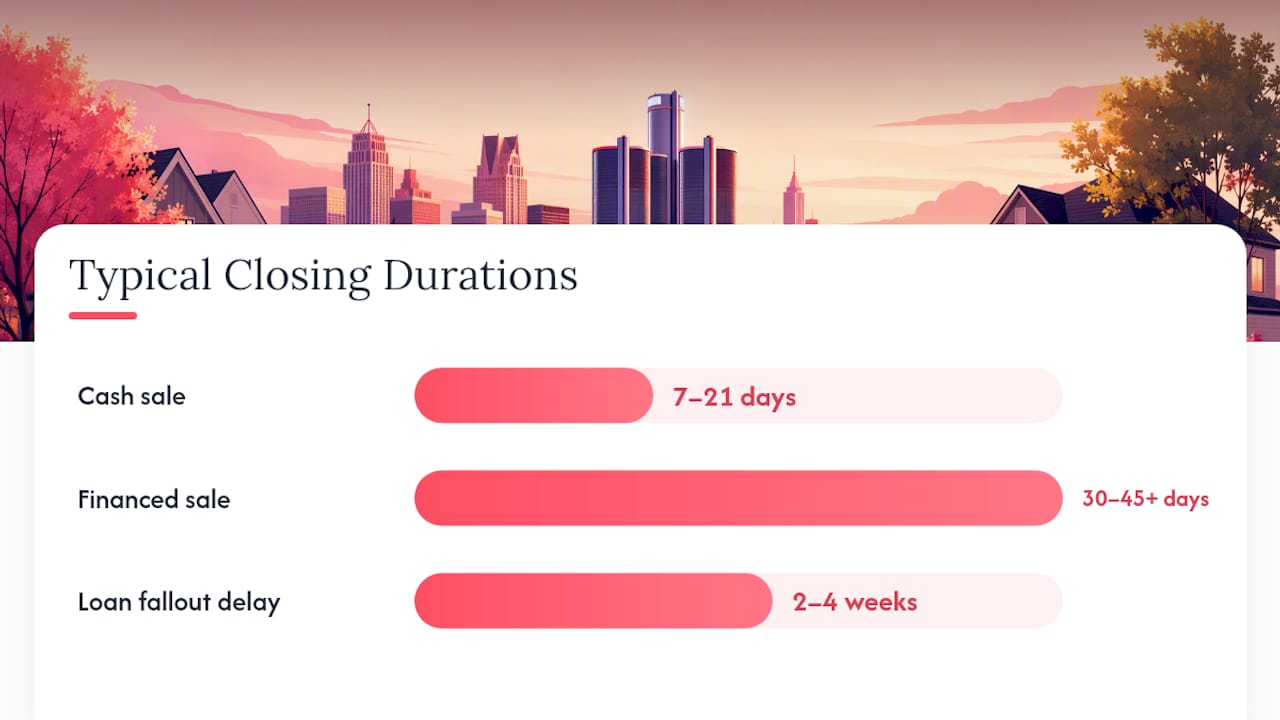
Cash sales in Metro Detroit typically close in seven to 21 days. Financed sales usually run 30 to 45 days or longer, with delays often tied to appraisal issues, buyer financing hiccups, or inspection negotiations. If your buyer’s loan falls through mid escrow, add another two to four weeks while they requalify or you relist.
Seller costs follow a fairly predictable pattern across Michigan:
- Agent commission: commonly in the 5 to 6% range of the sale price, split between listing and buyer’s agents.
- Closing costs: title fees, transfer tax, and prorated property taxes, typically a smaller percentage than commission but worth budgeting for.
- Repair and inspection costs: varies widely depending on the home’s condition and what a buyer’s inspection turns up.
Michigan law requires sellers to complete a Seller’s Disclosure Statement before an offer is accepted, and some Detroit-area municipalities layer on point-of-sale inspection ordinances that can affect your prep timeline. Check your city’s rules early, not after you’ve already picked a list date. For a deeper breakdown of what you’ll actually net after fees, see this guide to Michigan seller closing costs and this look at real estate commission structures.
Why a Checklist Beats a Guessing Game
Most sellers waste weeks agonizing over the “perfect” week to list when the real work is comparing three or four hard numbers: your ZIP code comps, inventory trend, and your own repair timeline. That’s what the checklist above is built to shortcut.
Time-sensitive situations, foreclosure deadlines, inherited properties, sudden relocations, don’t leave room for that kind of hesitation. Local rankings exist for exactly this moment: a fast way to compare vetted agents and cash buyers across Wayne, Oakland, and Macomb counties without starting from zero.
— Bryan
Find a Vetted Local Provider Match for Your Timeline
Comparespot is the alternative to cold-calling agents or gambling on an unfamiliar cash-buyer ad in Metro Detroit: every provider on the site is ranked through independent research and customer sentiment analysis, not paid placement. If your priority is maximizing proceeds, start with the best real estate agents in Metro Detroit ranking. If speed matters more than top dollar, especially for an inherited property or a tight deadline, check the cash home buyers ranked for the Madison Heights area. If you are coordinating a purchase alongside your sale, the mortgage lender rankings for Metro Detroit can help you line up financing without adding another unknown to the process. The mortgage lender rankings for Metro Detroit can help you line up financing without adding another unknown to the process. Pick the list that matches your goal and start comparing providers at Comparespot.

Sources
Local reporting from ClickOnDetroit supplied the spring timing data cited above, drawing on Realtor.com and RE/MAX Southeastern Michigan figures. The Beycome FSBO guide informed the disclosure and flat-fee MLS details. CompareSpot’s Metro Detroit local rankings provide the provider comparisons referenced throughout.
- Thinking of selling your Metro Detroit home? Experts say this week is the year’s top window
- Sell Your Detroit, MI Home Without a Realtor
FAQ
What Month Is Best to Sell a House in Detroit?
Late April through early June is typically the strongest window, driven by buyer activity ahead of the next school year, though a smaller bump sometimes appears in September.
Should I Wait for Spring or Sell Now?
Check your 90-day ZIP code comps, inventory trend, and days on market first; if those signals already favor sellers, waiting for spring can cost you more in carrying costs than you’d gain in price.
Is a Cash Buyer or an Agent Better for Selling Fast in Detroit?
A cash buyer typically closes in seven to 21 days and skips repairs and showings, while an agent usually nets more money but takes 30 to 45 days or longer through a financed sale.
How Do I Find a Trustworthy Agent or Cash Buyer in Metro Detroit?
Independently researched, ranked lists of local agents, cash buyers, and lenders across Wayne, Oakland, and Macomb counties, based on data and customer sentiment rather than paid placement, are published on relevant comparison sites.