

Agents represent one side; brokers represent the other — and that single distinction shapes everything from who shops your insurance to who signs off on your real estate closing. In most U.S. transactions, an insurance agent works on behalf of the carrier, while an insurance broker works on behalf of you. In real estate, a broker holds an advanced license that lets them operate a firm and supervise agents, while agents must work under a supervising broker in nearly every state. If you’re shopping multiple insurance carriers, start with a broker. If you’re buying or selling a home, you’ll almost certainly work with an agent — but the brokerage behind them matters just as much as the agent you choose. Comparespot’s independently researched rankings of Metro Detroit real estate professionals and the National Association of Realtors (NAR) are two reliable starting points for vetting whoever you hire.
Table of Contents
- What exactly is an agent?
- What exactly is a broker?
- How licensing and legal authority actually differ
- What agents and brokers actually do day to day
- How agents and brokers get paid
- Agent vs broker: a side-by-side comparison
- When should you hire an agent versus a broker?
- Questions to ask before you hire anyone
- Quick answers to common questions
- Key Takeaways
- The title matters less than you think
- Find vetted agents and brokers in Metro Detroit through Comparespot
- Authoritative sources and where to verify
- FAQ
What exactly is an agent?
The word “agent” covers a lot of ground depending on the industry, but the core idea is consistent: an agent acts on behalf of another party, usually within defined legal limits.
In insurance, an agent typically represents the insurance company, not you. They’re authorized to sell that carrier’s products and, in many cases, can bind coverage directly, meaning your policy goes into effect on the spot. Two main subtypes exist:
- Captive agents sell exclusively for one carrier (think a State Farm or Allstate office). Their product menu is limited to that company’s offerings.
- Independent agents represent multiple carriers but still act as the carrier’s representative in the transaction, not as your personal advocate.
In real estate, an agent holds a state-issued real estate license and must affiliate with a licensed brokerage. They cannot legally hang their own shingle and operate independently in most states. Within that structure, two roles dominate:
- Buyer’s agents represent the purchaser, helping locate properties, negotiate offers, and navigate inspections.
- Listing agents (also called seller’s agents) represent the homeowner, pricing the property, marketing it, and managing offers.
Agents are the day-to-day contact in almost every transaction. They handle showings, calls, paperwork, and negotiations. The license behind them, and the brokerage supervising them, is what determines their legal authority.
What exactly is a broker?
A broker holds a higher-level license and, in most contexts, represents the client rather than the product provider.

In insurance, a broker works for you, the buyer. They’re not tied to a single carrier, so they can shop your coverage across multiple insurers and present competing quotes. That independence is the main practical advantage. One important caveat: insurance brokers typically cannot bind coverage themselves. They submit your application to the carrier, and the carrier issues the policy. If you need immediate binding authority, an agent with that carrier relationship is the one who can do it.
In real estate, a broker has completed additional education, passed a more rigorous state exam, and earned a license that allows them to operate independently or run a firm. Real estate brokers can open a brokerage, hire agents, and are legally responsible for every transaction those agents handle. Three broker subtypes appear frequently:
- Principal brokers (or designated brokers) own or manage the firm and carry ultimate legal responsibility.
- Managing brokers oversee day-to-day agent activity without necessarily owning the firm.
- Associate brokers hold a broker’s license but choose to work under another broker rather than run their own operation.
One thing worth knowing: state rules vary considerably. A handful of states use “broker” as the entry-level real estate license, which means the agent-vs-broker distinction looks different there than it does in Michigan or California. Always check your state’s real estate commission for the exact title structure.
How licensing and legal authority actually differ
Licensing is where the agent vs broker distinction becomes legally concrete, not just semantic.
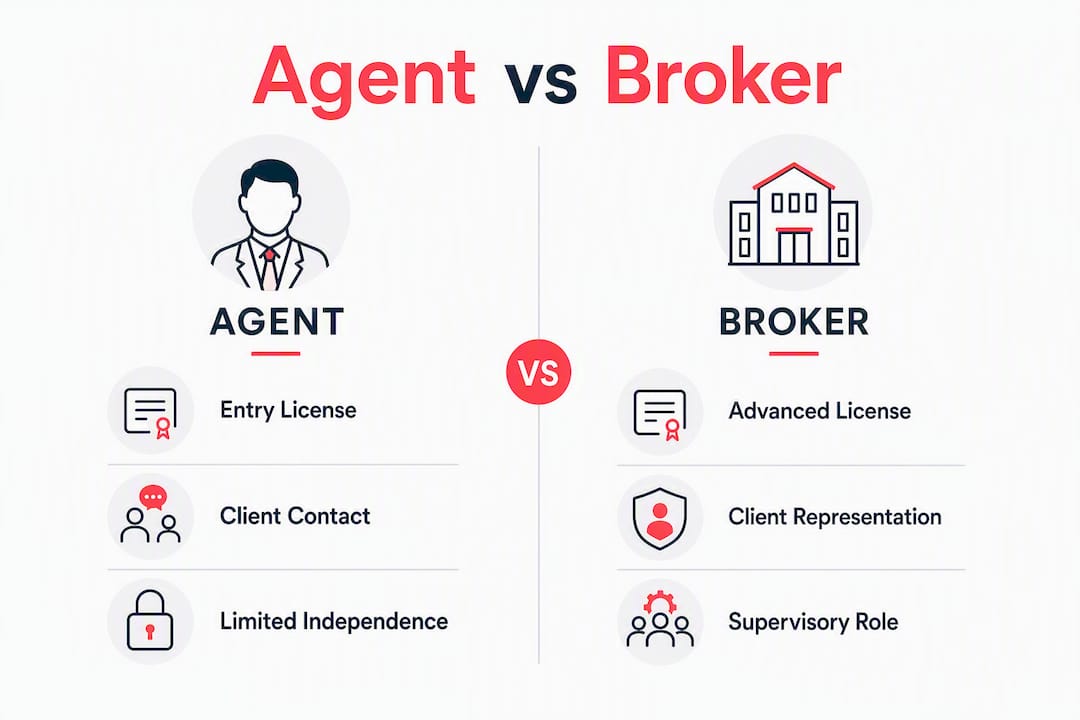
For real estate, agents complete a pre-licensing course (typically 40–90 hours depending on the state), pass a state exam, and then must work under a licensed broker. Brokers complete additional coursework beyond the agent level, accumulate required experience (often two or more years as a licensed agent), and pass a separate, more demanding broker exam. That extra credential is what grants them the authority to supervise agents, hold escrow funds, and operate a firm.
| Role | License level | Can operate independently | Can supervise agents | Can hold escrow | Can bind insurance |
|---|---|---|---|---|---|
| Insurance agent | State insurance license | No (works for carrier) | No | No | Often yes |
| Insurance broker | State insurance license (broker) | Yes | No | No | Typically no |
| Real estate agent | State real estate license | No | No | No | N/A |
| Real estate broker | Advanced state broker license | Yes | Yes | Yes (in most states) | N/A |
The binding authority question matters most in insurance. Agents often bind coverage on behalf of a carrier; brokers act as intermediaries sourcing options across insurers but typically cannot bind the policy themselves. In real estate, escrow authority follows the broker license, not the agent license.
Where to verify: Check your state’s insurance department for insurance professionals (Michigan residents can use the Michigan Department of Insurance and Financial Services) and your state’s real estate commission for real estate professionals. Both maintain free online license lookup tools. NAR’s database confirms Realtor membership separately.
The brokerage’s compliance systems and reputation often matter more than a single agent’s title — because the supervising broker remains legally responsible for agent activity even when the consumer never meets them.
What agents and brokers actually do day to day
Understanding the job-to-be-done for each role makes the hiring decision much clearer.
Insurance agents (captive or independent):
- Quote and explain policies from their authorized carrier(s)
- Bind coverage immediately when authorized
- Handle policy changes, renewals, and claims reporting
- Serve as the ongoing carrier contact for the client
Insurance brokers:
- Assess your coverage needs independently
- Shop your risk across multiple carriers and present competing options
- Negotiate terms and placement on your behalf
- Collect a broker fee or commission from the carrier upon placement (more on this below)
Real estate agents:
- Conduct property showings and open houses
- Prepare and submit offers or listing agreements
- Coordinate inspections, appraisals, and contingencies
- Communicate between parties through closing
Real estate brokers:
- Review and approve contracts signed by agents under their supervision
- Manage escrow accounts and ensure regulatory compliance
- Recruit, train, and supervise licensed agents
- Handle disputes or errors that arise from agent transactions
A quick scenario: you’re a first-time buyer in Metro Detroit. You’ll almost certainly work directly with a buyer’s agent for showings and negotiations. That agent’s broker reviews the purchase agreement, holds the earnest money in escrow, and is legally on the hook if something goes wrong. Practically, the transaction runs through the broker even when the client only ever talks to the agent.
How agents and brokers get paid

The pay structure differs enough between industries that it’s worth separating them clearly.
Insurance compensation:
- Captive agents earn a commission from their carrier, typically a percentage of the premium. The client pays nothing directly to the agent.
- Independent agents earn commissions from whichever carrier places the policy.
- Insurance brokers may earn a carrier commission, a broker fee charged directly to the client, or both. Ask upfront which model applies and whether the fee is refundable if coverage falls through.
Real estate compensation:
- Agents earn a commission, typically a percentage of the sale price, paid at closing.
- That commission is usually split between the listing agent’s brokerage and the buyer’s agent’s brokerage, then split again between the brokerage and the individual agent.
- Brokers can earn from their own personal transactions and from a share of commissions generated by agents working under them — which is why running a productive brokerage can be more lucrative than selling solo.
- Commission structures and who pays what have shifted following recent NAR settlement changes; always ask for a written buyer representation agreement that spells out compensation before you start working with anyone.
Pro Tip: Ask any real estate professional to show you their written compensation disclosure before signing anything. If they hesitate, that’s a signal worth taking seriously.
Agent vs broker: a side-by-side comparison
| Dimension | Insurance agent | Insurance broker | Real estate agent | Real estate broker |
|---|---|---|---|---|
| Primary duty | Sell carrier’s products | Shop market for client | Assist buyers/sellers | Operate firm, supervise agents |
| Who they represent | The insurance carrier | The client/insured | Buyer or seller | The brokerage and its clients |
| Licensing & authority | State insurance license | State broker license | State real estate license | Advanced state broker license |
| Can bind coverage / supervise | Often can bind coverage | Typically cannot bind | Cannot supervise | Can supervise agents and hold escrow |
| How they get paid | Carrier commission | Carrier commission or client fee | Commission split at closing | Commission split + share of agents’ splits |
| Best use case | Single-carrier purchase, fast binding | Complex or multi-carrier shopping | Buying or selling a home | Running a firm, complex transactions |
When should you hire an agent versus a broker?
The right choice usually comes down to three factors: complexity, independence, and oversight.
Choose an insurance agent when:
- You want a single carrier’s products and need coverage bound quickly
- You have a long-standing relationship with a specific company and just need a policy update
- Your coverage needs are straightforward (standard auto, renters, or term life)
Choose an insurance broker when:
- You’re placing complex or high-value coverage (commercial liability, specialty lines, business interruption)
- You want someone to shop the market on your behalf without a carrier loyalty conflict
- You’re a business owner comparing multiple carriers for employee benefits
Choose a real estate agent when:
- You’re buying or selling a standard residential property
- You want a dedicated day-to-day contact who knows your local market
- You’re a first-time buyer who needs hands-on guidance through the process
Choose to work directly with a real estate broker when:
- You’re buying or selling a high-value or complex property where firm-level oversight matters
- You want the principal broker personally handling your transaction, not delegating to an agent
- You’re an investor managing multiple transactions and need brokerage-level compliance support
- You’re in a state where broker-only licensing is the norm and the title distinction is different
The honest answer for most homebuyers and sellers: you’ll work with an agent, and that’s fine. What matters is that the brokerage behind them has solid compliance systems and a clean disciplinary record.
Questions to ask before you hire anyone
Most people spend more time researching a restaurant than vetting the professional who will handle their largest financial transaction. Don’t do that.
Ask every candidate:
- Are you licensed in this state, and can I verify that online?
- Are you an agent or a broker, and who supervises your transactions?
- Who signs the closing documents or binds my coverage?
- How are you compensated, and is any part of that paid by me directly?
- Can you provide references from clients with similar transactions in the past 12 months?
Red flags to watch for:
- Evasive or vague answers about licensing or supervision
- Refusal to provide a written compensation disclosure
- Pressure to sign a representation agreement before answering your questions
- No verifiable license in the state’s online database
- Claims of a title or designation that doesn’t appear in any official registry
Pro Tip: License lookups take about 90 seconds. For real estate, go to your state’s real estate commission website and search by name. For insurance, use your state insurance department’s producer lookup. In Michigan, the Department of Insurance and Financial Services maintains a free online search. If the name doesn’t appear or shows a lapsed license, stop the conversation there.
Quick answers to common questions
Which is better, a broker or an agent?
Neither is universally better. Expert commentary consistently points to matching the professional’s experience to the transaction rather than choosing by title alone. A seasoned agent at a reputable brokerage will outperform a newly licensed broker on most residential deals.
What are the three main differences between a broker and an agent?
- Licensing: Brokers hold an advanced license; agents hold an entry-level license.
- Independence: Brokers can operate independently or run a firm; agents must work under a broker.
- Authority: Brokers can supervise agents and (in real estate) hold escrow; agents cannot.
Can an agent work without a broker?
In real estate, no. U.S. real estate agents must affiliate with a licensed brokerage and cannot legally operate independently in most states. In insurance, a licensed agent works under appointment from a carrier, not a broker, so the structure is different — but they still operate within a regulated framework.
Who typically earns more?
Real estate brokers who run productive firms tend to earn more than individual agents because they collect a share of every agent’s commission in addition to their own. However, a high-volume agent at a top brokerage can out-earn a broker who runs a small or slow firm. Title alone doesn’t determine income.
Key Takeaways
Brokers hold advanced licenses and represent the client; agents hold entry-level licenses and typically represent the carrier or work under a supervising broker in nearly every U.S. state.
| Point | Details |
|---|---|
| Agents represent the carrier or work under a broker | In insurance, agents represent the carrier; in real estate, they must affiliate with a licensed brokerage. |
| Brokers hold advanced authority | Real estate brokers can supervise agents, hold escrow, and operate a firm independently. |
| Binding authority differs | Insurance agents often bind coverage immediately; brokers typically cannot bind but shop multiple carriers. |
| Realtor is a designation, not a license | A Realtor is an agent or broker who joins NAR and follows its Code of Ethics — it says nothing about license level. |
| Comparespot ranks vetted local professionals | Metro Detroit homeowners can use Comparespot’s independently researched rankings to find top-rated agents and brokers without paid placement distorting the results. |
The title matters less than you think
Most people searching “agent vs broker” are really asking: “Who should I call?” And the honest answer is that the title is a starting point, not a guarantee of quality.
Here’s what the conventional framing gets wrong: it treats the broker designation as inherently superior. It isn’t. A broker license means more education and more legal authority. It does not mean better judgment, stronger negotiation skills, or deeper knowledge of your specific neighborhood. Many of the most effective real estate professionals in Metro Detroit hold agent licenses and choose to stay agents because they’d rather focus on clients than manage a firm. That’s a deliberate choice, not a limitation.
What actually predicts a good outcome is the brokerage’s compliance infrastructure, the individual’s transaction volume in your price range and property type, and whether their incentives align with yours. An insurance broker who earns a higher commission from one carrier than another has a conflict of interest that their independence doesn’t automatically resolve. A captive agent who knows their carrier’s underwriting inside out may get you a better outcome on a standard policy than a broker shopping five carriers superficially.
The practical takeaway: verify the license, ask who supervises the transaction, and look at the brokerage’s track record, not just the individual’s business card. In Metro Detroit’s market, where Wayne, Oakland, and Macomb counties each have distinct pricing dynamics, local knowledge and brokerage reputation carry more weight than the letters after someone’s name.
Find vetted agents and brokers in Metro Detroit through Comparespot
Knowing the difference between an agent and a broker is step one. Finding a trustworthy one in your market is where most people get stuck.
Comparespot publishes independently researched rankings of top-rated real estate agents in Metro Detroit and top mortgage brokers across Wayne, Oakland, and Macomb counties — ranked by customer sentiment, licensing verification, and local market performance, not by who paid for placement. No provider can buy a spot in the rankings.
Whether you’re selling a home in a time-sensitive situation or comparing financing options before you buy, Comparespot’s free rankings give you a shortlist of professionals who have already been vetted against the criteria that actually matter. Visit comparespot.org to browse current rankings and find the right professional for your transaction.
Disclosure: Comparespot may earn a referral fee when users contact featured providers through the platform. This does not affect ranking placement or editorial independence.
Authoritative sources and where to verify
These are the primary sources behind the claims in this article. Use them to verify facts or dig deeper.
- National Association of Realtors (NAR) — Defines the Realtor designation and NAR’s Code of Ethics; the authoritative source for the Realtor-vs-agent-vs-broker distinction.
- HousingWire: Real Estate Broker vs. Agent — Industry coverage of licensing differences, compensation structures, and the agent independence question.
- NAIC Model Regulation — The National Association of Insurance Commissioners’ model regulation governing insurance producer licensing across states.
State real estate commissions and state insurance departments are the definitive verification tools for license status and disciplinary history in your specific state. Rules vary enough that a detail true in Michigan may not apply in Texas or Florida — always confirm locally.
FAQ
Which is better, a broker or an agent?
Neither title is universally better. The professional’s experience, local market knowledge, and alignment with your transaction type predict outcomes far better than their license level alone.
Can a real estate agent work without a broker?
No. In nearly every U.S. state, real estate agents must affiliate with a licensed brokerage and cannot legally operate independently. The supervising broker is legally responsible for the agent’s transactions.
What’s the difference between a Realtor, an agent, and a broker?
A Realtor is an agent or broker who has joined NAR and agreed to follow its Code of Ethics. It’s a professional membership designation, not a license level — a Realtor can hold either an agent or a broker license.
Who typically earns more, a broker or an agent?
Brokers who run active firms tend to earn more because they collect a share of every agent’s commission in addition to their own production. A high-volume agent at a strong brokerage can still out-earn a broker running a small operation.
How do I verify that an agent or broker is properly licensed?
Use your state’s real estate commission website or state insurance department’s online producer lookup. Both are free and take under two minutes. Michigan residents can check insurance producer status through the Michigan Department of Insurance and Financial Services.