

A mortgage commitment letter is your lender’s written promise to make you a loan of a specific amount, on stated terms, if you meet the conditions listed in it. In Michigan it works the same way as anywhere in the U.S.: it arrives after your application is approved, it carries an expiration date, and it is not the same thing as being cleared to close. Read it line by line, because every condition on it is a task with a deadline.
TL;DR
- A commitment letter states the loan amount, terms and conditions the lender has approved. It comes after you apply, not before you shop.
- Most letters carry conditions (documents, an appraisal, insurance, clean title). Unmet conditions can stop the loan.
- You usually have to sign and return the letter within a short window, often five to 10 days, so check the dates the day it arrives.
- Do not change jobs, open credit or move large sums of money before closing.
- Michigan borrowers have written rights and a state complaint line if a lender denies or mishandles a loan.
Table of Contents
- What a mortgage commitment letter actually is
- What is inside the letter
- Signing, timing and the expiration date
- Is the commitment binding?
- Michigan specifics worth knowing
- If the lender denies you or changes course
- Choosing a lender before you ever see a commitment letter
- Compare Metro Detroit lenders before you commit
- Our perspective
- FAQ
- Sources
What a mortgage commitment letter actually is
The Federal Reserve defines a loan commitment as the lender’s promise to make a loan of a specific amount at a future time. You generally receive it after your application is approved. It spells out the approved terms, including the loan amount, how long the commitment stays valid, and the lender’s conditions, such as receiving a satisfactory title insurance policy.
That last part is what trips people up. The letter is a promise with strings attached. Lenders check a mortgage in stages, and some facts, like the property’s value or the state of its title, can only be confirmed late in the process. The commitment tells you the loan looks solid so far and lists what remains.
Commitment letter, preapproval and final approval
These three get mixed up constantly, and in Michigan’s fast-moving offers they matter.
| Document | When you get it | What it tells you |
|---|---|---|
| Preapproval letter | Before you have a house | The lender is tentatively willing to lend up to an amount, based on assumptions |
| Commitment letter | After you apply on a specific property | Approved terms, expiration date and the conditions still open |
| Clear to close | After every condition is met | The lender is ready to schedule closing |
The Consumer Financial Protection Bureau (CFPB) explains that a preapproval letter is a statement that a lender is tentatively willing to lend, is based on assumptions and is not a guaranteed loan offer. It also does not commit you to that lender. The CFPB advises waiting to choose a lender until you have made an offer and collected official Loan Estimates, because preapproval letters do not give enough detail to compare deals. If you are still at the preapproval stage, our guide to preapproval vs. prequalification walks through the difference, and our breakdown of the Loan Estimate shows how to compare offers page by page.
Some lenders also call a preapproval letter a commitment letter, so the name on the top of the page matters less than what the document says. Look for a named property, a loan amount, an expiration date and a list of conditions. Those signal a true commitment.
What is inside the letter
Freddie Mac’s step-by-step mortgage guide says the commitment letter you receive after approval should specify the loan amount, term, interest rate, annual percentage rate (APR, the yearly cost of the loan including certain fees) and monthly charges. Expect to find these items:
- Borrower, lender and property. Check every spelling and the address. A typo in a name or parcel can delay title work.
- Loan amount and type. Conventional, FHA, VA or USDA, plus term, such as 30 years.
- Interest rate and whether it is locked. A rate lock holds your rate for a set period. Make sure the lock dates run past your planned closing day.
- Expiration date. After this date the commitment can lapse.
- Conditions. The list of what you still owe the lender.
Compare each figure against your Loan Estimate. If the rate, APR or monthly charges differ from what you were quoted and you do not know why, ask the loan officer in writing before you sign.
Conditions you are likely to see
Conditions are the lender’s remaining checklist. Typical examples are updated pay stubs or bank statements, verification of employment shortly before closing, a letter explaining a recent large deposit, proof of homeowners insurance, a satisfactory appraisal, clear title and documentation of where your down payment came from. Gift funds usually need a signed gift letter.
Work through them in this order:
- Send the easy documents first. Pay stubs, statements and insurance quotes take you a day.
- Write the explanation letters plainly. A large deposit needs a short note and a paper trail, such as the transfer record or the check copy.
- Ask which conditions depend on someone else. Appraisals, title work and insurance binders run on third-party schedules, so start those early.
- Keep a log. Note the date you submitted each item and who confirmed receipt.
Signing, timing and the expiration date
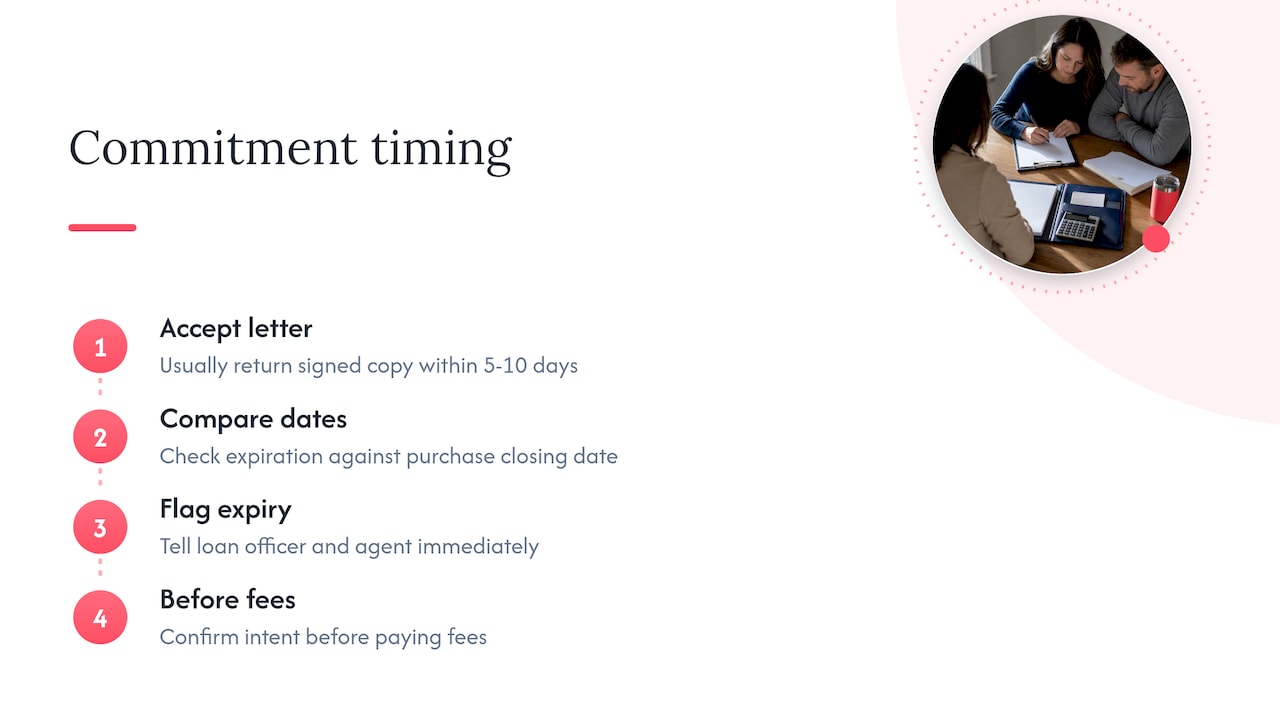
Freddie Mac notes that you usually must accept the commitment by returning a signed copy, commonly within five to 10 days, and that you may have to pay part or all of the origination fees at that point. Put that deadline on your calendar the day the letter arrives.
Then compare the letter’s expiration date with your purchase agreement’s closing date. If the commitment could expire before you are scheduled to close, say so to your loan officer and your agent right away, because a delay with title, the appraisal or the seller can push you past it. Extending a lock or a commitment can cost money, so catching the gap early saves you from a scramble.
The CFPB’s home loan toolkit adds an important reminder: you are not committed to any lender before you sign the final closing documents, and lenders must wait for your stated intent to proceed before charging an application fee, appraisal fee or most other fees. Before you pay anything, make sure you actually want to proceed with that lender. Our piece on lender fees explains which charges to look at closely.
Is the commitment binding?
Treat it as a strong, conditional promise, not a guarantee. The lender intends to lend if the conditions hold, but the loan is not final until everything on the list is satisfied and the lender clears the file to close. The usual reasons a loan stalls after a commitment are:
- a condition left unmet or unmet by the deadline
- a change in your finances, such as a new job, a missed payment or a new car loan that changes your debt-to-income ratio (your monthly debts divided by your monthly income)
- a property problem, such as a title defect or an appraisal below the price
The fix is simple to state and hard to do: hold your financial picture still from commitment to closing. Do not finance furniture, a car or appliances for the new house, and do not move money between accounts without a record. If you plan to furnish the home, wait until after you have the keys.
Michigan specifics worth knowing
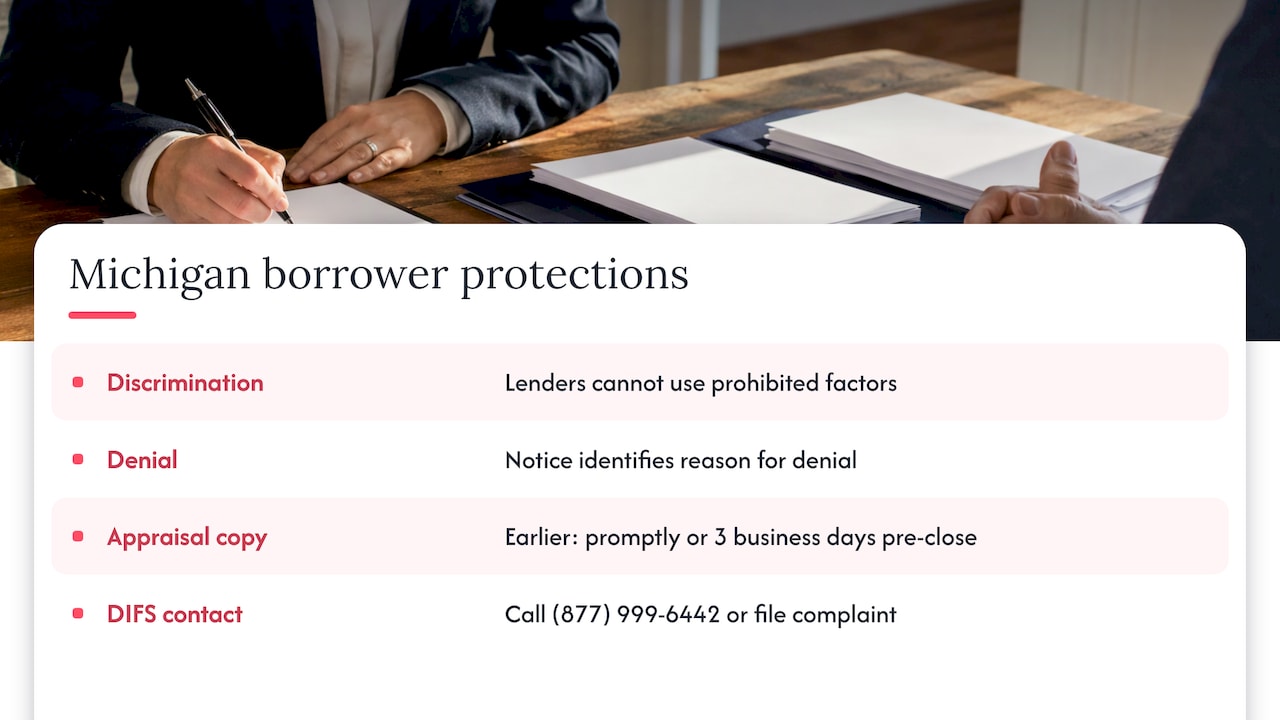
There is no separate Michigan commitment-letter form that replaces the federal process, but Michigan borrowers do have state-level protections. The Michigan Department of Insurance and Financial Services (DIFS) publishes a Consumer Guide to Mortgage Rights that says lenders cannot use prohibited factors, including race, religion, age, sex, marital status, disability, sexual orientation, gender identity or receiving public assistance income, when deciding whether to write a loan. If you are denied, you should receive a Notice of Adverse Action that identifies the reason.
If a dispute with your lender or servicer cannot be resolved, DIFS asks borrowers to call (877) 999-6442 (Monday to Friday, 8 a.m. to 5 p.m.) or file a complaint at Michigan.gov/DIFScomplaints.
Appraisals are another place the rules help you. Under Regulation B, a Michigan lender must give you a copy of the appraisal report if you paid for it, promptly after completion or three business days before closing, whichever is earlier, according to the DIFS Mortgage Compliance FAQ. If your commitment hinges on a satisfactory appraisal, read the report as soon as you have it.
Buyers using a state or federal assistance program often have extra paperwork on top of the standard conditions. Our first-time buyer programs in Michigan guide covers what those programs ask for.
If the lender denies you or changes course
A denial after a conditional approval is stressful, but you have steps:
- Ask for the reason in writing. A denied applicant receives a Notice of Adverse Action. If your credit score was used, the lender must also give you the score and instructions for a free copy of your credit report, according to the CFPB.
- Fix what can be fixed. Unsatisfied paperwork, a low appraisal you can contest, or a debt you can pay down may revive the loan.
- Get a second quote quickly. If you need to start with another lender, a directory of Michigan loan officers helps you find people to contact. Our broker vs. lender explainer shows which route suits your situation.
- Talk to a HUD-approved housing counselor. The CFPB lists the number as 1-800-569-4287.
- Use the state complaint line if you believe the lender broke the rules.
If your purchase falls through and you need to sell your own home on a tight timeline, the closing options change. Our cash closing timeline for Michigan shows what a 7 to 14 day sale involves, and the deed in lieu checklist is there for owners facing a harder situation.
Choosing a lender before you ever see a commitment letter
The best commitment letter starts with the best lender match. Collect Loan Estimates from at least a few lenders on the same day, compare rate, APR and fees, and confirm how quickly each one can issue a commitment on your timeline. Local knowledge matters in Wayne, Oakland and Macomb counties, where appraisal timing and title work can vary by community. Our guides to home loans in Metro Detroit and the best mortgage lenders in Detroit lay out the local picture.
Compare Metro Detroit lenders before you commit
CompareSpot publishes independently researched rankings of mortgage lenders, cash home buyers and real estate agents for Metro Detroit. Providers cannot pay for placement, and the rankings are updated quarterly with a published methodology. If you are weighing lenders, start with our ranking of the best mortgage lenders in Metro Detroit. If you also need to sell a home fast, the cash home buyers in Metro Detroit list is built for that.
Agents who work our three counties daily can also help you line up your offer, financing contingency and closing date, and our Metro Detroit agent rankings are there when you are ready.
Our perspective
A commitment letter feels like the finish line, and that is exactly when buyers get careless. We see the letter as a to-do list with a calendar attached. The borrowers who close smoothly treat the expiration date and each condition as deadlines, and they keep their finances boring until the keys change hands.
That is also why we rank lenders on research and customer sentiment rather than on who pays us. Our rankings take no payment for placement and are tailored to Wayne, Oakland and Macomb counties, because the lender who communicates clearly about conditions and timing is the one who gets you to the table on time. Choose that lender first, and the letter takes care of itself.
Bryan
FAQ
Is a mortgage commitment letter the same as final approval?
No. A commitment letter confirms the lender’s approved terms and lists what you still need to deliver. Final approval, often called clear to close, comes only after every condition is satisfied. Until then the lender can still deny the loan if a condition is unmet.
How long is a commitment letter valid?
It is valid until the expiration date printed on it, and that date is set by the lender. Freddie Mac says you usually need to return a signed copy within five to 10 days of receiving it. Check the expiration against your closing date the day it arrives.
Can a lender withdraw after issuing the letter?
Yes, if conditions are not met or your finances or the property change in a way that affects the loan. A new debt, a job change, a title problem or a low appraisal are common causes. Keep your finances steady and answer every condition promptly.
What should I do if I am denied in Michigan?
Ask for the Notice of Adverse Action and read the reason. You can then address the issue, request a new quote elsewhere, or call a HUD-approved housing counselor at 1-800-569-4287. If you think the lender acted unfairly, contact Michigan DIFS at (877) 999-6442.
Sources
- Federal Reserve: A Consumer’s Guide to Mortgage Lock-Ins
- Freddie Mac: Your Step-by-Step Mortgage Guide
- CFPB: Get a preapproval letter
- CFPB: Your home loan toolkit
- Michigan DIFS: Consumer Guide to Mortgage Rights
- Michigan DIFS: Mortgage Compliance FAQ