

TL;DR:
- Prequalification is an informal estimate based on self-reported data, while preapproval is a verified, conditional commitment backed by documentation.
- Preapproval provides a stronger signal to sellers and takes longer to obtain because of the required document review and credit checks.
Preapproval is generally a lender-verified, conditional commitment often backed by real documents and a credit check, though specific practices vary by lender. Prequalification is an informal estimate based on numbers you provide yourself, with no verification. The practical rule: get prequalified early to set your budget, then get preapproved before you make any offers. Lenders like Bank of America and Rocket Mortgage both offer both steps, and the Consumer Financial Protection Bureau (CFPB) is clear that neither one is a final loan approval.
Table of Contents
- What is mortgage prequalification and how does it work?
- What is a mortgage preapproval and what does the letter show?
- Prequalification vs preapproval: how do they compare?
- What documents do lenders verify for preapproval?
- Why preapproval and prequalification mean different things at different lenders
- When should you get prequalified, and when should you get preapproved?
- What neither letter guarantees, and mistakes to avoid
- Step-by-step: move from prequalification to a competitive offer
- Key Takeaways
- The part most buyers get wrong about preapproval timing
- Comparespot helps Metro Detroit buyers find the right lender faster
- Useful sources
- FAQ
What is mortgage prequalification and how does it work?
Prequalification is the first, lightest step in the mortgage process. You tell a lender your income, debts, and assets, and they give you a rough estimate of how much you might be able to borrow. No documents change hands. No one verifies anything.
Most lenders run a soft credit inquiry during prequalification, which does not affect your credit score. The whole process can take minutes online or over the phone. What you get back is a ballpark number, not a commitment.
That ballpark is genuinely useful at the right stage. If you’re still twelve months from buying, prequalification tells you whether your debt-to-income ratio needs work or whether your down payment savings are on track. It can surface problems worth fixing before you go through the more rigorous preapproval process.
What prequalification does not do: it does not prove to a seller that you can actually close. A prequalification letter says, in effect, “based on what this buyer told us, they might qualify for up to $X.” Sellers and their agents know the difference.
Key things to understand about prequalification:
- Based entirely on self-reported income, assets, and debts
- Typically uses a soft credit pull with no score impact
- Completes quickly, often in minutes online or by phone
- Produces an estimate, not a verified loan amount
- No documentation required from the buyer
What is a mortgage preapproval and what does the letter show?
Preapproval is a different animal. A lender actually reviews your financial documents, pulls your credit report with a hard inquiry, and issues a conditional commitment to lend up to a specific amount. Bank of America describes it as a conditional assessment that can also identify which loan programs, such as conventional, FHA, or VA, you qualify for.
A preapproval letter typically includes:
- A conditional loan amount the lender is willing to offer
- An estimated interest rate or APR
- The loan type you qualify for (conventional, FHA, VA, etc.)
- An expiration date, typically valid for 60–90 days
- The lender’s contact information and any stated conditions
The hard credit pull is a key operational difference; it may impact your credit score temporarily, but provides a letter that carries more weight with sellers. Sellers know a preapproved buyer has been vetted. A prequalified buyer has not.
Preapproval also takes longer. Because lenders are verifying actual documents, the process typically runs 1–10 business days depending on how quickly you submit paperwork and how busy the lender is.

Prequalification vs preapproval: how do they compare?
The table below covers the dimensions that actually matter when you’re deciding which step to take and when.

| Dimension | Prequalification | Preapproval |
|---|---|---|
| Purpose | Early budget estimate | Conditional lending commitment |
| Depth of verification | Self-reported only | Lender-verified documents |
| Credit check type | Soft pull (no score impact) | Hard pull (may lower score slightly) |
| Documents required | None | Pay stubs, W-2s, bank statements, ID |
| How sellers view it | Low confidence signal | Strong signal of buyer readiness |
| Time to complete | Minutes | 1–10 business days |
| Validity period | Not typically time-limited | Commonly 60–90 days |
| How definitive it is | Informal estimate | Conditional approval |
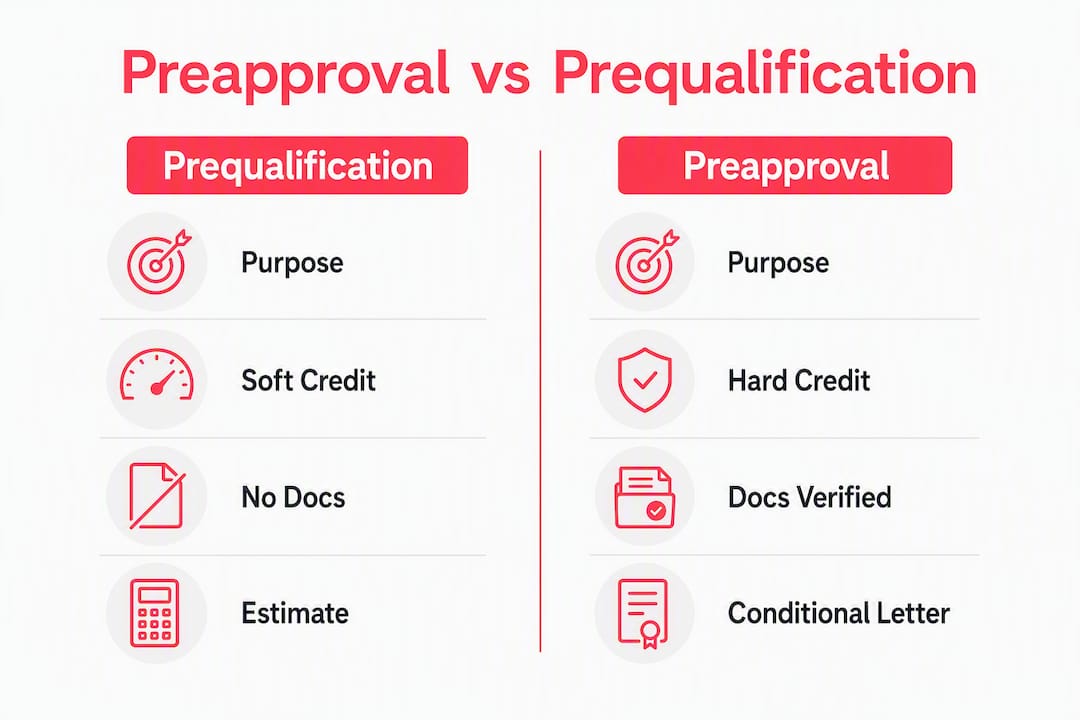
The three cells that move sellers most are credit verification, documentation, and the expiration date. A preapproval letter that expired two weeks ago tells a seller your finances haven’t been checked recently. A current, verified preapproval tells them you’re ready to close.
One important caveat: terms are not standardized across lenders. What one lender calls a preapproval, another might call a prequalification. Always ask what a letter actually represents before relying on it.
What documents do lenders verify for preapproval?
Assembling your paperwork before you apply is the single fastest way to cut preapproval time. Lenders are waiting on you more often than you’re waiting on them.
Here’s the standard document checklist:
- Pay stubs from the past 30 days (two to four pay periods)
- W-2 forms from the past two years, or 1099s if self-employed
- Federal tax returns from the past two years
- Bank statements from the past two to three months, all accounts
- Photo ID (driver’s license or passport)
- Proof of assets (investment accounts, retirement accounts, gift letters if applicable)
- Employment verification (lender may contact your employer directly)
- Social Security number or ITIN for the credit pull
Beyond documents, lenders calculate your debt-to-income (DTI) ratio, verify employment status, and review your full credit report. If anything looks inconsistent, they’ll ask for more. That back-and-forth is the most common source of delays.
Pro Tip: Submit all documents at once rather than piecemeal. Incomplete submissions restart the review clock and can trigger a second hard inquiry if too much time passes between your initial application and final document submission.
Processing time runs 1–10 business days for most lenders. Complex income situations, such as self-employment or multiple income streams, tend to push toward the longer end.
Why preapproval and prequalification mean different things at different lenders
The CFPB is direct about this: the terms are not standardized. A “prequalification” from one lender might involve document verification. A “preapproval” from another might be nothing more than a soft-pull estimate.
“Lenders use the terms ‘prequalification’ and ‘preapproval’ differently. Ask your lender what their specific process involves — whether it requires a hard credit pull, what documents they need, and how long the letter is valid.” — Consumer Financial Protection Bureau
Before you rely on any letter, ask your lender these questions directly:
- Does this process involve a hard or soft credit pull?
- What documents do you need from me?
- How long is the letter valid?
- Is this a conditional commitment or just an estimate?
- What conditions could prevent final approval?
The answers tell you exactly what you’re holding. A letter from a lender who verified nothing is worth far less than one from a lender who reviewed two years of tax returns and ran a full credit check.
When should you get prequalified, and when should you get preapproved?
Timing matters more than most buyers realize. Getting preapproved too early means your letter expires before you find a home. Getting prequalified too late means you’re making offers without the documentation sellers want to see.
Start with prequalification when:
- You’re 6–12 months from buying and still budgeting
- You want to identify credit or debt issues to fix before applying
- You’re not yet ready to commit to a specific lender
Move to preapproval when:
- You’re actively touring homes and plan to make offers within 60–90 days
- You’ve found a neighborhood or price range you’re serious about
- You’re entering a competitive market where sellers expect verified buyers
Experts recommend timing preapproval to coincide with active shopping to avoid expired letters and repeated hard pulls. In Metro Detroit’s faster-moving neighborhoods, showing up to an offer without a current preapproval letter is a real disadvantage.
A quick three-question check before pursuing preapproval:
- Are you ready to make an offer within the next 60–90 days?
- Is your credit stable and unlikely to change significantly?
- Is the local market competitive enough that sellers will compare buyer qualifications?
If you answered yes to all three, get preapproved now.
What neither letter guarantees, and mistakes to avoid
Neither prequalification nor preapproval is a final loan approval. Both letters state a lender’s likely willingness to lend up to a specified amount, subject to final underwriting, appraisal, and title review. Any of those can still block a loan after you’re under contract.
Common pitfalls that derail buyers after preapproval:
- Taking on new debt (car loan, credit card, furniture financing) between preapproval and closing
- Changing jobs or having income gaps that underwriting can’t verify
- Appraisal shortfalls where the home appraises below the purchase price
- Letting the letter expire and not re-verifying before making an offer
- Assuming prequalification is enough in a competitive market
On credit score impact: the hard pull from a preapproval typically reduces your score by a few points temporarily. If you’re shopping multiple lenders, mortgage-related hard inquiries made within a 14–45 day window are usually treated as a single inquiry by credit scoring models. Rate-shopping is not penalized the way opening multiple new credit cards would be.
If a lender denies your preapproval application, request an adverse action notice. It identifies the specific reasons, which might be correctable. A co-signer, a different loan program (FHA has lower credit thresholds than conventional), or a mortgage broker who shops multiple lenders can open options that a single lender rejection closes.
Pro Tip: Don’t apply for preapproval at five lenders simultaneously. Pick one or two, submit complete documents, and get your letter. Then rate-shop within the 14–45 day window if you want to compare rates.
Step-by-step: move from prequalification to a competitive offer
- Get prequalified to establish a realistic price range and identify any financial issues worth fixing before you apply for preapproval.
- Fix what prequalification reveals. Pay down high-balance cards, resolve any credit report errors, and avoid opening new accounts.
- Assemble your documents (pay stubs, W-2s, tax returns, bank statements, ID) before you contact a lender for preapproval.
- Apply for preapproval once you’re actively house-hunting and plan to make offers within 60–90 days.
- Confirm the letter’s expiration date and conditions with your lender before submitting it with an offer.
- Include the preapproval letter with your offer. Your agent will typically attach it as a supporting document.
When your agent submits the letter, it should show the conditional loan amount, the lender’s name and contact, and the expiration date. Do not include your full financial documents in the offer package. The letter itself is sufficient; sellers don’t need your tax returns.
What to avoid in offer language: never represent a preapproval as a guaranteed loan. Sellers’ attorneys read offer letters carefully, and overstating what a preapproval means can create liability if financing falls through.
Key Takeaways
Preapproval carries real weight with sellers because it reflects verified finances; prequalification is a useful planning tool but not a substitute when offers are on the table.
| Point | Details |
|---|---|
| Prequalification is an estimate | Based on self-reported data with a soft credit pull; no documents verified. |
| Preapproval is conditional and verified | Requires documents and a hard credit pull; validity periods vary by lender. |
| Terms vary by lender | Always ask whether a letter involves a hard pull, document review, and how long it’s valid. |
| Rate-shopping is safer than it looks | Multiple mortgage hard pulls within a 14–45 day window typically count as one inquiry. |
| Comparespot for local lenders | Comparespot ranks vetted Metro Detroit mortgage lenders and brokers to help buyers find preapproval-ready options. |
The part most buyers get wrong about preapproval timing
Most buyers treat preapproval as a formality they’ll handle once they find a home they love. That’s backwards. By the time you’re standing in a kitchen deciding whether to make an offer, you should already have a current, verified preapproval letter in hand.
The real risk isn’t the hard credit pull. It’s the gap between when you think you’re ready and when a lender confirms it. Income documentation issues, old collection accounts, or a DTI ratio that’s slightly too high can take weeks to resolve. Discovering those problems after you’ve fallen in love with a house is a painful way to learn them.
There’s also a subtler issue with how buyers read their own prequalification. Because the number comes from self-reported data, it tends to reflect the best-case version of your finances. Preapproval, which uses verified documents, often produces a lower or differently conditioned number. That gap matters when you’re budgeting for a specific price range.
The buyers who move fastest in competitive markets are the ones who treated preapproval as preparation, not paperwork. Get it done before you tour homes, not after.
Comparespot helps Metro Detroit buyers find the right lender faster
Finding a lender who handles preapproval efficiently is half the battle in a market like Metro Detroit, where Wayne, Oakland, and Macomb counties each have their own pace and inventory dynamics. Comparespot independently ranks the top mortgage lenders in Metro Detroit based on research and customer sentiment, not paid placement. No lender can buy their way onto the list.

If you’d rather work with a broker who shops multiple lenders on your behalf, Comparespot also ranks the best mortgage brokers in Metro Detroit. That’s especially useful if your income situation is complex or a single lender has already declined you. Browse the rankings, compare your options, and walk into preapproval with a lender you’ve already vetted.
Useful sources
These are the primary sources used in this guide. Each one is worth bookmarking for lender-specific definitions and current program details.
- Consumer Financial Protection Bureau (CFPB): Prequalification vs. Preapproval — the authoritative federal guidance on how terms are defined and why they vary by lender
Always confirm a lender’s specific process, validity period, and conditions before relying on any letter in a live offer situation.
This article is general information, not financial or legal advice. Confirm current program requirements and eligibility with your lender or a qualified mortgage professional.
FAQ
What is the main difference between preapproval and prequalification?
Prequalification is an informal estimate based on self-reported data with no document verification. Preapproval is a conditional commitment backed by verified income, assets, and a hard credit pull.
Does getting preapproved hurt your credit score?
A preapproval triggers a hard credit inquiry, which may lower your score by a few points temporarily. Multiple mortgage hard pulls within a 14–45 day window are typically treated as a single inquiry by credit bureaus.
How long is a mortgage preapproval valid?
Most preapproval letters are valid for 60–90 days. If your home search runs longer, contact your lender to re-verify your documents and extend the letter before making offers.
Do I need preapproval or prequalification to make an offer?
Sellers in competitive markets strongly prefer a current preapproval letter. Prequalification alone signals interest but not verified readiness, and many listing agents will advise sellers to favor preapproved buyers.
Where can Metro Detroit buyers find vetted mortgage lenders?
Comparespot independently ranks Metro Detroit mortgage lenders and brokers based on research and customer sentiment, giving buyers a starting point that isn’t influenced by paid placement.