

TL;DR:
- Choosing between a mortgage broker and a direct lender depends on your financial situation, with brokers better for complex files and direct lenders offering speed for straightforward cases. Both routes require comparing Loan Estimates to ensure fair pricing, and verifying licensing is essential before sharing financial documents. Ultimately, assessing your profile and asking the right questions helps you find the best option for your mortgage needs.
If your finances are straightforward — strong credit, stable W-2 income, solid down payment — a direct lender often saves you time and may reduce fees. If your income is nonstandard, your credit file is thin, or you want someone shopping the market on your behalf, a mortgage broker usually finds more options than any single institution can offer.
The core difference is simple: a lender funds your loan; a broker does not. A broker shops your file across multiple wholesale lenders, coordinates the paperwork, and presents you with competing offers. A direct lender underwrites and closes the loan in-house.
Quick profile guide:
- Straightforward file (W-2, 700+ credit, 20% down): Apply directly to a lender. Faster closing, fewer moving parts, and your existing bank may offer a loyalty discount.
- Complex file (self-employed, thin credit, nontraditional income): Start with a broker. Access to multiple lenders increases your odds of approval and competitive pricing.
- Time-sensitive deal: Direct lender. In-house underwriting typically closes faster than brokered loans that route through third-party underwriting.
- First-time buyer, unsure where to start: A broker can walk you through multiple loan programs simultaneously and act as your advocate.
The CFPB recommends shopping and comparing offers regardless of which route you take — collecting multiple Loan Estimates and comparing APR and total loan costs is the single most effective way to protect yourself from poor pricing.
Table of Contents
- What does a mortgage lender actually do?
- What does a mortgage broker do, and how are they licensed?
- How do brokers and lenders compare across the decisions that matter?
- Pros and cons of each route
- How brokers and lenders are paid — and what it costs you
- How the application and closing timeline differs
- How to choose: the questions to ask before you commit
- Which option works best for your borrower profile?
- U.S. consumer protections and licensing you should verify
- Key Takeaways
- The choice most borrowers get backwards
- Comparespot’s Metro Detroit mortgage rankings
- Useful sources and further reading
- FAQ
What does a mortgage lender actually do?
A mortgage lender is the institution that originates, underwrites, and funds your loan. When you close, the money comes directly from them. Types of direct lenders include commercial banks, credit unions, and non-bank mortgage companies — each operates under its own underwriting guidelines and product set.

When you apply directly, a loan officer at that institution handles your file from application through closing. That officer can only offer products their employer sells. Underwriting, appraisal coordination, and funding all happen under one roof, which is why direct lenders often produce a faster, more streamlined closing compared with brokered loans that require coordination with a third-party lender.
One underappreciated advantage: if you already hold accounts at a bank, that institution may offer rate discounts or reduced fees to existing customers. It is worth asking specifically — not all banks advertise these programs upfront.
What does a mortgage broker do, and how are they licensed?
A mortgage broker is an independent intermediary. They do not fund loans. Instead, they submit your application to multiple wholesale lenders, collect competing offers, and coordinate the paperwork on your behalf. As Chase explains, loan officers represent a specific lender’s products and interests; brokers represent your ability to access multiple lenders’ products — a meaningful governance difference when negotiation matters.
Brokers handle document collection across lenders, which saves you from repeating that process for each institution separately. If you were shopping three lenders on your own, you would submit a full package to each. A broker does that once and routes it accordingly.
Licensing matters. Every mortgage broker operating in the U.S. must be registered through the Nationwide Multistate Licensing System (NMLS) and hold a state license in the state where the property is located. You can verify any broker or loan officer at the NMLS Consumer Access portal (nmlsconsumeraccess.org) in under two minutes. The CFPB also flags that some firms operate as hybrids — acting as both broker and lender depending on the transaction — so always ask directly: “Are you acting as a broker or a direct lender on my file?” Get that answer in writing before you proceed.
How do brokers and lenders compare across the decisions that matter?
| Dimension | Direct Lender | Mortgage Broker |
|---|---|---|
| Access to loan options | Products from one institution only | Multiple wholesale lenders; broader product access |
| Typical costs | Origination fee (often 0.5%–1% of loan); no broker commission | Borrower-paid commission typically 1%–2% of the loan; lender-paid commission 0.5%–2.75% (built into rate) |
| Speed / friction | Faster; in-house underwriting and closing | Slower potential; depends on third-party underwriting timelines |
| Best borrower profile | Strong credit, stable income, clear documentation | Self-employed, thin credit, nontraditional income, or first-time buyers |
| Advocacy / negotiation | Loan officer works for the lender | Broker works for you; can negotiate across lenders |
| Transparency / disclosures | Loan Estimate required within 3 business days | Same Loan Estimate requirement; broker fees disclosed separately |

The table above is a starting framework, not a verdict. A credit union with a niche first-time buyer program may beat a broker’s best offer for a specific profile. Always collect at least two Loan Estimates before deciding.
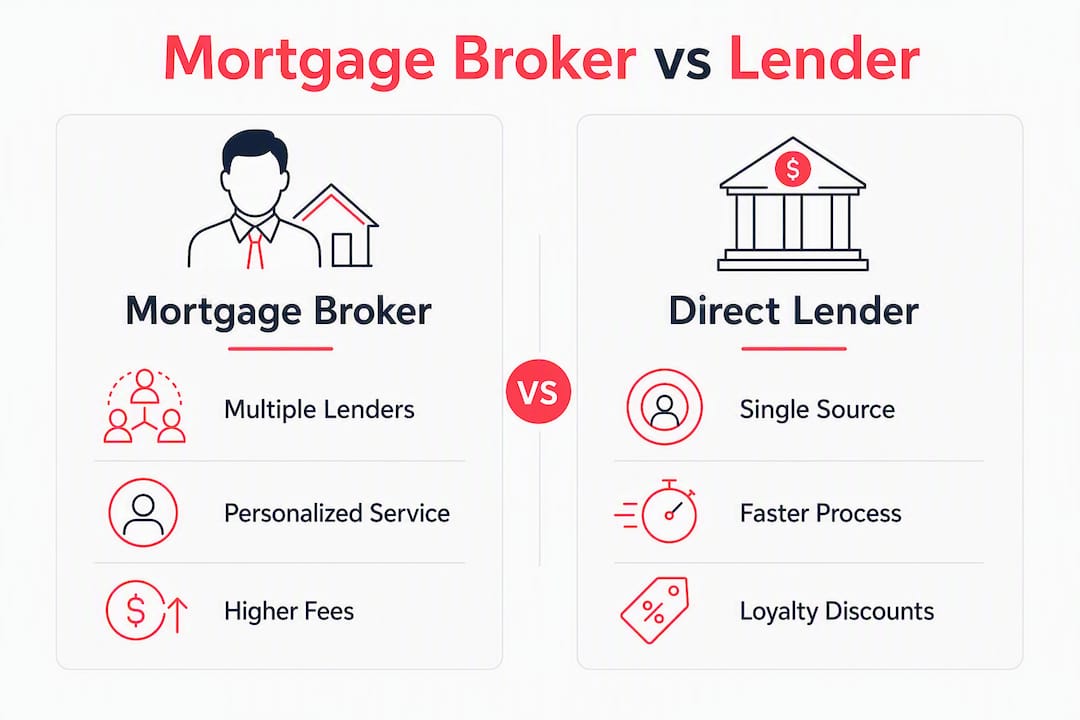
Pros and cons of each route
Mortgage broker: what you gain and what you give up
Pros:
- Access to wholesale rates and programs not available at retail banks
- Single point of contact handles document collection across multiple lenders
- Particularly useful for complex financial situations — self-employment, thin credit, or nontraditional income
- Broker acts as your advocate, not the lender’s
Cons:
- Closing may take longer when third-party underwriting is involved
- Broker compensation (borrower-paid or lender-paid) adds a cost layer
- Quality varies significantly; a poorly organized broker creates delays
- You are dependent on the broker’s lender relationships — if their network is narrow, so is your access
Direct lender: what you gain and what you give up
Pros:
- Faster, more predictable closing timeline
- Potential loyalty discounts for existing bank customers
- Direct communication with the underwriting team
- Straightforward files close more efficiently without an intermediary layer
Cons:
- Limited to that institution’s products and guidelines
- No built-in market comparison — you have to shop multiple lenders yourself
- Loan officer’s primary obligation is to the lender, not to you
Pro Tip: Ask any direct lender whether they sell your loan after closing. Many do. If your loan is sold, your servicer changes and your point of contact disappears. This matters more for refinancing and future modifications than for the initial purchase, but it is worth knowing upfront.
How brokers and lenders are paid — and what it costs you
Broker compensation comes in two forms. In a borrower-paid model, you pay the broker directly at closing, typically 1%–2% of the loan amount. On a $400,000 loan, that is $4,000–$8,000. In a lender-paid model, the broker receives a commission from the wholesale lender, commonly in the range of 0.5%–2.75%, which gets built into your interest rate rather than appearing as a line-item fee.
One rule worth knowing: brokers generally cannot be paid by both the borrower and the lender on the same transaction. If you are paying the broker directly, they should not also be collecting a separate lender commission for that loan. This affects how fees are disclosed and how you negotiate.
Direct lenders charge origination fees (often 0.5%–1% of the loan) and may offer discount points — prepaid interest that buys down your rate. They can also offer lender credits, which reduce your closing costs in exchange for a slightly higher rate.
Where to find these numbers: Your Loan Estimate, which lenders and brokers are required to provide within three business days of receiving your application, itemizes every fee. The Closing Disclosure, delivered at least three business days before closing, must match those figures within tolerance. Compare the APR across Loan Estimates — not just the interest rate — because APR folds in fees and gives you a true cost comparison.
How the application and closing timeline differs
The sequence of steps is similar whether you use a broker or a direct lender. What differs is who controls each step and how long handoffs take.
- Preapproval: Direct lenders issue preapproval letters in-house, often within 24–48 hours. Brokers submit to a wholesale lender, which may add a day or two.
- Full application: Both routes require the same documentation (tax returns, pay stubs, bank statements, ID). With a broker, you submit once; the broker routes to multiple lenders.
- Underwriting: Direct lenders underwrite internally. Brokered loans go to the wholesale lender’s underwriting team, which you have no direct access to.
- Appraisal: Ordered by the lender in both cases; timeline is similar.
- Conditional approval / conditions: Direct lenders can often clear conditions faster because the underwriter is in the same building. Brokered loans require the broker to relay conditions back and forth.
- Clear to close: Typically 30–45 days for a direct lender on a clean file; brokered loans can run similar timelines but are more variable.
- Closing and funding: Direct lenders fund from their own capital. Brokered loans fund from the wholesale lender.
Pro Tip: The single biggest source of closing delays — for both routes — is missing or incomplete documentation. Before you apply anywhere, assemble two years of tax returns, two months of bank statements, your most recent pay stubs, and a copy of your ID. Having this ready cuts conditional-approval back-and-forth by days.
How to choose: the questions to ask before you commit
Start by knowing your own profile. Pull your credit score, calculate your debt-to-income ratio, and be honest about how clean your income documentation is. That alone narrows the field.
Documents and outputs to request from any lender or broker:
- Loan Estimate (required by law within 3 business days of application)
- APR, not just the note rate
- All origination fees, points, and lender credits itemized
- Estimated cash to close
- Underwriting timeline and any known delays
Questions to ask a broker:
- “Which wholesale lenders are you submitting my file to?”
- “Are you accepting lender-paid or borrower-paid compensation on this loan?”
- “Can I see your NMLS license number?”
- “How many lenders did you compare before presenting this offer?”
Questions to ask a direct lender:
- “Do you offer any rate discounts for existing customers?”
- “Do you underwrite in-house, or do you broker some loans out?”
- “Will you service this loan after closing, or sell it?”
Red flags to watch for:
- No NMLS license number provided on request
- Vague or evasive answers about fees before you apply
- Pressure to skip the Loan Estimate comparison step
- Unusually long estimated timelines with no explanation
Learning how to negotiate mortgage rates before you sit down with either a broker or a lender puts you in a materially stronger position — most borrowers accept the first offer without realizing rates and fees are negotiable.
Which option works best for your borrower profile?
Different financial situations genuinely call for different routes. Here is how the evidence maps out across common profiles.
Self-employed borrower: Brokers are the stronger starting point. Lenders vary widely in how they treat self-employment income, and a broker who knows which wholesale lenders use bank-statement programs can save weeks of rejected applications.
Thin credit file (score below 640): A broker’s access to FHA-approved and portfolio lenders gives you more options than a single bank’s guidelines. Some wholesale lenders specialize in credit-repair-adjacent programs that retail banks do not offer.
Strong W-2 borrower, 20%+ down, 740+ credit: Go direct. Straightforward files close faster and with fewer fees when there is no intermediary layer. Your existing bank is a legitimate first call.
First-time buyer, uncertain about loan types: A broker’s market-facing role works in your favor here. They can compare FHA, conventional, and state first-time buyer programs side by side without you having to research each lender independently.
Existing bank customer with significant deposits: Call your bank first. Some lenders offer loyalty discounts or special pricing to existing customers that are not publicly advertised. Get that quote, then compare it against a broker’s best offer.
Time-constrained buyer (closing in under 30 days): Direct lender. In-house underwriting removes the third-party coordination layer that most commonly causes delays in brokered transactions.
Investor buying a rental property: Brokers often have access to DSCR (debt-service coverage ratio) and portfolio loan programs that conventional banks do not offer at retail. Worth the extra coordination time.
Hybrid firm scenario: Some companies operate as both broker and lender. Always ask which role they are playing on your specific file, and request written confirmation. The CFPB flags this explicitly as a point of confusion for borrowers.
U.S. consumer protections and licensing you should verify
Federal law gives you concrete tools to protect yourself. Use them.
Loan Estimate: Any lender or broker must provide this standardized form within three business days of receiving your completed application. It shows your interest rate, monthly payment, closing costs, and APR. Do not proceed without one.
Closing Disclosure: Delivered at least three business days before closing, this document must match the Loan Estimate within allowable tolerances. Review it line by line before you sign.
RESPA (Real Estate Settlement Procedures Act): Prohibits kickbacks between settlement service providers. If a broker or lender refers you to a title company or insurance provider and receives compensation for that referral without disclosure, that is a RESPA violation.
NMLS verification: Every mortgage broker and loan officer must be registered with the Nationwide Multistate Licensing System. Check their license at nmlsconsumeraccess.org before you share any financial documents. A legitimate professional will give you their NMLS number without hesitation.
Credit inquiry impact: Multiple mortgage inquiries within a short window (typically 14–45 days, depending on the scoring model) are usually treated as a single inquiry by FICO and VantageScore. Shopping three lenders in two weeks will not meaningfully hurt your credit score.
The CFPB’s core recommendation is straightforward: shop and compare offers. Collecting multiple Loan Estimates and focusing on APR and total loan costs — not just the headline rate — is the most reliable way to avoid overpaying.
Understanding the role of a loan officer in the process helps you know exactly what questions to ask and whose interests each person at the table is serving.
This article provides general information about U.S. mortgage options, not legal or financial advice. Confirm current rates, fees, and regulatory requirements with a licensed mortgage professional or directly with the CFPB.
Key Takeaways
Brokers suit complex borrower profiles; direct lenders suit clean files where speed and fewer intermediaries matter most — but both routes require you to collect and compare Loan Estimates before committing.
| Point | Details |
|---|---|
| Match route to your profile | Brokers help complex files; direct lenders close straightforward W-2 files faster and often cheaper. |
| Broker fees are real costs | Borrower-paid broker commissions typically run 1%–2% of the loan amount; lender-paid commissions are commonly 0.5%–2.75% and built into your rate. |
| Always compare Loan Estimates | The CFPB recommends collecting multiple Loan Estimates and comparing APR, not just the interest rate. |
| Verify licensing before sharing documents | Check every broker and loan officer on the NMLS Consumer Access portal before submitting financial information. |
| Comparespot for Metro Detroit | Comparespot publishes independently researched rankings of mortgage brokers and lenders in Wayne, Oakland, and Macomb counties. |
The choice most borrowers get backwards
Most people frame this decision as “broker vs. lender” when the real question is “what does my file look like, and who has the best tools for it?” The route is secondary. The profile is primary.
What gets overlooked: the broker’s value is not just access to more lenders — it is the document coordination. If you are shopping three lenders on your own, you are submitting a full package three times, answering three sets of underwriting questions, and managing three timelines. A good broker collapses that into one process. For a complex file, that alone is worth the commission.
The flip side is equally true. A W-2 borrower with a 760 credit score and 25% down who spends three weeks working through a broker’s wholesale pipeline is leaving time on the table. That borrower should call their bank, get a Loan Estimate in 48 hours, and close in 30 days.
The conventional wisdom that “brokers always get you a better rate” is not universally true. Wholesale pricing can be sharper than retail, but a direct lender with a loyalty discount or a credit union with a member rate can match or beat it. The only way to know is to collect both and compare APR line by line.
One more thing: ask every contact you speak with whether they are acting as a broker or a direct lender on your specific file. Some firms do both. The answer changes who they are working for.
Comparespot’s Metro Detroit mortgage rankings
Metro Detroit homebuyers have a specific challenge: the market in Wayne, Oakland, and Macomb counties moves fast, and not every lender or broker is equally active or competitive in this region.
Comparespot publishes independently researched rankings of the top mortgage lenders in Metro Detroit and the top mortgage brokers in Metro Detroit, built on editorial research and customer sentiment analysis — not paid placements. No provider can buy a spot on the list. If you want a vetted shortlist of local options rather than starting from scratch, those rankings are the fastest way to narrow the field.
Disclosure: Comparespot earns referral fees when users contact featured providers through the platform. Rankings and editorial content are produced independently of those commercial relationships.
View the full Metro Detroit service rankings at Comparespot to compare lenders, brokers, and agents side by side.
Useful sources and further reading
The claims in this article draw from the following authoritative sources. Each is worth bookmarking for your own research.
- FTC: Shopping for a Mortgage FAQs — Practical consumer guidance on comparing loan offers and understanding fees.
- HUD Settlement Costs Booklet — The official HUD guide to mortgage settlement costs, Loan Estimates, and Closing Disclosures.
- Chase: Mortgage Broker vs. Lender — Covers the loan officer vs. broker distinction and document coordination.
FAQ
Is it better to use a mortgage broker or a direct lender?
It depends on your financial profile. Brokers suit borrowers with complex files — self-employment, thin credit, or nontraditional income — while direct lenders are typically faster and simpler for straightforward W-2 borrowers with strong credit.
How much does a mortgage broker earn on a $500,000 loan?
On a borrower-paid model, a broker typically earns a commission of 1%–2% of the loan amount ($5,000–$10,000 on a $500,000 loan). On a lender-paid model, the commission is typically 0.5%–2.75% of the loan and is built into your interest rate rather than charged at closing.
Does using a broker hurt your credit score?
No, not meaningfully. Multiple mortgage inquiries made within a short window — typically 14–45 days — are treated as a single inquiry by major credit scoring models, so shopping several lenders or brokers simultaneously has minimal impact on your score.
What is the 3-7-3 rule in mortgage lending?
The 3-7-3 rule refers to federal disclosure timing requirements: lenders must provide the Loan Estimate within 3 business days of application, borrowers must wait 7 business days after receiving the Loan Estimate before closing, and the Closing Disclosure must be delivered at least 3 business days before the closing date.
How do I verify a mortgage broker’s license?
Search the broker’s name or NMLS number at nmlsconsumeraccess.org, the public portal for the Nationwide Multistate Licensing System. A licensed broker will provide their NMLS number on request — if they hesitate, that is a red flag.