

TL;DR
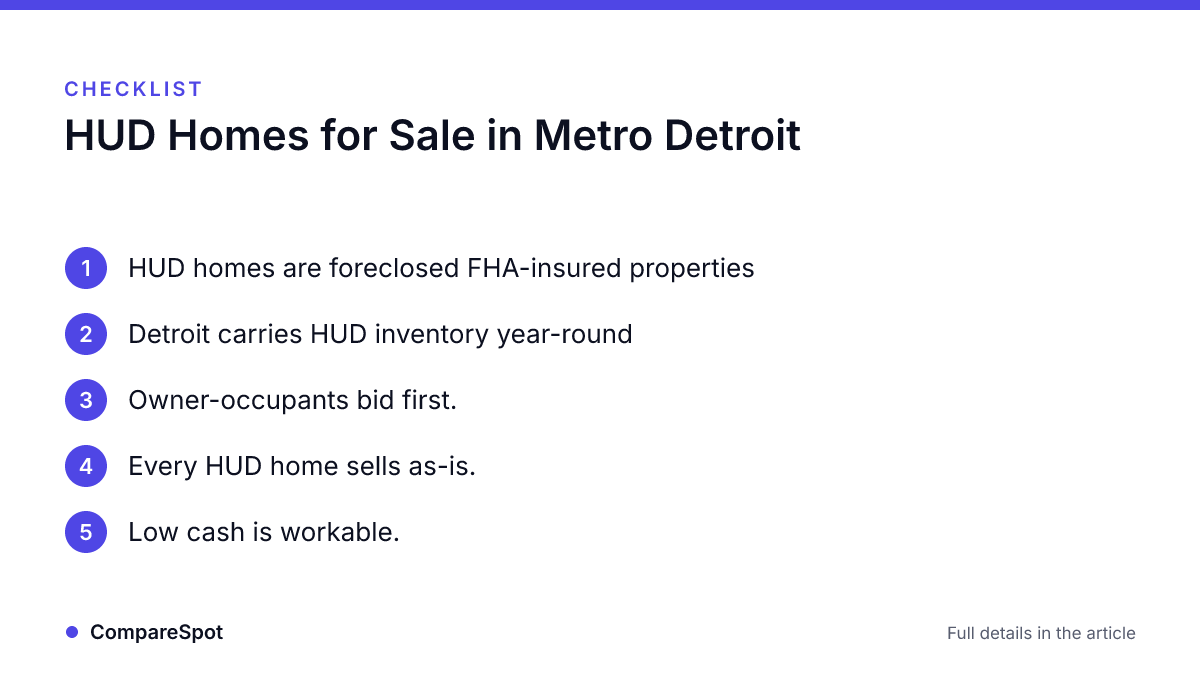
- HUD homes are foreclosed FHA-insured properties resold by the federal government through HUD Home Store and HUD-registered local brokers. You can't call HUD and make an offer; a registered agent submits the bid.
- Detroit carries HUD inventory year-round, clustered in neighborhoods like Bagley, Rosedale Park, University District, and Russell Woods. You can browse the current Detroit list on HUD.com.
- Owner-occupants bid first. Investors are locked out entirely until that exclusive window closes, which is the single biggest reason a first-time buyer can win one of these houses.
- Every HUD home sells as-is. With Detroit's pre-1950 brick bungalows and four-squares, we tell buyers to pencil in 20–25% of the purchase price for repairs before they fall in love with anything.
- Low cash is workable. FHA 203(k) renovation loans, HUD's $100-down program for FHA owner-occupant buyers, and seller-paid closing costs do most of the heavy lifting.
A teacher we'll call Keisha spent three June weekends driving past HUD-owned houses in Bagley and University District before she found the one: a brick bungalow listed at $79,900, dead furnace, kitchen stripped to the studs. She had $6,000 in savings and had never bought a house in her life. She closed anyway. Here's how that works, and what trips people up in Wayne, Oakland, and Macomb County.
Table of Contents
- What exactly is a HUD home?
- What is the best site for foreclosure listings?
- Can you buy a house with HUD Housing?
- How do you buy a foreclosed home with almost no money?
- How much do HUD homes actually sell for?
- What should you budget for repairs on a HUD home in Detroit?
- What's your next move?
- Frequently asked questions
What exactly is a HUD home?
A HUD home is a single-family property that was purchased with an FHA-insured mortgage, went into foreclosure, and is now owned by the U.S. Department of Housing and Urban Development. The agency has no interest in holding real estate. It wants the house back in private hands and the insurance claim closed out, so it lists the property publicly at an appraisal-driven price through its online marketplace and a network of registered brokers.
Detroit sees steady HUD inventory because the city has decades of FHA lending behind it. Listings show up across Boston Edison, Indian Village, Rosedale Park, Corktown, and Midtown, and you can filter HUD-owned properties on Redfin alongside the official list. Before you judge whether a HUD price is actually a bargain, pull the citywide baseline from Redfin's Detroit housing market data and a suburban read from a Metro Detroit housing market report, because Wayne, Oakland, and Macomb don't move in lockstep. What we consistently see: HUD list prices land well below what a renovated comparable sells for on the same block, because the price is written down for condition. That gap is the whole opportunity, and the whole risk.

What is the best site for foreclosure listings?
HUD Home Store is the official source and the only place a bid is actually recorded. Everything else is a mirror. The government interface is dated and clunky to filter, which is why most buyers we work with run it next to two aggregators. HUD.com and Foreclosure.com both keep Michigan-specific pages that are easier to sort by county, and USHUD is free and fine if you're watching one or two zip codes.
Pro tip: Check HUD Home Store first thing in the morning, not at night. New listings and status flips post on the government's clock, and the aggregators lag behind by anywhere from a few hours to a day. In the tighter Detroit pockets, a day is enough to lose the house. Set up alerts on two sites, then verify everything against the official listing before you get excited, because aggregators routinely show homes that already went under contract.
If you're weighing a HUD purchase against a conventional MLS listing, the representation question matters either way. Our breakdown of realtor vs. FSBO walks through those costs, and the same logic applies to the HUD-registered agent who'll be submitting your bid.
Can you buy a house with HUD Housing?
Yes. Anyone can buy a HUD home, but owner-occupants get an exclusive bidding period that investors are shut out of completely. During that window, only buyers who intend to live in the house, plus government entities and approved nonprofits, can submit a bid. Investors wait. If the home goes unsold when the period closes, the listing opens to everyone.
That one rule is why a schoolteacher with $6,000 can beat an LLC with a checkbook. Use it. Sign the owner-occupancy certification honestly, too, because HUD takes it seriously and the penalties for lying about intent are not worth a rental unit.
One point of confusion worth clearing up: HUD housing assistance, meaning Section 8 vouchers and subsidized rentals, has nothing to do with buying a HUD home. Different programs, same three letters. Buying one works like any other purchase. You get financed with conventional, FHA, VA, or cash, your registered agent submits the bid, HUD accepts or counters, and you close.
How do you buy a foreclosed home with almost no money?
You can't do it with zero, but you can do it with far less than the 20% people assume they need.
- The $100-down program: For owner-occupant buyers using FHA financing on eligible HUD properties, the required earnest money drops to a token $100. That doesn't erase closing costs, but it means you're not tying up thousands of dollars at offer time on a house you might not win.
- FHA 203(k) renovation loans: These roll the purchase price and the renovation budget into one mortgage. Since nearly every HUD home needs work, this is the loan that makes the whole category accessible. Our piece on what an FHA loan really costs first-time buyers covers the mortgage insurance you trade away for that flexibility.
- Good Neighbor Next Door: Teachers, firefighters, law enforcement, and EMTs can buy eligible HUD homes in designated revitalization areas at half the list price, with a reduced down payment. Inventory is thin and moves fast, so you have to be watching daily.
- Seller concessions: HUD will approve closing cost credits as part of an accepted bid. Build the ask into your offer rather than hoping to negotiate it later.
Pro tip: Get pre-approved, not pre-qualified, and get it from a lender who has actually funded 203(k) loans in Michigan. The consultant requirement, the draw schedule, and the contractor bid packet derail loan officers who've never done one. Ask the lender directly how many 203(k) files they closed last year. If the answer is vague, call someone else.
If the financing math is where you stall out, our mortgage refinance calculator breakdown shows the amortization arithmetic that applies here too.
How much do HUD homes actually sell for?
HUD prices to appraised value and then reduces the list price in steps the longer a property sits. This is not a courthouse auction where somebody steals a house for $8,000. It's an agency following a pricing schedule.
Here's an illustrative scenario built on the pattern we see repeatedly in Detroit. Keisha's bungalow:
- List price: $79,900
- Winning bid, full price during the owner-occupant window: $79,900
- Repair estimate for furnace, kitchen, and drywall, financed through the 203(k): $22,000
- Total all-in: $79,900 + $22,000 = $101,900
- Renovated comps on nearby blocks: roughly $150,000–$165,000
Call the renovated comp $155,000. Her all-in divided by the comp: $101,900 ÷ $155,000 = 66%. That's the number to care about. Our working threshold is 75%. If purchase price plus honest repair estimate lands under 75% of what finished houses sell for on the same blocks, the deal has enough cushion to absorb a surprise. Above 75%, one bad foundation report wipes out your equity and you're underwater on day one.
Run it on your own numbers: (list price + repair estimate) ÷ renovated comp. Under 0.75, keep going. Over it, walk. Neighborhood-level pages like Homeswipr's Detroit market view are a reasonable gut-check on the comp you plug in, but nothing replaces driving the three blocks around the house.
| Buying path | Price range we typically see in Wayne County | Who it favors |
|---|---|---|
| HUD home, owner-occupant bid | $60,000–$120,000 before repairs | First-time buyers who can manage a renovation |
| HUD home, post-window investor bid | Similar list, often reduced after sitting | Landlords and flippers paying cash |
| Traditional MLS resale, move-in ready | $200,000–$300,000 | Buyers who need to move in next month |
| Off-market cash purchase | Below HUD list, condition usually worse | Experienced rehabbers with crews on call |
For a wider view of what a finished budget buys across the metro, our guide on what $200K buys you in Detroit right now puts those HUD numbers in context.
What should you budget for repairs on a HUD home in Detroit?
Start at 20–25% of the purchase price for anything built before 1950, which covers most of the city's bungalows and four-squares, and get a licensed inspector inside before your bid deadline whenever the schedule allows.
The surprises in Detroit housing stock are predictable once you've seen enough of them:
- Knob-and-tube remnants spliced into later wiring in the attic and second-floor walls. Insurers hate it and many won't bind coverage until it's gone.
- Cast-iron waste stack that looks fine from the basement and is rotted through behind the bathroom wall. Budget for the possibility on any house with original plumbing.
- Frozen or cracked boiler sections in homes that sat vacant through a winter with the utilities shut off. A dead boiler and burst radiator lines can swallow your entire contingency.
- Roof decking, not just shingles. Vacant houses leak for months before anyone notices. Price a tear-off, not an overlay.
- Missing copper. Scrappers hit vacant HUD homes. Walk the basement and check whether the plumbing and the furnace are physically still there.
On Keisha's $79,900 bungalow, 25% is $19,975. Her actual estimate came in at $22,000, slightly over the rule of thumb, which is exactly why she padded the 203(k) draw rather than budgeting to the penny. On a pre-1950 house, assume you'll spend your contingency. Plan for it instead of hoping.
If a property turns out to need gut-level work past what a 203(k) comfortably funds, meaning structure, full systems, or years of accumulation, our guide on selling a hoarder house shows how sellers in that position think about the same repair math from the other direction.
Heirs face a version of this fork too: renovate and hold, or sell as-is. Our piece on who buys an inherited house as-is in Pontiac is useful reading if you want a sense of what a motivated as-is seller will actually take.
What's your next move?
Call a lender this week and ask how many FHA 203(k) loans they closed last year in Michigan. Get a real pre-approval letter from whoever gives you a straight number. Then set alerts on HUD Home Store for your target zip codes, line up an inspector who can be at a property within 48 hours, and start driving blocks on weekends so you already know the comps when a listing hits. If you're still deciding between a HUD purchase and a conventional resale, our 5 signals shaping Detroit's housing market in 2026 covers where prices and inventory are heading.
Frequently asked questions
Do HUD homes come with any warranty on condition?
No. HUD sells as-is, makes no repairs, and warrants nothing. Not the roof, not the furnace, not the appliances if any are still there. Everything you find after closing is yours. That's the entire argument for paying for an inspection before you bid.
How long does it take to close after a bid is accepted?
In our experience most HUD closings are scheduled in the 30-to-60-day range, with cash buyers closing toward the front of that and financed buyers using the full window for underwriting. Extensions are usually available and usually carry a per-diem fee charged to the buyer, so slow lenders cost you real money here.
Do you need a real estate agent, and does it cost extra?
You need one, and it's not optional. Only HUD-registered agents and brokers can submit a bid, so you physically cannot make an offer on your own. The buyer's agent commission typically comes out of the sale proceeds, which means it generally costs you nothing additional at the table. Ask the agent how many HUD bids they've submitted before you sign anything; the bid package has its own quirks and an inexperienced agent will get yours rejected on a technicality.