

TL;DR
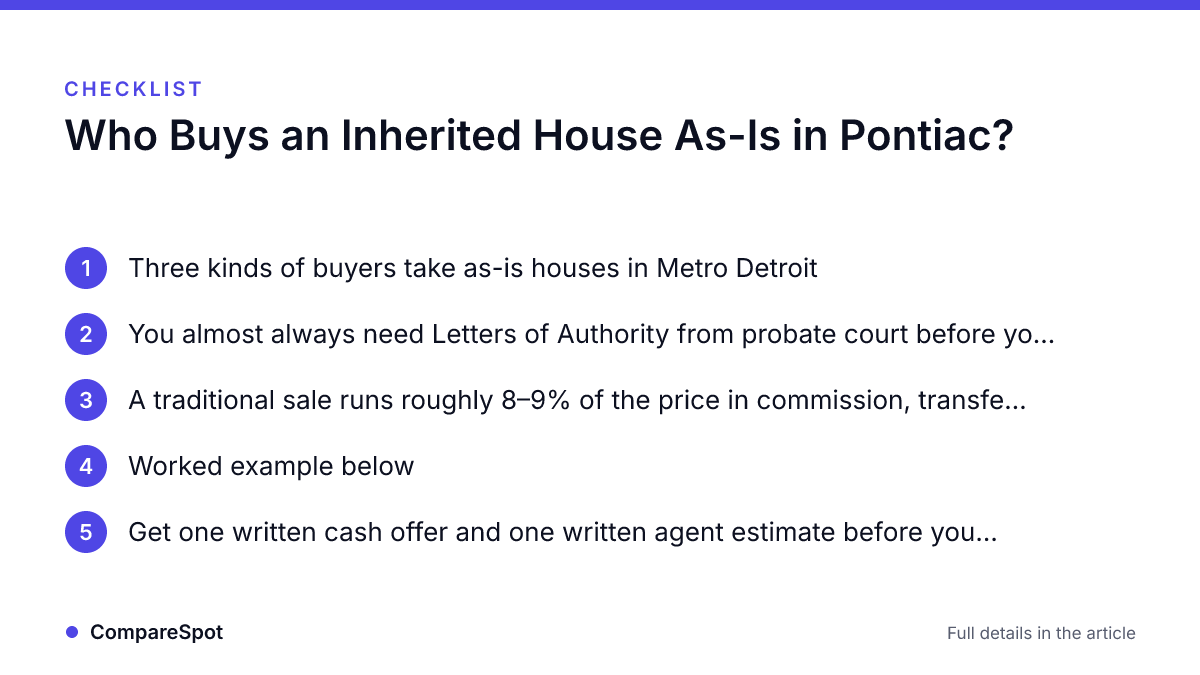
- Three kinds of buyers take as-is houses in Metro Detroit: local cash home-buying companies (7–21 days, offers usually land near 70% of after-repair value minus repair costs), iBuyers like Opendoor (fast, but a service fee in the 5–8% range), and regular buyers through an agent who'll accept as-is condition (closest to market value, 30–45 days).
- You almost always need Letters of Authority from probate court before you can sign a purchase agreement. Budget 4–8 weeks for that step in Wayne, Oakland, and Macomb counties before anything else moves.
- A traditional sale runs roughly 8–9% of the price in commission, transfer tax, and closing costs. On a $180,000 house that's about $14,000–$16,000 off the top, before any repair credit a buyer negotiates.
- Worked example below: a $180,000 as-is house nets about $157,700 through an agent versus about $101,000 from a cash buyer. That $56,700 gap is what speed and certainty cost.
- Get one written cash offer and one written agent estimate before you decide anything. Comparing two real numbers beats comparing a guess to a hope.
Marcus and his sister Dana inherited their mother's brick ranch on the east side of Pontiac last January. Their mom had lived there since 1978. The furnace still worked, mostly. The roof had two soft spots you could feel through your shoes. The panel was original, fuses instead of breakers, and one bedroom hadn't been touched since 1995.
Dana lives in Columbus. Marcus works nights in Sterling Heights. Neither had $20,000 sitting around for a roof and a rewire, and neither wanted to spend six months managing contractors on a house three hours from one of them.
So at 11 p.m. they typed "sell my house" into Google, the way most people in their position do, and got a wall of "we buy any house" ads plus a confusing pile of advice about probate, capital gains, and repair credits. (Names changed. The details come from calls we field constantly.) Here's what the decision actually looks like when you break it into numbers.
Table of Contents
- Who actually buys a house as-is in Metro Detroit?
- What's the timeline for selling an inherited house in Michigan?
- How much does it cost to sell an inherited house, and what do you actually keep?
- How do you price an inherited house that needs work?
- Cash buyer, iBuyer, or agent: which fits your situation?
- Frequently asked questions
Who actually buys a house as-is in Metro Detroit?
Three distinct buyer types, and choosing the wrong one for your situation costs real money.
- Local cash home-buying companies. The "we buy houses" operators on bandit signs and Google ads. They close in 7 to 21 days and price off after-repair value, usually landing somewhere around 70% of it minus their repair estimate. They're buying the risk of everything behind the drywall.
- iBuyers like Opendoor. Algorithm-driven offers, often within a day or two, priced closer to market. The trade is a service fee that typically runs 5% to 8% of the sale price on top of normal closing costs, plus they're picky about condition. A fuse panel and a soft roof can get you declined outright.
- Traditional buyers through an agent who'll accept as-is condition. Best price, slowest path: 30 to 45 days to close, a buyer's inspection, and real risk that financing dies if the house has knob-and-tube wiring, active roof leaks, or structural issues an appraiser flags.
For Marcus and Dana, the fast path meant giving up tens of thousands for speed and zero repair responsibility. The slow path meant more money but months of coordinating showings on a house neither of them lived near. There's no universal right answer. There's the right answer for your timeline, your cash reserves, and how much stress you can absorb.
Pro tip: Before you sign with a cash buyer, run them against our breakdown of common we-buy-houses scams. Legitimate buyers show proof of funds and let you walk away without penalty if a better offer shows up. Pressure to sign within 24 hours, or a contract with no LLC name on it, isn't a bargain. It's a warning.
What's the timeline for selling an inherited house in Michigan?
It starts with probate, not with a listing. If the house wasn't in a trust or titled with a transfer-on-death designation, someone has to petition the probate court to be appointed personal representative. In our experience that takes 4 to 8 weeks across Wayne, Oakland, and Macomb counties, longer if another heir objects or the court is backed up.
Here's how the full timeline tends to break down:
- Open probate and get Letters of Authority (4–8 weeks). This is the document that legally lets you sign a purchase agreement for the estate. Sign without it and the deal isn't enforceable.
- Clean out and assess the property (1–3 weeks). Decades of belongings take longer to sort than anyone expects, especially when siblings disagree about what's worth keeping.
- Pick a lane: repair and list, list as-is, or take a cash offer. If the family isn't aligned, budget a week just for this.
- List or accept an offer. Check current days-on-market for your county on Redfin before you set expectations. Cash buyers compress this to 7 to 14 days.
- Inspection and appraisal (10 to 17 days on a financed deal). This is where as-is inherited houses fall apart most often, because lenders won't fund a house with a failing roof or unsafe electrical.
- Closing. Usually 7 to 10 days after contingencies clear on a financed sale, as little as 3 to 5 days on all cash.
Probate took six weeks for Marcus and Dana. Once they had Letters of Authority, they pulled three cash offers and one agent consultation inside a week. Total time from their mother's passing to money in hand: about eleven weeks. Repair and list would realistically have been four to five months once contractor scheduling got layered on top.
Pro tip: Call the city building department before you list. Several Metro Detroit municipalities require a pre-sale inspection or certificate of occupancy before a transfer records, and finding that out two weeks before closing is how deals slip. Also: keep the utilities on and switch to a vacant-home policy. Standard homeowners coverage often lapses on an unoccupied house, and a burst pipe in February on a shut-off-heat vacancy can wipe out the entire difference between a cash offer and an agent sale.
Spring is generally the strongest selling window here, since warmer weather and melting snow bring out more motivated buyers before summer. If probate pushes you into a January closing, that's one more argument for a cash buyer who doesn't care about curb appeal.
How much does it cost to sell an inherited house, and what do you actually keep?
Plan on roughly 8% to 9% of the sale price in commission, transfer tax, and closing costs, before any repair credit. Let's run it on a $180,000 house, an illustrative number for an older unrenovated ranch. Swap in your own figure and the math works the same.
Traditional agent sale, sold as-is:
- Commission, split between listing and buyer's agent, roughly 5–6%: $9,000–$10,800
- Michigan state and county transfer tax, together typically just under 1%: about $1,500
- Title work, recording, and other closing costs, about 1%: about $1,800
- Repair credit the buyer negotiates after inspection (roof plus panel on a house like this): $8,000–$12,000
Add the midpoints: $9,000 + $1,500 + $1,800 + $10,000 = $22,300. Net to the estate: $180,000 − $22,300 = $157,700.
Cash buyer sale:
Most cash buyers run the same formula: offer = (after-repair value × 0.70) − estimated repairs. With a $180,000 ARV and $25,000 of work:
$180,000 × 0.70 = $126,000. $126,000 − $25,000 = $101,000.
No commission, no transfer tax out of your pocket on most cash deals, no repair credit negotiation. Net to the estate: about $101,000, in hand in 10 to 14 days rather than 8 to 10 weeks.
The gap is $157,700 − $101,000 = $56,700. That's the price of speed and certainty, and it's why we'd never tell every reader to just take the cash. Here's a rule of thumb: divide the gap by the extra months the slow path takes. In this scenario, roughly three extra months means about $19,000 per month of waiting. If that number beats what the delay costs you in stress, carrying costs, and family friction, list it. If it doesn't, take the cash.
| Selling method | Typical timeline | Repairs required | Estimated net on a $180K inherited house |
|---|---|---|---|
| Local cash buyer | 7–14 days | None | ~$101,000 |
| iBuyer (e.g., Opendoor) | 1–3 weeks | Minor only; major defects usually disqualify | ~$140,000–$150,000 |
| Agent, sold as-is with repair credit | 45–75 days | Credit at closing, no physical work | ~$157,700 |
| Agent, after full repairs | 4–6 months | Roof, electrical, paint and floors | ~$165,000–$175,000 |
Pro tip: Ask an agent what buyers in your specific ZIP are actually demanding in inspection negotiations. In parts of Pontiac and Detroit, buyers take as-is with a price adjustment and move on. In move-in-ready suburban pockets of Oakland and Macomb, they walk rather than inherit deferred maintenance. Our realtor vs. FSBO breakdown covers what leverage you hand away by skipping an agent.
How do you price an inherited house that needs work?
Start with closed comps in the same condition category. Not the Zillow estimate, not what your parents paid in 1978, and definitely not the flip three doors down with quartz counters.
- Pull condition-matched comps. Three to five closed sales in the last 90 days, within a half mile, filtered for as-is condition. A useful shortcut: ask an agent to pull sales financed with cash or hard money. Those are almost always the distressed ones, and they tell you what an investor will actually pay on your street.
- Get a contractor through the house before you set a number. Even if you're not doing the work. Knowing the roof quote is $9,000 and the panel upgrade is $4,500 means you can price with authority instead of getting talked down by someone waving vague repair estimates at you.
- Check the tax and water situation first. Delinquent summer and winter taxes, an unpaid water bill that attaches to the property, or a land bank lien all come out of proceeds at closing. Pull the tax record before you agree to a number, not after.
- Get both offers in writing before you choose. One cash number and one agent's net-sheet estimate, on paper, same week.
Regional numbers only take you so far here. Market reports built on Realcomp MLS data will tell you how Oakland, Macomb, and Wayne counties compare on median price, and the spread between them is enormous. A house in Grosse Pointe Park and an identical one in a soft pocket of Pontiac can differ by six figures with the same square footage and the same bad roof. Price to the block, not the county.
If you want a sanity check on where your number lands against what buyers are choosing between, our breakdown of what $200K buys in Detroit right now is a fast gut check.
Cash buyer, iBuyer, or agent: which fits your situation?
It comes down to how badly you need money now versus how badly you need the maximum price. There's no clever way around that trade.
- Choose a cash buyer if the house needs major work you can't front, heirs live in different states, or the estate needs funds inside 30 days to cover taxes, debts, or a funeral bill.
- Choose an iBuyer if the house is in decent shape, you want speed with better pricing than a local investor, and you're fine with an algorithm instead of a negotiation. Be realistic: a fuse panel and two soft roof spots will likely get you declined.
- Choose a traditional agent if you can wait 60 to 90 days, the house sits in a pocket of Oakland or Macomb where demand and days-on-market both favor sellers, and price matters more than calendar.
One thing that trips people up: with multiple heirs, whoever is personal representative signs, but everyone else needs to agree in advance or the deal stalls at the worst moment. Get written sign-off from your siblings on a minimum acceptable number before you invite offers.
Not sure you're even comparing the right buyer types? Our guide on iBuyers vs. cash buyers lays the fee structures side by side, and the agent vs. broker explainer helps sort out who's actually representing you once you decide to list.
Marcus and Dana took a $103,000 cash offer that closed in twelve days. They paid off their mother's delinquent property taxes and a small equity loan, then split the rest. It wasn't the biggest number on the table. It was the number that let them stop babysitting a house neither of them could reach.
Frequently asked questions
Do I have to pay capital gains tax on an inherited house in Michigan?
Usually very little. Inherited property generally gets a step-up in basis to its fair market value on the date the original owner died, so you're taxed on appreciation after you inherit, not on decades of gain since 1978. Talk to a CPA or estate attorney before closing, because the math shifts depending on how the estate is structured and how long you hold the property.
Can I sell a house that's still in probate?
You can sign a purchase agreement once you hold Letters of Authority as personal representative. In plenty of cases the court still wants notice to other heirs or formal approval before the sale finalizes, particularly when the will doesn't explicitly grant power to sell real estate. One conversation with an estate attorney will tell you which bucket your case falls in.
What if my siblings and I can't agree on whether to sell?
Any single heir can typically petition the probate court to force a sale, sometimes called a partition action, though it's slower and far more expensive than working it out. Cheaper approach: get everyone on one call with an actual written offer in front of them. A real number resolves arguments that abstract debate never will.
If you're where Marcus and Dana were, with an inherited house, a deadline you didn't pick, and three very different offers, do two things this week. Start the probate petition, because nothing else can legally happen until Letters of Authority are in hand. Then request one written cash offer and one agent net-sheet estimate so you're weighing real dollars against real dollars.