

TL;DR
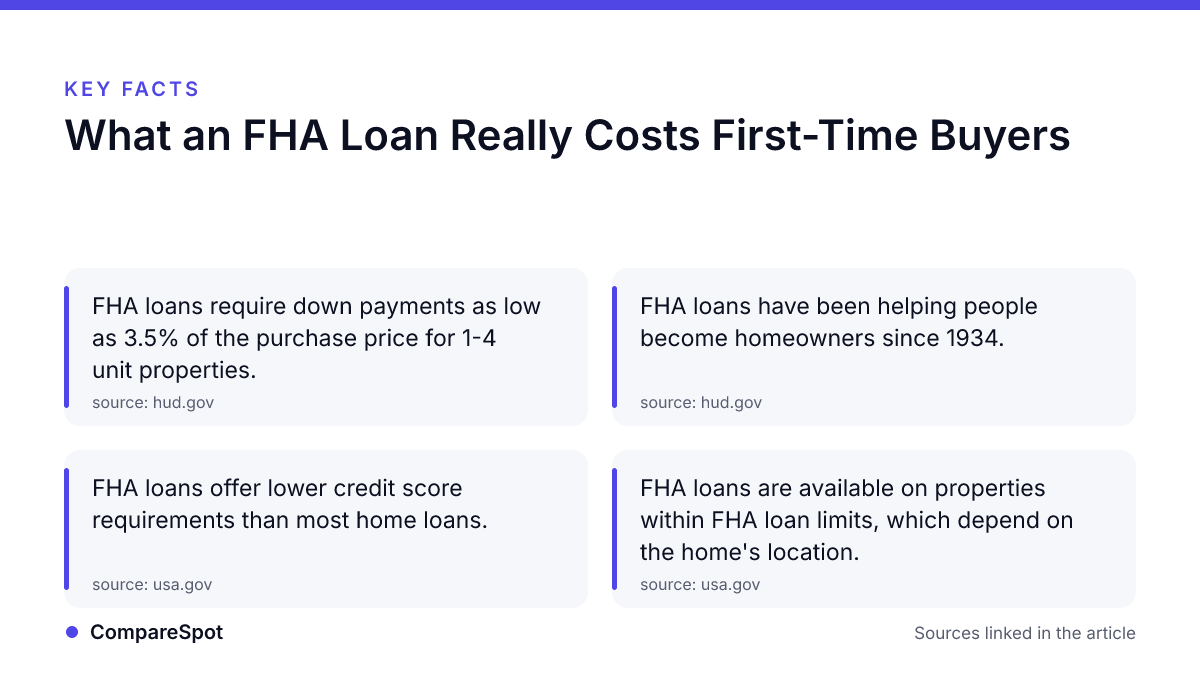
- Down payment: FHA loans require as little as 3.5% down on 1-4 unit properties, not the 20% most first-time buyers assume they need.
- Credit score: Most FHA-approved lenders want a 580 for the 3.5% down tier. Scores from 500-579 can still work, usually at 10% down and with far fewer lenders willing to take the file.
- Debt-to-income: Plan on a total DTI at or below 43%. Some lenders stretch to 50% if you bring cash reserves or a high score.
- Mortgage insurance: You pay an upfront premium (normally financed into the loan) plus a monthly premium for the life of most FHA loans. That's the price of the low down payment.
- Income for a $300k house: Roughly $67,000 to $94,000 in household income depending on your rate, taxes, and DTI cap. The full arithmetic is below so you can re-run it with your own numbers.
An FHA loan is a mortgage insured by the Federal Housing Administration, which lets lenders offer lower down payments, lower credit minimums, and looser qualifying rules than most conventional loans. The program has been doing this since 1934, and it's still the most accessible path to a house for Metro Detroit buyers without 20% sitting in savings or with a few dings on their credit report. The appeal fits in one sentence. The actual cost hides in the details most articles skip: your real credit cutoff, your real DTI math, and what mortgage insurance quietly adds every month.
Table of Contents
- What credit score do you actually need?
- Do you have to put 20% down on an FHA loan?
- How much do I need to make to buy a $300k house with an FHA loan?
- What disqualifies you from an FHA loan?
- Is an FHA loan good for a first-time buyer?
- What down payment assistance is available to first-time buyers in Metro Detroit?
- Frequently asked questions
What credit score do you actually need?
You don't need pristine credit, but your score sets your down payment. A 580 or higher gets you the 3.5% down tier that makes the program worth using. In the 500-579 range you can often still qualify, but expect to put 10% down and expect a much shorter list of lenders who'll touch it. FHA loans carry lower credit score requirements than most home loans, which is why they dominate first-time buyer searches. "Lower requirements" from HUD doesn't mean every lender in Metro Detroit sets their bar at the federal floor.
- 580+ credit score: Qualifies for the standard 3.5% down payment.
- 500-579 credit score: Still eligible in most cases, but expect a 10% down payment and a smaller pool of participating lenders.
- Below 500: Generally disqualifying for FHA financing, no matter how much you put down.
Pro tip: Most banks and credit unions add an internal "overlay" on top of FHA's published minimums. They advertise FHA loans and then require a 620 behind the scenes. If one lender declines you at 585, that's their credit policy talking, not an FHA rule. Ask each loan officer point blank: "What's your minimum FICO for FHA, not HUD's?" You'll get three different answers from three lenders, and the spread is worth real money.
Do you have to put 20% down on an FHA loan?
No. The minimum is 3.5% of the purchase price for buyers at a 580 or above, on properties within the FHA loan limits for the county. The 20% number gets stapled onto FHA loans by mistake, because 20% is the conventional threshold for skipping private mortgage insurance. FHA works differently. You pay mortgage insurance regardless of how much you put down, which is covered further down. If you're weighing the two side by side, our FHA vs. conventional breakdown walks through which one actually costs less over the years you plan to stay.
How much do I need to make to buy a $300k house with an FHA loan?
Here's the math, start to finish. Illustrative scenario only: a $300,000 purchase, 3.5% down, 7% on a 30-year fixed.
Down payment: $300,000 × 3.5% = $10,500. Financed amount: about $289,500. Principal and interest on that comes to roughly $1,926 a month. Add property taxes, homeowners insurance, and the monthly FHA mortgage insurance premium, and a realistic all-in housing payment lands near $2,400.
Now apply the ratio. Most lenders want your housing payment at or under 31% of gross monthly income:
$2,400 ÷ 0.31 = $7,742 per month, or about $93,000 a year.
If the lender underwrites to the total-debt side instead, allowing housing plus car notes, student loans, and credit card minimums up to 43% of gross income, and housing is your only debt:
$2,400 ÷ 0.43 = $5,581 per month, or about $67,000 a year.
That's your working range: $67,000 to $94,000 of household income for a $300,000 FHA purchase at a 7% rate. Every $500 a month in existing debt payments pushes the top of that range up by roughly $14,000 in required annual income, so paying off a car loan before you apply often does more for your approval than another six months of saving.
| Illustrative scenario, $300,000 purchase at 7% | 3.5% down | 10% down |
|---|---|---|
| Cash down payment | $10,500 | $30,000 |
| Financed amount | $289,500 | $270,000 |
| Principal and interest | $1,926/mo | $1,796/mo |
| Minimum credit score typically needed | 580 | 500 |
| Lender availability | Wide | Limited; expect to call around |
| Monthly MIP for the life of the loan | Yes | Yes |
What disqualifies you from an FHA loan?
Five things stop FHA applications cold, no matter how good the rest of the file looks:
- A DTI that's too high with nothing to offset it. Flexible underwriting still has limits, and the limit tightens as your credit score drops.
- Recent bankruptcy or foreclosure inside FHA's waiting periods. The clock differs by bankruptcy chapter and by how you've rebuilt credit since.
- The property failing FHA's minimum property standards. Appraisers in Wayne County flag peeling paint on pre-1978 homes, missing stair handrails, exposed wiring, and inoperable furnaces all the time.
- The home falling above the county loan limit. Caps depend on location, so a purchase price that clears in one part of Metro Detroit may not clear in another.
- Delinquent federal debt, such as a defaulted student loan, that hasn't been resolved or placed in an acceptable repayment plan. This one surfaces in CAIVRS, and it stops the file at underwriting even if your credit score looks fine.
Pro tip: Get in front of appraisal repairs before you write the offer. Walk the house looking for the cheap stuff that fails: no handrail on the basement stairs, a cracked window pane, a missing GFCI outlet near a sink. On a vacant or as-is listing, the seller often won't fix anything, so you'll need the repair escrow conversation before inspection, not after. Buyers shopping that tier should read our what $200K buys you in Detroit right now guide to see which condition issues show up repeatedly across Wayne, Oakland, and Macomb.
Is an FHA loan good for a first-time buyer?
For most Metro Detroit first-timers, yes, with one caveat: treat it as the loan that gets you in the door, not the loan you keep for 30 years. FHA insures the lender's risk, and that insurance is what buys you the lower down payment and lower closing costs. You pay for it twice. Once upfront, usually financed into the balance instead of paid in cash at closing. Then monthly, on top of principal and interest, for most or all of the loan's life. Buyers who put less than 10% down can't cancel that premium by building equity. They refinance out of it.
The other thing nobody warns you about: some listing agents in competitive Oakland County submarkets quietly discount FHA offers because they're worried about the appraisal standards. Have your agent attach a strong pre-approval letter and, if the house is in decent shape, say so in the offer cover. It costs nothing and it defuses the objection before it's raised.
If you're still deciding whether to buy at all right now, our rent vs. buy in Detroit piece runs that comparison with current local numbers. When you're ready to line up representation, our agent vs. broker guide explains who you actually want on your side during an FHA purchase.
What down payment assistance is available to first-time buyers in Metro Detroit?
You aren't limited to scraping together the 3.5% yourself. The Michigan State Housing Development Authority runs down payment assistance for eligible first-time buyers statewide, and several Metro Detroit municipalities, including Detroit-specific programs, stack local grants or forgivable loans on top.
Two practical things most articles leave out. First, DPA usually arrives as a second lien recorded at closing, not a check, and it changes your payoff math if you sell or refinance in the first few years. Ask what triggers repayment. Second, not every FHA lender is approved to originate the state program. Confirm that before you're three weeks into underwriting, because switching lenders mid-contract on a 30-day close is how deals die. Income caps, funding availability, and terms all shift year to year, so verify current numbers with a participating lender or your local housing authority rather than trusting last year's blog post.
Frequently asked questions
How long do I have to wait after a foreclosure to get an FHA loan?
FHA generally requires a multi-year waiting period after a foreclosure. The timeline can be shortened if you document extenuating circumstances such as a job loss or medical hardship, and show rebuilt credit since.
Can I use an FHA loan on a fixer-upper?
Yes, though a standard FHA loan requires the home to meet minimum property standards at closing. For a house needing real work, look at the FHA 203(k) rehabilitation loan, which folds renovation costs into the mortgage instead of demanding a move-in-ready property.
Does FHA mortgage insurance ever go away?
On most FHA loans originated with less than 10% down, the monthly premium stays for the life of the loan. The usual exit is refinancing into a conventional mortgage once you've built enough equity.
Get written estimates from three FHA-approved lenders in the same week, and compare them line by line: rate, credit overlay, lender fees, and the upfront MIP figure. The spread between the best and worst quote is bigger than most first-time buyers expect, and it's the one number in this whole process you fully control.