

TL;DR
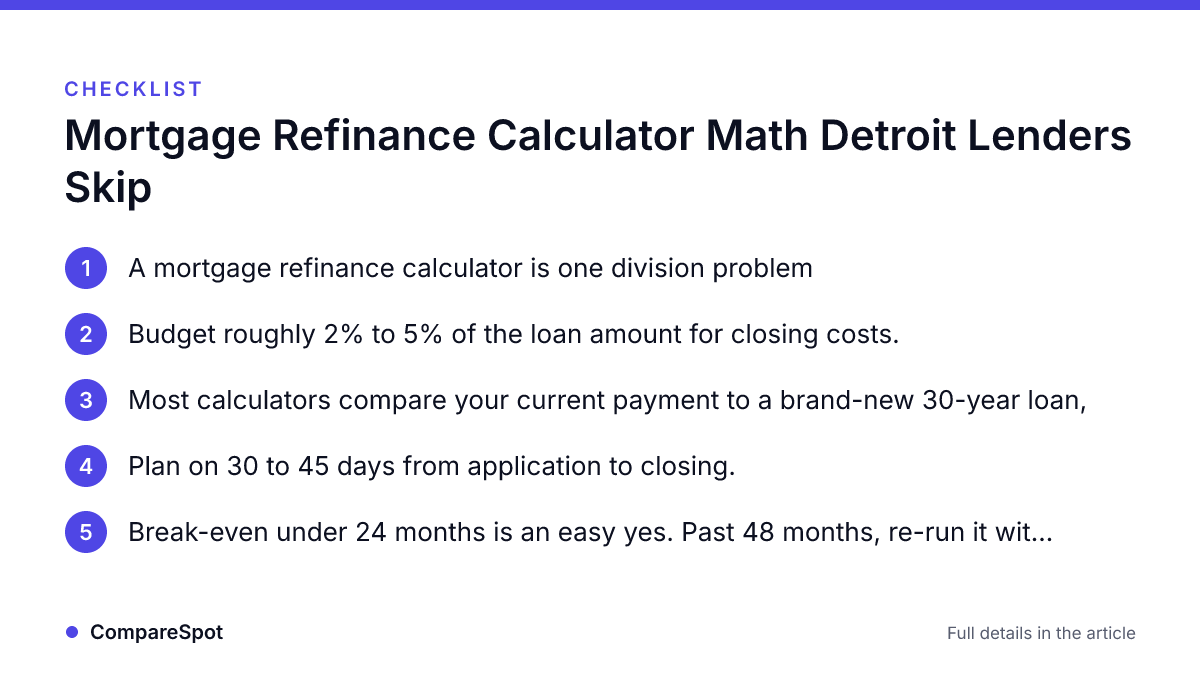
- A mortgage refinance calculator is one division problem: total closing costs ÷ monthly payment savings = your break-even month. For most Metro Detroit refinances in the $200K–$300K range, we typically see break-even land somewhere between two and four years.
- Budget roughly 2% to 5% of the loan amount for closing costs. On a $300,000 refinance that's usually $6,000 to $15,000. On a $100,000 loan the same work costs $2,500 to $5,000, because appraisal, title, and recording fees barely move with loan size.
- Most calculators compare your current payment to a brand-new 30-year loan, which quietly hides the fact that you're restarting the amortization clock. Compare total interest, not just the monthly number.
- Plan on 30 to 45 days from application to closing. The appraisal and underwriting document requests are where almost every delay comes from.
- Break-even under 24 months is an easy yes. Past 48 months, re-run it with a lender-credit ("no-cost") quote before you write the idea off entirely.
A mortgage refinance calculator answers one question: how many months of lower payments does it take to cancel out what you paid to get that lower payment? That's your break-even point. Save $175 a month, pay $5,250 in closing costs, and you break even in 30 months (5,250 ÷ 175 = 30). Stay past that and you're ahead. Sell in month 20 and you paid $5,250 to save $3,500.
Bankrate's tool, Fannie Mae's tool, your credit union's tool. They're all running that same division behind a nicer interface.
Table of Contents
- How much does it cost to refinance a $300,000 home?
- How much does it cost to refinance a $100,000 mortgage?
- How do you find your break-even point on a refinance?
- What should Michigan borrowers know about refinance pricing right now?
- Which refinance calculator should you actually use?
- What happens during the refinance process, from application to closing?
- Next step
- Frequently asked questions
How much does it cost to refinance a $300,000 home?
Plan on $6,000 to $15,000 to refinance a $300,000 mortgage in Michigan. Most of the closing disclosures we see for loans that size land in the $8,000 to $9,500 zone once title work, lender fees, and the appraisal are all on the page. Closing costs generally run 2% to 5% of the loan amount, and they're made of the same handful of line items every time:
- Loan origination fee. Usually 0.5% to 1% of the loan. This is the line most open to negotiation, especially if you have a competing loan estimate in hand.
- Appraisal fee. Expect $450 to $700 across most of Wayne, Oakland, and Macomb counties. Larger homes and properties out past the suburban ring run higher, and rural appraisals also take longer to schedule.
- Title search and title insurance. Often the single biggest chunk at $1,000 to $2,500. Ask your title company about a "reissue rate" if your current policy is only a few years old. Plenty of borrowers never ask and never get it.
- Recording fees and transfer taxes. Set at the county level, typically a few hundred dollars on a refinance.
- Prepaid interest and escrow setup. Not really a cost, more a timing shuffle, but it inflates the number at signing by a few thousand dollars. Your old escrow balance gets refunded separately, usually within about a month of payoff. A lot of people forget that check is coming and assume they're out the money for good.
Pro tip: Ask every lender to quote you twice, once standard and once with a lender credit. A lender credit trades a slightly higher rate for lower or zero upfront closing costs. If you're only planning to be in the house another five years, that trade often wins even when the rate looks worse on paper.
How much does it cost to refinance a $100,000 mortgage?
Refinancing a $100,000 mortgage typically runs $2,500 to $5,000, and the percentages work against you. Appraisal, title, and recording costs are roughly flat no matter the loan size, so the same $3,000 bill that's 1% of a $300,000 loan is 3% of yours. Smaller balances almost always sit at the ugly end of the 2%–5% range.
That's the whole reason a tight break-even calculation matters more on a smaller loan, which is exactly the situation in a lot of Detroit neighborhoods where home values sit well under $200,000. If you want a sense of what today's price points actually buy in square footage and location, our guide on what $200K buys you in Detroit right now is a useful gut check before you decide whether a small-balance refinance is worth the paperwork at all.
For loans under about $125,000, we'd point most people toward a no-closing-cost structure first. The dollar savings you're chasing are modest, and eating $4,000 upfront to save $70 a month is a five-year commitment you may not want to make.
How do you find your break-even point on a refinance?
Divide your total closing costs by your monthly savings. The result is the number of months until the refinance pays for itself. Here it is worked all the way through so you can swap in your own numbers.
The scenario: A Sterling Heights homeowner owes $220,000 on a 30-year mortgage at 7.25%. Their lender quotes a new 30-year loan at 6.10% with $5,400 in closing costs.
Step 1. Find the old payment. $220,000 at 7.25% over 30 years is about $1,501/month in principal and interest.
Step 2. Find the new payment. $220,000 at 6.10% over a fresh 30 years is about $1,333/month.
Step 3. Subtract. $1,501 − $1,333 = $168 in monthly savings.
Step 4. Divide. $5,400 ÷ $168 = 32.1 months, or a little under two years and nine months.
Stay past month 32 and every payment after that is money in the bank. Planning to list the house within two years? The refinance loses. If a move is genuinely on the table, our rent vs. buy in Detroit breakdown is a better starting point than a rate quote.
One thing that worked example doesn't show: this homeowner just restarted a 30-year clock. If they were eight years into the old loan, they're now paying for 38 years total. The monthly savings are real. The lifetime interest savings might not be.
| Loan amount | Typical closing costs | Illustrative monthly savings (≈1.15-pt rate drop) | Break-even range |
|---|---|---|---|
| $100,000 | $2,500 – $5,000 | $60 – $85 | 35 – 55 months |
| $200,000 | $5,000 – $9,000 | $120 – $170 | 30 – 45 months |
| $300,000 | $6,000 – $15,000 | $180 – $250 | 28 – 45 months |
| $400,000 | $8,000 – $17,000 | $240 – $335 | 28 – 42 months |
Figures above are illustrative planning ranges based on the deals we see, not quotes.
Pro tip: Under 24 months, refinance and don't overthink it, assuming you're staying put. Past 48 months, re-run the numbers with a lender-credit option before walking away. A slightly higher rate at zero upfront cost frequently beats a lower rate with a five-year payback, especially when you're not certain how long you'll stay.
What should Michigan borrowers know about refinance pricing right now?
Pricing comes down to three things: term, credit score, and loan-to-value. Fifteen-year fixed refinances price below 30-year fixed, generally by something in the half-point to full-point neighborhood. Scores above 740 with an LTV under 80% get the sharpest pricing available. Drop below roughly 680, or push above 90% LTV, and the quotes get noticeably worse.
A few patterns worth knowing before you start calling lenders:
- The 15-year payment shock is bigger than people expect. A lower rate does not offset a halved term. Run the actual payment before you fall in love with the interest savings.
- Cash-out pricing is not rate-and-term pricing. Lenders price cash-out higher because pulling equity raises their risk. Don't compare a cash-out quote from one lender against a straight rate-and-term quote from another and conclude one of them is cheap.
- FHA and VA streamlines often skip the full appraisal, which cuts both days and a few hundred dollars off the bill. Worth asking about if your current loan is FHA or VA and you're not taking cash out. If you're still sorting out which loan type fits, our FHA vs. conventional comparison covers the tradeoffs.
- Rate lock extensions cost real money. Locks typically run 30 to 60 days, and if your file drags past the expiration, the lender will charge you a fraction of a point to extend. This is why an appraisal scheduled three weeks out is a pricing problem, not just a scheduling one.
- Big-bank pricing isn't automatically best pricing. National lenders offer convenience and sometimes relationship discounts. On a plain vanilla refinance, a Michigan credit union or independent lender frequently beats them on rate, fees, or both. Get at least one credit union quote in the mix.
According to Bankrate's refinance calculator, the rate you're quoted is only half the equation. The calculator's real job is forcing you to compare that rate against your break-even timeline instead of just admiring the number. Fannie Mae's mortgage refinance calculator frames it differently, showing amortization changes side by side, which is the better tool if you want to see lifetime interest rather than the monthly figure.
Which refinance calculator should you actually use?
Not every result on a "mortgage refinance calculator" search answers the same question. Use the wrong one and you get a number that doesn't describe your loan.
- A basic refinance calculator is fine for a first pass: new payment versus old payment, nothing more. Good for deciding whether to bother making phone calls.
- A cash-out refinance calculator, like the one from United FCU, accounts for the equity you're pulling and recalculates your LTV. Use this one if you're funding a renovation or consolidating debt, because a basic calculator will understate your new rate.
- A calculator with taxes and insurance gives you the full PITI payment. This matters a lot in Michigan, where millage rates swing hard between municipalities. A move from one suburb's tax bill to another's can change your housing payment more than a half-point rate difference does. Worth saying plainly: refinancing does not uncap your taxable value the way a sale does. There's no transfer of ownership. We get asked that constantly.
- A 15-year calculator should show total interest over the full term, not just the monthly payment. That's the entire argument for the shorter term.
- A free calculator that doesn't ask for personal information lets you run scenarios before your phone number enters a lead system. Once you submit contact info to a rate-comparison site, expect calls for weeks.
Pro tip: Run your numbers on two tools before you talk to anyone. Landmark Credit Union's refinance calculator and Fannie Mae's tool assume different default closing costs, so the gap between their answers gives you a realistic range instead of one optimistic figure. Whatever a lender's own calculator tells you, treat it as the best-case version.
What happens during the refinance process, from application to closing?
Most refinances take 30 to 45 days and move through six stages. Knowing the sequence tells you where the delays live.
- Application and rate shopping. You submit income, debts, and current balance to several lenders and collect initial quotes. Do this inside a couple of weeks so the credit inquiries cluster together.
- Pre-approval. The lender pulls credit, verifies pay stubs, tax returns, and bank statements, and issues a conditional approval. This is real underwriting, not a rate quote, and it's the same process a first-time buyer goes through.
- Rate lock. You lock for a set window, usually 30 to 60 days. Lock too early and you may pay to extend. Lock too late and a rate move eats your savings.
- Appraisal and underwriting. The lender orders the appraisal, then underwriting reviews the whole file. This is where nearly every delay happens, usually a document request you answered incompletely the first time. Send the full statement, all pages, including the blank one that says "this page intentionally left blank."
- Closing disclosure review. Federal rules require you to have the closing disclosure three business days before signing. Read it line by line against your original loan estimate. Junk fees hide in the gap between those two documents, nowhere else.
- Closing. You sign, the old loan is paid off, the new one takes effect. Primary residences get a three-business-day right of rescission after signing, so funds don't disburse immediately.
If you're weighing refinancing against just selling, our piece on when to sell in Detroit covers the market-timing side. And if you're behind on payments, read our short sale Michigan guide before assuming refinancing is still on the table. Lenders won't refinance a loan that's already delinquent.
Next step
Pull your current mortgage statement and write down two numbers: exact remaining balance and exact interest rate. Run them through two calculators, one from a lender and one independent like Fannie Mae's or Landmark's, and write down the break-even month each gives you.
If that month comes well before the date you'd realistically move, start collecting loan estimates from three Michigan lenders, including at least one credit union. Compare the estimates page by page, not the advertised rates.
Frequently asked questions
Does refinancing hurt your credit score?
You'll usually see a small, temporary dip from the hard inquiry and the new account on your report. Shopping several lenders inside a short window counts as a single inquiry under most scoring models, so applying to four lenders in two weeks costs you roughly what applying to one does. Spreading those applications across three months does not.
Can you refinance with less than 20% equity?
Yes, but you'll likely carry private mortgage insurance on a conventional refinance above 80% LTV, and many lenders cap conventional refinances in the 95%–97% range. FHA and VA programs are more flexible on equity, so a conventional denial based purely on LTV isn't the end of the conversation.
Is a mortgage pre-approval the same as refinance approval?
No. A pre-approval tells a seller how much a lender will lend you toward a purchase. A refinance approval evaluates your existing home's current appraised value against the new loan amount. Both underwrite your income and credit, but the documentation and the appraisal requirements are different.