
TL;DR
- "Real estate agent" and "Realtor" are not interchangeable. A Realtor pays dues to the National Association of REALTORS and completes 2.5 extra hours of Code of Ethics training every three years. A licensed agent who skips membership doesn't.
- On a $300,000 sale at a 5% total commission, each side's agent grosses about $7,500 and takes home roughly $5,250 after a 70/30 broker split. Full arithmetic below so you can run your own price.
- Price point changes agent behavior. The same 5% on a $100,000 house produces about $2,500 per side before the brokerage cut, which is why marketing effort varies so much across Metro Detroit.
- Michigan licensing requires approved coursework, the state exam, a background check, and a sponsoring broker who agrees to hold your license. Nobody sells solo on day one.
- The best vetting tool is a phone call. Ask for the agent's last six closed sales, then call two of those sellers and ask if they'd hire the agent again.
Most articles about real estate agents read like a glossary. Useful if you're cramming for the licensing exam. Useless if you're standing in a Sterling Heights kitchen next month deciding who gets your listing, or sorting out an inherited house in Oakland County and wondering whether you need an agent at all.
This is the version for the person making that decision.
Table of Contents
- What's the real difference between a Realtor and a real estate agent?
- How much does a real estate agent make on a $300,000 house?
- What does it actually take to become a licensed agent in Michigan?
- How do you choose the right agent for a Metro Detroit sale?
- When does a broker, attorney, or cash buyer make more sense than an agent?
- Frequently asked questions
What's the real difference between a Realtor and a real estate agent?
Every Realtor is a licensed agent. Not every licensed agent is a Realtor.
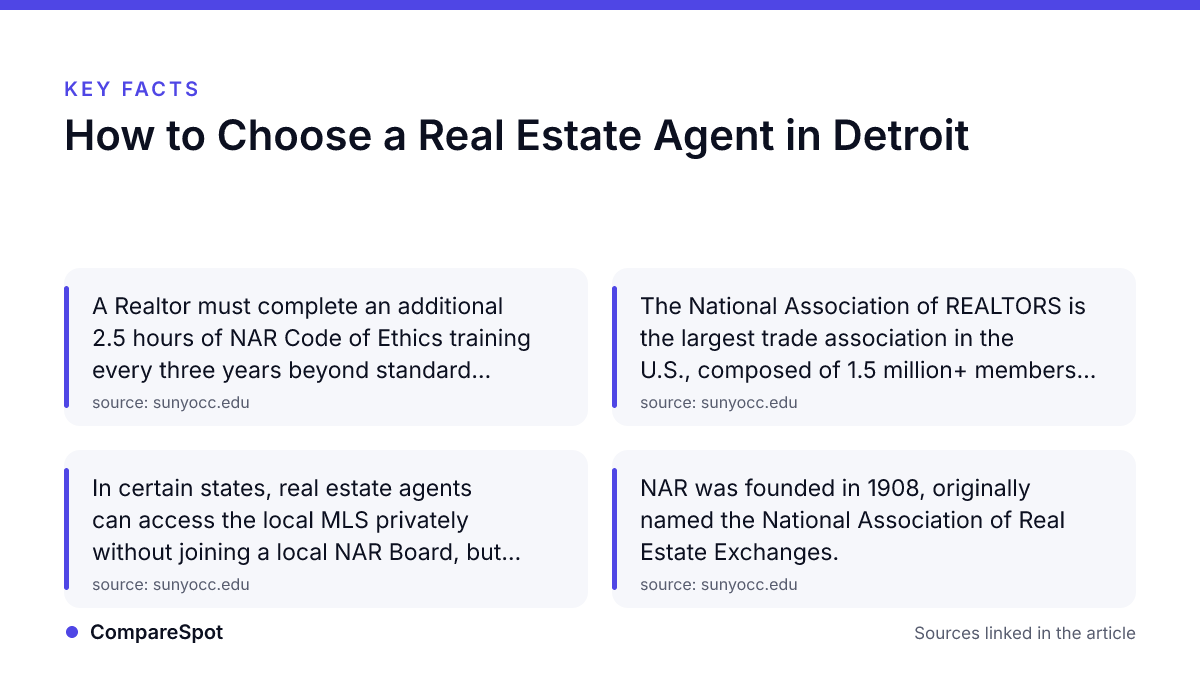
"Realtor" is a trademarked title reserved for members of the National Association of REALTORS (NAR), the largest trade association in the country with more than 1.5 million members: brokers, agents, appraisers, and property managers. To use the title, an agent joins NAR and their local board, agrees to the Code of Ethics, and completes 2.5 additional hours of ethics training every three years on top of whatever the state already requires.
There's an MLS wrinkle worth understanding. In some states, agents can get private access to the local MLS without joining a NAR board at all. NAR members, on the other hand, are required to join their local board to get that access.
| Term | What it actually means | Source |
|---|---|---|
| Real estate agent | State-licensed to help buy, sell, or lease property; no ethics-code obligation | Investopedia |
| Realtor | An agent or broker who pays NAR dues and follows its Code of Ethics | SUNY Occ |
| Real estate broker | Completed licensing beyond agent level; can operate independently or supervise agents | Investopedia |
| NAR | Trade group founded in 1908 as the National Association of Real Estate Exchanges; 1.5M+ members today | SUNY Occ |
Don't reject an agent purely because they aren't a Realtor. Some of the sharpest listing agents we've dealt with in Wayne and Macomb counties skip the membership and pay for MLS access another way. Just ask the question so you know what you're buying.
Deciding whether you want a listing agent at all? Our breakdown of Realtor vs. FSBO covers what you give up going alone. And if the person across the table calls themselves a "broker," our agent vs. broker guide explains the extra licensing behind that word.
How much does a real estate agent make on a $300,000 house?
Run the math yourself. It takes four steps, and commissions are negotiable at every one of them.
- Total commission = sale price × rate. $300,000 × 5% = $15,000.
- Split between the listing side and the buyer's side. $15,000 ÷ 2 = $7,500 each.
- Apply the brokerage split. Many agents are on 70/30 or 80/20 with their broker. At 70/30: $7,500 × 0.70 = $5,250.
- Subtract the agent's own costs. Photography, signage, print, sometimes staging, plus a per-transaction fee at many brokerages. In our experience that's a few hundred dollars up to a couple thousand on a well-marketed listing.
Now drop the price and watch what happens. An illustrative $100,000 Detroit sale at the same 5% rate creates a $5,000 pool. Split two ways, that's $2,500 per side. At 70/30, the listing agent nets $1,750 before spending a dime on photos. Same paperwork, same inspection repairs, same three showings that no-show.
That gap is the honest reason a $500,000 Grosse Pointe listing gets drone video and a Sunday open house while a modest bungalow on the east side gets a cell phone photo and a sign in the yard. It isn't a character flaw in any individual agent. It's arithmetic you should understand before you sign, because Detroit price points span an enormous range depending on the neighborhood you're in, which you can see in current Detroit housing market data. Corktown near the Michigan Central Station redevelopment prices nothing like a block two miles away.
Pro tip: if your house is on the higher end for your zip code, ask for a tiered commission. Something like a lower rate at your target price and a bump if the agent beats it by 5%. Agents almost never volunteer this, and plenty will take it.
What does it actually take to become a licensed agent in Michigan?
You need state-approved pre-licensing coursework, a passing score on the Michigan salesperson exam, a background check, and a sponsoring broker willing to hold your license. Until that last piece is in place, the license does nothing.
- Pre-licensing coursework. Real estate law, agency relationships, contracts, and fair housing. Most people knock it out online in a few weeks.
- The state exam. A national portion and a Michigan-specific portion. The state section is where people fail, because it covers Michigan land contracts and disclosure rules that the national prep material glosses over.
- Background check and application through the state's licensing division.
- A sponsoring broker. Every salesperson license hangs under an active broker. New agents usually discover at this stage that the brokerage charges desk fees, technology fees, and errors-and-omissions insurance whether or not they close anything.
- NAR and local board membership, optional. This is the step that converts "agent" to "Realtor" and ties into local MLS access.
- Building a pipeline. Referrals, open houses, and paid lead platforms, in that order of quality.
Here's what none of that guarantees. Licensing doesn't teach an agent that a house in Indian Village needs a Certificate of Appropriateness from the Historic District Commission before anyone touches the windows, or how to handle a delinquent water balance that follows the property to closing, or which title companies in Wayne County actually clear a tax foreclosure history without stalling the deal for six weeks. Ask about those things. Licensing is the floor.
How do you choose the right agent for a Metro Detroit sale?
Pick based on recent closed sales within a mile of your house, not star ratings. A five-star agent who's never sold in your zip code is less valuable than a four-star agent who closed three deals on your block last year.
- Ask for their last six closed sales, not active listings. Anyone can list a house at a flattering number. Closing near ask is the skill.
- Ask for their list-to-sale-price ratio and average days on market on those six. If they don't know it off the top of their head, they aren't tracking their own performance.
- Test submarket knowledge. An agent who's excellent with Royal Oak bungalows may badly misprice a Sherwood Forest colonial or a converted Corktown loft.
- Ask what's negotiable on commission. If the question makes them defensive, you've learned something for free.
- Confirm live Realcomp MLS access, not a syndicated feed. Pricing off stale comps in a market where a single block can swing thirty percent is how sellers leave money behind.
- Make them defend their number. A good agent walks you through three comps and explains the adjustments. A weak one hands you a figure and waits.
Pro tip: call two of their past sellers and ask one blunt question. "Would you use them again?" The pause before the answer tells you more than fifty online reviews.
Still working out whether this is the right season to list? Our when to sell in Detroit guide breaks timing down by neighborhood. If you're on the buying side, what $200K buys you in Detroit right now is a useful gut-check before you start interviewing anyone.
When does a broker, attorney, or cash buyer make more sense than an agent?
Not every sale needs a traditional listing. Foreclosure timelines, inherited property with liens, and title defects all push you toward a different professional.
| Situation | Best fit | Why |
|---|---|---|
| Standard sale with time to market properly | Real estate agent or Realtor | Full MLS exposure, negotiation, pricing strategy |
| Clouded title, contested inheritance, contract dispute | Real estate attorney | Legal authority an agent doesn't have |
| Supervising agents or running a brokerage | Real estate broker | Additional licensing required to oversee transactions |
| Behind on payments, need to close in days | Cash home buyer | No financing contingency, no repair demands |
| Underwater mortgage needing lender sign-off | Short sale specialist | Lender negotiation matters more than marketing |
If a cash offer lands in your inbox, learn to separate a real investor from a lowball operator first. Our we-buy-houses scams piece and the iBuyer vs. cash buyer comparison both walk through the red flags. Owe more than the house is worth? Start with our short sale in Michigan guide.
Frequently asked questions
Do I have to pay a real estate agent if my house doesn't sell?
Usually not. Most listing agreements pay commission only at closing, so a house that doesn't sell typically costs you nothing beyond marketing expenses you agreed to cover upfront. Read the contract anyway. Watch for cancellation fees and the protection period clause, which can obligate you to pay commission if you sell to a buyer the agent introduced, even after the listing expires.
Can I negotiate a real estate agent's commission rate?
Yes. There is no fixed national rate and never has been. Your leverage is highest on a higher-priced listing, a repeat relationship, or a deal where the agent represents both sides. On a low-priced starter home the total pool is already thin, and pushing hard there tends to buy you less effort rather than a better deal.
Is it better to use a local Detroit agent or a big national brand?
Neighborhood-level track record beats brand every time. A national brokerage brings referral volume and marketing budget. A solo agent who's closed four houses within six blocks of yours in the past year knows which buyers are circling and what the last appraiser pushed back on. Ask both for their closed sales in your zip code and let the list decide.
Before you sign anything, pull three closed sales from each agent you're considering, check them against current Realcomp MLS data for your neighborhood, and hire the one whose numbers match what's actually selling on your street.