

TL;DR
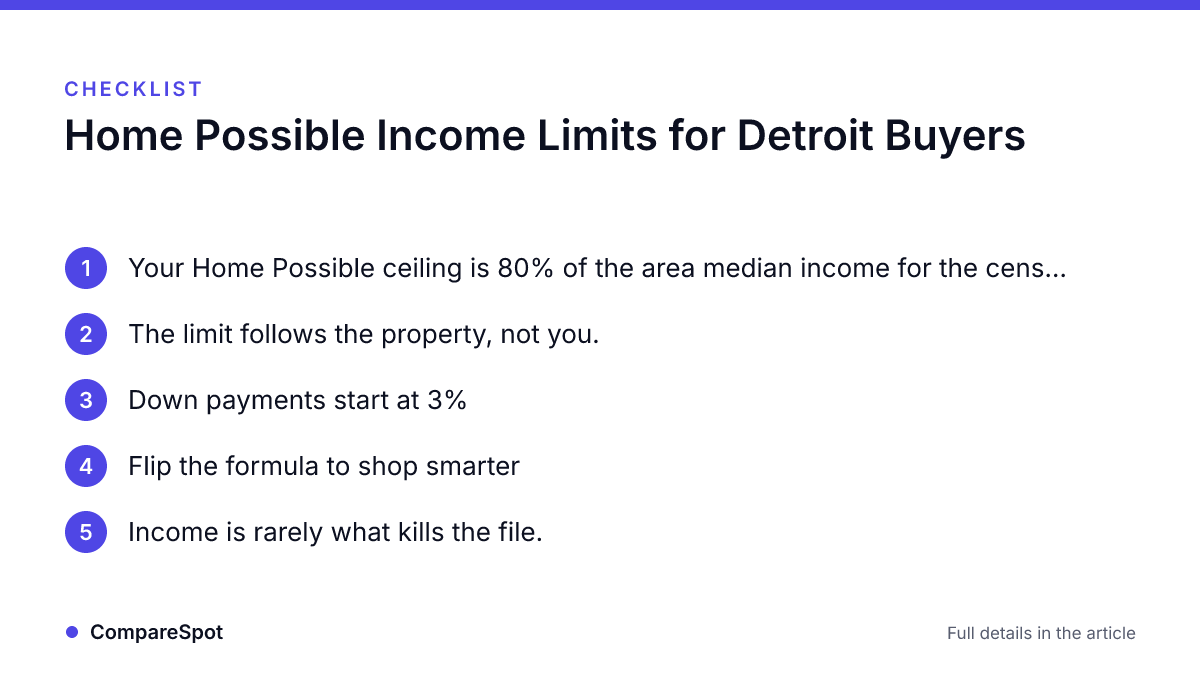
- Your Home Possible ceiling is 80% of the area median income for the census tract the house sits in, so your limit on a west-side Detroit block can look nothing like your limit in Royal Oak.
- The limit follows the property, not you. Two buyers with identical pay stubs can qualify on one street and get turned away two blocks over.
- Down payments start at 3%, and that cash can often come from gifts, grants, or down payment assistance instead of your own savings.
- Flip the formula to shop smarter: household income ÷ 0.80 gives you the minimum tract AMI you need, which lets you screen neighborhoods before you tour them.
- Income is rarely what kills the file. Credit score, debt-to-income, and lender-specific overlays wash out more Home Possible buyers than the income limit does.
Home Possible income limits cap your qualifying household income at 80% of the median income for the exact census tract your house sits in. Which means the honest answer to "do I qualify?" has less to do with what you earn and more to do with which block you're buying on.

Table of Contents
- What are Home Possible income limits?
- Who qualifies for Home Possible in Metro Detroit?
- How do you check your eligibility, step by step?
- What most people miss about these income limits?
- How does Home Possible compare to other first-time buyer programs?
- What does qualifying actually save you?
- Where do you go from here?
- Frequently asked questions
What are Home Possible income limits?
Home Possible is Freddie Mac's mortgage program for low- and moderate-income buyers who don't have 20% sitting in a savings account. The income test isn't one dollar figure for Michigan or even for your county. It's pegged to 80% of the Area Median Income (AMI) for the tract where the property is located.
In Metro Detroit that creates a patchwork. Tracts in parts of Oakland County carry higher median incomes, so the qualifying ceiling there runs higher too. Tracts in parts of Wayne County and Pontiac have lower medians, and the ceiling drops with them. The practical effect we see over and over: a buyer gets a number from a loan officer, assumes it's "the Detroit limit," then finds out it only applied to the one address they asked about.
Before you lock onto a neighborhood, it helps to know what your budget actually buys in different pockets of the city. Our breakdown of what $200K buys you in Detroit right now is a decent gut-check on where your price range and your eligibility are likely to overlap.
Who qualifies for Home Possible in Metro Detroit?
You qualify if your household income sits at or below 80% of the AMI for the property's tract, the home will be your primary residence, and you clear standard underwriting on credit and debt. First-time buyers get most of the marketing attention, but repeat buyers can use Home Possible too as long as they're living in the house.
Here's who tends to actually pencil out:
- Early-career earners with steady pay. Teachers, nurses and techs, skilled trades apprentices, city employees. Income is documentable and consistent, just not high yet.
- Multigenerational households. An adult child earning $42,000 and a parent on a documented pension can carry a mortgage together when neither would qualify alone.
- Buyers in modestly priced Detroit neighborhoods. A smaller loan needs less income to support it, which keeps you comfortably under the ceiling instead of flirting with it.
- Buyers with non-W-2 income. Gig work, a second part-time job, income from a legal second unit. Home Possible underwriting handles these more gracefully than some conventional options, as long as you can document the history.
Pro tip: If you're within about $5,000 of the ceiling, don't guess and don't work off a neighborhood average. Have your loan officer run the specific street address, because tract boundaries in Detroit often follow major roads and rail lines rather than anything you'd notice from the sidewalk.
How do you check your eligibility, step by step?
Most buyers jump straight to "can I afford this house" and never confirm they qualify for the program that makes the math work. Run it in this order:
- Pull your real household income, not your estimate. Count every qualifying borrower's gross income: base pay, consistent overtime, documented bonuses. If you plan to use a part-time job to qualify, that income counts toward the limit too. Leaving it off your own worksheet just gives you a number you can't rely on.
- Pin down the exact address, or two or three target areas. Limits are set by census tract, not city and not ZIP code. A house on one side of 8 Mile can carry a different ceiling than one a quarter mile away.
- Run the address through Freddie Mac's Home Possible eligibility lookup. The free tool returns the tract's AMI and your 80% limit in seconds. Do it for every neighborhood you're seriously considering.
- Compare the limit against everyone on the loan. Co-borrower income counts. A couple at a combined $72,000 can clear the limit in one tract and miss it by a few thousand in the next.
- Check your credit score against the lender's floor, not the program's. In our experience the score a lender will actually approve runs higher than the program minimum, and that gap is where plenty of otherwise-eligible buyers get stuck.
- Do the DTI math yourself. Add your monthly debt payments, car note, student loans, minimum credit card payments, and divide by gross monthly income. A $600 car payment plus $250 in student loans on $4,800 monthly gross is $850 ÷ $4,800 = 17.7% before the mortgage even enters the picture. That tells you how much room you have left.
- Ask about homeownership education. Home Possible typically requires a homebuyer course when everyone on the loan is a first-time buyer. It's usually a short online class. It's also a classic reason closings slide by a week, because nobody mentions it until the file is nearly done.
- Get pre-approved by a lender that actually originates the program. Not every bank does. Confirm it in the first conversation instead of discovering it three weeks into your search.
What most people miss about these income limits?
A few details trip up well-qualified buyers:
- The limit attaches to the property. Three houses at the same $190,000 price in three different neighborhoods can produce three different answers for the same borrower.
- Limits get refreshed on a cycle. Area income data updates, and the ceiling moves with it. A tract that was just out of reach can come back into range, and the reverse happens too.
- Gift funds and grants don't count as income. Down payment assistance won't push you over the ceiling, but it has to be documented as a gift or a properly structured second lien, not as cash someone handed you. A deposit that shows up in your account with no paper trail becomes an underwriting problem, not a bonus.
- Non-occupant co-borrowers carry extra rules. The program is built around you living in the house, so adding an uncle purely to boost income is treated more strictly here than on some other loan types.
- Two lenders can price the same loan very differently. Rate, lender credits, and overlays vary enough that shopping two or three is worth the hour.
Pro tip: Ask every loan officer directly whether their bank has overlays on Home Possible, meaning requirements layered on top of Freddie Mac's baseline. Tighter credit minimums and lower DTI caps are common, and an overlay is frequently the real reason a buyer inside the income limit still gets a no.
How does Home Possible compare to other first-time buyer programs?
Home Possible is one of several low-down-payment routes Metro Detroit buyers run into, and it's rarely the only one worth pricing.
| Program | Minimum down payment | Income limit | Mortgage insurance |
|---|---|---|---|
| Home Possible (Freddie Mac) | 3% | 80% of tract area median income | Required, cancellable as equity builds |
| HomeReady (Fannie Mae) | 3% | 80% of tract area median income | Required, similar cancellation rules |
| Conventional 97 | 3% | None | Required until you reach 20% equity |
| FHA loan | 3.5% | None | Required for most of the loan term |
| MSHDA (Michigan State Housing Development Authority) | As low as 0% with assistance | Set by county and household size | Depends on the first mortgage it pairs with |
If you're over the Home Possible ceiling, that's not a dead end. It usually means a standard conventional loan or FHA is the better fit. Our breakdown of what an FHA loan really costs first-time buyers walks through the mortgage insurance math FHA buyers routinely underestimate.
Big banks and local credit unions both play in this space, but their menus differ. Plenty of lenders push a proprietary low-down product of their own (Chase's DreaMaker, for instance) rather than Home Possible. Ask which program a quote is built on, because "3% down" doesn't mean the same mortgage insurance, the same income test, or the same closing cost credit everywhere.
What does qualifying actually save you?
Here's an illustrative scenario. Plug in your own numbers once you have a real pre-approval.
Say you're buying a $200,000 house in a tract where the AMI is $75,000. Your ceiling is 80% of that:
$75,000 × 0.80 = $60,000
Household income of $58,000 puts you under it, so you're eligible. Now the down payment:
$200,000 × 0.03 = $6,000
Against $40,000 for a traditional 20% down. That $34,000 gap is the whole point of the program. It isn't about shaving the interest rate, it's about how much cash has to exist in your account before you can buy anything at all.
The rule of thumb worth memorizing: run the formula backward. Your household income ÷ 0.80 equals the minimum tract AMI you need. At $58,000, that's $58,000 ÷ 0.80 = $72,500. Any tract with an AMI at or above $72,500 works for you. Any tract below it doesn't. That single number turns neighborhood shopping into a yes-or-no filter instead of a guessing game.
Stacking assistance on top of the 3% can cut your cash-to-close further still. Our guide to free down payment money Michigan buyers miss covers programs that pair directly with Home Possible.
One more sanity check before you pick a lender: look a few years down the road. Home Possible carries mortgage insurance, and knowing when it can come off, plus what a refinance might realistically look like, matters more than most buyers appreciate at the closing table. Our breakdown of mortgage refinance calculator math Detroit lenders skip is worth reading first.
Where do you go from here?
Check your tract-level income limit before you tour a single house, then get pre-approved by a lender who originates Home Possible regularly rather than one who mentions it as an afterthought. Calculate your minimum tract AMI with the formula above and hand that number to your agent so they stop sending you listings you can't finance.
If you're still deciding where to buy, pair the eligibility check with local market conditions. Our rundown of 5 signals shaping Detroit's housing market in 2026 will help you time the search, and our guide on how to choose a real estate agent in Detroit will help you find someone who already knows which neighborhoods fall inside these limits.
Frequently asked questions
Can my income limit change if I add a co-borrower later?
Yes. Anyone added to the loan adds their income to the total, which can push an eligible household over the ceiling. Rerun the numbers any time the borrower list changes, even late in escrow.
Do Home Possible income limits apply to rental income or only wages?
Qualifying income generally includes any consistent, documentable income used to support the application, including verified rent from a legal second unit. It isn't W-2 wages only. Ask your lender exactly which income sources they're counting before you assume you're over or under.
What happens if my income goes up after I close on a Home Possible loan?
Nothing. The income test applies at approval, not afterward. A raise or a new job six months into homeownership has no effect on a loan you've already closed.