

TL;DR
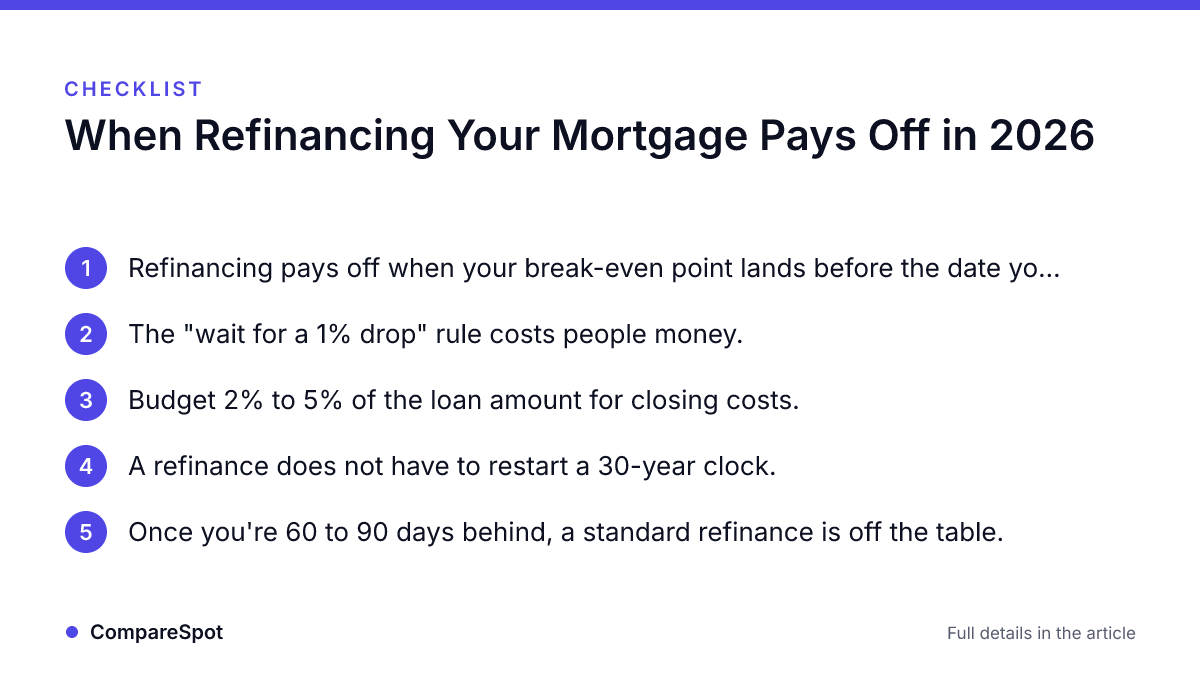
- Refinancing pays off when your break-even point lands before the date you expect to move. Rate drop size is secondary.
- The "wait for a 1% drop" rule costs people money. On a $300,000 balance, a half-point drop saves roughly $100 a month and clears a $5,000 closing cost bill in about 50 months.
- Budget 2% to 5% of the loan amount for closing costs. That's the range we see on Metro Detroit refinances once appraisal, title, lender fees, and county recording are added up.
- A refinance does not have to restart a 30-year clock. Ask for 20-year and 15-year quotes alongside the default, and compare total interest, not just payment.
- Once you're 60 to 90 days behind, a standard refinance is off the table. Loan modification, a short sale, or an outright sale become the realistic paths.
Refinancing a mortgage means paying off your current loan with a new one, usually for a lower rate, a different term, or cash out of your equity. It's worth doing when the savings outrun the cost of getting there. With rates bouncing around the way they have been, that calculation is the whole decision for Metro Detroit homeowners, and most people never actually run it.

Table of Contents
- What Does It Actually Mean to Refinance Your Mortgage?
- Does Refinancing Only Make Sense When Rates Drop 1% or More?
- Do Closing Costs Cancel Out the Savings From Refinancing?
- Will Refinancing Always Reset Your Loan to a Full 30 Years?
- Does Refinancing Hurt Your Credit Score for Years?
- Can Metro Detroit Homeowners Behind on Payments Still Refinance?
- How Do You Compare Mortgage Refinance Lenders in Metro Detroit?
- Your Next Step
- Frequently Asked Questions
What Does It Actually Mean to Refinance Your Mortgage?
Refinancing replaces your existing mortgage with a brand-new loan. The new lender (or your current one) pays off the old balance, and you start making payments under the new rate, term, and conditions. Your old loan is closed out. Your escrow account gets refunded and a new one gets funded.
People do it to lower a rate, to move off an adjustable-rate loan, to shorten or stretch a term, or to pull cash out for renovations and debt consolidation. Around Metro Detroit, the biggest group asking right now is homeowners who bought in 2022 and 2023 at the top of the rate cycle and have been waiting ever since. If you want the deeper breakdown of how to run that comparison yourself, our piece on the mortgage refinance calculator math Detroit lenders skip walks through the inputs most online calculators leave out, like PMI removal timing and recording fees specific to Wayne, Oakland, and Macomb counties.
Does Refinancing Only Make Sense When Rates Drop 1% or More?
No. The "1% rule" is lazy advice that got repeated until people started treating it as a law of nature.
The real question is how many months of savings it takes to cover your closing costs, and whether you'll still own the house when that month arrives. Rate drop size only matters because it drives monthly savings. It isn't the test itself.
Run it on a $300,000 balance. At 7.25% on a 30-year fixed, principal and interest come to about $2,046. At 6.75%, that's about $1,946. A half-point drop saves roughly $100 a month. If your closing costs are $5,000:
$5,000 ÷ $100 = 50 months, or a little over four years.
A homeowner in Royal Oak who plans to stay a decade just bought themselves six years of free savings. Somebody in the same house with a job offer in Columbus next spring should not touch it. Same rate drop, opposite answer.
Pro tip: Run the break-even math before you talk to a loan officer, not after. If a lender walks you through monthly payment savings but never mentions how long it takes to recoup the costs, you're being sold, not advised.
Do Closing Costs Cancel Out the Savings From Refinancing?
Not usually, but the only way to know is to do the arithmetic. On the Metro Detroit refinances we see, closing costs land somewhere between 2% and 5% of the loan amount once you add up the appraisal, title work, lender origination, and county recording fees.
Here's the full example, end to end.
Illustrative scenario: You owe $250,000 on a 30-year fixed at 7.25%. Principal and interest run about $1,705 a month. You refinance into a new 30-year at 6.25% and the payment drops to roughly $1,540. That's $165 a month back in your pocket. Closing costs come to $5,000.
Break-even formula: closing costs ÷ monthly savings = months to break even.
$5,000 ÷ $165 = about 30 months, or two and a half years.
Stay past month 30 and the refinance has paid for itself. Everything after is yours. If you're in Sterling Heights with a relocation on the horizon inside two years, skip it and keep the $5,000.
| Loan balance | Rate drop | Monthly savings (approx.) | Closing costs | Break-even |
|---|---|---|---|---|
| $150,000 | 0.5% | $45 | $3,500 | ~78 months |
| $250,000 | 1.0% | $165 | $5,000 | ~30 months |
| $350,000 | 1.5% | $320 | $7,500 | ~23 months |
| $400,000 | 0.75% | $190 | $8,000 | ~42 months |
Figures are illustrative, but the pattern holds every time. Bigger balances and bigger rate drops collapse the break-even window. Small balances with modest drops can take six or seven years to pay back, which is exactly why one blanket rule can't serve a $140,000 bungalow in Redford and a $420,000 colonial in Birmingham.
Will Refinancing Always Reset Your Loan to a Full 30 Years?
No. The term is a choice. Depending on the lender and what you qualify for, you can go 30, 20, 15, or 10 years, and plenty of lenders will write an odd term like 23 years to match what's left on your current loan.
The myth survives because the 30-year fixed is the product lenders advertise hardest. It produces the lowest payment, which makes it the easiest thing to sell. But if you're seven years into a 30-year note and roll into another 30-year, you've just added seven years of payments to the back end even though your rate went down. Some homeowners take that trade on purpose because cash flow today matters more than interest paid in 2050. Others would be furious if they understood what they'd agreed to.
Pro tip: Ask for three terms side by side on one sheet, with total interest paid listed for each, not just the monthly payment. The gap between a 25-year and a 30-year payment is usually smaller than people brace for, and the difference in lifetime interest is enormous.
Does Refinancing Hurt Your Credit Score for Years?
No. Expect a dip of a few points that typically recovers within a few months of on-time payments on the new loan.
Two things cause the dip. The hard inquiry when you apply, and the brand-new account with a zero-length history that replaces a loan you'd been paying for years. Account age matters to scoring models, so your average age of accounts drops the day the new mortgage reports. It climbs right back.
The "refinancing tanks your credit" idea almost certainly comes from people confusing it with foreclosure or charge-offs, which are a different universe of damage and stay on your report for years. Rate shopping is treated gently by most scoring models: multiple mortgage inquiries inside a short window generally get bundled and counted once. Pull your quotes inside two weeks and you're fine. One caution from experience, though: do not open a credit card, finance a car, or co-sign anything between application and closing. Underwriters re-pull credit days before funding, and a new tradeline at the wrong moment can blow up a locked rate. If you've been through a mortgage pre approval recently, you've already heard that lecture.
Can Metro Detroit Homeowners Behind on Payments Still Refinance?
Generally no. Underwriting exists to verify you can make payments reliably, and a 30-day late on a mortgage inside the last 12 months kills most refinance approvals outright. By 60 to 90 days late, a standard refinance isn't a realistic option with any conventional lender.
This is the version of the myth that actually costs people their houses. Someone falls two months behind, tells themselves they'll refinance once things stabilize, and burns four months waiting for a rescue that was never available. In Wayne County, sheriff's sale timelines move faster than most homeowners expect once the process starts, and every month of delay removes an option.
If you're behind now or can see it coming, the live paths are a loan modification through your servicer, a short sale, or selling the house. Cash buyers can typically close in two to three weeks with no repairs and no listing period, which is sometimes the difference between walking away with equity and walking away with nothing. If you've inherited a property in this situation rather than facing foreclosure on your own home, our guide on who buys an inherited house as-is in Pontiac covers how that process works for heirs specifically.
How Do You Compare Mortgage Refinance Lenders in Metro Detroit?
Rate, fees, term options, and how fast they actually close. That's the list. Big national shops like Chase offer convenience and a name you recognize. Local credit unions and regional lenders frequently beat them on closing cost credits, particularly for borrowers with strong credit and real equity.
What to check before you sign anything:
- Compare APR, not the headline rate. APR folds in points and lender fees, which is where a "better" rate often turns out to be worse.
- Ask about lender credits versus buying points. A lender covering part of your closing costs for a slightly higher rate is often the right call if you might sell inside five years.
- Ask how long their underwriting runs right now. Not their marketing number, their current one. A 45-day close on a 30-day lock means paying for an extension.
- Collect two or three quotes inside the same two-week window. Minimal credit impact, and competing Loan Estimates are the only real negotiating leverage you have.
- Confirm when PMI falls off the new loan. People build PMI savings into their break-even math and then find out the new loan structures it differently.
Pro tip: Get a written Loan Estimate from every lender, not a verbal quote. Lenders have to produce one after you apply, it uses a standardized format, and page two is where the fees they'd rather discuss over the phone are printed in black and white.
If you're weighing whether to refinance at all versus sell and buy something smaller, it helps to understand where Metro Detroit's housing market is heading first. Our breakdown of the 5 signals shaping Detroit's housing market in 2026 covers the inventory and pricing trends that affect both decisions. And if you're specifically weighing whether to stay and refinance versus sell and buy down, our cornerstone piece on what $200K buys you in Detroit right now is a useful gut-check on what you'd actually be trading your current equity for.
Your Next Step
Pull your most recent mortgage statement and write down three numbers: remaining balance, current rate, and how many years you realistically plan to stay. Get two or three quotes, then divide each lender's closing costs by the monthly savings they're promising. If that number of months lands comfortably before your move-out date, you have your answer. If it doesn't, you've saved yourself thousands by doing five minutes of division.
Frequently Asked Questions
Can you refinance an FHA loan into a conventional mortgage?
Yes, and it's a common move once you've got roughly 20% equity, because it lets you drop the mortgage insurance premium FHA charges for the life of the loan in most cases. It's a standard refinance application, but the appraisal carries extra weight since your equity position has to clear the conventional lender's threshold. If the appraisal comes in low, the whole plan stalls.
Is it better to refinance with your current lender or shop around?
Shop around. Your current servicer has no particular incentive to hand you their sharpest rate when they're already collecting your payments. Some do offer existing-customer discounts or waived fees, so get their quote too, just put it next to two outside offers before you decide.
Does a cash-out refinance work differently than a rate-and-term refinance?
Yes. A rate-and-term refinance changes your rate or term without meaningfully changing the balance beyond rolled-in closing costs. A cash-out refinance increases the balance and hands you the difference, which usually raises your payment. Most lenders cap cash-out at 80% of appraised value, so how much you can actually take depends entirely on where the appraisal lands.