

A no closing cost mortgage doesn’t make your fees disappear. The lender either raises your interest rate and covers the costs with a credit, or folds those costs into your loan balance so you finance them over 30 years instead of paying cash at the table. It tends to make sense if you plan to sell or refinance within a few years; it usually costs more if you’re staying put long term.
TL;DR:
- No closing cost mortgages shift expenses to either a higher interest rate or a larger loan balance, not eliminate costs entirely.
- The typical monthly increase from a lender credit costs about $50 to $150, with break-even points around seven years for a $7,000 fee on a $350,000 loan.
- The decision heavily depends on how long you plan to keep the loan, with shorter horizons favoring no-cost options.
- Lenders vary widely in their no-cost offers, influenced by credit score, debt ratio, down payment, and specific fee exclusions.
- Comparing multiple Loan Estimates is essential to identify the most cost-effective choice before signing any loan agreement.
Table of Contents
- What Is a No Closing Cost Mortgage, Really?
- How No Closing Cost Mortgages Actually Work
- The Real Trade-Offs Of Going No-Cost
- The Break-Even Math, Worked Out
- Who Offers No Closing Cost Loans And What They Look At
- Cheaper Ways To Cover Closing Costs
- How To Compare Offers And What To Ask Your Lender
- What Comparespot Sees When Homeowners Compare Lenders
- Compare Lender Offers Before You Sign Anything
- Sources
- FAQ
What Is a No Closing Cost Mortgage, Really?
Lenders use several names for the same idea: no closing cost mortgage, zero closing cost mortgage, no-cost home loan. All of them describe a loan where you avoid paying origination fees, appraisal costs, title charges, and similar expenses out of pocket at closing. The CFPB is direct about this: the costs don’t vanish, they move.
Several expenses almost always stay your responsibility, no matter which structure you pick:
- Your down payment (never covered by a no-cost arrangement)
- Prepaid interest and the initial deposit into your escrow account
- Private mortgage insurance if your down payment is under 20%
- Home inspection fees, since lenders rarely fold third-party inspection costs into their credit
Every one of these should show up on your Loan Estimate, the standardized form lenders must give you within three days of application, and again on your Closing Disclosure before signing.
How No Closing Cost Mortgages Actually Work
Two structures dominate this market, and they behave very differently over the life of your loan.
- Lender credit, higher rate. The lender pays your closing costs directly, then charges you an interest rate roughly 0.125% to 0.5% higher to recoup that money over time. Your Loan Estimate will show this as a negative number in the “lender credits” line, offsetting your costs section.
- Rolled-in principal. Instead of raising your rate, the lender adds your closing costs to your loan amount. You borrow more, and you pay interest on that larger balance for the full term.
The CFPB frames the choice as a trade between immediate cash flow and long-term cost, the mirror image of paying discount points to buy your rate down.
Quick math: on a $2,500 closing cost bill, a lender credit might add about $50 to $150 a month depending on your loan size and rate bump, while rolling it into a $350,000 loan barely moves your payment but adds thousands in interest by year 30.
Rolling costs in tends to suit buyers who are cash tight but confident they’ll stay long enough to absorb the extra interest. A lender credit suits buyers who expect to refinance or sell before the rate difference outweighs what they saved upfront.
The Real Trade-Offs Of Going No-Cost
Every no closing cost mortgage buys you something and costs you something else. Weigh both sides honestly before signing.
What you gain:
- Less cash needed at the closing table, which matters if your savings are tied up in the down payment
- The ability to close faster without scrambling to source extra funds
- More liquidity left over for moving costs, furniture, or immediate repairs
What you give up:
- More interest paid over the life of the loan, sometimes tens of thousands of dollars on a 30-year term
- Slower equity buildup, especially with the rolled-in principal option
- Potentially fewer refinancing options later if your loan balance sits closer to your home’s value
Pro Tip: If you’re not sure how long you’ll stay in the home, run the break-even math for a five-year horizon and a ten-year horizon separately. Your decision often flips between those two numbers.
The rule of thumb: if you expect to sell, refinance, or pay off the loan before your break-even point, a no closing cost mortgage usually wins. Beyond that horizon, paying costs upfront almost always saves more.
The Break-Even Math, Worked Out
Here’s a simplified comparison on a $350,000 loan at a 30-year fixed term, assuming $7,000 in closing costs (2% of a $350,000 purchase, within the typical 2% to 6% range) and a 0.375% rate bump for the lender-credit option.
At roughly a $87 monthly difference between paying upfront and taking the lender credit, the $7,000 you saved at closing gets erased in interest around year seven. That’s your break-even point in this example. NerdWallet’s calculations show the same pattern: the longer you hold the loan, the more a higher rate costs you compared to financing the fees into principal or paying them outright.
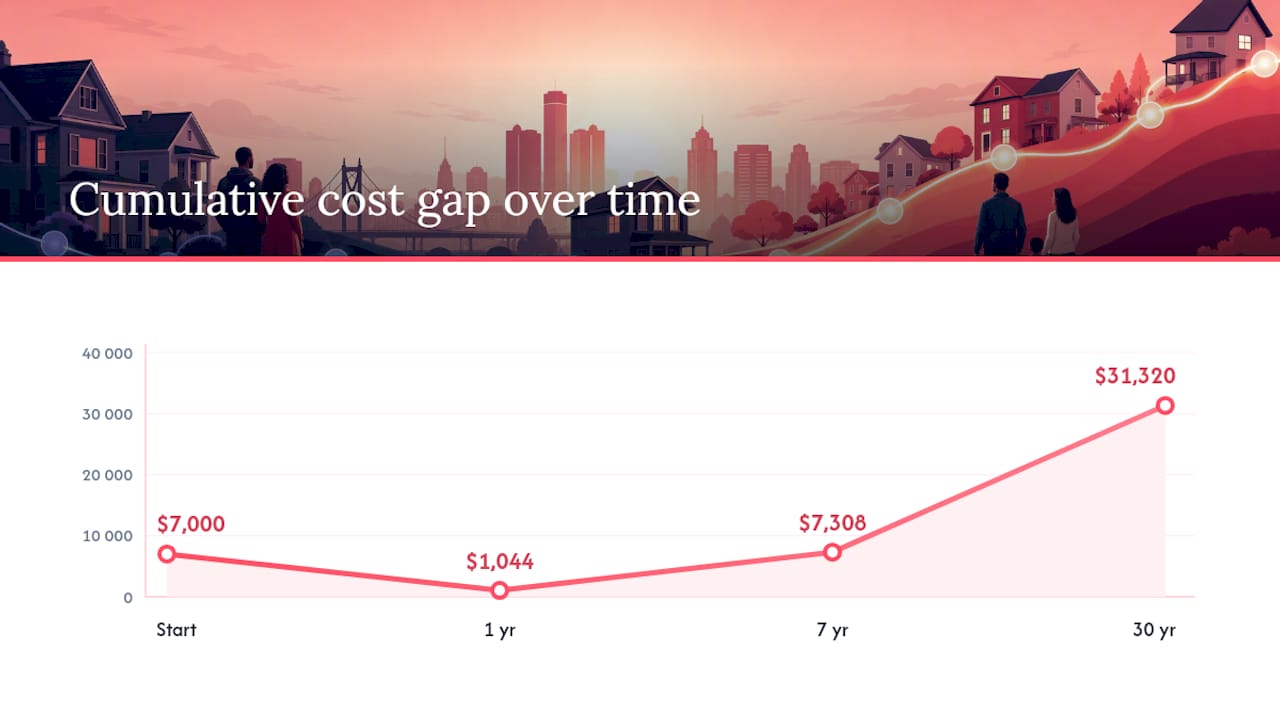
Your own numbers will shift with your loan amount, credit score, and the specific rate your lender offers, so treat this table as a template, not a quote. Pull your actual Loan Estimate and plug in the real figures.
Who Offers No Closing Cost Loans And What They Look At
Banks, credit unions, and online lenders all offer some version of a no closing cost mortgage, but the terms swing widely between them. Credit unions and community banks sometimes beat larger national banks on the rate bump they charge for the same credit, especially for borrowers with strong credit profiles.
Underwriters typically weigh:
- Your credit score, since a stronger score usually earns a smaller rate increase for the same credit
- Debt-to-income ratio, which affects how much of a rate bump you can absorb
- Down payment size and loan program (conventional, FHA, VA all price these differently)
- Whether the lender caps how much credit they’ll apply, or excludes certain fees like appraisal or recording costs from the offer
Ask directly whether any fees are excluded from their “no-cost” language. Some lenders quietly leave out third-party charges.
Cheaper Ways To Cover Closing Costs
A no closing cost mortgage isn’t the only route to a lighter closing table. Try these first:
- Ask for seller concessions in your purchase offer, common in slower markets where sellers want to close the deal.
- Check first-time homebuyer assistance programs through your state or local housing authority, many of which cover a portion of closing costs outright.
- Shop your title insurance and settlement services instead of accepting the lender’s default vendor.
- Compare offers from credit unions and community banks alongside big-bank quotes.
- Consider discount points only if you’re confident you’ll hold the loan long enough to recoup the upfront cost through a lower rate.
Working through this list before signing anything often saves more than a no-cost structure ever will.
How To Compare Offers And What To Ask Your Lender
Line up two or three Loan Estimates side by side before deciding anything. Ask each loan officer the same set of questions so you’re comparing apples to apples.
- “Is this a lender credit or are costs rolled into my principal?”
- “Exactly how much higher is my rate because of this credit?”
- “Which fees, if any, are excluded from the no-cost offer?”
- “What’s my break-even point compared to paying costs upfront?”
- “Does this loan carry a prepayment penalty if I refinance early?”
Check the “Loan Costs” and “Other Costs” sections on your Loan Estimate line by line, then confirm nothing changed on your Closing Disclosure before you sign.
Pro Tip: Get preapproved with two lenders using the same closing date and loan amount. Loan Estimates are only genuinely comparable when the underlying assumptions match.
If you’re planning to move or refinance within five years, the no-cost route usually wins. If you’re settling in for the long haul, paying costs upfront is typically the better financial move.
What Comparespot Sees When Homeowners Compare Lenders
After reviewing local lender offers across Metro Detroit, the pattern is consistent: the same borrower profile gets wildly different no-cost terms depending on which lender they ask. Comparespot’s rankings exist because most homeowners never get to see that spread side by side, which is exactly the gap worth closing before you sign anything.
— Bryan
Compare Lender Offers Before You Sign Anything
Comparespot is the alternative to calling five different banks and hoping you remember which one quoted what. Metro Detroit homeowners get a researched, ranked list of local lenders instead of piecing together quotes from scratch.
The trade-offs covered above, lender credits versus rolled-in principal, break-even timing, excluded fees, are exactly what separates a good no closing cost mortgage from a bad one, and the difference rarely shows up until you’re staring at a Loan Estimate wondering if the numbers are fair. Comparespot’s mortgage lender rankings for Metro Detroit are built from research and customer sentiment, not paid placement, so you can see which lenders actually deliver competitive no-cost terms before you commit to one. If you’re also weighing whether to work with a broker instead of a direct lender, this breakdown of mortgage brokers versus lenders is worth a read first. Pull up the rankings, shortlist two or three lenders, and request Loan Estimates from each this week.
This article is general information, not a substitute for advice from a qualified financial advisor. Consult a qualified financial professional about your own circumstances before acting on anything here.
Sources
- Is there such a thing as a no-cost or no-closing cost loan or refinancing? | Consumer Financial Protection Bureau
- No-closing-cost mortgage: Does it make sense for you? | Rocket Mortgage
- No-Closing-Cost Mortgage: You Pay One Way or Another | NerdWallet
FAQ
What bank has no closing costs?
No single bank owns this offer. Many banks, credit unions, and online lenders provide a no closing cost mortgage, but the rate bump or rolled-in amount varies enough that you need to compare Loan Estimates directly rather than assume one institution is cheapest.
What happens if you don’t have money for closing costs?
You have three realistic paths: negotiate seller concessions, apply for a first-time homebuyer assistance program, or accept a no closing cost mortgage structure that shifts the expense into your rate or loan balance instead of your bank account.
How much are closing costs on a $400,000 house?
Using the typical 2% to 6% range, closing costs usually amount to a few percent of your home’s purchase price, depending on location, loan program, and services you shop around for.
Can you buy a home without paying closing costs?
You can avoid paying them upfront through a no closing cost mortgage, but the costs still get paid, either through a higher interest rate over the loan term or by adding them to your loan principal.
What’s a reasonable break-even point to accept?
Most housing counselors and lenders point to somewhere between five and ten years, depending on the rate difference and loan size, as the point where paying costs upfront starts winning over a no-cost structure. Run your own numbers using your actual Loan Estimate rather than relying on a general rule.