

If you own or are buying property in Detroit, you face two tax bills each year, a Principal Residence Exemption deadline that can save you thousands, and one of the highest effective property tax rates in the country at 3.02% as of 2024 — which means a single missed filing can cost you far more than you’d expect.
Here’s what to do in the next 72 hours:
- Check your PRE status. Log into the City of Detroit’s parcel lookup and confirm your property shows a Principal Residence Exemption. If it doesn’t, you’re paying school operating millage you may not owe.
- Note your deadlines. Summer taxes are due August 31 (or August 15 for the first installment). Winter taxes are due January 15. Miss those dates and interest starts accruing immediately.
- Find your parcel number. You’ll need it for every payment, appeal, or exemption filing. It’s on your tax bill or the city’s online parcel search.
- Run a quick estimate. Use the State of Michigan Property Tax Estimator to see whether your bill matches what you should owe.
- Contact the Detroit Tax Service Center (DTSC) if you’re in hardship. Senior deferment and hardship exemption programs exist — but you have to apply before deadlines pass.
Official places to act now: City of Detroit property tax portal, Wayne County Treasurer delinquency site, and the Michigan property tax estimator linked above.
Key Takeaways
Detroit property owners who file the PRE affidavit by the June 1 deadline, pay by the indicated deadlines, and verify their assessed value annually can avoid the most common and costly mistakes in the city’s property tax system.
| Point | Details |
|---|---|
| PRE saves up to 18 mills | File the PRE affidavit with the City Assessor by June 1 each year to exempt your home from school operating millage. |
| Two tax cycles, firm deadlines | Summer taxes are due August 31 (first installment August 15); winter taxes are due January 15. |
| Delinquency transfers March 1 | Unpaid prior-year taxes move to Wayne County on March 1, where additional fees and foreclosure risk accumulate. |
| PRE and HPTC are separate benefits | The Homestead Property Tax Credit is a state income tax credit — claim it on your MI-1040CR in addition to, not instead of, PRE. |
| Comparespot for local service help | Use Comparespot’s ranked lists of Metro Detroit agents, cash buyers, and property managers when tax pressure drives a real estate decision. |
Table of Contents
- How Detroit property taxes are calculated
- What homeowners typically pay in Detroit now
- Deadlines, cycles, and penalties — the City of Detroit payment calendar
- Where and how to pay your Detroit property taxes
- Exemptions, credits, and relief programs: PRE, Homestead Property Tax Credit, senior deferment, and hardship
- What buyers and sellers must check at closing
- How to appeal your assessment or contest a tax bill
- How to use the state and city property tax estimator tools
- Comparespot local analysis: Detroit vs. county examples and homeowner scenarios
- Why Detroit’s property tax burden deserves your full attention
- Comparespot helps Detroit homeowners find the right local services
- Sources
- FAQ
How Detroit property taxes are calculated
Detroit property taxes rest on three numbers: assessed value, taxable value, and the millage rate. Getting these straight is the only way to verify your bill or spot an error.
So a home worth $120,000 on the open market carries an assessed value of $60,000. Taxable value is what you actually pay taxes on, and it’s almost always lower than assessed value for long-term owners. When a property sells, taxable value “uncaps” and resets to equal the assessed value in the year after the sale.
Mills are the tax rate unit. One mill equals $1 of tax per $1,000 of taxable value. Detroit’s total millage bundle includes city operating mills, county mills, school district mills, and the State Education Tax (SET) of 6 mills. The school operating portion — which runs up to 18 mills — is the piece the Principal Residence Exemption removes for owner-occupants.
A quick worked example:
- Taxable value: $55,000
- Total millage (with PRE, school operating removed): approximately 67 mills
- Annual tax: $55,000 × 0.067 = $3,685
Without PRE, add back up to 18 mills of school operating tax: $55,000 × 0.018 = $990 more per year.
That $990 difference is exactly why filing a PRE affidavit by June 1 matters so much. The Michigan Department of Treasury’s PRE guidelines, defined under MCL 211.7cc and MCL 211.7dd, spell out ownership definitions, contiguous parcel rules, and the appeal process if your exemption is denied.
Key figure: The school operating millage exempted by PRE runs up to 18 mills — meaning owner-occupants who file correctly avoid paying that portion entirely, while non-occupant owners pay it in full.
What homeowners typically pay in Detroit now
Detroit’s effective property tax rate of 3.02% reported by a University of Michigan analysis puts it well above the national average and among the highest of any major U.S. city. The Lincoln Institute of Land Policy has documented this gap in comparative research, noting that Detroit’s combination of high millage rates and historically low property values creates a disproportionate burden relative to home prices.
Here’s what that looks like on a real bill. Take a home with a market value of $100,000, an assessed value of $50,000, and a taxable value of $42,000 (reflecting several years of capped increases):
- With PRE (school operating exempted): roughly $2,800–$3,000 annually at typical Detroit millage bundles
- Without PRE: roughly $3,750–$4,000 annually
For context, a homeowner in Ann Arbor with a similar taxable value pays a meaningfully lower effective rate, and suburban Wayne County communities like Livonia or Dearborn carry lower total millage bundles than Detroit proper. The gap isn’t trivial. On a $42,000 taxable value, a 1-mill difference equals $42 per year — and Detroit’s city millage bundle runs substantially higher than most surrounding communities.
| Jurisdiction | Approximate effective tax rate (owner-occupied) |
|---|---|
| Detroit (with PRE) | 3.02% as of 2024 |
| Detroit (without PRE) | ~3.02% of market value |
| Dearborn | ~1.8–2.0% of market value |
| Ann Arbor | ~1.5–1.7% of market value |
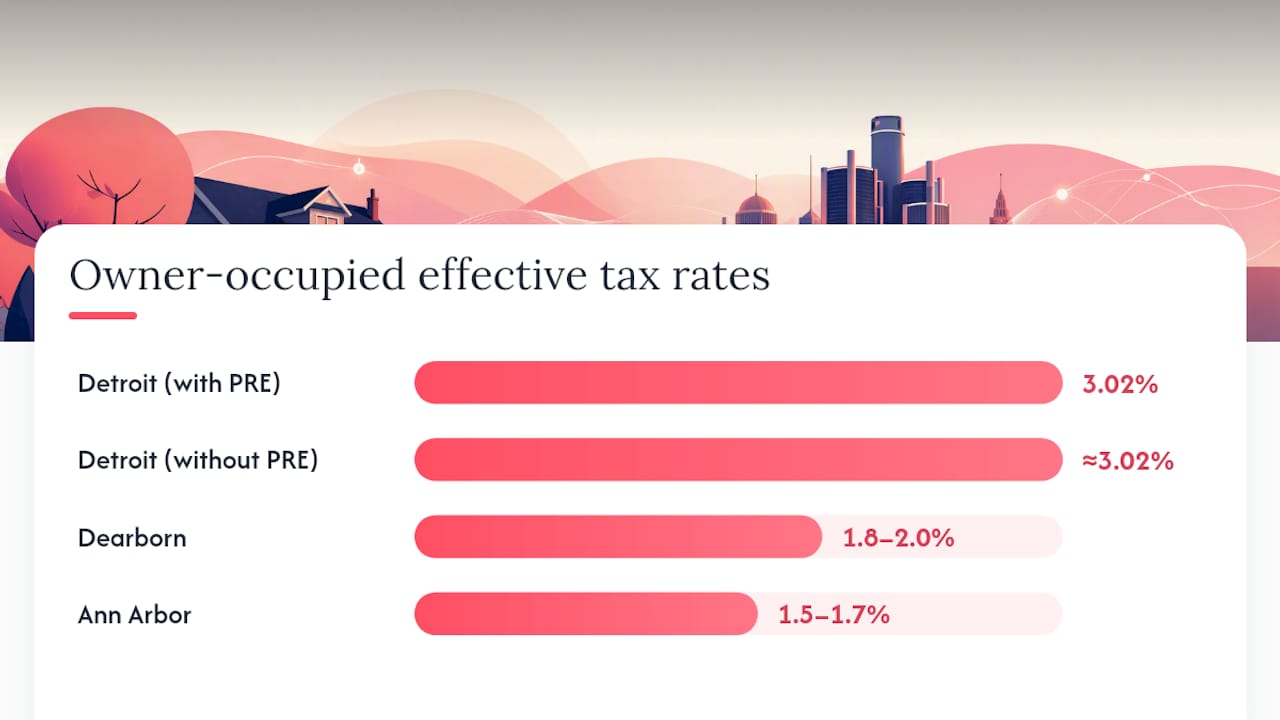
Rates are approximate and vary by school district and special assessments. Verify current millage bundles through the City Assessor or the Michigan property tax estimator.
Deadlines, cycles, and penalties — the City of Detroit payment calendar
The City of Detroit tax season runs July 1 through February 28. Here’s how the cycle actually plays out:
- Early July: Summer tax bills are mailed — often to the mailing address on file, so using a professional service like Apartment Mail & Package Room Management in Detroit, MI can help ensure you receive your statements on time. You have two options: pay the full amount by August 31, or split it into two installments.
- August 15: First installment of the summer bill is due if you’re paying in halves.
- August 31: Full summer payment due. Payments received after this date begin accruing interest and penalties.
- Early December: Winter tax bills are mailed.
- January 15: Winter taxes due. This is also the deadline for the second installment of summer taxes if you chose the installment plan.
- March 1: Any unpaid prior-year taxes transfer to the Wayne County Treasurer for delinquent collection. At that point, the City of Detroit is no longer your contact — Wayne County is.
Once taxes go delinquent with Wayne County, additional fees and interest accumulate quickly, and the path to forfeiture and foreclosure begins. Wayne County’s delinquent tax process is not forgiving, and catching up gets more expensive every month you wait.
Pro Tip: If your mortgage servicer pays taxes through escrow, confirm payment was posted before August 31 and January 15 — not just that your servicer “sent” the check. Mailed checks can post late. Call the City Treasury or check your parcel online a week after the due date to verify the payment landed.
Where and how to pay your Detroit property taxes
The City of Detroit’s PayDetroit365 portal lists every payment channel available. Here’s how each one works:
- Paymentus (online or phone): Pay by credit or debit card with a service fee, or by eCheck (ACH) for free if you create a registered Paymentus account. This is the most flexible option for most homeowners.
- DivDat app: Mobile app payment with card or bank account. Fees apply for card payments; check current rates before using.
- City kiosks and retail cash pay: Cash payments are accepted at city kiosks and participating retailers like CVS. A service fee applies at retail locations.
- Mail: Send a check or money order with your tax coupon to the City Treasury. Allow 7–10 business days for delivery and posting — never cut it close to a deadline with a mailed check.
- Phone: Call the Treasury to pay by card. Fees apply.
- AutoAgent (ACH/Wire for 11+ parcels): Investors and landlords with 11 or more properties should use AutoAgent to batch payments via ACH or wire transfer. It avoids per-transaction card fees and reduces administrative friction significantly.
For owners with up to 10 parcels, the city’s online portal supports a multiple-parcel cart — you can add all your properties to one checkout session. Many individual investors miss this and pay each parcel separately, racking up unnecessary fees.
What you need for any payment method:
- Your parcel number (formatted exactly as it appears on your bill — typically a 10-digit code)
- Your tax coupon or bill statement
- For eCheck: your bank routing and account numbers
- For AutoAgent: pre-registration with the City Treasury
Escrow payers checklist:
- Confirm your lender has your correct mailing address on file for the tax bill
- Verify your escrow account has sufficient funds before July 1
- Check your parcel online after each due date to confirm payment posted
- If your lender missed a payment, contact them immediately — you’re still liable for penalties even if it’s their error
Exemptions, credits, and relief programs: PRE, Homestead Property Tax Credit, senior deferment, and hardship
Detroit homeowners have access to several programs that can meaningfully reduce their tax burden. They work through different mechanisms, and confusing them is one of the most common and costly mistakes owners make.
Principal Residence Exemption (PRE)
The PRE removes up to 18 mills of local school operating tax from your bill — but only if you file. You must occupy the property as your primary residence and submit a PRE affidavit to the City Assessor by June 1 to receive the exemption for that tax year. Miss the June 1 deadline and you pay the full school operating millage for the year, with no retroactive relief.

Homestead Property Tax Credit (HPTC)
The Homestead Property Tax Credit is a completely separate benefit — it’s a refundable credit on your Michigan state income tax return, not a property-level exemption. Eligibility depends on your household income, the taxable value of your home, and residency status. You can file it up to four years late in many cases, which means homeowners who didn’t know about it can still claim past years. The PRE reduces what you owe on your property tax bill directly; the HPTC reimburses some of what you already paid through your income tax return. Both can apply to the same homeowner.
Senior Property Tax Deferred Payment Program
Seniors who qualify can defer payment of property taxes, allowing them to remain in their homes without immediate tax liability. Contact the City of Detroit Assessors’ Division or the Treasury Division to apply. Deadlines apply, so don’t wait until a bill is overdue.
Hardship exemption
Financially distressed homeowners can apply for a hardship exemption through the Assessors’ Division. This is not automatic — you must apply and demonstrate financial need.
Documents and deadlines checklist:
- PRE Affidavit (Form 2368): file with City Assessor by June 1
- HPTC (MI-1040CR): file with your Michigan state income tax return; up to 4 years retroactive
- Senior deferment application: contact Assessors’ Division before summer bill due date
- Hardship exemption application: contact Assessors’ Division; timing varies by year
What buyers and sellers must check at closing
PRE affidavits are standard closing paperwork in Michigan, but they’re easy to overlook in the stack of documents you sign at the table. Missing one means you’ll pay school operating millage for the rest of that tax year as a new owner — even if you move in the day after closing.
Closing checklist for buyers:
- Confirm the seller’s PRE status on the current tax bill before closing
- Sign and submit a PRE affidavit at closing (your title company should include it, but ask explicitly)
- Verify that prorations in the closing disclosure reflect the correct tax amounts — both summer and winter bills
- Confirm escrow instructions with your lender: which bills will be paid through escrow and when
- Bring certified copies of the deed if you’re clearing any prior-year delinquent taxes at closing
- After closing, check your parcel online within 30 days to confirm PRE is reflected on your account
If you miss the PRE affidavit at closing, file it with the City Assessor as soon as possible. Many assessors treat the property as non-PRE for the full tax year if the affidavit isn’t on file by June 1, which means you could owe the school operating millage for the entire year regardless of when you moved in. Buyers working with a knowledgeable local real estate agent familiar with Detroit’s PRE rules can catch this before it becomes a problem.
How to appeal your assessment or contest a tax bill
If your assessed value looks wrong, you have a defined process to challenge it. The window is narrow, so move quickly once you spot a potential error.
- Contact the City Assessor’s office first. Request an informal review of your assessment. Bring your tax bill, any recent appraisal, and comparable sales from your neighborhood. Many errors — wrong square footage, incorrect property classification — get corrected at this stage without a formal hearing.
- File with the Board of Review. If the informal review doesn’t resolve it, file a protest with the local Board of Review during the March review period. Forms are available through the City Assessor’s office. The filing window is typically the first two weeks of March.
- Present your evidence. The burden of proof is on you to show the assessment is wrong. Bring:
- Recent comparable sales (within the past 12 months, similar size and condition)
- Photographs documenting condition issues the assessor may have missed
- A recent independent appraisal if you have one
- Any errors in the property record (wrong bedroom count, incorrect lot size)
- Understand the outcome. The Board of Review can reduce, maintain, or increase your assessment. Most successful appeals result in modest reductions. If you’re still unsatisfied, you can appeal further to the Michigan Tax Tribunal, though that process is more involved.
What to expect at the hearing:
- Hearings are brief, typically 10–15 minutes
- Present your comparable sales clearly and concisely
- The assessor will respond with their own data
- Decisions are usually mailed within a few weeks
The Lincoln Institute of Land Policy notes that taxpayers who bring recent comparable sales and photo evidence succeed most often at Board of Review hearings. A well-organized packet matters more than a lengthy argument.
How to use the state and city property tax estimator tools
The State of Michigan Property Tax Estimator is the fastest way to check whether your bill is in the right ballpark or to model what your taxes would look like under different scenarios.
- Go to michigan.gov/taxes/property/estimator. No login required.
- Enter your taxable value (not assessed value — this is the number on your tax bill, usually lower).
- Select your millage bundle. For Detroit, choose the appropriate school district and city. The estimator lists millage bundles by jurisdiction.
- Toggle PRE on or off to see the difference the exemption makes. This is the most useful scenario to run — it shows exactly what you’re saving (or losing) with PRE status.
- Run a “new purchase” scenario. If you’re buying a property, enter the purchase price as the new assessed value (50% of purchase price = assessed value; taxable value will equal assessed value in the first year after sale). This gives you a realistic first-year tax estimate.
- Save or screenshot your results. Write down your parcel number alongside the output so you can reference it when calling the assessor or filing an appeal.
For parcel-specific lookups, the City of Detroit’s online parcel search lets you pull your current assessed value, taxable value, PRE status, and payment history. Cross-reference the estimator output against your actual bill — if they diverge by more than a few dollars, dig into which millage line items differ.
Common estimator pitfalls:
- Using assessed value instead of taxable value overstates your bill
- Forgetting to toggle PRE off when modeling an investment property
- Not accounting for special assessments (solid waste, lighting districts) that the estimator may not include
Comparespot local analysis: Detroit vs. county examples and homeowner scenarios
These three scenarios show how PRE status, missed filings, and portfolio size change the actual tax outcome for Detroit homeowners.
Scenario A: Owner-occupant with PRE vs. without
A homeowner with a taxable value of $42,000 and PRE in place pays approximately $2,814 annually at a 67-mill effective rate (school operating exempted). Without PRE, the same owner pays roughly $3,570 at an 85-mill total bundle. The difference: $756 per year, every year, simply because the PRE affidavit was filed on time.
Scenario B: New buyer who missed PRE at closing
A buyer closes on a $110,000 home in October. No PRE affidavit is filed at closing. For that tax year, the buyer pays school operating millage on the full $55,000 — roughly $990 in avoidable taxes. The following June 1, they file the PRE affidavit and the exemption takes effect for the next tax year. Total unnecessary cost: nearly $1,000 for one missed form.
Scenario C: Investor with multiple parcels
An investor owns 14 Detroit parcels. Paying each separately via card through Paymentus incurs a service fee per transaction. Switching to AutoAgent ACH eliminates those per-transaction fees. Beyond cost savings, the multiple-parcel cart (for up to 10 properties) or AutoAgent (for 11 or more) also reduces the administrative time of managing separate payment confirmations.
Assumptions for these scenarios: Taxable values are illustrative, not property-specific. Millage bundles reflect approximate Detroit city rates and vary by school district. Verify current millage rates through the City Assessor or the Michigan estimator before making financial decisions.
Detroit’s 3.02% effective rate compares unfavorably to Dearborn (roughly 1.8–2.0%) and Ann Arbor (roughly 1.5–1.7%), as shown in the rates section above. For homeowners considering whether to sell, that gap matters, as a Detroit property carries a heavier annual tax load relative to its market value than most comparable Michigan cities.
Why Detroit’s property tax burden deserves your full attention
Detroit’s effective property tax rate isn’t just a statistic — it’s a structural affordability problem that hits owner-occupants hardest when they don’t claim every exemption they’re entitled to. The PRE alone can save a typical homeowner $750–$1,000 annually. Miss it for three years and you’ve handed over $2,500–$3,000 that you didn’t owe.
What I find underappreciated is how the Proposal A cap creates a false sense of security. Long-term owners see their taxable value grow slowly and assume their bill is under control. Then they sell, the new buyer’s taxable value uncaps to assessed value, and suddenly the tax burden jumps dramatically in year one. Buyers who don’t model that reset before closing routinely underestimate their first-year costs.
Estate planning adds another layer. A transfer on death deed (Michigan enhanced life estate deed, sometimes called a lady bird deed in Michigan) can pass property to heirs without triggering probate — but it also triggers a taxable value uncap when the property transfers. Heirs who inherit a Detroit property and don’t immediately file a PRE affidavit face both the uncapped assessment and the full school operating millage. That combination can be a significant financial shock in the first year of ownership.
The appeals process is genuinely underused. Detroit’s assessment accuracy has improved, but errors still occur — wrong square footage, outdated condition ratings, comparable sales that don’t reflect your neighborhood’s actual market. A 30-minute Board of Review appearance with three solid comparable sales can reduce your assessment and lower your bill for years.
Comparespot helps Detroit homeowners find the right local services
When property tax pressure turns into a decision to sell, refinance, or bring in professional management, having the right local partner matters. Comparespot ranks the top real estate agents in Metro Detroit and cash home buyers based on independent research and customer sentiment — not paid placements. If you’re managing multiple properties and need someone who understands escrow, tax proration, and multi-parcel accounting, Comparespot’s rankings of property management companies in Metro Detroit cover that too.

Whether you’re selling to resolve a tax liability, buying and need a closing-savvy agent, or looking for a property manager who won’t let a tax deadline slip, start at Comparespot to find vetted local providers ranked for your specific situation in Wayne, Oakland, and Macomb counties. Comparespot is an editorial rankings platform, not a tax adviser — for complex exemption questions or assessment disputes, contact the City Assessor’s office or a licensed Michigan tax professional.
Sources
Use these official pages to act now:
- City of Detroit — Property Tax General Information (2025 update)
- PayDetroit365: Pay Property Tax | City of Detroit
- Principal residence exemption (PRE) — Michigan Department of Treasury
- Property Tax Information — Wayne County Treasurer
For billing questions, contact the City of Detroit Treasury Division. For delinquent prior-year taxes, contact Wayne County Treasurer. For PRE filings and assessment disputes, contact the City Assessor’s office. For hardship or senior deferment, contact the Assessors’ Division before your next bill due date.
This article is general information, not a substitute for advice from a qualified financial advisor. Consult a qualified financial professional about your own circumstances before acting on anything here.
FAQ
Are property taxes high in Detroit?
Yes. Detroit carries an effective property tax rate of 3.02% as reported in a University of Michigan analysis, placing it among the highest of any major U.S. city and well above the national average.
What city has the highest property taxes in Michigan?
Detroit consistently ranks as one of the highest-taxed cities in Michigan, driven by a high total millage bundle that includes city operating, county, school district, and State Education Tax mills. Suburban communities in Wayne, Oakland, and Macomb counties generally carry lower effective rates.
What is the Principal Residence Exemption and how do I claim it?
The PRE exempts your primary residence from up to 18 mills of local school operating tax. File a PRE affidavit (Form 2368) with the City Assessor by June 1 to receive the exemption for that tax year — details and the form are at michigan.gov/taxes/property/principal.
When are Detroit property taxes due?
Summer taxes are due in full by August 31, or in two installments (August 15 and January 15). Winter taxes are due January 15. Unpaid prior-year taxes transfer to Wayne County on March 1 per the City of Detroit’s official tax calendar.
What is the difference between the PRE and the Homestead Property Tax Credit?
The PRE is a property-level exemption that directly reduces your tax bill by removing school operating millage. The Homestead Property Tax Credit is a refundable credit on your Michigan state income tax return that reimburses a portion of taxes already paid. Both can apply to the same homeowner, and they work through entirely separate filing processes.