

Yes. First-time buyers in Detroit can qualify for a mortgage, and several local and state programs exist specifically to help cover the down payment. The City of Detroit Down Payment Assistance Program offers up to $25,000 for eligible residents, the MSHDA MI Home Loan pairs a statewide mortgage product with up to $10,000 in additional assistance, and a newer pilot, the Tobias Harris Homeownership Initiative, offers up to 40% of a home’s purchase price with no monthly payment attached. None of that requires perfect credit or a six-figure salary. It requires knowing which program fits your situation and getting your paperwork lined up in the right order.
Three names matter most as you start:
- City of Detroit DPA — the largest local grant, built for residents who’ve lived in Detroit at least 12 months and earn at or below 80% of the Area Median Income.
- MSHDA MI Home Loan — Michigan’s statewide first-time buyer mortgage, with its own down payment assistance layered in.
- Tobias Harris Homeownership Initiative (THHI) — a shared-appreciation pilot for buyers who need heavier down payment help and who are comfortable trading future home equity for it.
Before anything else, get prequalified with a lender who has actually closed deals using these programs. Then confirm your eligibility against each program’s residency and income rules, and register for the required homebuyer education class. Skip that last step and you’ll stall out right before closing.
Table of Contents
- First Time Mortgages in Detroit: Comparing Your Best Options
- What Mortgage Types Are Available to First-Time Buyers in Michigan?
- How Does the City of Detroit Down Payment Assistance Program Work?
- What Is the MSHDA MI Home Loan Program?
- What Other Homeownership Programs Exist for Detroit Buyers?
- From Prequalification to Closing: What the Timeline Looks Like
- How Do You Choose a Mortgage Lender in Detroit?
- How CompareSpot Ranks Metro Detroit Mortgage Lenders
- Find a Metro Detroit Lender or Agent With CompareSpot
- Key Takeaways: What to Do Next
- Sources
- FAQ
First Time Mortgages in Detroit: Comparing Your Best Options
Detroit’s first-time buyer landscape isn’t one program. It’s a stack of them, and picking the right combination depends on your income, your credit score, and how much cash you can bring to closing. A buyer earning $45,000 with a 660 credit score has a very different path than someone earning $70,000 with a 600 score, even though both count as “first-time buyers” under most program definitions.
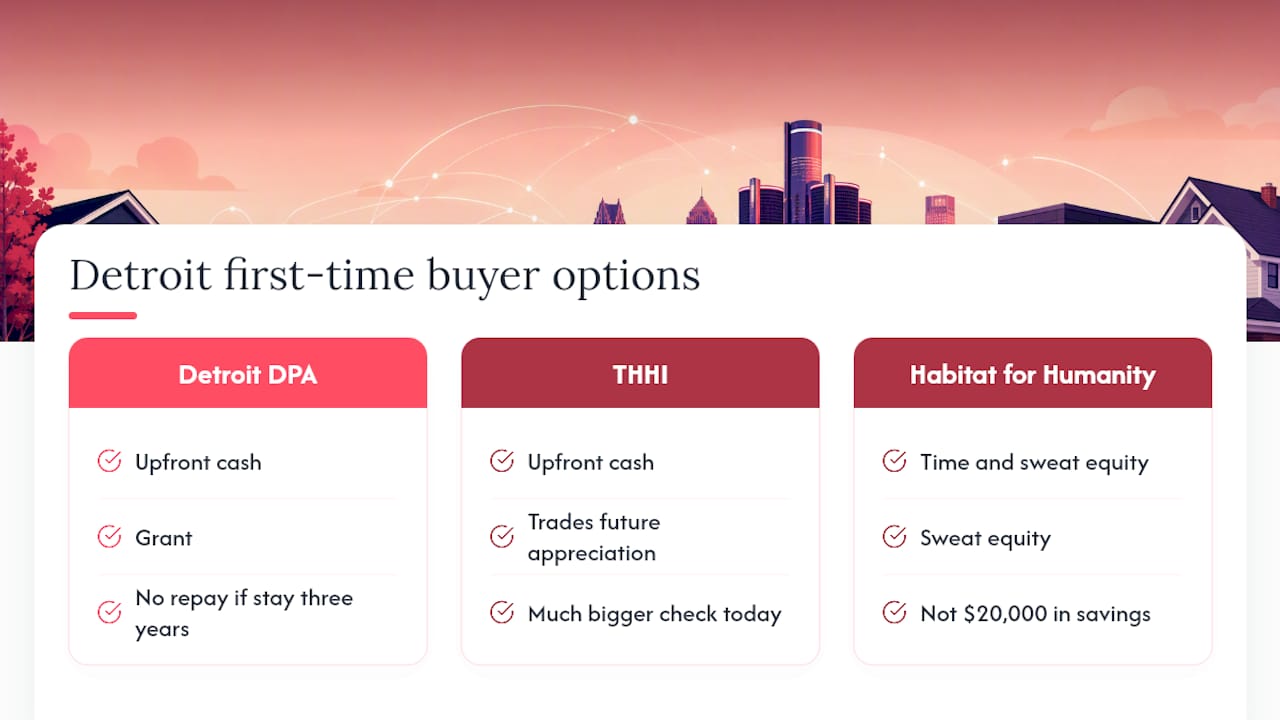
Here’s how the major options stack up against each other:
A few things jump out here. The Detroit DPA and THHI both solve the same core problem, upfront cash, but through opposite mechanics: one is a grant you don’t repay if you stay put three years, the other trades future appreciation for a much bigger check today. Habitat for Humanity solves a different problem entirely: it’s for buyers who have time and sweat equity but not $20,000 sitting in a savings account.
If you’re not sure where you land, CompareSpot’s Metro Detroit mortgage lender rankings can help you find lenders who’ve actually processed DPA and MSHDA paperwork before, which matters more than you’d think once you’re mid-transaction.
What Mortgage Types Are Available to First-Time Buyers in Michigan?
Most first-time buyers in Michigan end up choosing between four loan types, and each one fits a different financial picture.
- Conventional loans work best if you have a credit score above 680 and can put down at least 3-5%. They’re not backed by a government agency, so approval leans harder on your credit history and debt-to-income ratio.
- FHA loans are the go-to for buyers with lower credit scores or minimal savings. FHA allows scores as low as 580 with 3.5% down, and sometimes lower scores with a larger down payment.
- VA loans serve veterans and active-duty service members, often with zero down payment and no mortgage insurance requirement.
- USDA loans apply only to eligible rural and some suburban areas outside Detroit’s city limits, and they also allow zero down payment for qualifying buyers.
On top of loan type, you’ll choose between a fixed-rate mortgage and an adjustable-rate mortgage (ARM). A fixed rate locks your interest rate for the life of the loan, which is usually the safer call for a first-time buyer planning to stay put for years. An ARM starts with a lower rate that adjusts after an initial period, typically five, seven, or ten years. It can make sense if you know you’ll sell or refinance before the adjustment kicks in, but it’s a riskier bet for someone buying their first home with no track record of navigating rate changes.
Loan type also determines which assistance programs you can pair with your mortgage. The MI Home Loan program, for instance, supports conventional, FHA, USDA (referred to as RD), and VA loans, but the lender still has to be one that participates in MSHDA programs. Not every lender does. Ask before you fall in love with a particular loan officer.
Pro Tip: Get quotes on both a conventional loan and an FHA loan before you commit. FHA mortgage insurance premiums can add up over the life of the loan, and a slightly higher credit score might save you more with conventional financing than the lower FHA down payment saves you upfront.
How Does the City of Detroit Down Payment Assistance Program Work?
The Detroit DPA is the single biggest local grant available to first-time buyers, and it’s worth understanding in detail because the eligibility rules are specific. As of March 2026, the program provides up to $25,000 for qualified homebuyers earning at or below 80% of the Area Median Income.
Eligibility comes down to a short checklist:
- You must have lived in Detroit for at least 12 months, with an exception carved out for households displaced by tax foreclosure.
- You (and your household) cannot have owned a home in the past three years.
- Your household income must fall at or below 80% AMI. According to BridgeDetroit’s reporting on the program’s income limits, that threshold varies based on household size within program limits.
- You need to be prequalified with a participating lender and have a signed purchase agreement on a specific home before you apply. This isn’t a “get the grant, then go shopping” program. It works the other way.
The money itself can go toward the down payment, prepaid costs like insurance and taxes, an interest-rate buy-down, or closing costs, but the Apply Now page caps total assistance at a portion of your eligible costs. You’ll also need to plan on living in the home as your principal residence for three years; leave earlier and a prorated portion of the grant gets recaptured.
Funding comes from Community Development Block Grant (CDBG) and CDBG-DR sources, and the program runs in first-come, first-served rounds rather than as an always-open pot of money. Some rounds prioritize applicants affected by flooding, so timing and eligibility can shift between rounds. Have your appraisal (Form 1004), mortgage application (Form 1003), title insurance, and flood determination ready, because the application moves fast once a round opens and a stalled document can knock you out of contention.
What Is the MSHDA MI Home Loan Program?
The MI Home Loan is Michigan’s statewide answer to the first-time buyer problem, and it works alongside Detroit’s local grant rather than competing with it. Where the Detroit DPA is capped by city residency and 80% AMI limits, the MI Home Loan reaches buyers anywhere in the state, including outside Detroit’s boundaries.
The core numbers: MSHDA requires a minimum credit score of 640, and the statewide sales price limit sat at $566,355 as of June 1, 2026. That’s a high enough ceiling that most Detroit starter homes, which run well below the metro median, fit comfortably underneath it.
What makes MI Home Loan especially useful for first-timers is what it bundles in:
- MI 10K DPA Loan — a companion product offering up to $10,000 in down payment assistance, layered directly onto the MI Home Loan.
- Mortgage Credit Certificate (MCC) — a federal tax credit that can reduce your annual tax liability based on mortgage interest paid, worth asking your lender about even if you don’t think you qualify.
The practical difference between MI Home Loan and the Detroit DPA comes down to reach and stacking rules. Detroit’s grant tops out higher at $25,000, but it’s locked to city residents under 80% AMI. MI Home Loan’s $10,000 companion assistance is smaller, but it’s available to first-time buyers across Michigan and works through a different network of participating lenders. Some buyers use MI Home Loan as their primary mortgage and still pursue Detroit DPA separately for additional closing cost coverage, so it’s worth asking a lender familiar with both whether stacking makes sense for your specific purchase.
Finding a lender who processes MSHDA loans regularly matters here. Not every mortgage company on Metro Detroit’s main streets is set up to handle MI Home Loan paperwork efficiently, and a lender who does five of these a year moves faster than one who does five a decade.
What Other Homeownership Programs Exist for Detroit Buyers?
Grants and state loans aren’t the only path into homeownership. Two other routes deserve serious consideration, especially for buyers who don’t fit neatly into standard DPA income brackets or credit thresholds.
The Tobias Harris Homeownership Initiative launched in September 2025 as a shared-appreciation pilot, and it works differently from anything else on this list. Instead of a grant you pay back only if you sell early, THHI provides substantial down payment assistance based on a share of the home’s purchase price with no added monthly payment. When you eventually sell or refinance, you repay the assistance as a share of the home’s appreciation rather than as a fixed loan balance. The program runs through a partnership with Guild Mortgage and Homium, and it’s structured so the first mortgage can close without private mortgage insurance.
That structure sounds appealing, and for buyers who genuinely can’t assemble a large down payment otherwise, it is. But shared-appreciation deals trade something real: a slice of your future equity. If Detroit home values climb sharply in your neighborhood over the next decade, you’ll owe more back than you would with a flat second-lien loan. Financial advisors generally recommend running the numbers both ways, a shared-appreciation scenario versus a traditional forgivable grant, before signing.

Habitat for Humanity Detroit takes a completely different approach. Instead of cash assistance, it uses a sweat-equity model: candidates contribute a significant number of hours of labor plus required homeowner education classes in exchange for an affordable mortgage with no traditional down payment barrier. It’s slower and more hands-on than applying for a grant, but it’s built for buyers who have time and commitment rather than a lump sum saved up.
When you’re weighing these against each other, think in terms of what you’re trading:
- Grant-based assistance (Detroit DPA) costs you nothing extra as long as you meet the occupancy requirement.
- Shared-appreciation assistance (THHI) costs you a portion of future home value growth.
- Sweat-equity assistance (Habitat for Humanity Detroit) costs you time and physical labor instead of cash.
There’s no universally “best” option among the three. There’s only the option that matches what you actually have to offer, cash, time, or long-term equity flexibility.
From Prequalification to Closing: What the Timeline Looks Like
The order of operations trips up more first-time buyers than any single eligibility rule. Programs like the Detroit DPA require a signed purchase agreement before they’ll even review your application, which means you can’t apply for assistance and then go house hunting. You have to house hunt first.
- Get prequalified with a mortgage lender. This step also determines which DPA programs you’ll qualify to pursue, since some require lender prequalification as a prerequisite.
- Find a property and sign a purchase agreement. This is the trigger point for most DPA applications.
- Complete required homebuyer education. BridgeDetroit’s coverage of the DPA reopening confirms applicants need a HUD-approved homebuyer education course completed before applying, so don’t leave this for the last week.
- Submit your DPA and/or MSHDA application. Have your documents ready: appraisal (1004), mortgage application (1003), title insurance, and loan estimate.
- Move through underwriting and appraisal on your primary mortgage, while the DPA review runs in parallel.
- Close. DPA funds typically get applied at the closing table alongside your mortgage.
Bottlenecks usually show up in two places: a lender unfamiliar with DPA paperwork slows the review window, and funding rounds that close before your application clears can force a restart. That’s why lender selection matters as much as loan selection.
Here’s what typical closing costs look like and who tends to cover them:
| Cost item | Typical range | Who covers it |
|---|---|---|
| Down payment | 3-20% of purchase price | Buyer, often supplemented by DPA |
| Prepaid taxes and insurance | Varies by home value | Buyer, can be covered by DPA |
| Interest-rate buy-down | Optional, lender-quoted | Can be covered by DPA funds |
| Closing costs (title, recording, lender fees) | Several thousand dollars | Buyer, seller credit, or DPA |
| Appraisal fee | Paid upfront | Buyer |
Keep a folder ready with your purchase agreement, pay stubs, tax returns, bank statements, and ID. Lenders and DPA reviewers will ask for the same documents more than once during the process, so having digital copies on hand saves days.
How Do You Choose a Mortgage Lender in Detroit?
Not every lender is equally comfortable with Detroit’s DPA and MSHDA paperwork, and picking the wrong one can cost you weeks. Look for lenders with a documented track record closing loans that involve city or state assistance programs, not just a general mortgage business.
A few criteria to filter on:
- Direct DPA/MSHDA experience. Ask how many Detroit DPA or MI Home Loan transactions they’ve closed in the past year.
- Local closing track record. A lender who regularly closes in Wayne County knows the title companies, appraisers, and timelines that matter here.
- Fee transparency. Get a written loan estimate early and compare origination fees across at least two lenders.
- NMLS registration. Every legitimate mortgage professional carries an NMLS number, checkable through NMLS Consumer Access.
- References from recent first-time buyers, ideally someone who used the same assistance program you’re pursuing.
When you interview a lender, ask direct questions: How many Detroit DPA applications have you processed? What’s your average DPA turnaround time? Do you require a specific title company? What credit score do you typically need for the loan products you’re recommending? Vague answers to any of these are a warning sign. A lender who can’t tell you their average DPA turnaround time probably hasn’t handled many.
Watch for red flags too. If a lender keeps steering you toward seller credits instead of discussing DPA eligibility, or can’t name any participating lenders’ list they’ve worked from before, that’s worth a second opinion. For a structured list of interview questions and what to expect from lender evaluations, Kenneth Hogan’s first-time buyer guide walks through a useful framework, and a deeper look at how lenders evaluate income, debt, and reserves can help you understand what’s actually happening behind the scenes of your approval.
Pro Tip: Before your first meeting with any lender, look them up on NMLS Consumer Access. It takes thirty seconds and confirms they’re licensed to originate mortgages in Michigan, no exceptions.
How CompareSpot Ranks Metro Detroit Mortgage Lenders
Finding a lender who checks every box above, DPA experience, fee transparency, a fast local closing record, takes real research. CompareSpot builds its Metro Detroit lender rankings around exactly that gap.
The methodology draws on public records, review analysis across verified customer feedback, and direct evaluation of how responsive lenders are when contacted with program-specific questions. The evaluation weighs local coverage across Wayne, Oakland, and Macomb counties, documented DPA and MSHDA experience, transparency around fees and timelines, and how consistently a lender follows through on stated turnaround times.
That mapping matters most for first-time buyers navigating a program with a hard deadline, like a DPA funding round closing on a specific date. A lender who’s slow returning calls or unclear about paperwork can cost you the round entirely. CompareSpot’s rankings filter for lenders who’ve demonstrated they can move at the pace these programs demand, so you’re not learning that the hard way mid-transaction. You can browse the current Metro Detroit lender rankings filtered by program participation and local coverage area.
A Note From a Local Guide on Timing
The one thing that trips up more first-time buyers than credit scores or income limits is timing coordination. Your lender, your real estate agent, and the DPA program office all operate on different clocks, and if you don’t manage that overlap yourself, something slips. A signed purchase agreement that sits for two extra weeks while you wait on a homebuyer education certificate can push you into the next funding round entirely.
Most people are surprised to learn the mortgage payment itself usually isn’t the hard part. It’s often close to what they’re already paying in rent. The real barrier is the upfront cash and the paperwork sequencing, getting prequalified, signing the agreement, finishing the education course, and submitting the DPA application in the right order and on time.

Call a lender now, even if you’re still months from house hunting, and register for homebuyer education today. Both take almost no time upfront and save weeks later.
Find a Metro Detroit Lender or Agent With CompareSpot
Comparing lenders one by one, checking NMLS registrations, reading through scattered reviews, and guessing which ones actually process DPA paperwork efficiently eats up time you could be spending on your home search. CompareSpot’s Metro Detroit mortgage lender rankings pull that research into one place, evaluated against local coverage, program experience, and real customer feedback rather than paid placement.
If your search includes down payment assistance or MSHDA financing, start with CompareSpot’s Metro Detroit mortgage lender rankings to see which lenders have the track record to match. Pairing with an experienced Metro Detroit real estate agent who’s closed DPA transactions before can smooth the timeline even further, since your agent and lender need to move in sync once you’re under contract. Check the current rankings and shortlist two or three lenders before you sign anything.
Key Takeaways: What to Do Next
First-time buyers in Detroit have real, stackable paths to homeownership, but the assistance only works if the paperwork sequence, prequalification before purchase agreement, purchase agreement before DPA application, matches how these programs are actually built.
| Point | Details |
|---|---|
| Get prequalified first | Talk to a lender with DPA or MSHDA experience before you start house hunting. |
| Confirm your eligibility bracket | Check Detroit residency, 12-month rule, and 80% AMI income limits against the $58,700 to $110,700 range. |
| Sign before you apply | Detroit DPA requires a signed purchase agreement before the application can move forward. |
| Compare assistance types | Weigh the Detroit DPA grant against THHI’s shared-appreciation model based on what you can afford to trade. |
| Use CompareSpot to shortlist lenders | CompareSpot’s Metro Detroit rankings help you find lenders experienced with local DPA and MSHDA transactions before you commit. |
Where to Verify Official Program Details
Program rules, funding rounds, and income limits shift, so confirm details directly with the source before applying.
- City of Detroit Down Payment Assistance Program — process overview and required steps.
- Apply Now — Detroit DPA — current application requirements and documents.
- MSHDA MI Home Loan — statewide eligibility, credit score, and sales price limits.
- U.S. Department of Housing and Urban Development — national AMI definitions and homebuyer resources.
- NMLS Consumer Access — verify any lender’s licensing before you commit.
Confirm current funding round status and participating lender lists directly on these pages before submitting any application, since rounds open and close on their own schedule.
This article is general information, not a substitute for advice from a qualified financial advisor. Consult a qualified financial professional about your own circumstances before acting on anything here.
Sources
- Apply Now | City of Detroit
- MI Home Loan | Michigan State Housing Development Authority
- Buy a home | Habitat for Humanity Detroit
FAQ
What grants are available for first-time homebuyers in Michigan?
The two biggest are the City of Detroit’s Down Payment Assistance Program, offering up to $25,000 for eligible city residents, and MSHDA’s MI 10K DPA Loan, offering up to $10,000 statewide alongside the MI Home Loan.
What is the $25,000 grant for Detroit residents?
How do I buy a house for the first time in Michigan?
Start by getting prequalified with a lender, then find a home and sign a purchase agreement, complete required homebuyer education, apply for down payment assistance like the Detroit DPA or MI Home Loan, and move through underwriting to closing.
What is the minimum credit score required to buy a house in Michigan?
MSHDA’s MI Home Loan program requires a minimum credit score of 640, though FHA loans through other lenders can accept scores as low as 580 with a larger down payment.
Can CompareSpot help me find a lender who works with Detroit’s DPA program?
Yes. CompareSpot’s Metro Detroit mortgage lender rankings evaluate local lenders on their experience with DPA and MSHDA transactions, helping first-time buyers shortlist lenders who can move efficiently through program paperwork.