

A portfolio loan is a mortgage the lender keeps on its own books instead of selling it, so the lender writes its own rules. The upside is flexibility: it can work when your income, credit or property doesn’t fit a standard checklist. The downside is cost: you usually pay a higher rate and higher fees, and some loans end in a balloon payment. If your file is clean and conventional, a conventional loan is normally cheaper. If it isn’t, a portfolio loan can be the way to get the deal done.
TL;DR
- A portfolio loan stays with the lender, which sets its own underwriting guidelines and terms instead of following secondary-market rules.
- Pros: flexible approval for self-employed buyers, recent credit events and unusual properties, plus faster closings and fewer limits on investment property counts.
- Cons: higher rates (commonly quoted at 0.5 to 2 percentage points above conventional), higher fees, possible prepayment penalties and balloon payments.
- Best fit: borrowers whose situation makes sense but doesn’t fit the standard form. Best avoided when you qualify easily for a conventional or FHA loan.
- Compare lenders on the Loan Estimate, not the advertised rate.
Table of Contents
- What a portfolio loan is and how it works
- The pros of a portfolio loan
- The cons of a portfolio loan
- Portfolio loan vs. conventional: a quick side-by-side
- Who a portfolio loan fits
- What lenders look at
- How to compare portfolio loan offers
- A worked example
- Selling first? Check your timeline
- Promo: Compare local lenders without paid placement
- Perspective
- FAQ
- Sources
What a portfolio loan is and how it works
Most mortgages are originated and then sold to investors on the secondary market, including Fannie Mae and Freddie Mac. To be sold, a loan has to meet their standardized rules on credit, debt-to-income ratio, documentation and property type.
A portfolio loan skips that step. The bank, credit union or other lender keeps the loan in-house, which means it holds the default risk itself. Because it carries that risk, it is free to decide who qualifies and on what terms. Underwriting often becomes more of a conversation with a person than a pass or fail from an automated system.
Portfolio lenders are often smaller, privately owned community banks, and they do not answer to outside investors when setting their guidelines. That is where both the advantages and the costs come from.

The pros of a portfolio loan
Flexible underwriting
This is the main reason borrowers look at portfolio loans. Lenders can evaluate the whole case instead of relying only on conforming checklists, which helps people with nontraditional income, credit histories or other guideline gaps.
One portfolio program describes looking at compensating factors such as reserves, equity, cash flow and overall financial strength. It accepts full documentation, bank statements, CPA-prepared profit and loss statements, or asset depletion. That matters if you are self-employed and your tax returns show less income than you really earn.
A second chance after a credit event
Conventional programs typically make you wait years after a foreclosure or bankruptcy. One lender states that its portfolio programs can approve borrowers as soon as 12 to 24 months after a bankruptcy discharge or foreclosure, compared with 2 to 7 years for conventional programs. Terms vary by lender, so treat this as a range to ask about, not a promise.

Unusual or hard-to-finance properties
Portfolio loans can cover property types that standard mortgages may not, such as 1 to 4 unit buildings or complex properties. Non-warrantable condos and mixed-use buildings are common examples, and Texana’s guidelines list them as fits for this kind of loan. Portfolio lenders also often don’t require a property to be in a particular condition, which is relevant if you are buying a home that needs work.
Room for investors to grow
Traditional lenders may not finance more than five investment properties, while portfolio lenders often don’t restrict the number you can buy. A cross-collateral portfolio loan can also finance several properties under a single mortgage, which one bank notes can go beyond the ten-property conventional cap. One payment is simpler to track than five.
Jumbo and super jumbo financing
Portfolio loans make it easier to finance homes above conforming loan limits. A super jumbo loan generally means a mortgage over $3 million. Most Metro Detroit buyers will never need this, but some high-net-worth buyers will.
Faster closings, sometimes
Without secondary market compliance steps, the process can move quicker. One source reports community bank portfolio loans closing in two to three weeks, against 45 to 60 days for conventional investment property loans. Another puts the general range at one to six weeks, depending on how complex your finances are and how complete your paperwork is. Speed helps in a competitive offer, and it matters when you are selling and buying on a deadline.
Privacy and ownership structure
Some portfolio lenders allow you to hold title in a trust, LLC, S corporation or partnership, which can protect privacy and reduce personal liability. For investors, that structure can be the whole reason to choose this route.
The cons of a portfolio loan
A higher rate and higher fees
Because the lender holds the default risk, portfolio loans are often priced with higher rates, higher fees, and sometimes prepayment penalties. Published figures differ by lender and by how far your file sits from conventional:
| Cost item | Reported range | Source |
|---|---|---|
| Rate premium over conventional (close to the conventional box) | 0.25% to 0.75% | Lender guide |
| Rate premium (recent credit event or high LTV on a complex property) | 0.75% to 1.5% or more | Lender guide |
| Rate premium, general | 0.5 to 2 percentage points | Legal and finance explainer |
| Origination charges | 1% to 2% of the loan, vs. about 1% conventional | Legal and finance explainer |
| Typical down payment | 15% to 30% | Chase education page |
These are third-party estimates, not quotes. Your own rate depends on your credit, your loan-to-value ratio and the property.
The premium compounds over time. One analysis estimates that even a 1-percentage-point premium on a $400,000 loan adds roughly $90,000 in extra interest over 30 years. That is why a portfolio loan is worth it only when it solves a problem a cheaper loan can’t.
Bigger down payments and tighter loan-to-value limits
Lenders often want 70% to 75% loan-to-value on complex scenarios, versus 80% to 97% on conventional loans. Qualifying standards can still be stringent for larger loans or higher-risk properties. Flexible does not mean easy.
Balloon payments and shorter terms
Some portfolio loans run 5 to 10 years but are amortized over 20 to 30, which leaves a balloon payment at the end. If you can’t refinance when it comes due, you face what one analysis calls a financial cliff. Before you sign, know the date the balloon is due and plan how you’ll handle it. A guide on refinancing versus restructuring can help you think through the options early, before a deadline forces your hand.
Prepayment penalties
Portfolio lenders may charge a prepayment fee that raises the overall cost, and borrowers should negotiate terms that allow an easier refinance. Non-QM portfolio loans can carry penalties that run longer than the federal qualified mortgage caps of 2% in the first two years and 1% in the third. If you plan to refinance or sell within a few years, this clause matters as much as the rate.
Cross-collateralization for investors
When one loan covers several rentals, all of them secure that loan. Investors weighing rental portfolio loans should account for cross-collateralization exposure, along with larger down payments and prepayment penalties. If one property struggles, the others are on the line.
No standard terms
Terms vary widely between portfolio lenders, which makes shopping harder. Your loan can also still be sold or moved to a different servicer. Read the note, not just the summary.
Portfolio loan vs. conventional: a quick side-by-side
| Factor | Portfolio loan | Conventional loan |
|---|---|---|
| Who sets the rules | The lender | Fannie Mae and Freddie Mac guidelines |
| Credit and income flexibility | Higher | Lower |
| Rate | Usually higher | Usually lower |
| Fees | Usually higher | Usually lower |
| Property types | Wider range | Standardized |
| Number of financed properties | Few or no caps | Capped |
| End of term | Balloon possible | Fully amortizing standard |
| Comparison shopping | Harder | Easier |
If you’re also weighing government-backed options, see our breakdown of FHA vs. conventional before you assume you need a portfolio loan.
Who a portfolio loan fits
A portfolio loan tends to make sense when:
- You are self-employed and your documented income understates your cash flow.
- You had a recent foreclosure, short sale or bankruptcy and have rebuilt since.
- You’re buying a non-warrantable condo, mixed-use or unique property that conventional lenders decline.
- You are an investor who has hit the conventional property cap, or who wants to hold title in an LLC or trust.
- You need a jumbo amount that conforming rules don’t handle well.
It makes less sense when you have solid credit, steady W-2 income and a standard single-family home. In that case, the cheaper rate on a conventional loan is hard to beat. The question to ask is whether the flexibility is worth the premium. If the alternative is no loan at all, it often is.
One more distinction: portfolio lending is a real long-term mortgage, not a short-term bridge like hard money. Hard money loans are priced and structured differently, so don’t compare the two on rate alone.
What lenders look at
Because the lender keeps the risk, asset quality is central. A strong property in a good market with a conservative loan-to-value ratio gives the lender confidence the collateral is recoverable if you hit trouble. Typical credit score floors reported by lenders sit around 600 to 650, though one program accepts 620, and lower case by case with compensating factors. Lenders may weigh liquid assets, asset-based income and property cash flow instead of relying only on standard debt-to-income rules.
What helps your file:
- Cash reserves that you can document.
- Meaningful equity or a larger down payment.
- Clean, organized income paperwork, such as bank statements or a CPA-prepared P&L.
- A written explanation of any past credit event and what changed since.
- A property that appraises well and is easy to resell.
How to compare portfolio loan offers
Since there is no standard product, a rate quote alone tells you little. Ask each lender for a Loan Estimate and compare these items:
- Rate type: fixed or adjustable, and when it adjusts. Our guide to fixed vs. adjustable mortgages shows how to match this to your timeline.
- Term and amortization: is there a balloon, and when is it due?
- Prepayment penalty: the amount, how long it lasts, and whether it applies if you sell.
- Origination fee and closing costs: the total cash to close.
- Cost over your real holding period: our method for comparing mortgage offers looks at what you will actually pay over your first five years.
Also compare lender types. Portfolio loans often come from smaller banks and credit unions, so our piece on bank vs. credit union mortgages is a useful companion. Brokers can sometimes reach portfolio lenders you wouldn’t find on your own, and our explainer on mortgage brokers vs. lenders covers that trade-off.
A worked example
Say you’re self-employed, buying a $300,000 home with 20% down, so you borrow $240,000. If a conventional lender can’t count your income, a portfolio lender might approve you using bank statements. Suppose its rate is 1 percentage point higher. The premium compounds into a large sum over 30 years, in line with the $90,000 estimate on a $400,000 loan quoted earlier. That cost isn’t a reason to skip the loan if it’s your only path to the house. It is a reason to plan: build your documentation, make sure there’s no prepayment penalty that blocks a refinance, and aim to move to a conventional loan once your tax returns catch up. A loan that’s easy to refinance out of turns a higher rate into a temporary cost.
Selling first? Check your timeline
Many Metro Detroit buyers who look at portfolio loans are also selling a house, and the sale and purchase have to line up. If you need to sell fast, we rank the local options on our Metro Detroit cash home buyers page, and you can compare financing on our Metro Detroit mortgage lenders rankings. For local context, read our guide to home loans in Metro Detroit.
Promo: Compare local lenders without paid placement
CompareSpot publishes independently researched rankings of mortgage lenders, real estate agents and cash home buyers across Wayne, Oakland and Macomb counties. Providers can’t pay for placement, and we update rankings quarterly with a transparent methodology.
If you’re lining up financing, start with our Metro Detroit mortgage lender rankings.
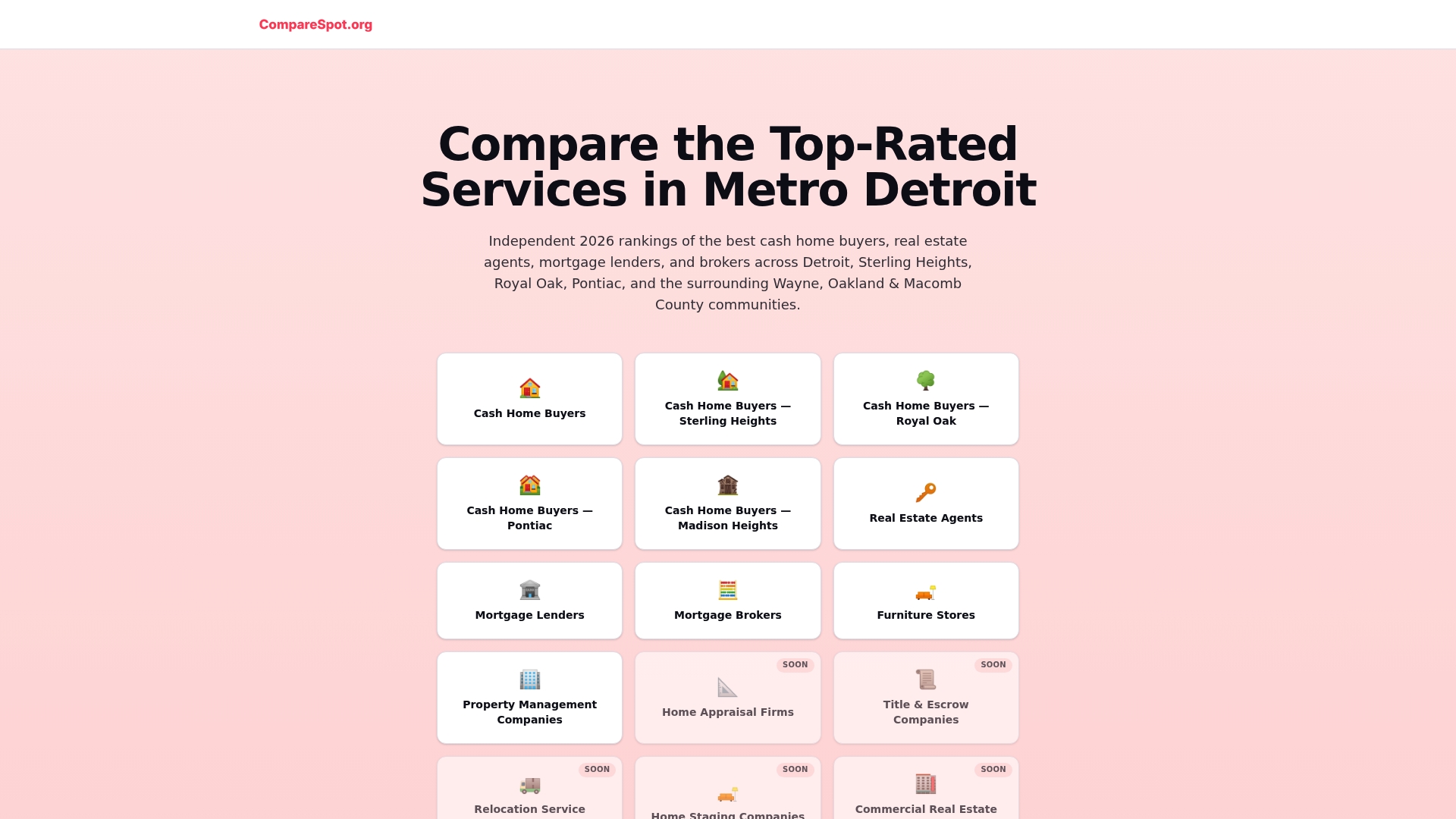
If you also need to sell, our agent rankings are the next stop.
Perspective
Every week we see Metro Detroit buyers assume a turned-down application means they can’t buy. Often it only means the file didn’t fit one lender’s standard form. Self-employed owners, buyers rebuilding after a hardship and investors adding a second or third property are the people portfolio lending exists for.
Our view is simple: use the flexibility, but don’t pay for it blindly. Compare the Loan Estimates side by side, look hard at the prepayment clause and any balloon date, and make a plan to refinance if your situation improves. That is why we rank lenders on research and customer sentiment rather than on who pays us, and why we tailor the rankings to Wayne, Oakland and Macomb counties instead of giving you a national average.
A good local lender, whatever loan type it writes, explains the terms plainly and doesn’t rush you. Use our rankings to find those lenders first.
Bryan
FAQ
Are portfolio loans a good idea?
They can be when you don’t fit conventional guidelines, for instance with nontraditional income, a recent credit event or an unusual property. They usually cost more, so they are less attractive if you qualify for a standard loan. Compare the full Loan Estimate, including fees and prepayment terms, before deciding.
Are portfolio loan rates higher than conventional rates?
Usually, yes. Published estimates range from about 0.25% to 0.75% higher for near-conventional files to 0.5 to 2 percentage points higher in general. Your rate depends on your credit, down payment and property.
What credit score do I need for a portfolio loan?
There is no single minimum, because each lender sets its own. Reported floors run from around 600 to 650, and some programs consider lower scores case by case when you have strong reserves, equity or cash flow.
Do portfolio loans have prepayment penalties?
Some do. Lenders may charge them, and they can raise your total cost if you refinance or sell early. Ask for the penalty amount and duration in writing, and try to negotiate terms that allow a clean refinance.
Can I use a portfolio loan to buy several rental properties?
Often, yes. Portfolio lenders may not cap the number of properties you finance, and cross-collateral loans can bundle several under one mortgage. Remember that bundling means every property secures the same loan.
Sources
- What Is a Portfolio Loan? (Business Insider)
- Understanding Portfolio Lenders: Benefits, Risks, and More (Investopedia)
- What Is a Portfolio Mortgage? (Experian)
- Portfolio Loan: Flexible Guidelines (Texana Bank)
- Portfolio Loans: Rates, Requirements and How They Work (Lumen Mortgage)
- Portfolio Loans in Oregon and California (Lumen Mortgage)
- What Is a Portfolio Loan and How Does It Work? (Chase)
- What are the Advantages of a Portfolio Loan? (NASB)
- What Is a Portfolio Loan? (Axos Bank)
- Portfolio Loans in 2026: Your Complete Guide (AmeriSave)
- Portfolio Loans: Finance Multiple Investment Properties (Neuhaus Realty Group)
- Are Portfolio Loans a Good Idea? Pros and Cons (LegalClarity)
- Rental Property Portfolio Loans (Biz2Credit)
- Portfolio Loans: A Complete Guide (Rocket Mortgage)