

TL;DR:
- A fixed-rate mortgage is best for borrowers staying more than seven years or seeking payment certainty. An adjustable-rate mortgage can save money initially but poses risks if rates rise beyond your ability to pay. Your decision should depend on your timeline, exit plan, and ability to afford potential payment increases.
If you plan to stay in the home more than seven years and need predictable payments, a fixed-rate mortgage is almost always the right call. If you have a firm plan to sell or refinance before the first rate reset, an adjustable-rate mortgage (ARM) can save you real money upfront. The CFPB puts it plainly: the core question is whether you can still afford the payment if the rate rises to the loan’s contractual maximum. Comparespot’s editorial research for Metro Detroit borrowers consistently points to the same two decision triggers: your timeline and your exit plan.
Table of Contents
- How does a fixed vs adjustable mortgage actually compare?
- How does a fixed-rate mortgage work?
- How does an ARM work?
- What do the monthly payments actually look like?
- What are the real risks, and how do you check for them?
- How do you choose between fixed and adjustable?
- What are your exit strategies if you have an ARM?
- Key Takeaways
- The Metro Detroit angle matters more than most guides admit
- Useful sources to verify rates and run your own numbers
- FAQ
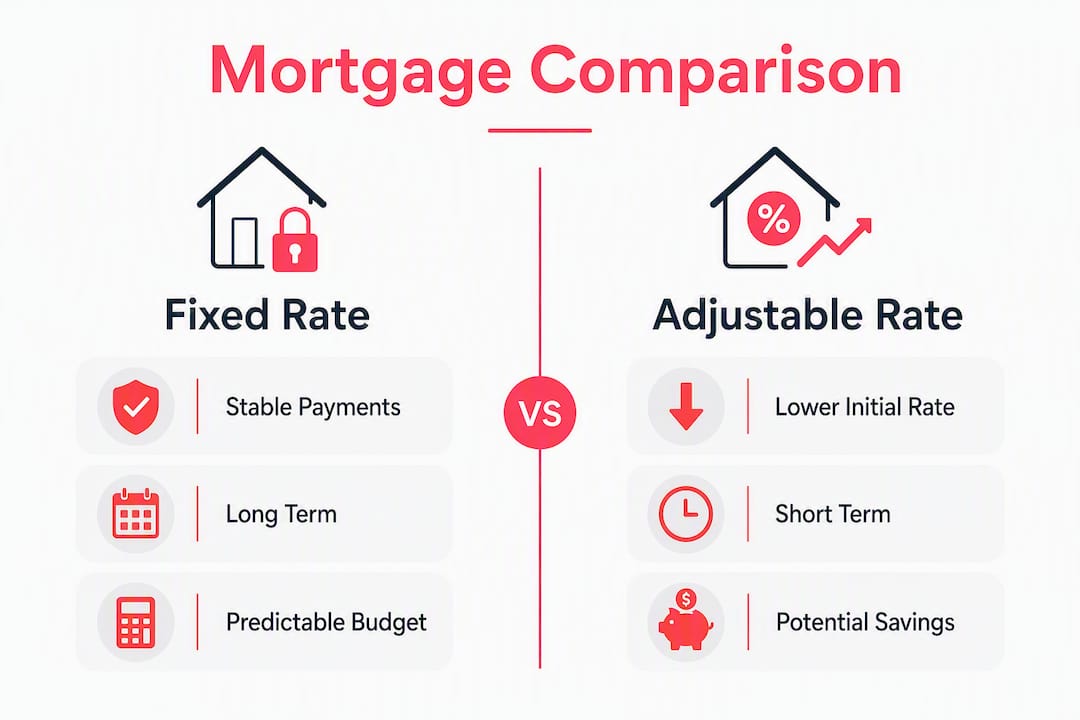
How does a fixed vs adjustable mortgage actually compare?
The table below covers the dimensions that matter most when you are deciding between these two loan types.
| Dimension | Fixed-Rate Mortgage | Adjustable-Rate Mortgage (ARM) |
|---|---|---|
| Initial interest rate | Higher at closing | Lower at closing (commonly lower than a 30-year fixed) |
| Payment predictability | Fully stable for the loan’s life | Stable during intro period, then variable |
| Typical loan terms | 15-year, 30-year | 5/1, 7/1, 10/1 (intro period / adjustment frequency) |
| Ideal borrower timeline | Staying 7+ years | Selling or refinancing before first reset |
| Refinance risk | Low (rate already locked) | Higher after fixed window closes |
| Rate caps | N/A | Initial cap, periodic cap, lifetime cap |
| Rate floor | N/A | Often present in contract |
Choose a fixed rate if: you value payment certainty above all else, or you cannot confidently predict when you will sell.
Choose an ARM if: you have a clear, high-confidence exit plan before the first adjustment date and want to keep monthly costs lower during that window.
Common ARM formats include those with an initial fixed period of five, seven, or ten years and subsequent annual adjustments. The first number is the initial fixed period in years; the second is how often the rate adjusts after that (annually, in most cases). A 7/1 ARM locks your rate for several years, typically seven, then resets every year based on a market index plus the lender’s margin.
How does a fixed-rate mortgage work?
A fixed-rate mortgage locks your interest rate at closing and keeps it there for the entire loan term, whether that is 15 years or 30. Your principal and interest payment never changes, which makes budgeting straightforward regardless of what the Federal Reserve does with benchmark rates.
Key structural features:
- Rate locked at closing. Whatever rate you negotiate on signing day is the rate you carry to payoff.
- Amortization front-loads interest. In the early years, most of each payment covers interest; principal paydown accelerates over time. On a 30-year loan, you will not reach 50% equity through payments alone until roughly year 18 or 19.
- Term choice changes total interest sharply. A 15-year term carries a lower rate than a 30-year and cuts total interest paid nearly in half, but the monthly payment is substantially higher.
- No adjustment risk. Rising rates in the broader market have zero effect on your payment once the loan closes.
A practical illustration: On a $350,000 loan at 7.00% fixed for 30 years, the monthly principal and interest payment is approximately $2,329. At 6.25% fixed for 15 years, the payment rises to roughly $3,002 per month, but total interest paid over the life of the loan drops by more than $200,000. The right term depends on your monthly cash flow, not just the rate.
The fixed-rate structure suits buyers who plan to stay long-term, those on fixed incomes, and anyone who would lose sleep watching rate headlines.
How does an ARM work?

An ARM starts with a fixed introductory rate, then adjusts periodically based on a market index plus a lender-set margin. The index fluctuates with market conditions; the margin is permanent. Add them together and you get the fully indexed rate, which is what your payment will be based on after each adjustment.

The index and margin
Most ARMs now use SOFR (Secured Overnight Financing Rate) as the index after LIBOR was discontinued. SOFR is published daily by the Federal Reserve Bank of New York. The lender’s margin typically runs 2.5–3.0 percentage points on top of whatever SOFR is at the adjustment date.
So if SOFR is at 4.50% and your margin is 2.75%, your new rate after reset would be 7.25%, subject to caps.
Caps and floors
Caps limit how far your rate can move. Three types matter:
- Initial cap: limits the first adjustment (commonly 2%).
- Periodic cap: limits each subsequent annual adjustment (commonly 1–2%).
- Lifetime cap: the maximum total increase over the start rate (commonly 5%).
A rate floor means the rate cannot fall below a set minimum even if the index drops sharply. This protects the lender, not you.
Example worst-case scenario: Start at 6.375% on a 5/1 ARM with a 2% initial cap, 2% periodic cap, and 5% lifetime cap. At adjustment points, the rate can increase significantly within the limits set by the initial, periodic, and lifetime caps, potentially more than doubling from the start rate. That is a significant payment increase from where you started.
Contract items to verify before signing:
- Which index does the loan use (SOFR, or something else)?
- What is the exact margin?
- What is the full cap schedule (initial, periodic, lifetime)?
- Is there an interest rate floor?
- Does the loan allow negative amortization or interest-only periods?
- How is the payment recalculated at each reset?
What do the monthly payments actually look like?
The table below uses a $350,000 loan to show how payments compare across scenarios. Assumptions: 30-year fixed at 7.00%; 5/1 ARM initial rate at 6.375% (roughly 0.625% below the fixed rate); ARM margin of 2.75%; caps of 2% initial, 2% periodic, 5% lifetime.
| Scenario | Rate | Monthly P&I (approx.) |
|---|---|---|
| 30-year fixed | 7.00% | $2,329 |
| 5/1 ARM — initial period (years 1–5) | 6.375% | $2,184 |
| 5/1 ARM — first reset (year 6, +2% cap) | 8.375% | $2,570 |
| 5/1 ARM — second reset (year 7, +2% cap) | 10.375% | $2,975 |
| 5/1 ARM — lifetime cap scenario | 11.375% | $3,192 |
During the fixed window, an ARM can save a meaningful amount per month compared to a 30-year fixed loan, accumulating to a substantial total over several years. After the first reset, the ARM payment exceeds the fixed-rate payment by $241 per month. By the lifetime cap, the gap is $863 per month.
Pro Tip: Before you sign an ARM, calculate the monthly payment at the lifetime cap rate using a basic mortgage calculator. If that number would strain your budget, the ARM is not the right product for you regardless of the initial savings.
The calculation for the fully indexed rate is straightforward: take the current SOFR value, add the lender’s margin, and check it against the cap schedule. The resulting rate applies to the remaining loan balance at the time of adjustment, not the original balance, so the payment recalculation also reflects whatever principal you have paid down.
What are the real risks, and how do you check for them?
Payment shock is the most cited ARM risk, and it is real. A borrower who qualifies comfortably at 6.375% may face serious budget pressure at 10.375% five years later. The CFPB advises borrowers to confirm they can afford the payment at the loan’s maximum allowable level before signing, not just the initial rate.
A second risk: lenders sometimes underwrite ARMs at the initial note rate rather than the fully indexed rate. That can let you qualify for a larger loan than you could actually sustain if rates rise. Knowing this is how the underwriting works is not a reason to avoid ARMs, but it is a reason to run your own affordability math at the worst-case rate.
Some conventional ARM programs also require a higher minimum down payment than comparable fixed-rate programs. Check program-specific rules with your lender before assuming your down payment amount qualifies you for either product.
Safety checklist before signing any ARM:
- [ ] Calculate the monthly payment at the lifetime cap rate and confirm your budget can handle it.
- [ ] Confirm the index (SOFR or other) and the exact margin in the loan documents.
- [ ] Read the full cap schedule: initial, periodic, and lifetime.
- [ ] Check for a prepayment penalty clause.
- [ ] Ask whether the loan allows negative amortization.
- [ ] Verify how the lender underwrote the loan (initial rate or fully indexed rate).
- [ ] Confirm there is no ambiguous or undefined index language in the note.
How do you choose between fixed and adjustable?
Work through this sequence before you commit to either product.
- Estimate your realistic hold time. If you are confident you will sell or refinance within five to seven years, an ARM’s fixed window may cover your entire ownership period. If your timeline is uncertain, a fixed-rate is the safer default.
- Test your budget at the worst-case ARM payment. Use the lifetime cap scenario from the table above. If that payment is unmanageable, stop here and choose a fixed rate.
- Confirm your refinance plan is realistic. Can you qualify for a new loan in five years? Do you have sufficient equity? Will closing costs on a refinance eat the savings from the lower initial rate?
- Compare total cost over your actual hold period. Add up total payments for each option over the years you realistically expect to own the home, not over 30 years.
Questions to ask your lender:
- What index does this ARM use, and where can I track it daily?
- What is the exact margin, and is it in writing in the loan documents?
- What are the initial, periodic, and lifetime caps?
- How will my payment be recalculated at each reset?
- Is there a prepayment penalty, and if so, how long does it last?
- Are you underwriting me at the initial rate or the fully indexed rate?
Red flags to watch for:
- Vague or undefined index language in the loan note.
- A lender who cannot clearly state the margin or cap schedule.
- Steep prepayment penalties that would make early refinancing expensive.
- Underwriting only at the initial rate with no discussion of fully indexed affordability.
- Pressure to take an ARM without a clear explanation of worst-case scenarios.
For borrowers comparing loan programs, the FHA vs. conventional breakdown on Comparespot’s blog covers how down payment requirements and qualification rules differ across programs, which is directly relevant when you are weighing ARM eligibility.
What are your exit strategies if you have an ARM?
The three practical exits from an ARM are: sell the home before the first reset, refinance to a fixed rate before the reset, or accelerate principal paydown during the fixed window to reduce the balance the reset applies to.
Selling before the first reset is the cleanest exit. If you bought with a 7/1 ARM and sell in year five, you never experience a rate adjustment. This works well for buyers who know their stay is temporary.
Refinancing to a fixed rate requires planning well in advance. Start shopping for refinance options 12 months before the first reset date, not 60 days before. Rate shopping, appraisals, and underwriting take time, and you want to close before the adjustment, not scramble after it.
Pro Tip: Set a calendar reminder for 12 months before your ARM’s first adjustment date. That is your window to compare refinance offers, run break-even math on closing costs, and lock a new rate without pressure.
Costs to expect when refinancing:
- Closing costs typically run 2–5% of the loan balance.
- Prepayment penalties on the existing ARM (check your note).
- A new appraisal, title search, and lender fees.
- Potential points to buy down the new fixed rate.
Refinancing may not be feasible if home values have dropped (reducing equity), your credit profile has weakened, or rates have risen so sharply that the new fixed rate offers no meaningful savings over staying on the ARM. In that scenario, accelerating principal payments during the remaining fixed window is the next best move, since it reduces the balance the adjusted rate applies to.
If a quick sale becomes the most practical exit, Comparespot’s rankings of cash home buyers in Metro Detroit can help you find vetted local buyers who can close fast.
Key Takeaways
A fixed-rate mortgage is the right default for most long-term buyers; an ARM makes sense only when you have a clear, tested exit plan and can afford the payment at the lifetime cap.
| Point | Details |
|---|---|
| Timeline drives the decision | Stay 7+ years: choose fixed. Plan to sell or refinance before first reset: ARM may work. |
| Test the worst-case payment | Calculate your monthly payment at the lifetime cap before signing any ARM. |
| ARM savings are real but limited | A 5/1 ARM typically starts roughly 0.50–0.75% below a 30-year fixed, saving about $145/month on a $350,000 loan during the fixed window. For example, with a 7.00% fixed-rate mortgage, the initial rate on a 5/1 ARM is commonly around 6.375%. |
| SOFR is the index to watch | Most ARMs now reset using SOFR plus a fixed margin of 2.5–3.0 percentage points. |
| Exit plan must be concrete | Treating an ARM as a bet on future rate declines is risky; a firm sell or refinance plan is the only safe use case. |
The Metro Detroit angle matters more than most guides admit
Most national mortgage guides treat the fixed vs adjustable decision as a pure math problem. Run the numbers, pick the lower total cost, done. That framing misses something important for buyers in Wayne, Oakland, and Macomb counties: local market conditions affect how realistic your exit plan actually is.
In Metro Detroit, home values and days-on-market can shift meaningfully from one zip code to the next. A borrower in Royal Oak who assumes they can sell in five years and exit an ARM cleanly is making a very different bet than someone in a slower-moving market where a quick sale at the right price is less certain. The math on paper does not account for that.
The other thing national guides underweight is lender selection. The margin on your ARM, the cap schedule, and whether the lender underwrites at the initial rate or the fully indexed rate are all negotiable or at least comparable across lenders. Shopping one lender and accepting their ARM terms at face value is how borrowers end up with a margin that is 0.25–0.50 points higher than necessary. That difference compounds over every adjustment for the life of the loan.
Comparespot’s editorial rankings for Metro Detroit mortgage brokers and local mortgage lenders are built specifically to help borrowers compare these terms across providers who actually operate in this market. Before you commit to either a fixed or adjustable rate, get at least three loan estimates and compare the margin and cap schedule line by line, not just the initial rate.
Useful sources to verify rates and run your own numbers
Before you finalize any mortgage decision, check these primary sources directly.
- CFPB — Fixed vs ARM explainer: The Consumer Financial Protection Bureau’s plain-language guide covers affordability testing, cap definitions, and disclosure requirements. Start here for regulatory context.
- Freddie Mac — Choosing between fixed and adjustable: Freddie Mac’s homebuyer resource covers the trade-off between initial cost and long-term predictability in accessible terms.
- U.S. Bank — ARM vs fixed overview: A lender-side breakdown of advantages and disadvantages for each product type.
- SOFR daily values: Published by the Federal Reserve Bank of New York. Track the current index at oig.federalreserve.gov or the New York Fed’s public data pages. Knowing today’s SOFR lets you calculate what your ARM rate would be if it reset right now.
- Mortgage calculators: Use any amortization calculator (many are available at Bankrate or through your lender’s website) to model the monthly payment at each cap scenario. Enter the loan balance at the time of the first reset, not the original balance, for accurate results.
A note on rate data: Published rate averages shift weekly. The 0.50–0.75% spread between a 5/1 ARM and a 30-year fixed cited in this article reflects recent 2026 market snapshots. Always pull a live loan estimate from a licensed lender before making a final decision.
FAQ
What is the main difference between a fixed and adjustable mortgage?
A fixed-rate mortgage keeps the same interest rate and payment for the entire loan term. An ARM starts with a lower introductory rate, then adjusts periodically based on a market index plus a lender-set margin.
When does an ARM make more financial sense than a fixed rate?
An ARM makes sense when you have a firm plan to sell or refinance before the first rate reset, and you have confirmed you can afford the payment at the loan’s maximum allowable rate.
What index do most ARMs use today?
Most ARMs now use SOFR (Secured Overnight Financing Rate) as the benchmark index after LIBOR was discontinued. The lender adds a fixed margin, typically 2.5–3.0 percentage points, to SOFR to calculate the adjusted rate.
How much can an ARM rate increase over its life?
A typical lifetime cap limits the rate increase to 5 percentage points above the initial rate. On a loan starting at 6.375%, that means the rate cannot exceed 11.375% regardless of how high the index rises.
Is a 15-year fixed or a 30-year fixed better for most buyers?
A 15-year fixed carries a lower rate and cuts total interest paid dramatically, but the monthly payment is significantly higher. Choose the 15-year term only if the larger payment fits your budget without strain.