

Compare Mortgage Offers by the ‘In 5 Years’ Line on Loan Estimates
The fastest reliable way to compare mortgage offers is to request Loan Estimates for the exact same loan structure from two or three lenders, then line up interest rate, APR, and Section A origination charges side-by-side. Skip the sales pitch and go straight to the five-year cost line on page three of each estimate. Whichever number is lowest, adjusted for any points you’d need to buy, usually wins.
TL;DR:
- Request Loan Estimates from multiple lenders with identical loan features, including rate, term, down payment, and zero points, to ensure a fair comparison.
- Focus on interest rate, APR, monthly principal and interest, and Section A origination charges when comparing offers, ignoring pass-through fees like escrow and third-party costs unless significantly out of line.
- Normalize offers by requesting zero-point quotes on the same loan structure and making all quotes on the same day to account for daily market rate shifts.
- Be aware that temporary buydowns do not typically affect qualifying income, while permanent discounts lower rates long-term and influence debt-to-income calculations.
- Use actual Loan Estimates to negotiate better terms, verifying if lenders can match competing offers and considering key factors like closing timelines, loan lock conditions, and reputation beyond just the rate.
Table of Contents
- What to request: Loan Estimates and the same loan features
- Side-by-side comparison: the numbers that actually matter
- Normalize offers and run scenarios (zero points, same-day quotes, lock terms)
- How to treat buydowns and discount points (temporary vs permanent)
- Negotiation and soft criteria: using competing Loan Estimates effectively
- Calculate the short-term cost and break-even: quick math you should run
- How CompareSpot’s local research and Bryan’s guidance can help
- Understanding different mortgage types (fixed vs. adjustable rates) and how they affect offers
- Assessing lender reputation and customer service quality
- Evaluating prepayment penalties and other less obvious loan terms
- Considering the impact of lender-required mortgage insurance and escrow accounts
- Reviewing conditions for rate locks and float-down options
- Author perspective: a concise, practical takeaway
- Sources
- FAQ
What to request: Loan Estimates and the same loan features
Everything starts with the Loan Estimate, a standardized three-page form every lender must issue within three business days of a completed application. It’s the primary apples-to-apples tool for comparing offers, and it’s federally regulated, meaning the layout is identical no matter which lender sends it. That standardization is the whole point. You can put three from three different companies on your kitchen table and know exactly where to look.
The trap most buyers fall into is asking for quotes on loans that aren’t actually the same product. A 30-year fixed with 1 point isn’t comparable to a 30-year fixed with zero points, even if the rate looks better on paper. Before you request anything, lock down these details and give the same specs to every lender:
- Loan program (conventional, FHA, VA, etc.)
- Loan term (15-year, 30-year)
- Down payment amount
- Zero-point pricing, so you’re not comparing apples to discounted apples.
- Application timing, ideally the same morning, since rates move daily
Side-by-side comparison: the numbers that actually matter
Most of a Loan Estimate is noise for comparison purposes. Page 2 and the “In 5 years” line on page 3 carry almost all the useful information, and everything else is largely administrative clutter.
The four numbers worth your attention: interest rate, APR, monthly principal and interest, and Section A origination charges. CFPB guidance points to these same fields, along with mortgage insurance and total monthly payment, as the core comparison set. Section A specifically captures what the lender itself charges you, origination fees, underwriting fees, discount points, which is the closest thing to a pure measure of lender cost.
Escrow, prepaid taxes, and Section C fees (title, recording, and similar third-party charges) are largely pass-throughs. They vary by property and closing date, not by lender skill, so don’t let a $200 difference in prepaid interest sway you unless it’s wildly out of line with the other quotes.
A quick manual review works like this:
- Line up rate, APR, and monthly principal and interest across all offers
- Compare Section A totals only, not the full “total closing costs” figure
- Flag any offer where Section C fees differ by more than a few hundred dollars from the others (a sign something’s miscategorized)
- Check that loan amount, term, and down payment match across every estimate
Normalize offers and run scenarios (zero points, same-day quotes, lock terms)
Two offers with different point structures aren’t really two offers, they’re two different products wearing the same label. Normalizing removes that distortion before you compare anything.
- Ask each lender for a zero-point quote on the identical loan structure, so you’re comparing base pricing, not discounted pricing against full pricing.
- Request all quotes the same day, ideally the same morning, since mortgage pricing shifts with the bond market and a Tuesday quote isn’t fair competition for a Thursday one.
- Compare lock length (15, 30, 45, 60 days), whether a float-down clause is included, and what extension fees apply if your closing slips.
- Get each lender to confirm the scenario in writing, loan amount, rate, points, and lock period, so nothing shifts quietly between application and closing disclosure.
Pro Tip: Call all your lenders between 9 and 11 a.m. on the same business day. Mortgage-backed securities trade throughout the day, and a rate quoted at 9 a.m. Monday can look meaningfully different from one quoted at 4 p.m. Wednesday, even with identical lender pricing.
How to treat buydowns and discount points (temporary vs permanent)
These two tools get confused constantly, and the confusion costs buyers real money. A temporary buydown lowers your payment for the first one to three years of the loan, then reverts to the note rate. It’s often seller-funded or builder-funded, and here’s the part that surprises people: it usually does not lower the rate lenders use to qualify you for debt-to-income purposes.
Permanent discount points reduce your note rate for the entire life of the loan, and because the lower rate is real and permanent, it does affect your qualifying DTI. The tradeoff is upfront cash: you’re paying now for savings that accrue slowly.
The break-even math is simple: point cost divided by monthly savings equals the number of months before the point pays for itself.
| Scenario | Who typically pays | Affects DTI qualification? | Best fit |
|---|---|---|---|
| Temporary buydown (e.g., 2/1) | Often seller or builder | Usually no | Short holding period, seller concession available |
| Permanent discount points | Buyer | Yes | Long holding period, buyer funding own points |
A seller-funded temporary buydown is close to a free win since you’re not the one paying for it. Buyer-funded temporary buydowns are a tougher call, and they often underperform permanent points unless you’re fairly confident you’ll refinance or sell within a couple of years.
Negotiation and soft criteria: using competing Loan Estimates effectively
Once you have two or three real Loan Estimates in hand, use them. Lenders will often match a competitor’s bona fide estimate rather than lose the deal, especially if you’re a strong borrower they’re eager to close. Email or fax the actual document, not a verbal summary, and ask specifically whether they can match the rate, the Section A total, or both.
When two offers land within a few hundred dollars of each other, decide with these tie-breakers instead of price:
- Average time to close for that lender, since a slow closer can blow your rate lock
- Lock reliability and how often that lender extends past the original date
- Underwriting overlays that might trip up your specific file (self-employment income, condo approval, etc.)
- Loan servicing history, since some lenders sell servicing rights immediately and others don’t
Watch closely for fee swaps, where a lender drops the origination charge but quietly raises the rate or adds a junk fee elsewhere. If the numbers move but the total doesn’t improve, walk away from that “concession.”
Calculate the short-term cost and break-even: quick math you should run
Most people don’t keep a mortgage for 30 years. Average tenure runs closer to five, which is why the “In 5 years” line on page 3 of the Loan Estimate matters more than the sticker rate.
- Pull the “In 5 years” total from each Loan Estimate; it already bundles principal, interest, mortgage insurance, and fees.
- Subtract the principal paid down (also listed) to isolate the true five-year cost of interest and fees.
- For any points offer, divide the point cost by the monthly payment savings to get your break-even in months.
- Run the same math at 1, 3, 5, and 7 years, since your actual holding period, not the loan term, determines whether points were worth it.
A loan comparison calculator can automate steps 1 through 3 in under a minute once you have the raw numbers from each estimate.
How CompareSpot’s local research and Bryan’s guidance can help
Comparing rate sheets is only half the job. Knowing which lenders in your market are worth quoting in the first place is the other half, and that’s where independent local research earns its keep.
The platform is built around one idea: homeowners deserve rankings based on rigorous research and real customer sentiment, not paid placement. Every list, whether it’s mortgage lenders, agents, or cash buyers, gets evaluated consistently across the local counties.
That local focus matters because loan pricing, overlays, and closing timelines vary by lender and by market. If you’re assembling your shortlist of two or three lenders to quote, Comparespot’s best mortgage lenders in Metro Detroit rankings are a reasonable starting point built specifically for this region.
Understanding different mortgage types (fixed vs. adjustable rates) and how they affect offers
A fixed-rate mortgage locks your interest rate for the entire loan term, so your principal and interest payment never changes. An adjustable-rate mortgage (ARM) starts with a lower introductory rate, often for 5, 7, or 10 years, then adjusts periodically based on a market index.
This distinction changes what “comparing offers” even means. Comparing a 30-year fixed quote from one lender against a 7/6 ARM quote from another isn’t a fair fight, they’re different risk profiles wearing similar-looking rate numbers. The ARM’s lower initial rate might win on the five-year cost line, but it carries adjustment risk the fixed loan doesn’t.
If you’re genuinely undecided between structures, request estimates for both from at least one lender so you can see the tradeoff cleanly, then request matching structures from your other two lenders for a true comparison. Readers weighing this decision in more depth can look at how fixed and adjustable mortgages fit different timelines, since the right answer depends heavily on how long you plan to keep the loan or the house.
Term length compounds this further. A 15-year fixed and a 30-year fixed from the same lender will show wildly different monthly payments and five-year interest costs, which is why loan term needs to be locked in as a constant before you request quotes, not treated as another variable to shop.
Assessing lender reputation and customer service quality
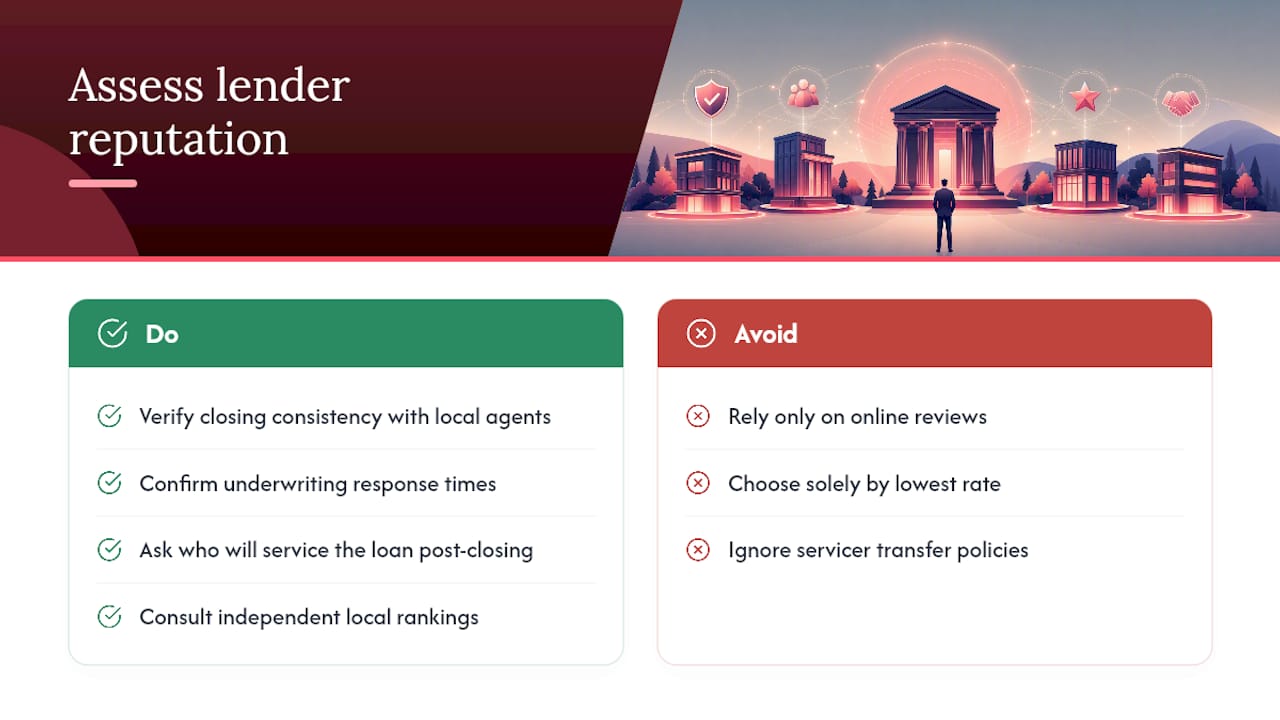
Price isn’t the only variable that determines whether your closing goes smoothly. A lender offering a slightly better rate but a track record of blown closing dates can cost you more in stress, extension fees, or a lost rate lock than the rate difference ever saved.
Look at three things beyond the numbers. First, closing consistency: does this lender close on the date promised, or do files routinely slip? Real estate agents and loan officers in your market often know this reputation cold, even when it never shows up in online reviews. Second, communication style during underwriting: a lender that responds within a day when underwriting requests another document beats one that goes quiet for a week, especially if you’re on a tight contract deadline. Third, post-closing servicing: some lenders sell your loan to a servicer within weeks, which is common and not inherently bad, but it’s worth knowing upfront rather than being surprised by an unfamiliar company on your first statement.
Online review platforms give a partial picture, but they skew toward extreme experiences, either furious or delighted. Independently researched local rankings, like Comparespot’s editorial reviews of Metro Detroit mortgage lenders, weigh customer sentiment against a broader research process rather than letting the loudest reviews dominate. That combination, hard numbers plus reputation, is what actually protects your closing timeline.
Evaluating prepayment penalties and other less obvious loan terms
Prepayment penalties are rare in standard conventional mortgages today, but they still show up in some non-QM loans, certain investment property products, and occasionally in loans with unusually aggressive pricing. Check Section on the Loan Estimate that discusses this directly. It will state plainly whether the loan “may have a prepayment penalty,” and if so, under what conditions.
A few other terms worth reading closely before you sign anything:
- Balloon payments, common in some short-term or non-traditional products, where a large lump sum is due at the end of an initial period
- Late payment fees and grace periods, which vary by lender and can differ by a full percentage point of your payment
- Assumability, whether a future buyer could take over your loan at your rate, which matters more for VA and FHA loans than conventional ones
- Escrow waiver conditions, since some lenders charge a rate premium if you waive escrow for taxes and insurance
None of these show up prominently in the marketing pitch, which is exactly why they deserve a slower read during your side-by-side comparison. If a lender’s Loan Estimate or accompanying documents mention any of these terms, ask for a plain-language explanation before you move forward, not after you’ve already committed an application fee.
Considering the impact of lender-required mortgage insurance and escrow accounts
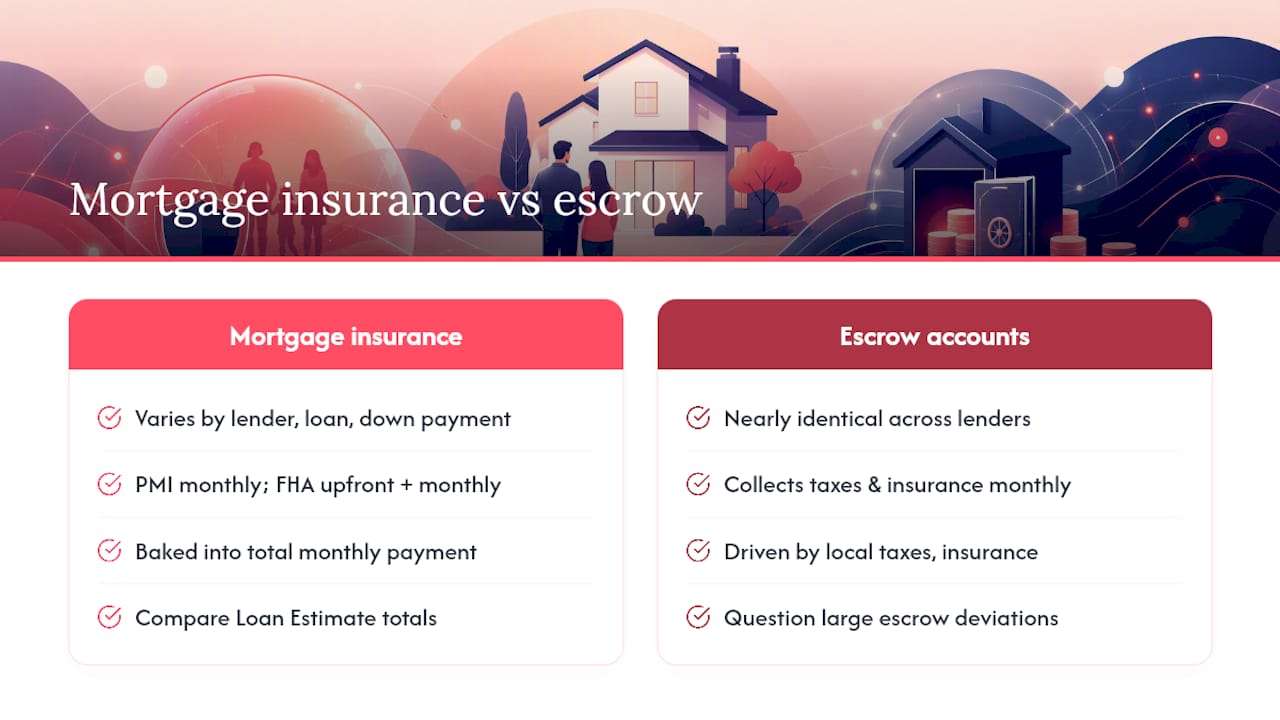
Mortgage insurance adds a real, recurring cost that varies by lender, loan type, and down payment size, and it’s easy to miss when you’re focused on the headline rate. Conventional loans with less than 20% down typically require private mortgage insurance (PMI), while FHA loans carry their own mortgage insurance premium structure that behaves differently, including an upfront charge in addition to the monthly one.
Two lenders quoting the same rate on the same loan amount can still produce different total monthly payments if their PMI providers price risk differently. This is one area where the “total monthly payment” line on the Loan Estimate matters more than the interest rate alone, since PMI is baked into that total.
Escrow accounts, which collect property tax and homeowners insurance payments monthly and pay them on your behalf, are largely standardized and not a meaningful point of lender competition. The amounts should be nearly identical across offers for the same property, since they’re driven by your local tax assessor and your insurance policy, not by lender pricing decisions. If one Loan Estimate shows a dramatically different escrow figure than the others, it’s more likely a data entry error or a different insurance estimate than a genuine cost difference, and it’s worth a direct question to that lender before you draw any conclusions.
Reviewing conditions for rate locks and float-down options
A rate lock guarantees your interest rate for a set period, typically 15, 30, 45, or 60 days, while your loan moves through underwriting. Longer locks generally cost more, either through a higher rate or an upfront fee, since the lender is absorbing more market risk on your behalf.
When you’re comparing lock terms across lenders, three questions matter most. How long is the lock, and does it comfortably cover your expected closing timeline with a buffer for delays? What happens if the loan doesn’t close in time, does the lender charge an extension fee, and how much? And does the lender offer a float-down option, which lets you capture a lower rate if the market improves after you lock, typically for a fee or a slightly higher initial rate?
Float-downs sound appealing, but read the fine print on how much the rate has to drop before you can trigger one. Some lenders set that threshold high enough that it rarely activates in practice. A shorter, cheaper lock with no float-down might beat an expensive lock with a float-down you’ll never actually use, depending on your closing timeline and how confident you are that rates will move in your favor.
Author perspective: a concise, practical takeaway
The buyers who get the best deals aren’t the ones who negotiate the hardest. They’re the ones with the discipline to request Loan Estimates from two or three lenders the same morning, on the same loan structure, and actually put the numbers side-by-side instead of trusting a verbal quote. Use those competing estimates to negotiate, then get any concession confirmed in writing before you lock. Run the five-year math and at least one longer scenario. The lender with the best story rarely wins. The one with the best numbers on paper does.
— Bryan
This article is general information, not a substitute for advice from a qualified financial advisor. Consult a qualified financial professional about your own circumstances before acting on anything here.
FAQ
How Do I Compare Two Mortgage Offers Side by Side?
Line up the interest rate, APR, monthly principal and interest, and Section A origination charges from each Loan Estimate, then check the “In 5 years” line on page 3 for total cost over that period.
How Do You Compare Loan Offers to Get the Best Deal?
Request Loan Estimates from two to three lenders on the same day for the identical loan structure, normalize point pricing where possible, and compare the resulting rate, APR, and origination fees rather than relying on a verbal quote.
What’s the Difference Between Interest Rate and APR?
The interest rate is the cost of borrowing the principal, while the APR wraps in most upfront fees and expresses them as a yearly rate, making APR generally the better single number for comparing total loan cost.
Should I Buy Mortgage Points?
Buying points makes sense if the break-even period, point cost divided by monthly savings, comfortably fits within how long you plan to keep the loan; if you might sell or refinance within a few years, skip them.
What’s the Difference Between a Temporary and Permanent Buydown?
A temporary buydown lowers your payment for the first one to three years and is often paid by the seller, while a permanent buydown (discount points) reduces your rate for the life of the loan and typically comes out of your own funds.