

A Michigan listing agreement is the contract that hires a real estate brokerage to market and sell your home. It sets the price, the fee, how long the brokerage has the exclusive job and what happens if you want out. Most of it is negotiable, and the parts that are not are set by Michigan law. Read the fee, the term, the protection period and the cancellation clause before you sign, because that is where sellers in a hurry lose money.
If you are selling because of a foreclosure, an inheritance, a job move or a repair bill you cannot cover, speed makes it tempting to sign whatever is put in front of you. This guide walks through what the agreement contains, what the state requires, and what to push back on. When you are ready to compare agents, our ranking of the best real estate agents in Metro Detroit is built on independent research, and providers cannot pay for placement.
TL;DR
- A listing agreement is a contract with the brokerage firm, not only the individual agent. It sets price, fee, term, marketing and your obligations.
- Michigan law sets minimum services the agent must provide. Fee, term length, protection period and marketing promises are negotiable.
- The agreement needs a definite expiration date. An automatic renewal clause is not allowed.
- Under a 2024 law, a right-to-list agreement, where a company pays you now for the right to list later, is void unless it meets strict conditions, including a two-year maximum and an early-termination option.
- Under the standard Michigan Realtors form, you can cancel only by mutual written consent, so settle the exit terms before you sign.
Table of Contents
- What a Michigan listing agreement actually is
- What the law requires your agent to do
- The main types of listing agreements
- Seven terms to check before you sign
- Canceling or changing a listing agreement
- The 2024 right-to-list law
- A quick pre-signing checklist
- Where to start if you need to choose an agent
- Our perspective
- FAQ
- Sources
What a Michigan listing agreement actually is
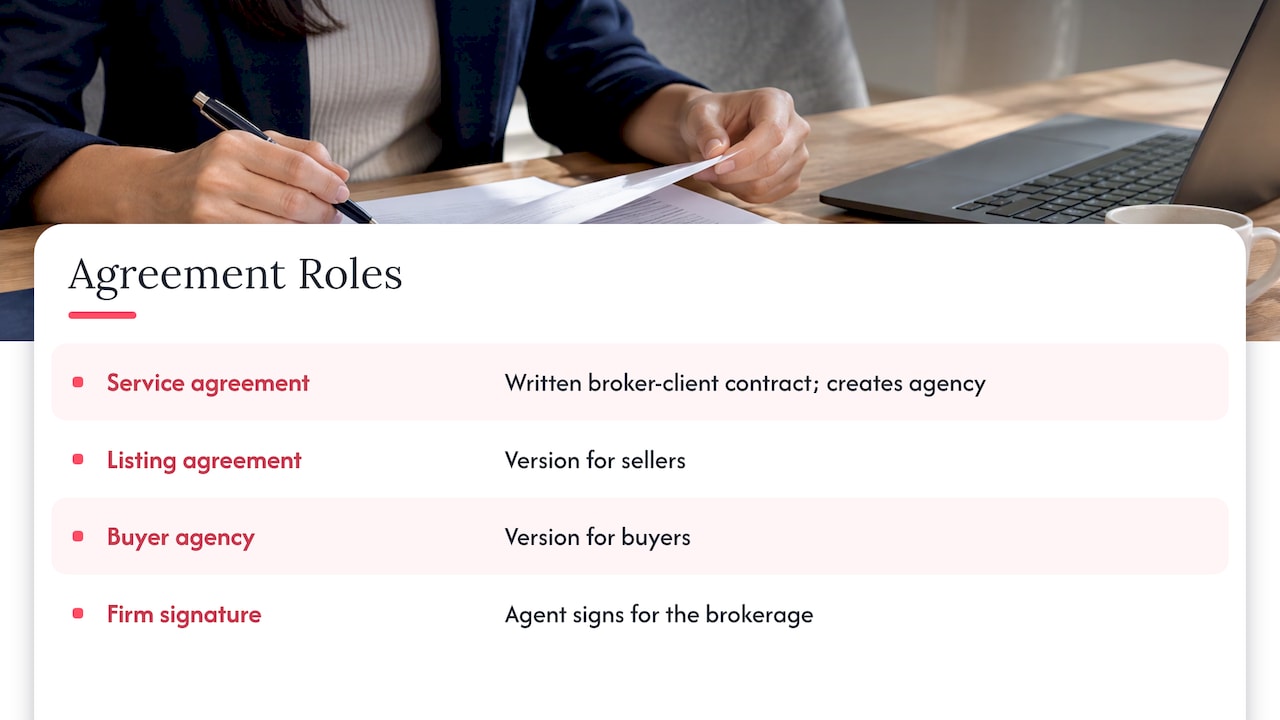
Michigan’s real estate licensing law has its own name for it: a service provision agreement. That is the written contract between a broker and a client that creates an agency relationship, meaning the broker acts on your behalf. A listing agreement is the version for sellers. A buyer agency agreement is the version for buyers.
The state’s standard form is the Michigan Realtors Exclusive Listing Contract. Under it, the brokerage gets the exclusive right to offer and sell your property for the listing period. In return, the firm promises to use reasonable efforts to sell, to present the property to other brokerages through a multiple listing service (MLS, the shared database agents use to list homes), and to carry out marketing. The Michigan Bar Foundation describes the same bargain in plain terms: the owners promise a commission, and the agent promises to use best efforts to sell, in its plain-English guide to residential listing contracts.
The signature that matters is the firm’s. The agent signs for the brokerage, which holds the listing. That is why a listing can stay with the firm even if the agent who pitched you moves on. For a closer look at who does what inside a brokerage, see our explainer on what a real estate broker actually does in Michigan.
What the law requires your agent to do
Michigan sets a floor. Under MCL 339.2512d, a licensee representing a seller must provide five minimum services:
- Market the property in the manner agreed in the agreement.
- Accept and present offers and counteroffers.
- Help negotiate offers until a purchase agreement is signed.
- Help after signing to complete the transaction.
- Provide the other duties the statute lists.
The offer-handling, negotiation and post-agreement services can be waived in a limited service agreement. That is the structure behind some discounted or flat-fee arrangements. The statute also bars advertising a seller’s property as “for sale by owner.” If you are weighing a reduced-service deal, our guide on flat-fee MLS listings in Detroit covers the questions to ask about Realcomp, the MLS most Detroit-area listings run through.
Before you share anything confidential, MCL 339.2517 requires the licensee to tell you about the types of agency relationships available and the duties each one creates. If a single agent or firm might represent both you and the buyer, read our piece on dual agency in Detroit before signing.
The main types of listing agreements
The type you sign decides who gets paid and when.
| Type | How it works | Who it suits |
|---|---|---|
| Exclusive right to sell | One brokerage holds the listing and is paid when the property sells during the term, even if you find the buyer yourself | Most sellers; it is the default and what the Michigan Realtors form is built around |
| Exclusive agency | One brokerage holds the listing, but you keep the right to sell to a buyer you find yourself without paying commission | Sellers with a likely private buyer, such as a relative or neighbor |
| Open listing | You can use several brokers, and only the one who produces the buyer is paid | Rare for residential sales; agents have less reason to invest in marketing |
A net listing, where the broker keeps everything above a set price, is generally banned or restricted in many states and is not something to expect on a Michigan home sale. If anyone proposes it, ask for a standard fee structure instead.
The standard Michigan Realtors form is built on the exclusive structure, so that is the one to understand first.
Seven terms to check before you sign
1. The fee
The fee is not set by law. The Michigan Realtors form says the listing broker’s fee is fully negotiable, and Realcomp’s rules require participants to tell sellers and buyers this in conspicuous language as part of any listing or buyer agency agreement. The form has you agree to a stated dollar fee plus a percentage commission if someone produces a ready, willing and able buyer during the term.
For the numbers sellers actually see in this market, and how the buyer-side share fits in, read what you’ll actually pay in real estate commission in Michigan. Then work out your net with our Michigan seller closing costs breakdown, because the commission is only one line.
2. The term
No Michigan statute caps the length of an ordinary listing agreement. A figure an agent calls “standard” is an opening position, not a rule. If you need a fast sale, a shorter term keeps the agent working to a deadline and gives you a clean exit if results disappoint. Ask for a term you can defend, and expect the agent to want enough time to market properly.
Whatever the length, the agreement needs a definite expiration date. Michigan Realtors’ legal hotline guidance explains that a service provision agreement must carry a definite expiration date and cannot require you to notify the broker that you intend to cancel at or after expiration. In practice, an automatic six-month renewal clause is not legal. The MLS side matches this: Greater Metropolitan Association of Realtors (GMAR) MLS rules require a definite and final termination date, and a listing is removed on that date unless you sign an extension.
3. The protection period
This clause is the one that catches sellers. Also called a tail or holdover clause, it says that if you sell within a set number of months after the agreement expires to someone who was introduced to the property during the listing, the brokerage still gets paid. The Michigan Realtors form includes this, unless the property is then listed with another Realtor company.
The wording varies a lot. Michigan Realtors’ article on successive listing agreements notes that some clauses trigger if the broker had negotiations with the buyer, others if the buyer merely viewed or became aware of the property. Exceptions are not uniform either, and the law does not require any. It also cites a 1989 Michigan Court of Appeals decision, Hawkins v. Smithson, holding such clauses enforceable, so a seller who lists with a second company can owe two commissions when the clause has no exception.
What to ask for:
- A short protection period, with the number of months written in.
- Coverage limited to buyers named on a written list the brokerage gives you after the term ends.
- A clear statement that the clause does not apply if you relist with another licensed broker.
4. The services and marketing promised
The statute guarantees the minimum. Anything beyond it, such as professional photography, a specific MLS launch date or open houses, only binds the brokerage if it is written into the agreement. Put the marketing commitments on paper before you argue about the fee. A lower fee with vague marketing can cost you more than a higher fee with specific work attached.
5. Completeness and your copy
Michigan’s licensing rules call for a fully completed agreement with no blanks, and a true executed copy handed to you at signing. Do not sign a form with spaces left “to fill in later.” A blank fee or a blank date is a problem you will be stuck with.
6. Who signs
Everyone with an ownership interest in the home should sign. This matters most for inherited property, divorces and homes with several owners. If you are selling an estate, our guide to selling probate real estate in Michigan explains who has authority to list.
7. How you get out
See the next section. It deserves its own look because it is the term sellers most often ignore until they need it.
Canceling or changing a listing agreement
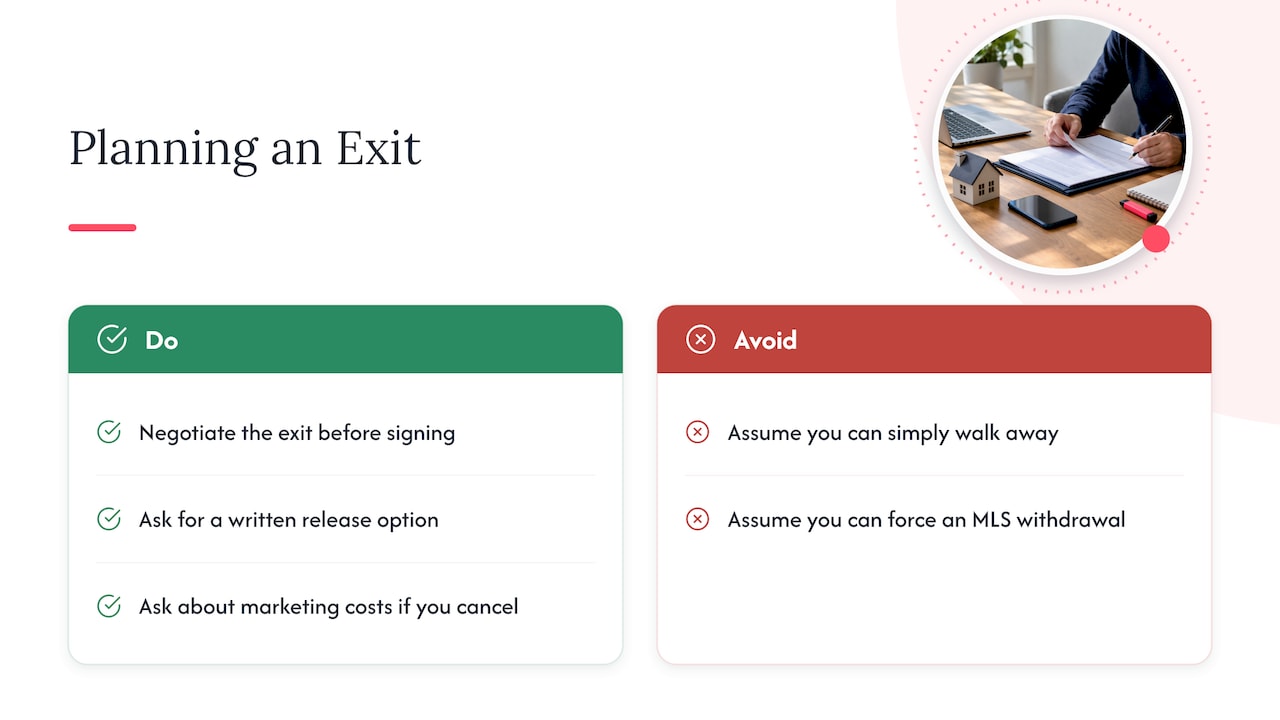
Under the Michigan Realtors form, the agreement can be canceled or revoked only by mutual consent in writing. You cannot simply walk away because you are unhappy. The same form requires any claim or lawsuit between you and the brokerage over the agreement to be filed within six months after termination.
The MLS adds a second layer. Under GMAR’s rules, a listing can be withdrawn before the agreement expires only by the listing broker, with notice filed with the service and a copy of the agreement authorizing the withdrawal. A seller does not have a unilateral right to force a withdrawal, although the MLS may remove a listing when you document that the exclusive relationship with the broker has ended.
The practical lesson: negotiate the exit before you sign, not after. Ask for a written release option, and ask what happens to marketing costs if you cancel. A brokerage that is confident it can sell your home will usually discuss a fair release clause. If your timeline is genuinely short, it can also help to compare a conventional listing against selling to a cash home buyer in Metro Detroit, which involves no listing term at all and sidesteps agent commissions. Our guide to selling a Michigan house as is shows the legal steps and net proceeds for that route.
The 2024 right-to-list law
Some homeowners are approached by companies offering cash now in exchange for the exclusive right to list the home later. Michigan changed the rules for these in 2024. On July 25, 2024, Senate Bill 602 was signed, as the state’s announcement explains. A right-to-list home sale agreement is void and unenforceable if it:
- is not in writing,
- is not signed by everyone with an ownership interest,
- runs longer than two years, or
- lacks an early-termination option.
Brokers who enter void agreements face penalties that include license revocation, fines up to $10,000, restitution and probation.
The enrolled text of the bill spells out the early-termination option. You can end the agreement early by paying no more than what the broker initially paid you, plus 6% per year interest from the date of payment. The agreement’s effective period and an explanation of the option must appear conspicuously on the first page. The law applies to agreements entered into, extended or renewed on or after its effective date. A complaint seeking a penalty must be filed within 18 months after the violation or the completion of the connected transaction, whichever is later.
If you already have such an agreement, or are offered one, take it to a Michigan real estate attorney before you sign or try to exit. This is a legal question where the details of your contract decide the answer.
A quick pre-signing checklist
Bring this to the listing appointment:
- Is every blank filled in, and do I get a signed copy today?
- Is the fee stated in dollars and percent, and have I negotiated it?
- Is there a definite expiration date, and no automatic renewal?
- How many months is the protection period, and does it cover only a written list of buyers?
- What marketing is promised, in writing?
- How do I cancel, and what would it cost?
- Have all owners signed?
- Do I understand which agency relationship I am entering and whether dual agency is possible?
Also confirm that your disclosure paperwork is ready. Listing is usually when the seller’s disclosure statement gets completed, and our summary of Michigan seller disclosure requirements shows what you must state about the property.
Where to start if you need to choose an agent
If you want an agent to hold the listing, the choice of brokerage matters as much as the clauses. Our Metro Detroit real estate agent rankings are independent editorial research, updated quarterly, built on a published methodology and customer sentiment, and no provider can pay to rank higher. If you would rather skip the listing process, the cash home buyer rankings for Metro Detroit apply the same approach to buyers who purchase directly, and there are city versions for Royal Oak, Sterling Heights and Madison Heights.

Our perspective
Most sellers read a listing agreement for the price and the commission, then sign. We think the better habit is to read it for the exit. The fee gets the attention, but the term, the protection period and the cancellation language decide how much control you keep over the next six months of your life.
That is why we publish rankings the way we do. Our Metro Detroit lists of agents, cash buyers and lenders come from independent research and customer sentiment, with a transparent methodology and quarterly updates. Providers cannot pay for placement, and the content is free to read. When you are under pressure from a foreclosure date, an estate or a relocation, a ranking you can trust saves time you do not have.
Use the checklist above, then use our rankings to find someone who will agree to it in writing. Agreement terms that are negotiable are the best place to start.
Bryan
FAQ
What is the most common type of listing agreement?
The exclusive right-to-sell listing is the default. One brokerage holds the listing and is paid when the home sells during the term, even if you found the buyer yourself. The Michigan Realtors standard form is built on this exclusive structure.
Can I cancel a listing agreement in Michigan?
Under the standard Michigan Realtors form, cancellation requires mutual written consent. That is why the release terms are worth negotiating before you sign. If the agreement is a right-to-list contract, Michigan’s 2024 law requires an early-termination option, and a contract without one is void.
Is the real estate commission set by law in Michigan?
No. The standard form states the fee is not set by law and is fully negotiable, and Realcomp rules require participants to say so in conspicuous language. You can negotiate the percentage, any flat dollar fee and the buyer-side portion.
Can a Michigan listing agreement renew automatically?
No. Michigan Realtors’ legal guidance says the agreement needs a definite expiration date and cannot require you to give notice to cancel at or after expiration, so an automatic renewal clause is not legal. If you see one, ask the brokerage to remove it before you sign.
Sources
- MCL 339.2512d, Michigan Legislature
- MCL 339.2517, Michigan Legislature
- Michigan Realtors Exclusive Listing Contract (Traditional Agency)
- Plain English in Residential Real-Estate Listing Contracts, Michigan Bar Foundation
- Realcomp Rules and Regulations
- Michigan Realtors Legal Hotline companion
- GMAR MLS Rules and Regulations
- Successive Listing Agreements, Michigan Realtors
- State of Michigan announcement on right-to-list legislation, July 25, 2024
- Enrolled Senate Bill 602, Michigan Legislature