

TL;DR
- A real estate broker holds a higher-level license than a salesperson, which lets them run their own brokerage, hold client funds in trust, and legally supervise other agents.
- Brokers earn mainly through commission splits on their agents' closed deals, and in Metro Detroit offices we commonly see the broker keeping somewhere between 20% and 50%, plus desk, franchise, or per-transaction fees.
- Michigan requires years of active salesperson experience, broker-specific coursework, and a passing state exam before LARA will issue a broker license. Check current hour and year requirements before you plan around them.
- The broker carries legal responsibility for every deal their agents close, which is why they review contracts, manage earnest money, and provide training in exchange for a cut.
- Before you sign a listing agreement in Wayne, Oakland, or Macomb County, ask who the sponsoring broker is and how fast they respond when a deal stalls. That answer predicts your experience better than any star rating.
Here's the part almost nobody explains: your agent doesn't have final legal authority over your transaction. Their broker does.
A real estate broker is a state-licensed professional who has logged additional experience and education beyond a salesperson license, passed a separate broker exam, and accepted legal responsibility for every transaction completed under their brokerage. In Michigan, that means supervising the agents working under them, reviewing contracts before they go final, and answering to the state when a deal goes sideways.
Most buyers and sellers never speak to the broker at all. You work with the agent who schedules your showings, writes your offer, and sits beside you at closing. But the broker's name is on the brokerage license, the broker's errors-and-omissions policy covers the deal, and the broker's compliance standards shape what your agent is allowed to do. If you're comparing a listing agent in Royal Oak against one in Sterling Heights, part of what you're comparing is the shop behind them.

Table of Contents
- What does a real estate broker do exactly?
- How do real estate brokers make money?
- How does someone become a real estate broker in Michigan?
- What's the difference between a real estate broker and a real estate agent?
- What services does a broker provide to the agents they sponsor?
- What should Metro Detroit buyers and sellers actually look for in a brokerage?
- What if I'm selling a distressed or inherited property instead of listing traditionally?
- Your next move
- Frequently asked questions
What does a real estate broker do exactly?
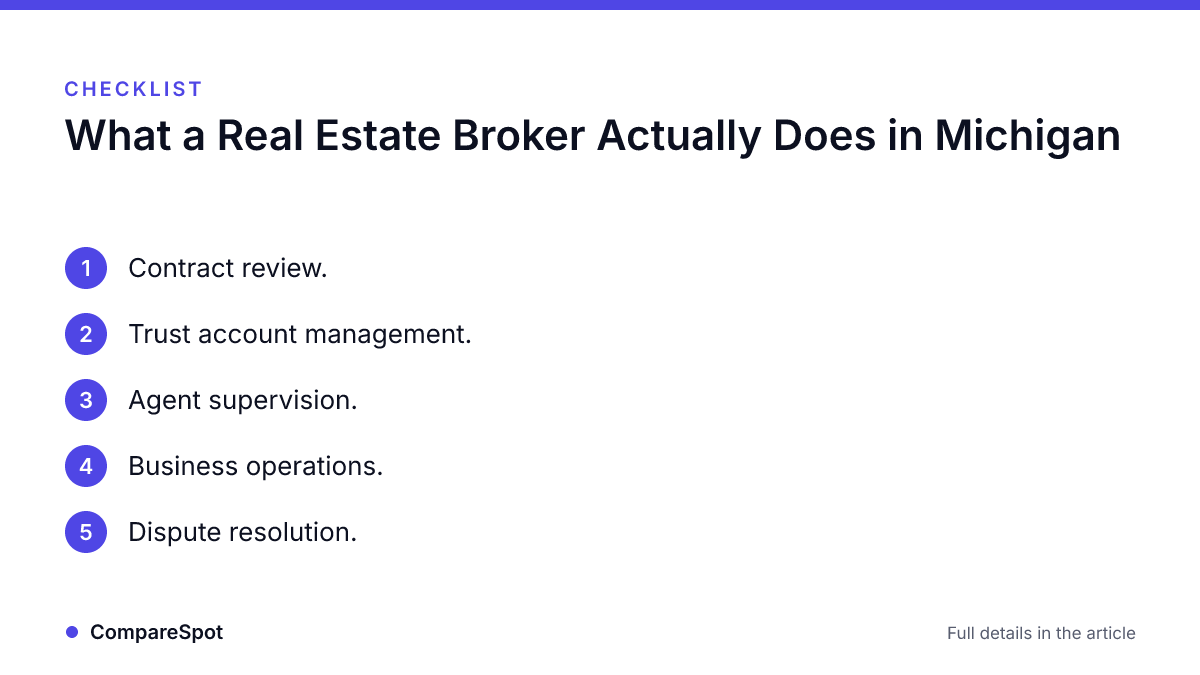
A broker's core job is supervision and liability. They review contracts, manage trust accounts, make sure agents follow fair housing and disclosure law, and stand personally accountable to the state for every transaction their office handles. The rest of the job is running a business: recruiting and training agents, negotiating lockbox and MLS vendor contracts, setting commission splits, and choosing which marketing and lead tools the office pays for.
An agent can show you a house and write an offer. Behind that agent sits someone who's legally on the hook if the Seller's Disclosure Statement is missing, if the lead-based paint addendum never got signed on a 1940s bungalow in Ferndale, or if earnest money lands in the wrong account. That's not a technicality. It's why Michigan makes you work as a licensed salesperson for years before you can even apply for a broker license, as outlined in The CE Shop's breakdown of Michigan licensing requirements.
Day to day, the job usually looks like this:
- Contract review. Reading purchase agreements, addenda, and disclosures before submission, catching the errors agents make at 9 p.m. against an offer deadline.
- Trust account management. Receiving and disbursing earnest money deposits under state rules. Commingling client funds with operating money is one of the fastest ways to lose a license.
- Agent supervision. Monitoring advertising, client communication, and conduct so the brokerage stays on the right side of Michigan license law and fair housing rules.
- Business operations. Setting splits, negotiating vendor costs, deciding which CRM and transaction platform everyone has to use.
- Dispute resolution. Stepping in when the inspection response turns ugly, when two heirs on a listing stop speaking, or when an agent needs backup against an aggressive opposing broker.
Pro tip: When you interview agents, ask for the broker's name and then ask the agent, point blank, when they last called that broker about a problem. An agent who can describe a specific save ("my broker caught that our occupancy agreement had no per-diem") is telling you the oversight is real. An agent who can't remember ever calling is telling you something too.
How do real estate brokers make money?
Brokers make money primarily by taking a cut of every commission their sponsored agents earn. In our experience across Metro Detroit offices, splits run anywhere from 50/50 for a brand-new agent to 80/20 or better for a high producer. On top of the split, brokerages often charge monthly desk fees, a flat fee per closed deal, franchise fees under a national brand, and an E&O charge passed through to the agent.
Here's the math, with illustrative numbers you can swap for your own. Take a $280,000 sale, a realistic mid-market price for a three-bedroom in Macomb County (if you want current figures by county, TopAgent Realty's Metro Detroit housing report tracks them).
Total commission at 6% is $280,000 × 0.06 = $16,800, split between the two sides. The listing side takes $8,400. On a 70/30 split, the agent keeps $8,400 × 0.70 = $5,880 and the broker keeps $2,520. Put that same deal with a new agent on a 50/50 split and the broker's share jumps to $4,200.
Then subtract the fixed costs. A $300 monthly desk fee plus a $395 transaction fee means that agent on the 70/30 split nets closer to $5,185 before taxes and their own marketing spend. Run your own split and fee numbers through the same three steps and you'll see why agents fight harder over fees than over the split percentage on a single closing.
Commission rates themselves are negotiable, and we're seeing more of that conversation happen openly than we used to.
| Broker revenue model | How it works | What we typically see |
|---|---|---|
| Commission split | Broker keeps a percentage of each closed deal | 20% to 50% to the broker, depending on production |
| Desk fee | Flat monthly charge for office, tech, and support | A few hundred dollars a month |
| Transaction fee | Flat charge per closed deal, sometimes replacing the split | A few hundred dollars per file |
| Franchise fee | Pass-through cost for operating under a national brand | A small percentage off the top of gross commission |
| E&O insurance | Billed annually or per transaction | Modest per-file charge, varies by carrier |
Pro tip: The 100%-commission shops flip the model. You keep nearly everything and pay higher flat monthly fees instead. That works beautifully for an agent closing two a month. It leaves a part-timer paying for the privilege of being alone when a title problem surfaces three days before closing.
How does someone become a real estate broker in Michigan?
You start as a licensed salesperson, put in several years of active experience, complete the state-approved broker pre-licensing coursework, pass the Michigan broker exam through the state's testing vendor, and submit your application to the Department of Licensing and Regulatory Affairs (LARA). The experience requirement is the whole point. Michigan wants brokers who have actually sat through blown appraisals and failed inspections before they supervise anyone.
The sequence:
- Hold an active Michigan salesperson license and keep it active for the full experience period LARA requires.
- Complete approved broker pre-licensing education, which covers brokerage management, trust accounting, and agency law rather than rehashing the salesperson material.
- Pass the Michigan broker exam through the state's approved testing vendor.
- File your application with LARA along with fees and documentation of your transaction history.
- Decide your structure. Associate broker under someone else's firm, solo broker, or open your own shop with agents under you. These are very different businesses.
If you're weighing this as a career move, CareerVillage's thread on becoming a real estate broker has blunt answers from people who've done it. Read it next to the official requirements, because the state tells you the hoops and the practitioners tell you the cost. Opening your own brokerage means E&O coverage, a separate trust account, a compliance system, and overhead that starts the month you open, whether or not anybody closes anything.
What's the difference between a real estate broker and a real estate agent?
An agent (salesperson) must hang their license with a broker and cannot operate independently. A broker has cleared the extra licensing bar and can run a firm, hold trust funds, and supervise others. Every agent you've worked with in Detroit, Pontiac, or Madison Heights is tied to a sponsoring broker, even if that name never came up once during your search.
The practical effect shows up when something breaks. Your agent can't unilaterally release your earnest money deposit after a terminated deal. Your agent can't sign off on a mutual release. Your agent can't decide how a disputed deposit gets handled. The broker does all of that, which means the broker's responsiveness becomes your timeline.
So when you're comparing three names in Oakland County, you're really comparing three brokerages with different training, different oversight, and different answers to "who picks up the phone on a Sunday." A boutique shop may give you less back-office infrastructure and far more direct access to the person with signing authority. We go deeper in our agent vs. broker comparison.
Pro tip: Ask whether you're hiring a solo agent or a team. On team structures you'll often work with a showing assistant and a transaction coordinator, not the person on the yard sign. That's fine if you know it going in and irritating if you don't.
What services does a broker provide to the agents they sponsor?
Training, compliance review, transaction management software, marketing support, and a place to work, all in exchange for a share of each closing. What's actually included swings hard from office to office, which is why two agents in the same ZIP code can deliver completely different experiences.
A well-run brokerage usually provides:
- Real onboarding, not a login. Sessions on Michigan contract language, fair housing practice, and how to read a title commitment, beyond the state's continuing education minimum.
- Transaction coordination. A coordinator or platform that tracks the inspection deadline, the financing contingency, and the appraisal date, and nags everyone before a contingency lapses by default.
- Lead generation. CRM access, portal leads, or a referral network so a new agent has something to work before their sphere matures.
- Marketing production. Listing flyers, photography relationships, social templates, and sometimes paid ad spend on active listings.
- Someone to call at 7 p.m. A managing broker who will actually read a weird addendum and tell the agent whether to sign it.
The tradeoff is direct: brokerages that provide less usually pay a bigger split. A 90/10 split with no training and no coordinator is not a raise for a newer agent, it's a loan against the first deal they mishandle. Agents three or four years in, with their own pipeline and their own contract instincts, are the ones who genuinely come out ahead on the high-split model.
What should Metro Detroit buyers and sellers actually look for in a brokerage?
Agents who know your specific submarket, fee structures in writing, and a broker you can reach when a transaction hits a wall. Metro Detroit isn't one market. It's dozens of pockets with different buyer pools, different financing realities, and different appraisal behavior block to block.
Values swing enormously across the city. Entry-level neighborhoods like Warrendale and Chadsey Condon trade at a fraction of what Corktown does, and Ark7's analysis of Detroit's best investment neighborhoods walks through those differences neighborhood by neighborhood. A firm built on luxury listings near the restored Detroit RiverWalk or the Indian Village mansion district isn't automatically the right fit for a seller trying to move a distressed inherited duplex near Eastern Market. Different buyer, different financing, different marketing entirely.
Confirm these four things before you sign a listing or buyer's agreement:
- Local transaction volume. Ask how many closings they've had in your neighborhood in the last 12 months. Metro-wide numbers hide a lot.
- Who reviews your contract. Some firms designate a managing broker separate from the owner. Get a name.
- Fee transparency. A written breakdown of commission, any transaction or admin fee, and whether any of it gets passed to you at closing.
- Response expectations. What happens when you text your agent on a Saturday under contract, and what happens when your agent needs their broker.
If this sounds like homework, good. Our piece on the 5 signals shaping Detroit's housing market in 2026 covers how quickly local conditions are moving, and brokerage choice matters far more in a shifting market than a flat one.
What if I'm selling a distressed or inherited property instead of listing traditionally?
If you've inherited a house in Oakland or Macomb County, or you own something you can't afford to repair, the standard broker-agent listing may not be your fastest or cheapest exit. Cash buyers and wholesalers work outside the commission structure. No listing agent, no broker split, usually no repairs. You net less than full market value and you skip months of contractor estimates, showings, and buyers whose lenders balk at the furnace.
That calculus shifts in Detroit proper, where the city's property maintenance code can produce blight violations on a property nobody is maintaining. Heirs living out of state are especially exposed: the grass grows, the tickets accumulate, and the carrying cost quietly grows while everyone decides what to do. Our guide on who buys an inherited house as-is in Pontiac covers how those offers are structured and what to read closely.
Pro tip: Spend an hour with a real estate attorney before you sign a cash offer on inherited property. Unclear title, an unrecorded deed, or a sibling who never signed off will stop a closing cold, and no cash buyer's purchase agreement sorts that out for you.
| Scenario | Traditional broker/agent sale | Cash or wholesale sale |
|---|---|---|
| Typical timeline | A month to three months, longer with financing hiccups | One to three weeks, title permitting |
| Commission cost | Roughly 5% to 6% of price, negotiable, split between sides | None; buyer usually covers closing costs |
| Repairs required | Usually yes, to satisfy the buyer's lender and appraisal | Rarely; most buy as-is |
| Price vs. market value | At or near market value | Meaningfully below, to cover the buyer's rehab and risk |
| Best fit | Sellers with time and a financeable property | Heirs, out-of-state owners, sellers facing foreclosure |
For a broader read on what your money buys across price points here, our cornerstone guide on what $200K buys you in Detroit right now is a useful gut check before you set a list price or write an offer.
Your next move
Don't assume the broker behind your agent is interchangeable. Before you sign anything, ask three questions: who is the sponsoring broker, how is the commission split structured on this deal, and who do I escalate to when something stalls. Write the answers down. That five-minute conversation will tell you more about how your transaction goes than any review page.
Frequently asked questions
Can a real estate broker also work directly with buyers and sellers like an agent does?
Yes, and many do, particularly in smaller shops. A broker still writing their own deals usually has sharper, more current market instincts than one who spends all day managing an office. The flip side: a producing broker has less time to review your file.
Do I pay more if I work with a broker directly instead of one of their agents?
Usually not. Commission is negotiated at the transaction level, not based on which license the person representing you holds. How the money divides between broker and agent happens internally and doesn't change your side of the settlement statement.
Is it better to use a big national brokerage or a small local one in Metro Detroit?
Depends on the property. Large firms bring marketing reach and relocation buyer traffic, which matters on higher-end listings. Small local firms often know specific neighborhoods like Corktown, Indian Village, or Warrendale street by street and move faster on distressed or niche properties. Ask about recent closings in your neighborhood, not about the brand.