

Expect to pay roughly 5% to 6% of your home’s sale price in total real estate commission in Michigan, with the seller typically covering that full amount at closing. That commission gets split between the listing agent and the buyer’s agent, usually close to evenly. Since the 2024 NAR settlement took effect, buyer-agent compensation is no longer advertised on the MLS, and buyers now sign written agreements spelling out exactly what they owe their own agent. That single change is why sellers and buyers need to read the fine print before signing anything.
- Michigan’s average total commission runs around 6%, among the higher rates nationally
- Sellers customarily pay the full commission, but buyers can now be on the hook for a shortfall
- Every commission arrangement must be in writing under Michigan law
By the numbers: Michigan’s average total real estate commission sits at about 6.03%, among the highest state averages in the country.
Key Takeaways
| Point | Details |
|---|---|
| State average runs high | Michigan’s total commission averages around 6.03%, above most other states. |
| Written agreements are mandatory | Michigan law and the NAR settlement both require commission terms to be documented in writing. |
| Watch the compensation gap | A buyer’s signed agreement can exceed what a seller offers, creating an out-of-pocket shortfall at closing. |
| Alternatives exist for cost cutting | Flat-fee MLS, discount brokerages, FSBO, and cash buyers all reduce fees with different tradeoffs. |
| Vet agents before signing | Comparespot’s Metro Detroit rankings help you compare agents on fees, marketing, and net proceeds before committing. |
Table of Contents
- Real Estate Commission Rates Across Michigan and What They Cost You
- How Commission Structures Changed After the 2024 NAR Settlement
- How to Negotiate Lower Real Estate Fees in Michigan
- Flat-Fee, Discount Brokerage, FSBO, and Cash-Buyer Options
- What Commission Looks Like on a Michigan Closing Statement
- Using Metro Detroit Agent Rankings to Match Your Fee Strategy
- Why Getting Commission Terms in Writing Matters More Than Ever
- Find a Metro Detroit Agent Who Matches Your Fee Strategy
- Sources
- FAQ
Real Estate Commission Rates Across Michigan and What They Cost You
Michigan runs hotter than the national average when it comes to agent pay. Recent reporting puts the state’s average total commission at 6.03%, which lands Michigan among the priciest states for sellers to move a home. Other consumer guides put the range slightly lower, closer to 5.7% to 6.2% depending on the metro area and how competitive the local agent market happens to be.
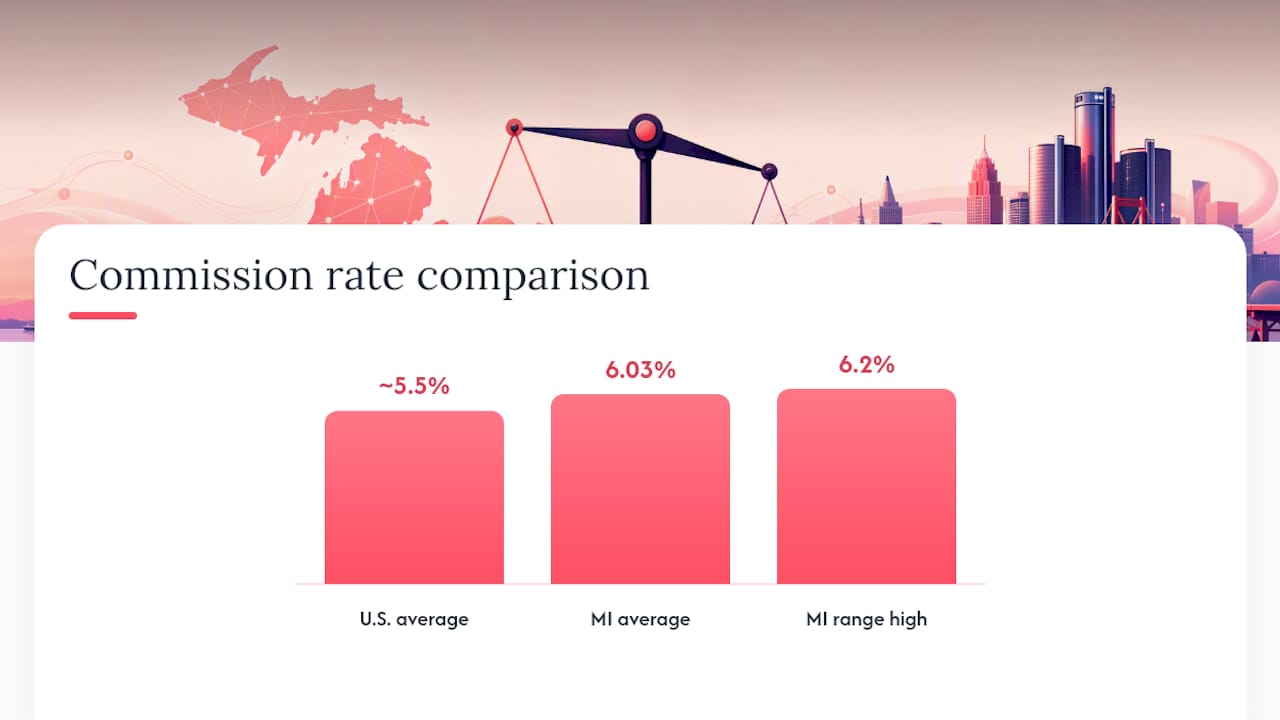
Detroit and its suburbs tend to track close to the state average, though rates can shift based on how much negotiating a seller does upfront and how many agents compete for a listing. Rural markets sometimes run slightly higher because fewer agents means less price pressure.
Real numbers matter more than percentages, so here’s what that commission actually costs at three common Michigan sale prices, assuming a 6% total split:
- $200,000 home: $12,000 total commission, typically $6,000 per side
- $300,000 home: $18,000 total commission, typically $9,000 per side
- $450,000 home: $27,000 total commission, typically $13,500 per side
Those numbers come straight out of your net proceeds. On a $300,000 sale, that $18,000 is more than most people’s annual property tax bill, and it’s one of the biggest line items you’ll ever negotiate outside the price of the house itself. Compare that to the national picture, where average total commissions have generally trended in the mid to high 5% range, and it’s clear Michigan sellers have real room to push back on rate before signing a listing agreement.
How Commission Structures Changed After the 2024 NAR Settlement
Michigan law has always required real estate commission agreements to be in writing. Under state statute, an oral promise to pay a commission generally is not enforceable. Your listing agreement is the document that spells out your commission rate, how it’s split with a buyer’s agent, and under what conditions it’s owed.
What changed in August 2024 is how that split gets communicated and negotiated. Before the settlement, listing agents commonly advertised buyer-agent compensation directly in the MLS, so buyer’s agents knew upfront what a given listing would pay them. The NAR settlement ended that practice. Buyer-agent compensation offers no longer appear as a standard MLS field, and buyer’s agents must now get their compensation terms in a signed, written buyer representation agreement before showing homes.
Here’s the practical sequence that plays out now:
- A buyer signs a written agreement with their agent specifying the agent’s fee, often a percentage or flat amount.
- The buyer makes an offer, which may include a request that the seller cover part or all of that fee.
- The seller either agrees to pay it, negotiates it down, or declines, in which case the buyer may owe the difference out of pocket.
- The final numbers show up as separate line items on the Closing Disclosure.
That gap between what a seller offers and what a buyer’s agreement specifies is where a lot of confusion (and occasional conflict) happens at the closing table.
Pro Tip: Read your buyer representation agreement before you fall in love with a house. If it locks you into a 3% fee and the seller is only offering 2%, you need to know that gap exists weeks before you’re staring at a closing statement.
How to Negotiate Lower Real Estate Fees in Michigan
Commission rates in Michigan have never been fixed by law, but the NAR settlement put a much brighter spotlight on that fact. Both sellers and buyers have leverage they often don’t use.
If you’re selling:
- Ask for a lower percentage, especially on higher-priced homes where the dollar commission climbs fast
- Request a flat fee instead of a percentage if your home is likely to sell quickly
- Push back on services you don’t need, like professional staging, if it means a lower rate
- Run the math on net proceeds, not just the headline rate. A 5.5% fee with strong marketing can outperform a 4.5% fee with a weak one
If you’re buying:
- Negotiate your buyer-agent fee directly in your representation agreement before house hunting
- Ask your agent to request seller-paid buyer-agent compensation as part of your offer
- Understand that agreeing to pay part of your agent’s fee yourself, in writing, is common now and not automatically a red flag
Before you sign anything, ask every agent you interview these questions: What’s your marketing budget for my listing? What net proceeds do you realistically project? Are there any administrative or transaction fees beyond the commission split?
Pro Tip: A lower commission rate only helps you if it doesn’t cost you a higher sale price or a longer time on market. Always ask an agent what their average days-on-market and list-to-sale-price ratio look like before comparing fees.

A discount model makes sense when your home is in a hot neighborhood, well-priced, and likely to move with minimal marketing. It’s a riskier bet in a slower market where professional photography, paid ads, and an agent’s negotiating experience carry more weight in the final sale price.
Flat-Fee, Discount Brokerage, FSBO, and Cash-Buyer Options
Sellers who want to cut commission costs have several real alternatives in Michigan, each with a different tradeoff between savings and support.
- Flat-fee MLS listings put your home on the MLS for a set price, often a few hundred dollars, but you typically handle showings, negotiations, and paperwork yourself
- Discount brokerages charge a reduced percentage or flat commission, usually trading full-service marketing and hands-on negotiation for the lower cost
- For Sale By Owner (FSBO) eliminates listing-agent commission entirely, though sellers still commonly pay a buyer’s agent fee to attract offers, and legal or paperwork mistakes become the seller’s own risk
- Cash buyers and iBuyers skip commission negotiations altogether by making a direct offer, trading speed and certainty for a lower net price than a fully marketed listing typically brings
Each option can save real money on paper, but the savings only count if your final sale price and timeline hold up. A flat-fee listing that sits unsold for four extra months because it lacked professional photography and pricing strategy can cost more than the commission it saved. Cash buyers fit best for sellers facing foreclosure, inherited property, or a tight timeline where certainty matters more than maximizing sale price. If speed is your priority, comparing local cash home buyers side by side is a faster path than negotiating a traditional listing.
What Commission Looks Like on a Michigan Closing Statement
On a $300,000 sale at a 6% total commission split evenly, the Closing Disclosure shows $9,000 to the listing brokerage and $9,000 to the buyer’s brokerage. On a $500,000 sale at the same split, that’s $15,000 per side, $30,000 total, coming straight out of seller proceeds.
Here’s where it gets tricky. The buyer owes the $4,500 difference on a $300,000 purchase, either as an out-of-pocket cost or negotiated into the deal some other way.
- Seller’s offer: 1% of $300,000 = $3,000 toward buyer-agent compensation
- Buyer agreement requires: 2.5% of $300,000 = $7,500
- Buyer’s shortfall: $4,500 due at closing unless renegotiated
VA loan borrowers face an added wrinkle: federal guidance around what buyer-broker fees a veteran can pay directly has shifted, so VA buyers should confirm current rules with their lender before assuming a seller will cover the gap.
Using Metro Detroit Agent Rankings to Match Your Fee Strategy
Comparespot ranks real estate agents across Wayne, Oakland, and Macomb counties using editorial research, not paid placements. That makes it a practical starting point for narrowing candidates before you negotiate.
- Verify a ranked agent’s marketing commitments match what you need for your price point
- Ask for a realistic net-proceeds estimate, not just a commission quote
- Confirm there are no hidden administrative or transaction fees
- Make sure your final written agreement reflects whatever rate you negotiated
Why Getting Commission Terms in Writing Matters More Than Ever
Michigan’s commission averages are already among the highest in the country, and the shift to written buyer agreements means vague verbal promises won’t protect anyone anymore. The data and the law point the same direction: document everything before you sign.
My one piece of advice after all this: get every commission number in writing, then read your closing statement line by line before you sign it, not after.
— Bryan
Find a Metro Detroit Agent Who Matches Your Fee Strategy
Comparespot is the alternative to guessing which Metro Detroit agent will actually negotiate hard on your commission. Instead of interviewing agents blind, you get an editorially researched ranking built on customer sentiment and local market performance across Wayne, Oakland, and Macomb counties.
None of the agents on Comparespot’s list paid for placement. The rankings come from independent research and real customer feedback, with the methodology laid out for anyone who wants to check the work. If you’re ready to start interviewing agents with the negotiation tactics above in hand, browse Comparespot’s ranked list of Metro Detroit real estate agents and start comparing marketing commitments and fee structures before you sign anything.
Sources
- National Association of Realtors (NAR)
- Who Pays Realtor Fees in Michigan: Buyer or Seller? - LegalClarity
- Average Realtor Commission in Michigan (2026 Update)
FAQ
How Much Commission Do Realtors Get in Michigan?
Michigan realtors typically split a total commission of around 6.03% of the sale price, usually divided close to evenly between the listing agent and buyer’s agent.
Are Real Estate Prices Dropping in Michigan?
Home prices vary by county and city rather than moving uniformly, and commission rates have stayed relatively steady even as the disclosure rules around them changed in 2024.
Who Pays the Buyer’s Agent Now That MLS Disclosure Changed?
The seller can still offer to cover the buyer’s agent fee, but the buyer’s written agreement determines what they owe if the seller’s offer falls short, making early negotiation essential.