

Dual agency is legal in Michigan, but only if both the buyer and seller give informed, written consent, per MCL §339.2517. Once you agree to it, your agent switches from full advocate to neutral facilitator, meaning they can’t share your bottom-line price motivation with the other side. The sections below walk through the statute, what duties survive, and how to protect yourself before you sign anything.
TL;DR:
- Dual agency is permitted in Michigan only with written, informed consent from both parties, and agents cannot disclose full price details to either side.
- A dual agent’s ability to advocate for clients is limited to fair disclosure of material facts, with no loyalty or strategic negotiation support allowed.
- The most common dual agency scenarios involve open houses, in-house referrals, or pocket listings, often catching buyers off guard.
- Buyers and sellers can mitigate risks by asking for designated agents, reading disclosures carefully, and avoiding signing agreements under pressure.
- For complex transactions or high-stakes deals, single-party representation is the safest choice to ensure full advocacy and confidentiality.
Table of Contents
- What Dual Agency Actually Means in a Detroit Transaction
- Michigan Law and Disclosure: What MCL 339.2517 Actually Requires
- What a Dual Agent Can and Cannot Do for You
- Pros and Cons for Buyers and Sellers
- How to Protect Yourself Before You Consent
- Designated Agency vs. Dual Agency vs. Single-Party Representation
- CompareSpot’s Local Research Note
- A Local Perspective on Dual Agency
- Find Vetted Metro Detroit Agents Through Comparespot
- Sources
- FAQ
What Dual Agency Actually Means in a Detroit Transaction
Dual agency happens when one real estate licensee represents both the buyer and the seller in the same deal. That licensee stops being your advocate and becomes a neutral go-between, bound to treat both sides fairly instead of fighting for either one.
Detroit-area buyers run into it more often than they expect, usually in one of a few patterns:
- The open house scenario: You walk into an open house, love the place, and ask the listing agent to write your offer instead of finding your own representation.
- The in-house referral: A friend’s agent happens to also have the listing you want, and the brokerage suggests keeping it “simple.”
- The pocket listing: An agent at a busy Birmingham or Royal Oak brokerage has both a seller client and a buyer client interested in the same property.
Michigan also allows a variation called designated agency, where two different agents from the same brokerage each represent one side of the deal. That’s not true dual agency. It preserves more independent advocacy, since each agent works only for their own client even though a single broker technically oversees both.
Michigan Law and Disclosure: What MCL 339.2517 Actually Requires
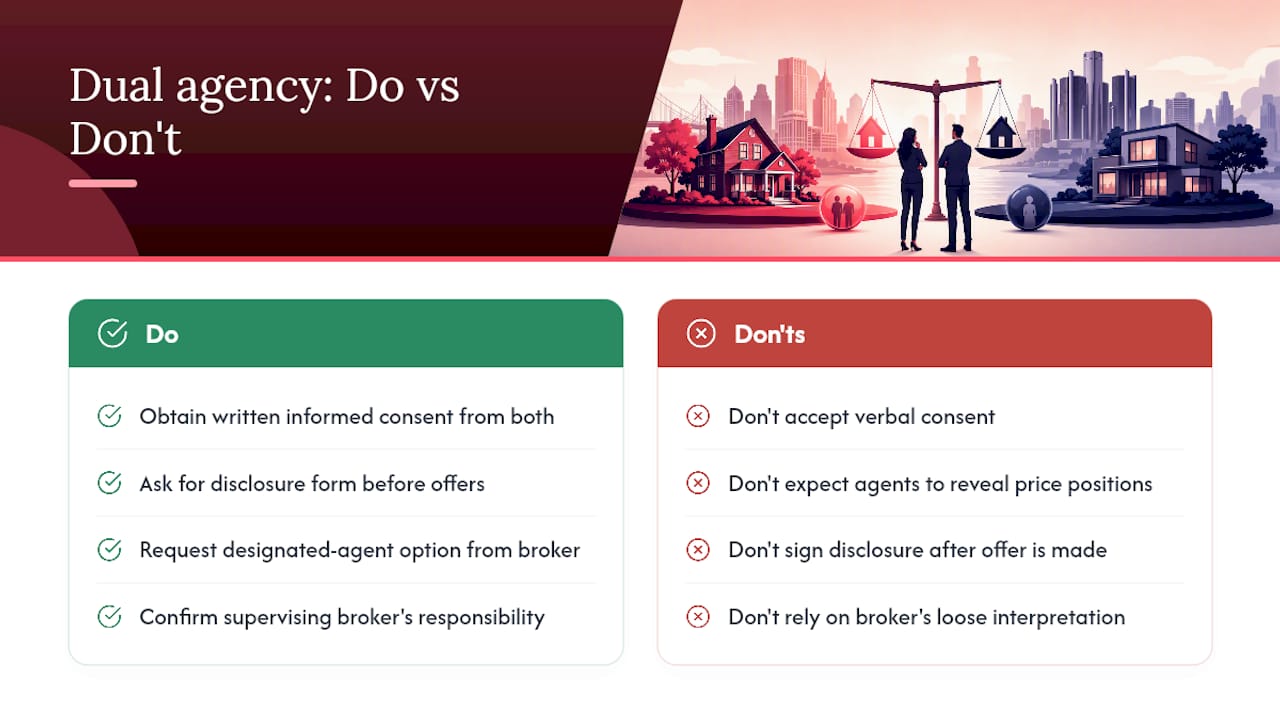
MCL §339.2517 is the statute that governs this arrangement, and it’s worth reading before you sign anything. The law permits a licensee to act as agent for both parties in the same transaction, but only with the knowledge and informed written consent of both the buyer and the seller. That consent has to be documented. A verbal “yeah, that’s fine” over the phone doesn’t satisfy the statute.
The law also draws a hard line around what a dual agent can share. Once consent is given, the agent cannot disclose all known information to either party. That’s the tradeoff you’re accepting: neutrality in exchange for reduced transparency. The agent legally cannot tell the seller how high the buyer is willing to go, and can’t tell the buyer how low the seller will accept. Public Act 0236 restates this same written-consent framework in the broader Michigan Legislature text, reinforcing that the requirement isn’t a gray area open to broker interpretation.
The statute also builds in the designated agency option mentioned above, and assigns the supervising broker specific responsibility for managing that split representation. If your brokerage proposes dual agency, ask directly whether they’d rather set up designated agents instead. It’s a fair question, and a broker who bristles at it is telling you something.
Pro Tip: Ask for the written disclosure form before offers get presented, not after. Once an offer is on the table, you’re under time pressure and far less likely to read the fine print carefully.
What a Dual Agent Can and Cannot Do for You
Some fiduciary duties survive dual agency. Others get cut off entirely, and knowing the difference matters more than most buyers realize.
Honesty stays intact. A dual agent still has to disclose material facts about the property, like a leaky roof or a title issue, to both sides. What disappears is undivided loyalty. Normally, your agent owes you full advocacy: pushing your interests, strategizing your offer, and keeping your negotiating position confidential from the other side. Dual agency legally strips that away.
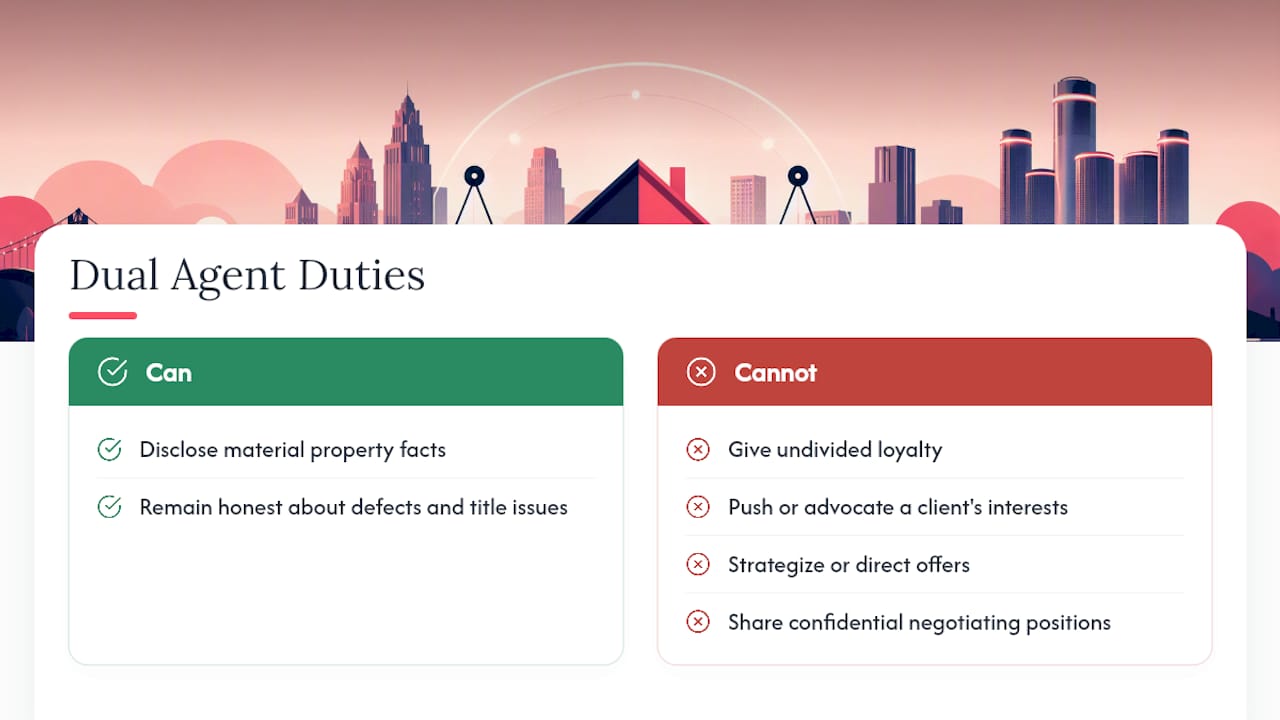
In practice, this shows up in specific, restricted disclosures. The agent cannot tell the seller “the buyer will actually go $15,000 higher if pushed.” They cannot tell the buyer “the seller is desperate and will take any reasonable offer.” Both of those disclosures would normally help their respective client negotiate harder, and both are off the table once dual agency kicks in.
The New York Department of State’s legal memorandum on dual agency puts it plainly: dual agency reduces an agent’s ability to advocate, and it recommends full disclosure with a clear written acknowledgment before any party accepts the arrangement. That guidance isn’t Michigan law, but the underlying warning applies just as much in Wayne, Oakland, or Macomb County as it does anywhere else. If an agent representing both sides can’t fully advocate for either, you’re negotiating with one hand tied.
Pros and Cons for Buyers and Sellers
Dual agency isn’t automatically bad. It’s a tradeoff, and where you land depends on how straightforward your deal actually is.
The upside:
- Faster communication, since there’s no back-and-forth between two separate agents relaying messages.
- Fewer parties involved, which can simplify scheduling showings, inspections, and paperwork.
- It can work reasonably well in simple, low-conflict transactions where price and terms are already close.
The downside:
- The built-in conflict of interest is real. Nobody is fully fighting for your side.
- You have to be more careful about what you say out loud, since anything revealing your true price flexibility could work against you.
- Negotiations often settle toward the middle instead of toward the best deal you could have gotten with your own advocate.
Experienced sellers or buyers in straightforward, low-stakes sales sometimes accept dual agency without much worry. First-time buyers, anyone navigating a complicated estate sale, or family transactions with emotional weight attached should think twice. That’s exactly where a neutral agent’s limits hurt the most.
How to Protect Yourself Before You Consent
Don’t sign a dual agency disclosure the moment it’s handed to you. Take it home, read every line, and ask these questions first:
- Will you use designated agents instead? This single question can preserve far more advocacy than straight dual agency.
- Who exactly sees my confidential information, and does that person also talk to the other party?
- How will offers be presented if multiple buyers are interested in the same listing?
- What happens if I refuse dual agency? A good agent has a straightforward answer. A defensive one doesn’t.
Watch for red flags: pressure to sign quickly, vague language in the disclosure form, or resistance to putting anything in writing. Legal guidance on dual agency consistently points to the same fix: insist on independent counsel for anything complex or high-value, whether that’s a probate sale, a divorce-related transaction, or a purchase well above the median Detroit-area price point.
Pro Tip: If an agent already represents the seller and suggests writing your offer too, ask for a designated agent instead. It costs you nothing and keeps someone actually on your side of the table. Before you commit to any single agent, it also helps to verify their track record independently rather than relying on a brokerage’s internal recommendation.
Designated Agency vs. Dual Agency vs. Single-Party Representation
Three arrangements exist, and they are not interchangeable, despite how loosely some brokerages use the terms.
- Single-party representation means your agent works only for you, full advocacy, full confidentiality. Insist on this for anything with real complexity or emotional stakes: divorce sales, inherited property, or a first home purchase where you don’t know what you don’t know.
- Designated agency puts two separate agents from the same brokerage on opposite sides. Each still advocates for their own client, even though one broker technically supervises both. Understanding the difference between how agents and brokers operate inside the same firm makes this distinction much clearer.
- True dual agency means one person represents everyone, and nobody gets full advocacy.
Run a quick check before agreeing to anything: how complex is the deal, how much money is at stake, and is there any personal conflict between the parties? The more “yes” answers, the more you want single-party representation, full stop.
CompareSpot’s Local Research Note
An independent comparison platform ranks Metro Detroit real estate providers using editorial research, not paid placements, with rankings specific to Wayne, Oakland, and Macomb counties. That local focus matters here: an agent’s reputation in Grosse Pointe doesn’t tell you much about how they handle deals in Dearborn. If you need a separate, independent agent after reading this, These Metro Detroit agent rankings are a reasonable place to start looking.
A Local Perspective on Dual Agency
Get the disclosure in writing, read it slowly, and don’t be shy about asking for a separate agent. Detroit’s market moves fast enough that skipping this step costs more than the time it takes to do it right.
— Bryan
Find Vetted Metro Detroit Agents Through Comparespot
This platform is an alternative to guessing whether your listing agent’s “let me handle both sides” pitch is actually good for you. Instead of relying on whoever a brokerage hands you, it ranks Metro Detroit real estate agents using independent research and verified customer feedback, so you can compare options before you’re stuck in a dual agency conversation you didn’t ask for.
If you’re weighing whether to accept designated agency, insist on single-party representation, or just want a second opinion on an agent already in the picture, start with these 10 Best Real Estate Agents in Metro Detroit rankings. Financing questions coming up alongside a dual agency decision? The Metro Detroit mortgage lender rankings cover that too. And if you’re prepping a home for sale and need vendor support, listing prep services can help get a property market-ready before an agent conversation even starts. Check the current rankings on Comparespot before you sign anything.
Sources
Verify the statute directly at MCL §339.2517, review NAR’s agency guidance on disclosure standards, and read the New York Department of State’s dual agency memorandum for a deeper look at the risks involved.
- Michigan Legislature — MCL §339.2517
- Legal Memorandum LI12: Be wary of dual agency — NY Department of State
FAQ
Is Dual Agency Allowed in Michigan?
Yes. MCL §339.2517 permits it, but only with the knowledge and informed written consent of both the buyer and seller. Without that written consent, the arrangement isn’t lawful.
Which States Ban Dual Agency?
A minority of U.S. states prohibit dual agency outright, while most, including Michigan, allow it with written disclosure, according to NAR’s national resources. Rules vary significantly by state, so always check the specific requirements where the property is located.
Is Dual Agency Good for the Buyer?
It can speed up communication in a simple deal, but it usually isn’t ideal. The agent can no longer fully advocate for the buyer’s price position, since Michigan law restricts what a dual agent may disclose to either side.
How Much Would a Real Estate Agent Make on a $300,000 House?
Commission structures vary by brokerage and by individual negotiation, and Michigan doesn’t set a fixed statutory rate. For a full breakdown of how commissions typically work on a Michigan sale, see this guide to real estate commission costs in Michigan.