

TL;DR
- For local real estate decisions (cash home buyers, agents, mortgage lenders, furniture stores), a site that actually shops Wayne, Oakland, and Macomb County providers beats a national aggregator that treats Detroit like a zip code.
- CompareSpot doesn't accept payment for placement. No provider can buy a higher spot, and the ranking method is published where you can read it before you trust a list.
- General platforms like Top10.com cover dozens of categories nationally, which is useful for insurance or movers and thin for a single metro's housing market.
- Health and telehealth comparison sites (GetZealthy, RoenRx, Healthline, GLP.medvi.org) surface in the same searches, but they compare medications and virtual care, not real estate.
- Two-minute trust test: does the site name its data sources, disclose sponsorships, and show different results for Pontiac than for Sterling Heights? If not, read it as an ad.
There's no single "best comparison website" for everything, and that's the trap most people fall into when they type this phrase into Google. A Wayne County homeowner three payments behind needs a site that knows which cash buyers actually close and which ones assign your contract to somebody else the day after you sign. A first-time buyer comparing lenders needs local quotes, not a national rate engine that's never dealt with a Detroit tax bill. And if you were searching for cheap car insurance or a weight-loss prescription, you're on the wrong block entirely. I'll point you somewhere better for that too.
Table of Contents
- What does "best comparison website" actually mean in Detroit?
- How do you verify a comparison site isn't just an ad in disguise?
- What local data should back a real Detroit ranking?
- How does CompareSpot compare to the other options?
- What should Wayne County homeowners facing foreclosure look for?
- How much does comparing lenders actually save you?
- Which comparison site should you actually use?
- Frequently asked questions
What does "best comparison website" actually mean in Detroit?
It depends entirely on what you're shopping for. "Comparison website" isn't a category, it's a business model, and dozens of unrelated industries run it. Search the phrase with "reddit" tacked on and you'll get threads about insurance rate shopping, mattresses, and listing agents in the same result set.
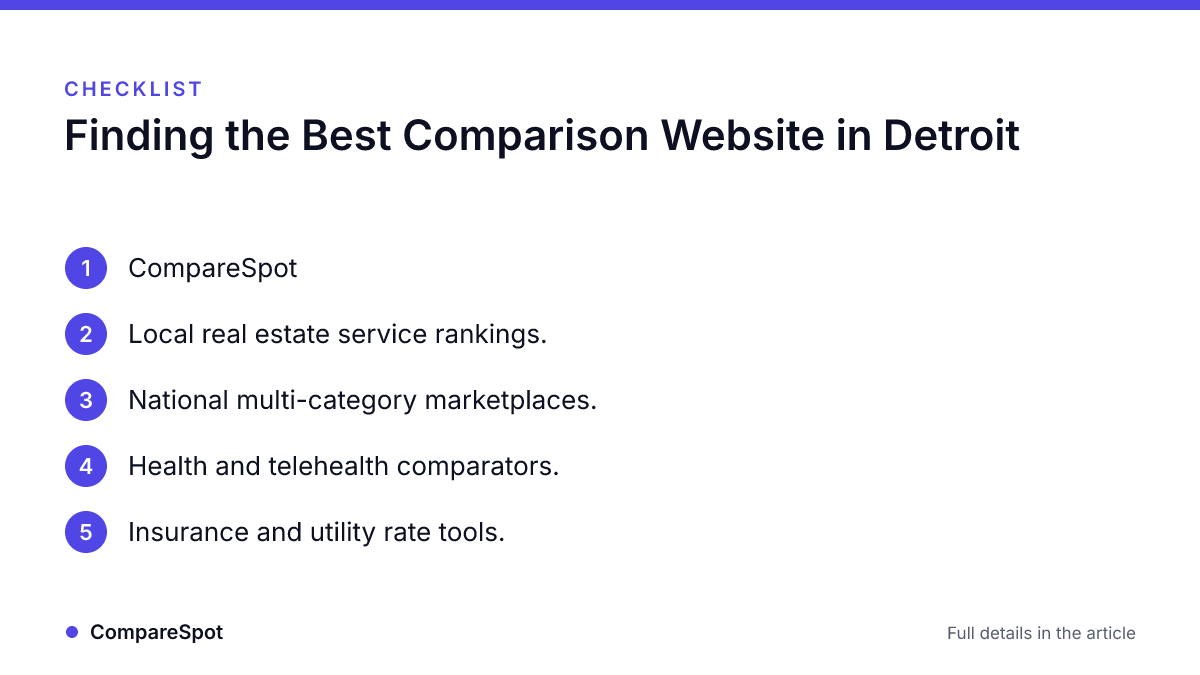
For homeowners and buyers, the sites that matter sort into four buckets:
- Local real estate service rankings. Cash home buyers, listing agents, mortgage lenders, property managers, furniture stores. This is CompareSpot's lane.
- National multi-category marketplaces. Top10.com and similar sites rank providers across insurance, internet, moving companies, and more. Broad by design, shallow on any one metro's market conditions.
- Health and telehealth comparators. GetZealthy, RoenRx, Healthline, and GLP.medvi.org compare prescription services, GLP-1 programs, and virtual care. None of them will tell you a thing about selling a house on Gratiot.
- Insurance and utility rate tools. Weighing CURE Auto against LA Insurance, Progressive, or Liberty Mutual is a rate-aggregator problem. Different search, different site.
Pro tip: if one site ranks car insurance, mattresses, dating apps, and real estate agents with the same five-star badges, it's a lead funnel first and a research tool second. Here's the tell that takes ten seconds: open three provider pages and look at the phone numbers. If they're identical, you're not comparing companies. You're being routed to a call center that sells your info to whoever bids highest.
How do you verify a comparison site isn't just an ad in disguise?
Check three things: whether providers can pay for placement, whether the site publishes its research method, and whether it names the data it benchmarks against. Affiliate commissions on their own aren't dishonest. Paid position is, because it quietly converts a ranking into a rate card.
Run this in about two minutes:
- Find the methodology page. If there isn't one, or it's marketing copy with no specifics about what was measured, close the tab.
- Search the page for "sponsored" and "paid placement." Honest sites disclose it near the top of the list, not buried in a footer link.
- Change the city and re-run the search. Real local research produces different names for Sterling Heights than for Pontiac. An identical list everywhere means nobody did any local legwork.
- Look for named sources. Real estate rankings should point to something checkable like Realcomp MLS or county assessor records, not "our team's opinion."
- Call one ranked provider and mention the site. If the receptionist has never heard of it, nobody verified anything.
CompareSpot's position is plain: providers can't pay to move up a list, and rankings get rebuilt as new market data comes in rather than sitting untouched for years. You can read how the site operates on the about page, and the terms of use covers the fine print on how lists are compiled.
What local data should back a real Detroit ranking?
Metro Detroit is really three counties with three different housing markets, and a single "Detroit average" flattens all of it into a number that helps nobody. Wayne, Oakland, and Macomb sit side by side and behave nothing alike, as even a quick read of Wikipedia's Metro Detroit overview makes obvious.
| County | What the housing stock looks like | What that changes for you |
|---|---|---|
| Oakland | Royal Oak bungalows, Troy and Birmingham colonials, lakefront estates up north | Highest price ceiling and the deepest retail buyer pool, so listing usually beats a cash offer unless the house is rough |
| Macomb | Warren and Sterling Heights postwar brick ranches, newer builds toward Macomb Township | Steady, mid-market demand; condition matters more than address |
| Wayne | Detroit bungalows and two-family flats, Dearborn brick, Grosse Pointe on the east end | Block-by-block pricing swings; cash buyers are most active here and offers vary the most |
Oakland runs the widest range in the state, from entry-level starters to ultra-luxury, which is exactly why a ranking built on Wayne County behavior would steer an Oakland seller wrong. Firas Real Estate's suburb guide is a decent orientation to how those communities differ. For current medians and inventory counts, pull them yourself from Realcomp MLS data compiled by Top Agent Realty and MiHomes' Detroit market update rather than trusting a number some ranking page typed in two years ago and never touched again.
Want a feel for what your budget actually buys? Our $200K Buys You in Detroit Right Now breakdown walks through real neighborhoods at that price point.
How does CompareSpot compare to the other options?
No site here is best at everything. They solve different problems, and the honest answer is that two of these three shouldn't be anywhere near your house sale.
| Factor | CompareSpot | Top10.com | GetZealthy / RoenRx / Healthline / GLP.medvi.org |
|---|---|---|---|
| Specialty | Metro Detroit real estate: cash buyers, agents, lenders, furniture, property management | Multi-category national comparisons across insurance, internet, moving, and more | Telehealth, GLP-1 weight-loss programs, general health information |
| Service area | Wayne, Oakland, Macomb counties | National, not metro-specific | National, not location-based |
| Local data used | Realcomp MLS, Michigan Realtors, U.S. Census | Category-level national data; request Detroit-specific sourcing before relying on it | None; ask about clinical sourcing and FDA status instead |
| Pay-for-placement | Not accepted, stated on the site | Affiliate-driven; confirm their ranking policy in writing | Confirm whether featured providers are sponsors |
| Best for | Detroit-area homeowners and buyers researching a specific transaction | Everything outside real estate you'd rather compare in one place | Telehealth and prescription research, not property |
Pro tip: when a site's category doesn't match your question, don't force it. Researching a GLP-1 prescription? Healthline or a telehealth-specific comparator beats any real estate site, this one included.
What should Wayne County homeowners facing foreclosure look for?
Speed and honest timelines, above everything else. If you're behind on payments in Detroit or Dearborn, the calendar matters more than the website's design. Any site worth your time should tell you how fast each buyer closes, whether they need an inspection contingency, and roughly where their offers land against market value. "Get a fast, fair offer" repeated across five provider pages tells you nothing.
Ask every buyer, and every site ranking them:
- How many days from accepted offer to closing? In our shopping of Metro Detroit buyers, the real ones commit to something in the 7-to-21-day range. Anything vaguer is a soft answer.
- Where are you relative to the sheriff's sale? A buyer who can't discuss your sale date and redemption window without checking with a manager has never actually closed a pre-foreclosure deal.
- Will you buy as-is, including open violations? Detroit enforces compliance through its Buildings, Safety Engineering, and Environmental Department, and unpermitted work can stall a conventional sale. A serious buyer explains exactly how they handle it. Start with Detroit's BSEED department page so you know what you're dealing with.
- What's your typical offer as a share of market value? It varies with condition and location. A buyer who won't give a range is hiding one.
- Is there a fee if I walk before closing? Legitimate buyers rarely charge one. If yours does, get the amount in writing first.
One more thing practitioners know and marketing pages don't mention: ask whether the contract can be assigned. If yes, you may be dealing with a wholesaler who's shopping your house to investors rather than buying it. Sometimes that still works out. You deserve to know before you sign.
Weighing a fast sale against a traditional listing? Our cash offer vs. listing breakdown runs the trade-offs in dollars, not just days.
How much does comparing lenders actually save you?
More than most first-time buyers expect, and you can run the math in five minutes. Here's an illustrative scenario using round numbers.
Say you're financing a $232,000 house with 10% down, so your loan balance is $208,800 on a 30-year fixed. Lender A, the first one you called, quotes 7.25%. Lender B, found by making two more calls, quotes 6.75%.
Standard amortization on both:
- Lender A at 7.25%: about $1,424 a month in principal and interest
- Lender B at 6.75%: about $1,354 a month
- Difference: roughly $70 a month
Over the full term, $70 × 360 months = about $25,200. Sell or refinance at year seven instead and you've still kept $70 × 84 = roughly $5,880, for the cost of two phone calls.
The rule of thumb worth remembering: on a loan around $200,000, every quarter point is close to $35 a month. Run your own balance and rate spread through any amortization calculator and you'll see whether a quote is worth chasing. Anything under about an eighth of a point usually isn't, once you factor lender fees.
Deciding between loan structures next? Our FHA vs. conventional and 15-year vs. 30-year mortgage comparisons cover what comes right after picking a lender.
Which comparison site should you actually use?
Match the site to your situation instead of defaulting to whatever ranks first:
- Selling a distressed or inherited property in Wayne, Oakland, or Macomb: CompareSpot's cash home buyer rankings, built around closing speed and offer transparency.
- Choosing a listing agent in Royal Oak or Sterling Heights: CompareSpot, plus our realtor vs. FSBO and agent vs. broker guides so you know what to ask before the listing presentation.
- Comparing mortgage lenders as a first-time buyer: CompareSpot's lender rankings, cross-checked against at least two quotes you gather yourself on the same day. Rates move; quotes from different weeks aren't comparable.
- Managing rental property: CompareSpot's property management rankings, launching alongside appraisal, title, and home inspection coverage.
- Insurance, internet, or anything outside real estate: a multi-category platform like Top10.com gets you further than a real estate specialist ever will.
- Telehealth or prescription weight-loss programs: GetZealthy, RoenRx, Healthline, or GLP.medvi.org, regardless of how the search results blend them together.
Frequently asked questions
Does CompareSpot charge homeowners to use its rankings?
No. Browsing is free, the research is funded independently of the companies being ranked, and providers can't buy a better position.
Can I trust a site that only covers a few counties?
In real estate, that narrow focus is the point. A site working Wayne, Oakland, and Macomb can actually call local providers and track how they behave. A national site covering fifty states rarely gets past whatever each company writes about itself.
What if the provider I'm considering isn't listed anywhere?
That's not disqualifying. Plenty of solid local operators are new or simply haven't been reviewed. Ask them what a good comparison site would have asked: closing timeline, fee structure, licensing, and two references from Metro Detroit clients who closed in the last six months. Then call the references.
Pick the category that matches your actual situation, check the current rankings on the blog, and get one quote of your own to compare against before you sign anything.