

A cash offer wins when speed or certainty matter more than the last few thousand dollars of sale price. Listing wins when your home is in decent shape, your local market has buyers competing for inventory, and you can afford to wait 45 to 90 days for a closing.
Run through this before reading further:
- Timeline: Need to close in under three weeks? Cash offers close in 7 to 14 days on average versus 30 to 45 for financed sales.
- Condition: Foundation issues, an old roof, or code violations push the math toward cash, since buyers using a mortgage often can’t get financing approved on an unfinanceable house.
- Stakes: If a 5 to 10% price gap changes your financial picture, that gap is worth fighting for through a listing.
The rest of this guide shows you exactly how to turn a headline offer number into a real net-proceeds figure, so you’re not guessing.
Key Takeaways
Comparing net proceeds, not headline price, is the only reliable way to decide between a cash offer and a traditional listing.
| Point | Details |
|---|---|
| Cash wins on speed | Cash sales typically close in 7 to 14 days versus 30 to 45 for financed deals. |
| Listing wins on price | Traditional listings net roughly 95 to 98% after fees versus 89 to 94% for cash programs. |
| Always calculate net proceeds | Subtract commissions, closing costs, repairs, and holding costs from every offer before comparing. |
| Vet cash buyers in writing | Require proof of funds and itemized deductions before signing anything. |
| Compare local options | Comparespot ranks Metro Detroit cash buyers and agents so you can check real offers side by side. |
Table of Contents
- Cash Offer vs Listing: What “All-Cash” Actually Means
- What Are the Benefits of Accepting a Cash Offer?
- What Are the Drawbacks of a Cash Offer?
- What Does Listing a House Traditionally Involve?
- What Are the Benefits of Listing a House on the Open Market?
- What Are the Drawbacks of Listing Traditionally?
- Cash Offer vs Traditional Listing: A Side-by-Side Comparison
- How Do I Compare Offers Using a Net-Proceeds Worksheet?
- What Factors Should Decide Your Choice?
- How Do You Vet a Cash Buyer and Spot Red Flags?
- How Comparespot Helps You Compare Real Offers
- Sources
- FAQ
Cash Offer vs Listing: What “All-Cash” Actually Means
An all-cash offer means the buyer pays the full purchase price without a mortgage. Instead of a lender preapproval letter, the buyer shows you proof of funds, usually a bank statement or a letter from their financial institution confirming they have the cash on hand.
Cash buyers fall into a few distinct groups, and knowing which type you’re dealing with changes what to expect:
- Individual buyers who sold another property or have savings and want a simpler transaction.
- Real estate investors buying to renovate and resell, or to hold as a rental.
- iBuyers and cash-buying companies that purchase at scale and often resell quickly.
- Heirs or relatives settling an estate who want to liquidate a property fast, often without ever moving in.
Their motives differ, but the mechanics are the same: no loan, no lender-ordered appraisal, and usually a much shorter path to closing.
What Are the Benefits of Accepting a Cash Offer?
Speed is the headline benefit. Cash sales typically close in 7 to 14 days, compared to 30 to 45 days for a financed purchase, because there’s no underwriter reviewing income, assets, and credit before signing off.

Certainty matters just as much as speed. A financed deal can collapse in the final week if the buyer’s loan falls through or the appraisal comes in low. Cash offers eliminate both risks, since there’s no lender in the chain to disqualify the buyer at the last minute.
Most cash buyers also purchase as-is, which means:
- No pre-listing repairs, painting, or deep cleaning required.
- No staging costs or weeks of showings disrupting your routine.
- No repair negotiations after a buyer’s inspector finds something minor.
That speed and certainty carry real dollar value if you’re paying a mortgage, taxes, insurance, and utilities on a house you’re trying to leave. Every month you avoid carrying those costs is money back in your pocket, even before you compare sale prices.
What Are the Drawbacks of a Cash Offer?
The tradeoff for speed is usually price. Cash offers commonly land 5 to 10% below what a financed buyer would pay, and that gap isn’t uniform. Individual, non-investor cash buyers often stay within 3 to 5% of market value, while institutional investors can offer 30 to 50% below market on distressed or outdated properties.
Watch for costs that shrink the number after you’ve already agreed to the deal:
- Repair deductions added after their “inspection,” sometimes well after the initial offer.
- Service fees or transaction fees baked into certain cash-buying programs.
- Assignment clauses that let the buyer sell your contract to someone else before closing.
You also lose leverage. A single buyer with no competing offers has no reason to negotiate upward.
Pro Tip: Before you sign anything, ask the buyer for a written, itemized list of every deduction they plan to take off the initial offer. A verbal “we might need a few thousand for repairs” is a red flag; a line-item breakdown is a real number you can compare.
What Does Listing a House Traditionally Involve?
A financed sale through the open market runs a longer, more structured path:
- Interview and select a listing agent.
- Prep the home (repairs, cleaning, staging, photography).
- List on the MLS and field showings.
- Accept an offer, often with financing and inspection contingencies attached.
- Move through escrow, appraisal, and loan underwriting.
- Close, typically 45 to 90 days after listing.
Financed offers usually include contingencies such as loan approval and appraisal, which cash deals do not. This route is generally better suited for homes in good condition where the seller has time.
What Are the Benefits of Listing a House on the Open Market?
Full market exposure is the biggest advantage. When multiple buyers compete for one listing, you often end up with a higher gross price than any single cash buyer would offer upfront. A side-by-side comparison of both paths shows traditional listings typically net around 95 to 98% of the sale price after fees, compared to 89 to 94% for cash programs.
A listing agent earns their commission through several distinct services:
- Setting a listing price strategy based on comparable sales, not guesswork.
- Professional photography, marketing, and scheduling showings.
- Negotiating offers, counters, and repair requests on your behalf.
- Handling contracts, disclosures, and legal paperwork through closing.
Listing tends to be the smarter financial move when your house is in good condition, your local market favors sellers, and you can wait out a 45 to 90 day timeline.
What Are the Drawbacks of Listing Traditionally?
Listing costs money and time before it pays off.
Before you ever get an offer, you may need to spend on:
- Repairs and staging to make the home market-ready.
- Monthly carrying costs, mortgage, insurance, taxes, and utilities, while the home sits.
- Buyer concessions negotiated after a home inspection turns up issues.
There’s also real risk baked into a financed deal. A buyer’s loan can fall through late in escrow, or an appraisal can come in under contract price, forcing a renegotiation or killing the deal entirely. Between commissions, closing costs, and concessions, a $300,000 sale price can easily shrink to a net closer to $270,000 to $285,000 once everything clears.
Cash Offer vs Traditional Listing: A Side-by-Side Comparison
Here’s how the two paths stack up across the factors that actually decide which one nets you more.
| Factor | Cash Offer | Traditional Listing |
|---|---|---|
| Time to close | 7 to 14 days | 45 to 90 days |
| Typical net proceeds | 89 to 94% of retail value | 95 to 98% after fees |
| Certainty / fall-through risk | Low, no financing contingency | Moderate, loan or appraisal can fail |
| Contingencies & inspections | Minimal, often waived | Standard: finance, appraisal, inspection |
| Showings required | Usually one visit, no staging | Multiple showings over weeks |
| Upfront seller costs | Little to none | Repairs, staging, carrying costs |
| Best for | Tight deadlines, distressed condition, inheritance | Move-in-ready homes, strong local demand |
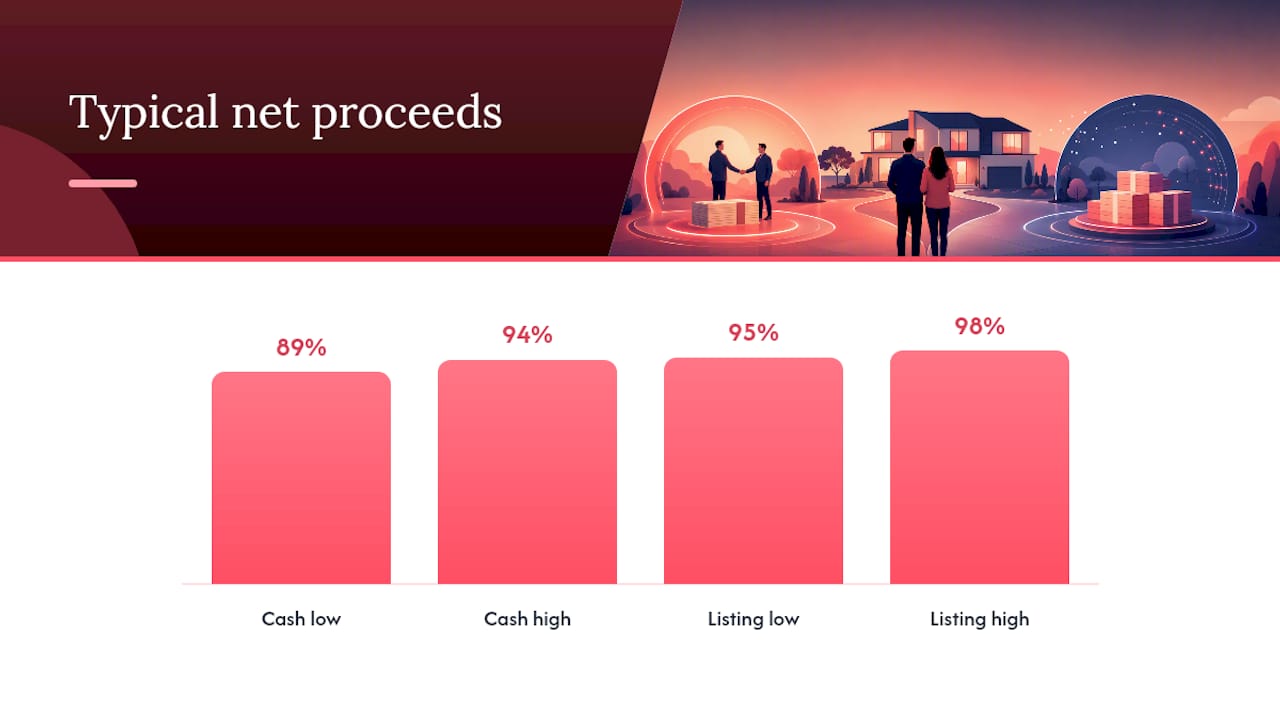
Those ranges hold up across a direct comparison of both paths, but they’re averages, not guarantees. Your ZIP code, home condition, and the specific buyers looking at your listing all shift the numbers. Treat this table as a starting point, then run your own figures before deciding.
How Do I Compare Offers Using a Net-Proceeds Worksheet?
The only fair way to compare a cash offer vs listing is to reduce both to the same number: what actually lands in your account after every cost is subtracted. Building two net-proceeds sheets side by side instead of comparing headline prices can change which offer wins by thousands of dollars.
The formula:
Net proceeds = Gross price − Agent commissions − Closing costs − Repair deductions − Holding costs − Buyer concessions − Program fees
Save it as a simple spreadsheet so you can update it as real numbers come in.
Here’s a worked example on a home worth $300,000 on the open market:
In this example, listing nets roughly $11,900 more, but that assumes a smooth 60 day sale with no financing hiccups. If a $12,000 difference isn’t worth two extra months of mortgage payments, showings, and uncertainty to you, the cash offer is the better deal even at a lower headline price.
What Factors Should Decide Your Choice?
Run through these before signing anything:
- Deadline: A job relocation or closing on your next home in three weeks points toward cash.
- Home condition: Foundation, roof, or electrical issues that would scare off financed buyers favor a cash sale.
- Carrying costs: High mortgage or tax payments make every extra month of listing more expensive.
- Local market strength: A seller’s market with multiple offers usually justifies the wait to list.
- Emotional cost: Repeated showings and open houses take a real toll if you’re still living in the home.
Probate and foreclosure situations usually favor cash because of the deadline pressure. A move-in-ready home in a competitive neighborhood usually favors listing because the price upside outweighs the wait.
How Do You Vet a Cash Buyer and Spot Red Flags?
Not every cash buyer is legitimate, and a bad one can cost you weeks and leverage. Before accepting any cash offer, verify:
- Proof of funds in the form of a recent bank statement or letter from a financial institution, not just a verbal promise.
- Written, itemized deductions for any repairs or fees, never a vague verbal estimate.
- BBB business profile for complaint history if you’re dealing with a company rather than an individual.
- Title company and escrow timeline confirmed in writing before you sign anything.
- State real estate commission consumer notices, which explain protections and common fee structures for alternative sale programs.
Red flags include offers made entirely over the phone with nothing in writing, contracts containing assignment clauses that let the buyer flip your contract to someone else, unexplained “transaction fees,” and pressure to sign before you’ve had time to review documents.
Pro Tip: If a buyer won’t put their deductions in writing or rushes you to sign within 24 hours, walk away. Legitimate cash buyers expect you to take a day or two to review the numbers.

Comparing cash and listing math for real sellers
When homeowners ask which route to take, the honest answer is: build both net-proceeds sheets and let the numbers, not a slogan about “guaranteed cash,” make the decision. A cash offer that nets $259,000 with no risk can beat a listing that nets $271,000 but carries a real chance of falling through in month two.
What I ask for before advising anyone: the actual buyer’s proof of funds, a written repair deduction list, and a current comparative market analysis from a licensed agent. Without those three documents, you’re comparing a guess to a guess.
How Comparespot Helps You Compare Real Offers
Comparespot is the alternative to guessing which cash buyer or agent actually delivers for Metro Detroit sellers. Instead of taking one company’s headline offer at face value, you can see independently researched rankings of local cash buyers and agents side by side, built from customer sentiment and transaction data rather than paid placement.
If you’re weighing a cash sale, start with the ranked list of cash home buyers in Metro Detroit to see which companies actually close on time and disclose fees upfront. Sellers in specific suburbs can check the Sterling Heights or Madison Heights rankings for local options. If listing looks like the better math for your situation, the Metro Detroit real estate agent rankings can help you find someone who prices and negotiates well in your specific ZIP code.
Every ranking on Comparespot is editorial, not paid placement, and the site earns a referral fee only if you choose a provider after browsing, never from providers paying for a spot on the list. Request a comparison for your address and get a clearer picture of what a real cash offer and a real listing price would look like on your specific home.
Sources
For deeper vetting, consult the TREC consumer protection notice on alternative sale program fees, HUD’s fair housing guidance to understand non-discrimination rules during marketing and buyer selection, and BBB.org for complaint histories on any cash-buying company you’re considering. A partner explainer on FHA closing costs also breaks down lender-related fees that only apply to financed sales, useful for understanding why a listed sale’s closing costs differ from a cash deal’s.
- Are Cash Offers Better for Sellers?
- Cash Offer vs. Mortgage: Which Is Better?
- TREC consumer protection notice
FAQ
Why Do Realtors Prefer Cash Offers?
Agents often favor cash offers because they close faster and rarely fall through, since there’s no lender underwriting or appraisal contingency that can kill the deal in the final weeks.
Is It Better to Accept a Cash Offer on a House?
It depends on your priorities: cash offers usually win when speed or certainty matter more than price, while listing usually wins when your home is in good condition and you can wait for full market exposure.
Do House Sellers Prefer Cash Offers?
Many sellers facing tight deadlines, inherited property, or homes needing major repairs prefer cash offers, but sellers with move-in-ready homes in strong markets often prefer listing for the higher net proceeds.
Why Would a Seller Reject a Cash Offer?
Sellers reject cash offers most often because the price is too far below market value, typically when investor offers run 30 to 50% below market on properties that would sell well through a traditional listing.
How Do I Know If a Cash Offer Is Legitimate?
Ask for proof of funds, get every deduction in writing, and check the buyer’s BBB profile before signing, or compare vetted options through a local ranking like Comparespot’s cash buyer list.