

TL;DR
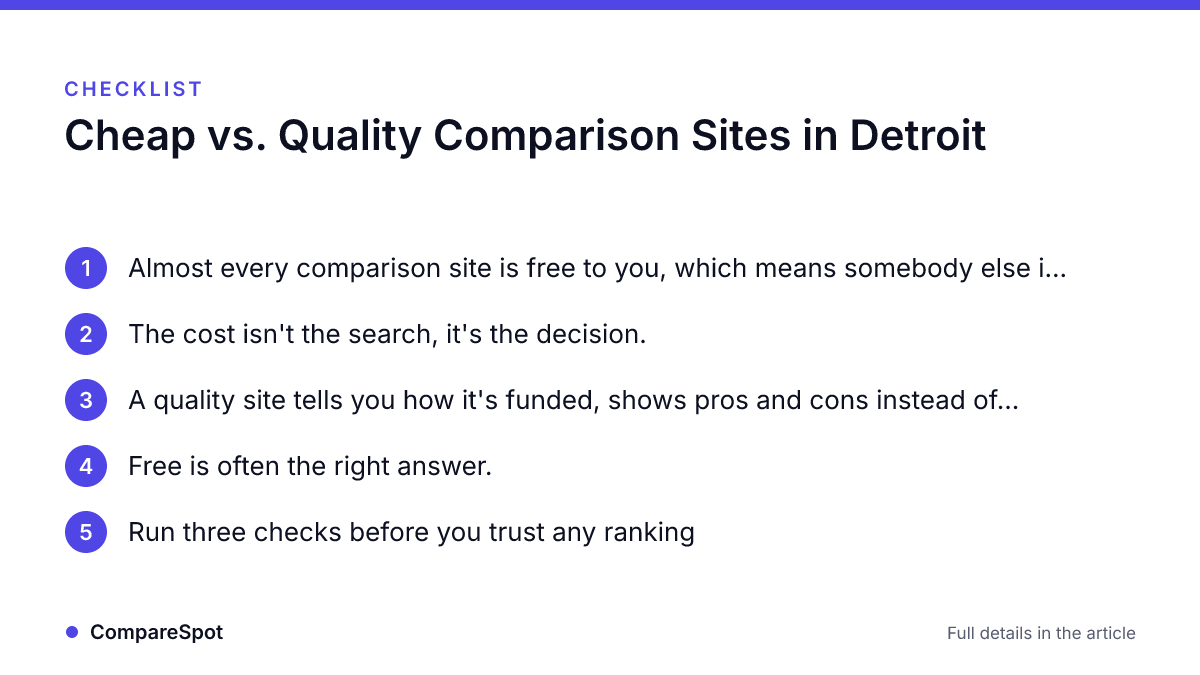
- Almost every comparison site is free to you, which means somebody else is paying. Usually it's the businesses being ranked, through affiliate commissions or flat pay-for-placement fees, so the #1 spot can belong to the biggest marketing budget rather than the best provider.
- The cost isn't the search, it's the decision. In the scenario we walk through below, a sponsored cash offer came in roughly $31,000 under what a standard investor formula would produce on the same house.
- A quality site tells you how it's funded, shows pros and cons instead of stars, and benchmarks against county-level Metro Detroit data rather than one flat "Detroit" number, because Wayne, Oakland, and Macomb don't price anything alike.
- Free is often the right answer. For a couch, a mattress, or a lawn crew, a quick ad-supported tool is fine. For a cash buyer, a lender, an agent, or a property manager, the vetting behind the list matters far more than the price of using it.
- Run three checks before you trust any ranking: find the funding disclosure, look for stated trade-offs, and confirm the data is local and dated.
Denise's aunt died last fall and left her a three-bedroom brick colonial in Madison Heights. Solid bones, original knob-and-tube wiring, a roof with maybe one winter left in it. Denise lives in Ohio. She has no interest in managing a rehab from four hours away, and she needs the house sold before probate and holding costs eat the estate.
So she does what nearly everyone does. She types "sell my house fast Detroit" into Google and clicks the first site promising the "top cash home buyers" in her area.
The site is free. It's fast. Clean layout, five-star badges everywhere. Its #1-ranked buyer offers her $65,000.
She almost takes it.
(Denise is a composite of sellers we talk to every month. The numbers below are illustrative, but the math behind them is the math real cash buyers use.)
Table of Contents
- What is the cheapest comparison site?
- How do you tell a cheap comparison site from a quality one?
- What does picking the wrong ranking actually cost you?
- What is the best website for comparing prices?
- What is the best price comparison website in the US?
- When is the free option actually the right call?
- What does this look like in practice?
- Frequently asked questions
What is the cheapest comparison site?
Whichever one you're looking at, most likely. Nearly every comparison site is free to browse, cheap or quality, which makes "cheapest" a useless sorting question.
The money comes from somewhere else. Affiliate commissions, cost-per-click ads, or direct placement deals with the businesses on the list. Wikipedia's overview of comparison shopping websites describes the common setup plainly: a business pays a fee or commission for the traffic and leads a site sends its way. Perfectly legal. Perfectly ordinary. It only becomes a problem when nobody tells you.
So the better question is what the #1 provider paid to sit there, and whether that payment moved them up. If a company can buy position, you're not reading a ranking. You're reading a billboard with numbers on it.
How do you tell a cheap comparison site from a quality one?
About two minutes of poking around will tell you. Check how the site makes money, how the list was built, and when it was last touched.
- A disclosed business model. A site doing this honestly says somewhere visible whether providers can pay for placement. If you can't find that sentence in a minute of looking, assume the answer is yes.
- Evidence of actual work. Mystery-shop calls, contract reviews, side-by-side pricing requests. That takes hours. A list that reads like somebody skimmed page one of Google usually was.
- Pros and cons per entry, not a star average. Real vetting surfaces trade-offs. A lender with great rates and a slow underwriting desk. A cash buyer whose offers are fair but who needs 45 days to close instead of 14.
- County-level data, not a single "Detroit" number. Median prices in Oakland County run dramatically higher than Wayne County's, with Macomb sitting in between. That's one metro area with a six-figure spread across three counties. Any site pricing "Detroit" off one flat figure doesn't understand the market it claims to rank.
- A visible last-updated date. Detroit's citywide median is a fraction of what the suburbs command, and it moves. A ranking built on data nobody has touched in two years is guessing.
Pro tip: Before you trust any property-manager ranking, search the company name plus "complaint" and plus "BSEED." Detroit requires rental properties to hold an annual Certificate of Compliance verifying working utilities, heat, plumbing, and secure locks. Managers who let that lapse leave a trail in city records and tenant forums months before a review site notices. We've seen five-star-rated operators with a stack of open violations sitting in plain view.
What does picking the wrong ranking actually cost you?
The gap between the offer you took and the offer you should have gotten. On a house, that gap is almost never small. Run Denise's numbers with me.
The Madison Heights house, fully renovated, would appraise around $180,000. That's the after-repair value, or ARV. It needs roughly $30,000 of work: roof, wiring, a few plumbing runs.
Most legitimate cash buyers price off the same rule of thumb. Offer equals about 70% of ARV, minus repairs.
$180,000 × 0.70 = $126,000 $126,000 − $30,000 = $96,000
Call $96,000 the fair floor, give or take a few thousand depending on how thin the buyer runs their margin. The sponsored #1 buyer offered $65,000. That's about $31,000 below what the standard formula produces on the same property.
Plug in your own house: take your realistic renovated value, multiply by 0.70, subtract a contractor's repair estimate rather than the buyer's. If the offer in front of you sits more than 10% under that number, ask why out loud and listen to the answer.
That's the exact trap our guide to we-buy-houses scams digs into: offers that feel legitimate because they arrived through a "top-rated" list, when the list itself was for sale. If you haven't settled on a cash sale at all, our breakdown of iBuyers versus traditional cash buyers is worth reading first.
Pro tip: Ask any cash buyer to show their work. ARV, repair estimate, and the percentage they're applying. A buyer who won't walk you through those three numbers is counting on you not running them yourself.
What is the best website for comparing prices?
The one whose research depth matches what's at stake. A $40 blender doesn't need mystery shopping. A $250,000 mortgage does.
For low-stakes goods, a fast ad-supported tool is genuinely fine, because the worst case is a return label. For anything attached to real property, the bar goes way up. Here's what separates a useful lender comparison from a useless one: the useful one shows total cost, not the teaser rate. Points, origination fee, lender credits, and the actual monthly payment at your down payment amount. Two lenders quoting the same rate can be thousands apart once you add a point on one side and a lender credit on the other, and the site that only publishes the rate is hiding the part that matters.
Same principle with agents. An "average days on market" figure means nothing unless it's filtered to your price band and your ZIP. An agent who moves $400,000 Royal Oak listings in nine days may have never sold a $90,000 house on Detroit's east side, and those are different jobs with different buyer pools.
If you're still figuring out what your budget reaches across the metro, our breakdown of what $200K buys you in Detroit right now is a decent gut-check. It'll tell you whether you're shopping in the city market or an Oakland County market, and that changes which providers are even relevant.
What is the best price comparison website in the US?
There isn't one, and any site claiming the title is selling something. "Best" depends entirely on category and geography.
A national appliance comparison works fine for a refrigerator, because a refrigerator costs the same in Ferndale as it does in Fresno. A national real estate comparison tool fails almost by design. Housing is hyper-local, and so is everything attached to it: closing cost norms, transfer taxes, which title companies actually close on time, which lenders understand Michigan's property tax uncapping.
The tri-county Metro Detroit area is several markets wearing one name. Sterling Heights, one of Michigan's largest cities and firmly Macomb County, behaves nothing like emerging Detroit neighborhoods such as North End/Milwaukee Junction or Core City, where appreciation has been real but uneven block to block. A national "best of" list can't see any of that. A regional one, done honestly, can.
One tell we'd flag immediately: a national lender ranking that never mentions Michigan's summer and winter tax bills or how proration gets handled at closing. If the page doesn't know that, it doesn't know your closing costs either.
When is the free option actually the right call?
More often than you'd guess. Free and cheap aren't insults, they're tools with a job description. Match the tool to the stakes.
| Factor | Free ad-funded comparison site | General review aggregator (stars only) | Independent vetted comparison site |
|---|---|---|---|
| Cost to browse | Free | Free | Free |
| How it makes money | Placement fees or affiliate commissions from ranked businesses | Ad revenue, sometimes paid review management | No payment accepted for placement or position |
| Depth of vetting | Minimal; often just paid listings | Crowdsourced opinions, no verification | Mystery shopping, pricing checks, sentiment review |
| Local data used | Rarely; usually national averages | None | County-level MLS, Census, and state Realtor data |
| Update frequency | Inconsistent, sometimes years stale | Continuous but unfiltered | Set schedule, typically quarterly |
| Best for | Furniture, small services, low-stakes buys | Gauging reputation, not ranking order | Agents, lenders, cash buyers, property managers |
| Risk if you're wrong | Wasted time, mild buyer's remorse | Missing red flags buried under old or fake reviews | Low, which is the entire point of the vetting |
Use the free ad-funded tool for furniture, movers, lawn care. Wrong pick, small loss, easily reversed.
Use a review aggregator to sanity-check reputation, but don't treat the average as truth. A provider with 4.8 stars across 12 reviews and one with 4.3 across 800 are telling you completely different stories, and the second one is usually the more reliable business.
Reach for an independently vetted comparison site whenever being wrong costs five figures: a cash home sale, a mortgage, a listing agent, or a property manager responsible for keeping a rental compliant with Detroit's annual inspection.
Pro tip: First-time buyers, don't compare advertised rates. Compare the total five-year cost including points and fees, then read our FHA versus conventional loan breakdown before you fall for a rate that looks beautiful on a landing page and falls apart at your down payment amount.
What does this look like in practice?
Denise did the thing more people should do: she checked a second ranking before signing anything. That one disclosed up front that it doesn't take payment for placement, and it listed pros, cons, and typical closing timelines beside each buyer instead of a lone star rating.
Two buyers on that list came back in the low $90,000s. Right where the 70%-minus-repairs math said they'd land. Fourteen-day close, no repair contingencies. She took one, netted roughly $27,000 more than the sponsored offer, and closed before the estate's holding costs turned into a real problem.
That $27,000 had nothing to do with negotiating harder. She just checked who was paying for the ranking she almost trusted.
Weighing a straight as-is sale against fixing things first? Our comparison of realtor-led sales versus FSBO covers that fork. Still unsure about timing, our timing guide walks through the seasonal patterns that actually show up in Metro Detroit. And you can read exactly how we build our own rankings, including why we turn down placement payment from everyone we list.
Frequently asked questions
Do comparison sites get paid by the companies they rank?
Plenty do. Affiliate commissions, referral fees, flat placement deals. It's a standard, legal model across the comparison shopping industry. The model isn't the problem. Hiding it is, because then you read a purchased position as an earned one.
How often should a real estate comparison ranking be updated?
Quarterly at minimum. Housing data shifts fast enough that a list goes misleading inside a few months, and median prices across Metro Detroit can move noticeably from one quarter to the next. If a ranking won't tell you when it was last updated or what data it's built on, treat every figure on the page as unverified.
Is a free comparison tool ever better than a paid or ad-free one?
For low-stakes buys, absolutely. Furniture, appliances, small home services. Being wrong costs you a return trip. For a cash offer or a rate lock, the funding model behind the ranking matters far more than whether the tool charges you, since almost none of them do anyway.
Before you act on any "top-rated" list involving your house, spend two minutes hunting for the funding disclosure. Can't find it in two minutes? Open a second list from a site that publishes one, and compare what the two rankings say. That's the cheapest due diligence available, and on a single decision it can be worth tens of thousands.