

On a mortgage of average size, closing costs typically range from low to high estimates based on the percentage guidelines. The next move is simple: pull Loan Estimates from at least three lenders or run a calculator before you get too attached to a listing price.
TL;DR:
- Buyers should obtain Loan Estimates from at least three lenders to compare total closing costs, focusing on the “Total Closing Costs” and cash-to-close figures.
- Closing costs usually range from 2% to 5% of the loan amount, with smaller loans having a higher percentage due to fixed fees.
- Many fees are fixed or non-negotiable, such as government recording taxes and third-party appraisal fees, while lender-related fees are often negotiable.
- Location-specific costs, like transfer taxes and recording fees, heavily influence the total, especially in certain states or counties.
- Shopping early, questioning line items, and timing the closing near month’s end can significantly reduce upfront cash requirements.
Table of Contents
- What Are Buyer Closing Costs in Dollars, Not Just Percent?
- What Do All Those Closing Cost Line Items Actually Cover?
- How Do You Calculate Your Own Cash to Close?
- Who Pays Buyer Closing Costs, and What Can You Negotiate?
- What Actually Lowers Your Closing Costs?
- When Do You Get Your Loan Estimate and Closing Disclosure?
- Which Closing Cost Calculators Are Worth Using?
- Does Buying a Condo Cost More at Closing Than a Single-Family Home?
- Does Your Loan Type or Down Payment Change What You’ll Pay?
- What Do Buyers Get Wrong About Closing Costs Most Often?
- Do First-Time Buyers Pay More in Closing Costs Than Repeat Buyers?
- Publisher Perspective: What to Prioritize First
- Compare Local Lenders and Agents Before You Commit
- Sources
- FAQ
What Are Buyer Closing Costs in Dollars, Not Just Percent?
Percentages are easy to say and hard to picture, so here’s what that 2% to 5% range actually looks like once you attach real numbers to it.
- For a home costing several hundred thousand dollars, closing costs usually span a range estimated by applying low and high percentage points to the loan amount.
Those figures track the typical range lenders and calculators use to set buyer expectations, but where you land in that band isn’t random. Smaller loans tend to skew toward the higher percentage, because flat fees like appraisal, credit report, and settlement charges don’t shrink just because your loan does. A $150,000 loan absorbs the same $500 appraisal fee a $600,000 loan does, so it eats a bigger share of the total. High transfer taxes, condo or HOA transfer charges, and city-specific recording fees push the number up too.
One thing gets missed constantly: this range is separate from your down payment. Add both together to see your real cash-to-close, not just one or the other.
What Do All Those Closing Cost Line Items Actually Cover?
Closing cost statements read like alphabet soup until someone breaks down who charges what and why.
Lender-related fees come first: origination charges (the lender’s fee for processing your loan), discount points (optional, paid to lower your interest rate), underwriting fees, and the credit report pull. These vary the most between lenders, which is exactly why comparing more than one Loan Estimate matters.
Third-party fees cover the appraisal (an independent valuation the lender requires), the home inspection (optional but recommended, paid to your inspector directly), and a survey if the property or lender requires one.
Title and settlement charges include title insurance, which comes in two flavors: lender’s title insurance (protects the bank) and owner’s title insurance (protects you, and worth paying for even when it’s optional). You’ll also see a settlement or closing fee for the attorney or title company running the transaction, plus escrow account setup.
Government charges show up as recording fees and transfer taxes, and these are where location swings the total the most, since some counties charge a flat fee and others charge a percentage of the sale price.
Prepaid items aren’t technically fees. They’re your first year of homeowners insurance paid up front, plus an escrow deposit covering a few months of property taxes and insurance, collected so the lender has a cushion before your first mortgage payment.
Buyer closing costs typically include one-time loan and title charges alongside these prepaid insurance and escrow amounts, and sellers can sometimes agree to cover a portion of either category.
Pro Tip: Origination fees, points, and the settlement fee are usually negotiable. Appraisal fees and government recording taxes are not, since those go to independent third parties or the county, not the lender.

How Do You Calculate Your Own Cash to Close?
The formula is short enough to do on a napkin, but the inputs matter more than the math.
- Find your loan amount. Purchase price minus down payment. A $350,000 home with 20% down ($70,000) leaves a $280,000 loan.
- Apply the low end. Multiply the loan amount by 2%: $280,000 × 0.02 = $5,600.
- Apply the high end. Multiply by 5%: $280,000 × 0.05 = $14,000.
- Add your down payment. Cash to close is closing costs plus down payment, not either one alone: $70,000 + $5,600 to $14,000 = $75,600 to $84,000.
- Layer in prepaids. Escrow deposits and first-year insurance can add another $2,000 to $4,000 depending on your tax rate and premium, and prepaid interest (the daily interest from your closing date to month’s end) adds a smaller amount depending on when in the month you close.
Before you trust any estimate, collect four things from your purchase agreement and lender: purchase price, down payment amount, estimated interest rate, and your target closing date. Those four numbers turn a generic percentage range into a number you can actually plan around.
Who Pays Buyer Closing Costs, and What Can You Negotiate?
Buyers cover most of their own loan-related and title fees, but the line between buyer and seller responsibility is more flexible than most people realize.
- Buyers typically pay: lender fees, appraisal, credit report, lender’s title insurance, and their share of prepaids and escrow.
- Sellers typically pay: their own agent’s commission, owner’s title policy in some regions, and any transfer taxes assigned to the seller by local custom.
- Seller concessions let a seller agree to pay part of the buyer’s closing costs, but loan programs cap how much: conventional, FHA, VA, and USDA loans each set their own concession limits, generally scaled to your down payment or loan-to-value ratio.
Asking for seller-paid costs makes the most sense in a slower market or when a listing has sat unsold for a while. In a competitive bidding situation, asking for concessions can make your offer look weaker next to an all-cash or no-concession bid, so weigh that tradeoff before you write it into your offer. Gift funds from family, employer assistance programs, and local down payment assistance programs can also close the gap. Sellers who understand how concessions affect their own net proceeds are often more open to the request than buyers expect.
What Actually Lowers Your Closing Costs?
Most of the savings sit in decisions you make weeks before closing day, not tricks you pull at the table.
- Shop at least three lenders. Fees and APR vary more than headline rates suggest, and two lenders quoting the same interest rate can differ by thousands in total fees.
- Question every line item. Ask your lender and title company to explain or waive fees you don’t recognize; some, like courier or administrative charges, are padding.
- Shop your title and settlement provider separately. In many states you can choose your own, and prices differ by company.
- Consider lender credits or rolling costs into the loan. This raises your rate or loan balance slightly but cuts your upfront cash need, a real tradeoff worth running the long-term math on before you decide.
- Time your closing near month’s end. Fewer days of prepaid interest between closing and your first payment means less cash due at the table.
Pro Tip: When you compare Loan Estimates, look past the interest rate at the “Total Closing Costs” box and the cash-to-close figure. That’s the number that actually determines what check you write, and it’s the line item worth comparing across every lender you’re considering.
When Do You Get Your Loan Estimate and Closing Disclosure?
Federal timing rules exist specifically so you’re not surprised on closing day, and knowing the schedule lets you catch problems while there’s still time to fix them.
Under TILA-RESPA, lenders must send a Loan Estimate within three business days of a completed application, and a Closing Disclosure at least three business days before your loan closes. Both forms include a Calculating Cash to Close table and a cost at Closing summary, which break your total down into loan costs, other costs, and the amount you’re actually bringing.
Watch for these red flags when you compare the two documents:
- A large jump in total fees between the Loan Estimate and Closing Disclosure with no explanation
- Seller credits listed on your offer but missing or reduced on the Closing Disclosure
- New or unexplained charges that weren’t on the original Loan Estimate
- A cash-to-close figure that doesn’t match your own calculation
If a correction to the Closing Disclosure changes your annual percentage rate, adds a prepayment penalty, or changes the loan product, it can restart the three-business-day waiting period, pushing your closing date back. Ask your lender directly whether a correction resets the clock rather than assuming your closing date is fixed once you have a disclosure in hand.
Which Closing Cost Calculators Are Worth Using?
A calculator is only as good as the inputs it lets you enter. Look for tools that ask for your state and county, not just a national average, since transfer taxes and recording fees drive most of the state-by-state difference in totals.
- Federal and nonprofit housing counseling calculators, which tend to explain each line item in plain language
- Major bank and lender calculator tools, useful for a quick range before you formally apply
- Site-specific calculators from title companies or real estate platforms, which sometimes factor in local transfer tax rates directly
Treat every calculator output as a planning range, never a bill. The only number that counts is the one on your actual Loan Estimate, so use the calculator to set expectations, then compare it against what your lender sends.
Does Buying a Condo Cost More at Closing Than a Single-Family Home?
Property type changes your closing costs more than most buyers expect going in. Condos often add fees single-family buyers never see: a condo association questionnaire fee, HOA document review charges, and sometimes a capital contribution or transfer fee paid to the association itself. Some lenders also require additional condo-specific underwriting review, which can add a small fee of its own.
Single-family homes usually carry lower add-on fees but can face higher survey or septic/well inspection costs in rural areas, where those inspections aren’t standard on a condo purchase at all.
Location layers on top of property type. That’s why a state-by-state view of average closing costs matters more than a single national percentage. Before you assume your estimate is accurate, check whether the county you’re buying in charges transfer tax as a percentage or a flat fee, since that single variable can shift your total by thousands.
Does Your Loan Type or Down Payment Change What You’ll Pay?
Loan type affects closing costs through the fees baked into the program itself, not just the interest rate you’re quoted. FHA loans carry an upfront mortgage insurance premium added to closing costs (or rolled into the loan). VA loans include a funding fee, though VA rules also limit which fees a veteran can be charged directly.
Down payment size matters in a less obvious way: a bigger down payment means a smaller loan, and several closing cost line items, including some lender fees and mortgage insurance setup, scale with loan size.
The practical takeaway: never compare your closing cost estimate to a friend’s without checking whether you’re using the same loan type.
What Do Buyers Get Wrong About Closing Costs Most Often?
The single biggest misunderstanding is treating closing costs and the down payment as the same bucket of money. They’re not. You need both, and skipping that math is how buyers show up to closing short on funds.
A close second: assuming the first Loan Estimate they receive is the final number. It’s an estimate, and it can shift, sometimes for legitimate reasons like a change in your locked rate or a different appraisal outcome. Buyers also frequently assume all fees are negotiable, when in reality government recording taxes and independent appraisal fees are fixed, no matter which lender you choose.
Another common mistake: not knowing which funds are acceptable at closing. Most settlement agents require a cashier’s check or wired funds, not a personal check, and wire fraud targeting buyers near closing has become common enough that you should always confirm wiring instructions by phone with a known contact, never solely by email.
Last, plenty of buyers skip comparing multiple Loan Estimates because they think switching lenders mid-process is complicated. It isn’t, and the fee differences between lenders are frequently large enough to justify the extra paperwork.
Do First-Time Buyers Pay More in Closing Costs Than Repeat Buyers?
First-time buyers don’t inherently pay higher closing costs, but they tend to end up with a higher total for a few predictable reasons. Smaller down payments are more common among first-time buyers, which often triggers mortgage insurance and a larger loan-to-value ratio, both of which add cost. First-time buyers are also less likely to negotiate seller concessions, simply because they don’t know to ask.
Repeat buyers often bring larger down payments from the sale of a previous home, which shrinks the loan amount and reduces several fees tied to loan size. They’re also more likely to shop multiple lenders because they’ve been through the process before and know fees vary, and they’re more comfortable asking for seller-paid costs during negotiation.
The gap isn’t about loan programs treating first-time buyers worse. FHA and other first-time-buyer-friendly loans exist specifically to lower the barrier to entry, and some come with reduced mortgage insurance rates or assistance programs that can narrow the total cost gap significantly. The real difference is experience and down payment size, both of which are fixable with the right preparation before you make an offer.

Publisher Perspective: What to Prioritize First
Get Loan Estimates from at least three lenders before anything else, then check the Calculating Cash to Close table line by line. If you’re short on funds, ask about lender credits, seller concessions, or local down payment assistance before assuming you’re stuck. Ranked local lender and broker listings exist to assist with this comparison step, before committing to one provider.
— Bryan
Compare Local Lenders and Agents Before You Commit
There are alternative platforms that publish independently researched, ranked lists of local mortgage lenders, brokers, and real estate agents for specific counties, built from customer sentiment and market research rather than paid placement.
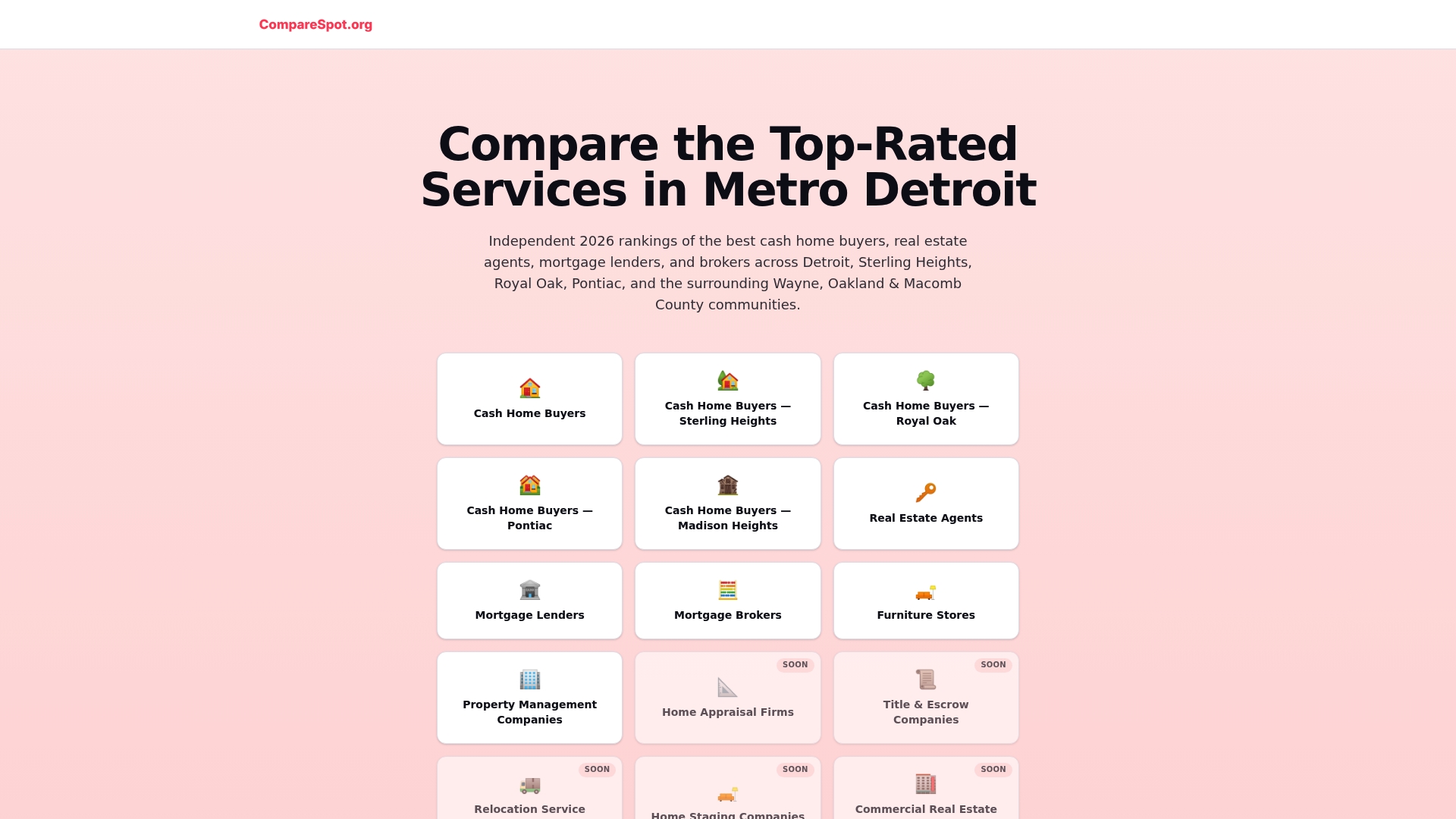
Before you contact anyone, it’s worth seeing how local providers stack up against each other on service and pricing. Check the ranked mortgage lenders in Metro Detroit or browse top-rated real estate agents in the area to see who’s actually earning strong reviews from recent buyers. Start at Comparespot’s Metro Detroit rankings to compare your options before you request a single Loan Estimate.
Sources
- Closing Costs Calculator | Fannie Mae
- What are closing costs and how much will I pay? | Freddie Mac
- Executive summary of the 2017 TILA-RESPA rule | CFPB
- Average closing costs by state | Bankrate
FAQ
How much does a buyer pay for closing costs?
Buyers typically pay 2% to 5% of their loan amount in closing costs, separate from the down payment. The exact figure depends on loan size, location, and how many fees a seller agrees to cover.
How much are closing costs for a $400,000 house?
Your actual total depends on your loan amount, down payment size, and local transfer taxes.
How much are closing costs on $300,000?
Smaller loans sometimes land toward the higher end of that range because flat fees make up a bigger share of the total.
How much are closing costs on a $600,000 house?
A home priced higher, such as $600,000, typically sees closing costs within a range estimated by percentage rates on the loan amount. Higher-value purchases often land closer to the lower percentage since fixed fees represent a smaller share of a larger loan.
Do I need to compare more than one Loan Estimate?
Yes. Comparing at least three Loan Estimates is the most reliable way to catch fee differences between lenders, since APR and total fees often vary more than the advertised interest rate suggests.