

Most cash sales in Detroit close in 2 to 3 weeks once a seller accepts an offer, and sellers who pre-clear title and skip inspections can sometimes close in as few as 7 days. The tradeoff for that speed is usually a lower price than a fully marketed listing would fetch. The step-by-step breakdown below shows exactly where those days go, and where a vetted buyer list can shave time off the slowest parts.
TL;DR:
- A Detroit cash sale can close as quickly as 7 days if the title is clear and the buyer skips inspections, but typical closings range from 2 to 3 weeks.
- Most delays occur during the title search and lien clearing stage, especially with unresolved municipal liens, unpaid water bills, or probate issues.
- Investor buyers usually close faster, often in 7 to 21 days, because they buy as-is and waive inspections, but they generally require a larger price concession.
- Preparing key documents and ordering payoff and title searches immediately after accepting an offer can shave several days off the closing timeline.
- Vetting local buyers based on their performance history and reputation significantly reduces the risk of delays or buyer default during the closing process.
Table of Contents
- What Is a Realistic Cash Sale Timeline for Detroit Sellers?
- What Are the Steps From Offer to Closing?
- How Does the Buyer Type Change Your Timeline?
- What Local Issues Slow Down a Detroit Cash Closing?
- What Should You Have Ready Before Accepting an Offer?
- How Do Cash Buyer Categories Compare on Speed and Cost?
- What Does Speed Actually Cost You?
- Why Local Buyer Vetting Matters More Than the Timeline Itself
- Get Vetted Cash Offers Without Guessing Which Buyer Is Legit
- Sources
- FAQ
What Is a Realistic Cash Sale Timeline for Detroit Sellers?
The cash sale timeline in Detroit generally falls into three tiers, and which one applies to you depends less on wishful thinking and more on the condition of your title and how fast you can move paperwork.
- 7 days: Reserved for sellers with clean title, no back taxes, no municipal liens, and a buyer willing to skip inspection. This tier usually means an investor buyer paying cash outright with no financing contingency.
- 2 to 3 weeks: The most common range for a Detroit cash sale. It allows time for a title search, a payoff statement from any existing mortgage, and a short inspection window without dragging the deal out.
- 30 to 60 days: Applies when title problems surface, a lien needs to be paid off and released, or the property sits in probate and requires court documentation before a sale can close.
National guides on selling for cash confirm that a week is possible but that most cash closings run days to a few weeks once title and buyer type are factored in. Investors and iBuyers tend to hit the 7 day to 3 week window because they buy as-is and use standardized closing paperwork. Agent-assisted cash deals often land in the 2 to 3 week tier since they still involve a purchase agreement review and sometimes a short marketing period to collect competing bids. One scheduling detail catches people off guard: title companies, county recorder offices, and mortgage payoff departments run on business days, not calendar days, so a deal that “closes in 10 days” might stretch to two calendar weeks once weekends are subtracted.
What Are the Steps From Offer to Closing?
A cash sale moves through four distinct stages, and knowing what happens in each one lets you spot delays before they cost you a week.
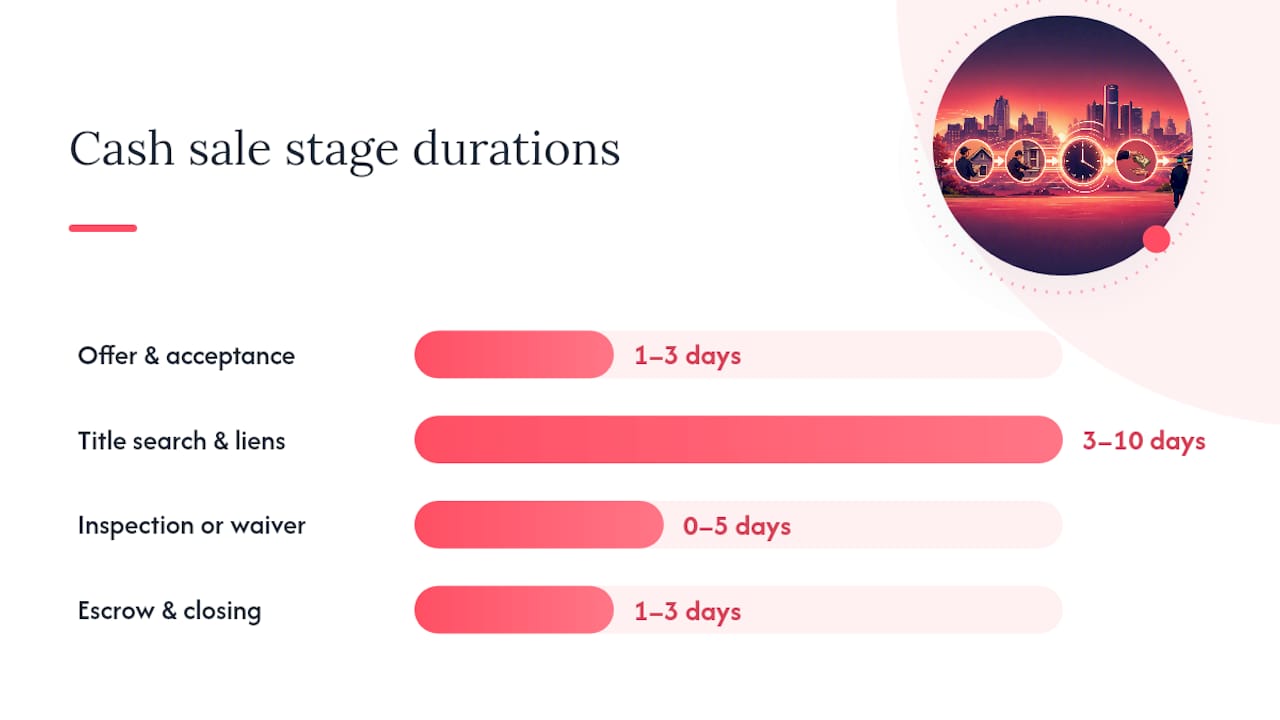
- Offer and acceptance (1 to 3 days). The buyer submits a written offer, you review and sign it, and earnest money gets deposited into escrow. This is also when you and the buyer agree on a target close date, which becomes the anchor for every deadline that follows.
- Title search and lien clearing (3 to 10 days). A title company pulls records to confirm you actually own the property free of undisclosed claims. In Detroit, this step is where most delays start, since Wayne County properties frequently carry unpaid water bills or municipal fines that attach to the title rather than the owner. The Wayne County utility and title resources page is the fastest way to check for these before a title company flags them and stalls your closing.
- Inspection or waiver (0 to 5 days). Investor buyers frequently waive inspection entirely since they’re buying as-is. iBuyers and agent-assisted cash buyers may still send someone through the house, and if they find something material, expect a short renegotiation window of two to four days.
- Escrow and closing (1 to 3 days). Once title is clear and any repair terms are settled, the closing agent prepares the deed transfer, you sign, funds wire into your account, and the deed records with the county. Wiring alone can take a business day depending on your bank’s cutoff times.
Pro Tip: Ask your closing agent for the exact list of documents they need on day one, not day ten. Title companies process files in the order paperwork arrives complete, not in the order deals were opened.
A 7-day fast-close checklist looks like this: signed offer on day 1, title search ordered same day, payoff statement requested from your lender same day, inspection waived, title clears by day 5, closing scheduled day 6 or 7. Compare that to a 21-day typical fast close: signed offer days 1 to 2, title search and lien resolution days 3 to 12, a short inspection and repair negotiation days 10 to 15, and closing scheduled days 18 to 21 once everything clears. The gap between those two timelines almost always comes down to how clean your title is on day one.
How Does the Buyer Type Change Your Timeline?
The buyer you choose determines your speed ceiling more than any other single factor.
- Investor buyers are usually the fastest option because they buy as-is, skip financing contingencies, and often waive inspection outright. The tradeoff is a price concession, since they’re pricing in repair costs and resale risk.
- iBuyers run standardized digital workflows, with offer submission and scheduling often handled through an app rather than a phone call, which speeds up the front end of a deal. Service-area limits and fixed service fees can offset some of that speed advantage, and coverage in Detroit neighborhoods isn’t universal.
- Agent-assisted cash offers move a bit slower on the front end since an agent typically markets the property briefly to attract multiple cash bids, but that competition can push your net proceeds higher than a single investor offer.
Match the buyer type to your situation. A seller facing foreclosure risk or a hard deadline should call investor buyers first. Someone handling an inherited property through probate often does better with an agent-assisted process, since the extra time allows for court paperwork to run in parallel with buyer outreach. A seller relocating for a new job (say, transferring to a new hospital system or employer) may prioritize an iBuyer’s certainty over squeezing out the last few thousand dollars. If you want to compare more than one path before committing, our breakdown of cash sale versus listing outcomes in Detroit walks through the price side of that decision.
What Local Issues Slow Down a Detroit Cash Closing?
Detroit closings run into a specific set of hold-ups more often than other markets, mostly tied to the city’s aging infrastructure and tax history.
- Title defects and back taxes. Unresolved liens, unpaid property tax assessments, or a title chain with a missing signature can add two to four weeks while the title company sorts it out.
- Wayne County water and utility liens. Detroit water bills attach to the property, not the person, so a previous owner’s unpaid balance can surface during title search and block closing until it’s paid or negotiated. Checking the Wayne County utility redirect page before you list saves real time.
- Mortgage payoff delays. Lenders can take five to seven business days to issue an accurate payoff statement, and if your loan servicer is slow to respond, that alone can push a 2-week closing into week three.
- Code violations and occupancy issues. A tenant who won’t vacate, or an open code violation from the city, adds negotiation time that has nothing to do with the buyer and everything to do with getting the property legally ready to transfer.
The fix for most of this is surfacing problems in the first 24 to 48 hours rather than letting the title company find them on day 12. Pull your own tax and utility records before you accept an offer, and you’ll know exactly what you’re dealing with before it becomes a surprise.
What Should You Have Ready Before Accepting an Offer?
Preparation is the single biggest lever you control, and most of it takes a phone call or an email rather than a trip to an office.
- Gather your core documents: the deed, a recent mortgage statement or loan payoff request, photo ID, past two years of property tax bills, current utility receipts, and any HOA documentation if it applies to your property.
- Order your payoff statement immediately if you still owe on a mortgage. This single step is one of the most common causes of a closing slipping past its target date.
- Authorize the title search the same day you accept an offer. Don’t wait for the buyer to prompt you. Every day earlier that a title search starts is a day you get back at closing.
- Clear any small known liens now, even minor ones, since resolving a $200 municipal fine ahead of time avoids a title company holding up a six-figure closing over it.
- Coordinate tenant access early if the property is occupied, and set clear expectations about move-out dates in writing.
Pro Tip: Build a simple 72 hour plan the day you accept an offer: day 1, order payoff and authorize title search; day 2, pull utility and tax records yourself; day 3, confirm your closing agent has everything they need. Sellers who do this consistently shave several days off their overall timeline.
For a fuller walkthrough of what buyers expect during this stage, see our guide on Detroit cash for keys transactions, which covers offer review and title work in more detail.
How Do Cash Buyer Categories Compare on Speed and Cost?
Choosing between buyer categories gets easier once you line up their tradeoffs side by side.
| Buyer category | Typical closing time | Fees or price concession | Repairs required | Best for |
|---|---|---|---|---|
| Investor buyer | 7 to 21 days | Larger price concession, often reflecting full repair costs | None, buys as-is | Sellers needing speed or facing foreclosure |
| iBuyer | 10 to 21 days | Moderate concession plus a standardized service fee | Minor repairs sometimes requested | Sellers wanting a digital, low-hassle process |
| Agent-assisted cash offer | 30 to 60 days | Smaller concession, especially with multiple bidders | Varies, negotiable | Sellers with more time who want a stronger net price |
Use this table as a shortlist filter, not a final answer. If your priority is closing before a specific date, cross out any category that can’t realistically hit it. If your priority is maximizing proceeds and you have three or four weeks of flexibility, requesting bids from more than one buyer type tends to outperform accepting the first offer that lands in your inbox. Our guide on requesting multiple cash offers in Detroit covers how to run that comparison without losing your fastest offer in the process. For sellers weighing whether an agent could squeeze out more value, our ranking of Metro Detroit real estate agents breaks down which agents handle cash-offer negotiations well.
What Does Speed Actually Cost You?
Selling fast almost always means selling for less than a fully marketed listing would bring, and the size of that gap depends on your property’s condition and how many buyers you let compete for it.
- Expect a price concession that scales with the repair work a buyer will need to absorb; a move-in-ready home concedes less than one needing a full rehab.
- You’ll still typically cover title insurance, recording fees, and prorated property taxes at closing even in a cash sale, since these are standard Michigan closing costs regardless of buyer type.
- Competition narrows the gap. A seller who gets three investor bids instead of one often sees the concession shrink because buyers know they’re being compared.
A quick note on the math: if repair costs are the main driver of a lower offer, a Detroit-specific rehab estimator can show you roughly what a buyer is pricing in, which helps you judge whether an offer is fair or padded.
Why Local Buyer Vetting Matters More Than the Timeline Itself
The fastest closing in Detroit isn’t worth much if the buyer disappears at the title company or reneges after finding a water lien you didn’t know about. Detroit’s utility and tax history creates more surprises than most markets, which is exactly why vetting a buyer’s track record matters as much as their quoted timeline. Rankings are built around local case studies and closing timelines specific to Wayne, Oakland, and Macomb counties, not generic national averages. Complaint patterns tracked through the CFPB’s public database reinforce a simple rule: get every offer in writing, and don’t skip the step of checking a buyer’s reputation just because they promised a fast close. Speed and a fair price aren’t mutually exclusive, but only if you’re comparing buyers who’ve actually earned trust.
— Bryan
Get Vetted Cash Offers Without Guessing Which Buyer Is Legit
There are alternatives to cold-calling roadside “we buy houses” signs, including platforms that rank local cash buyers using real closing timelines and customer sentiment, not paid placement, so you can pick from buyers who’ve actually performed.
Start with our ranked list of Metro Detroit cash home buyers, which breaks down closing speed and typical offer ranges by buyer type. If you’re in a nearby suburb, our Madison Heights cash buyer rankings cover that market specifically. While you wait on offers to come in, work through the document checklist above so you’re ready to move the moment you pick a buyer and a close date. Visit Comparespot to request matches and compare offers side by side before you sign anything.
Sources
FAQ
How Quickly Can a Cash Sale Actually Go Through?
A cash sale can close in as little as 7 days if title is clean and the buyer waives inspection, though most cash sales close within a few weeks once a title search and payoff statement are factored in. In Detroit, the realistic range is 2 to 3 weeks for a typical file and 30 to 60 days if liens or probate issues surface.
What Is the 3-3-3 Rule in Real Estate?
The 3-3-3 rule refers to a general guideline some agents use for listed home sales: roughly 3 days to get initial offers, 3 weeks to negotiate and finalize a contract, and 3 months to close with financing involved. It applies loosely to traditional financed sales and doesn’t map directly onto cash transactions, which typically move faster than any leg of that rule.
What Is the $25,000 Grant for Detroit Residents?
Detroit and Michigan have run various down payment assistance and homeowner grant programs over the years aimed at helping residents buy or repair homes, and program names and funding amounts change frequently. Because eligibility and availability shift, sellers or buyers interested in a specific grant program should confirm current details directly with the city of Detroit’s housing department rather than relying on a fixed figure.
What Is the Hardest Month to Sell a House?
Winter months, particularly January and February, tend to see the slowest traditional listing activity due to cold weather and holiday distractions. Cash sales are largely insulated from this seasonal slowdown since investor and iBuyer demand stays fairly consistent year round, which is one reason sellers facing a winter deadline often turn to cash buyers instead of listing.
Does Using Comparespot Change My Closing Timeline?
Comparespot doesn’t buy your home directly. It connects you with vetted local cash buyers so you can compare real closing timelines and offers instead of guessing which buyer will actually perform. Sellers who compare multiple vetted offers through the Metro Detroit cash home buyer rankings often close faster simply because they avoid buyers who stall or renegotiate late in the process.