

Yes, cash home buyers are a legitimate category of the real estate market, not a fringe scheme. But legitimate as a category doesn’t mean every offer in your inbox is trustworthy. Treat each one as unverified until you confirm proof of funds and see a title or escrow company named in writing. Your next move should be simple: request that documentation before you sign anything.
TL;DR:
- Most cash home buyers fall into categories like individual investors, wholesalers, iBuyers, REITs, or agents, each with different risks and verification needs.
- About 32% of U.S. home sales are cash deals, reflecting mainstream adoption, but individual offer validity still requires careful verification.
- Always request a recent proof of funds, confirm the buyer’s identity and license, and ensure a neutral third-party title company handling escrow before signing.
- Red flags include upfront fees, pressure tactics, requests to sign over ownership early, and lack of verifiable proof of funds or title company details.
- Cash offers typically range from 50% to 80% of fair market value, influenced by property condition, legal issues, and seller urgency, with a standard closing timeline of 7 to 30 days.
Table of Contents
- Are Cash Home Buyers Legit, and Who’s Actually Making These Offers?
- Cash Sales Are Common. That’s Evidence, Not a Guarantee
- How to Verify a Cash Offer Before You Sign Anything
- Common Cash Buyer Scams and the Red Flags That Precede Them
- What to Expect on Price: The Speed Tradeoff
- How the Cash Sale Process Actually Works
- Should You Sell to a Cash Buyer? A Quick Decision Check
- How Comparespot Vets Cash Buyers Before They Make Our Lists
- An Editor’s Take on Moving Fast Without Getting Burned
- Find a Vetted Cash Home Buyer Without Starting From Zero
- Sources
- FAQ
Are Cash Home Buyers Legit, and Who’s Actually Making These Offers?
A cash sale means the buyer pays the full purchase price without a mortgage contingency, which cuts out the loan underwriting delay that slows most transactions. That’s the whole mechanical difference. Who’s on the other end of that offer, though, varies enormously, and knowing which type you’re dealing with changes how much verification you need.
- Individual investors buy with personal or business funds, often planning to rent or resell the property themselves.
- Wholesalers never intend to close. They sign a purchase contract, then assign it to another buyer for a fee. This is legal in most states, but it means the person you’re negotiating with may not be the one paying you.
- iBuyers are large, tech-driven companies that make algorithm-based offers, usually with fast, standardized closings.
- REITs and investor groups operate at scale, often through local acquisition teams, and typically have the deepest funding.
- Agents buying off-market sometimes represent themselves or a client as the direct cash buyer, which can blur the line between representation and self-interest.
Wholesalers tend to offer the fastest initial response and the lowest price, since they’re building in room for their assignment fee. iBuyers and REITs generally offer more consistency and better documentation, but their pricing models leave less room to negotiate. Knowing which category you’re talking to tells you what questions to ask next, and how much skepticism to bring to the table.
Cash Sales Are Common. That’s Evidence, Not a Guarantee
About one-third of U.S. home sales were all-cash transactions in recent years, the highest share since 2014, according to National Association of Realtors data. That’s roughly one in three closings nationwide, which puts cash buying firmly in the mainstream rather than at the margins.
That statistic answers the “are we buy houses companies legit” question at the category level. A practice this widespread, drawing in retirees downsizing, investors scaling portfolios, and institutional buyers alike, isn’t inherently predatory. Cash sales exist because they solve a real problem: speed, and freedom from financing contingencies that can collapse a deal at the last minute.
Prevalence doesn’t vouch for any individual buyer, though. Scale tells you the category survives scrutiny. It tells you nothing about the specific person who just called your phone. That distinction is where most seller mistakes happen: assuming that because cash offers are normal, this particular cash offer must be fine.
How to Verify a Cash Offer Before You Sign Anything
Run these checks in order. Each one takes minutes, and together they separate legitimate cash home buyers from the operators hoping you won’t bother looking closely.
- Request dated proof of funds. Ask for a bank or brokerage letter showing available funds, dated within 30 days, naming the account holder and covering the purchase price. Then call the issuing institution using a phone number you find independently, not one printed on the letter itself, and confirm the letter is real. Forged or screenshotted proof-of-funds documents are one of the most common ways sellers get strung along.
- Ask directly whether they’re buying or assigning. “Will you be the one closing on this property, or are you assigning this contract to someone else?” A wholesaler isn’t automatically a problem, but you deserve to know who’s actually funding the deal before you take your house off the market for them.
- Read the contract for three specific things. It should name a licensed title or escrow company, require earnest money in the 1% to 3% range, and charge you no seller-side fees. Insist on a neutral third party handling the closing, never the buyer’s own attorney or an unnamed “closing service.”
- Check their business identity independently. Look up state business registration, pull their BBB profile at bbb.org directly rather than trusting a badge displayed on their own website, and read live reviews on Google or Trustpilot. Ask for two or three recent local transactions you can verify.
- Pause if anything feels evasive. No proof of funds, no named title company, a request for any upfront payment, or a deadline that expires “tonight” are all reasons to stop and get a second opinion. Comparespot’s proof of funds walkthrough breaks down exactly what a legitimate letter should include if you want a document to check against.
Pro Tip: Ask the buyer to walk you through their offer math, the after-repair value, estimated repair costs, and their margin. A serious investor answers this without hesitation. Vague deflection is often a sign you’re talking to someone who isn’t actually capitalized to close.
Common Cash Buyer Scams and the Red Flags That Precede Them
Most fraud in this space follows a small number of repeatable patterns, which is actually good news. Once you know them, they’re easy to spot.
- Upfront payment requests. Any request for a “processing fee,” “administrative fee,” or deposit from you before closing is a hard stop. Legitimate buyers get paid at closing, not before.
- Pressure to sign immediately. Refusing to let you show the contract to an attorney or title company, or manufacturing a “the offer expires in two hours” deadline, is a classic pressure tactic.
- Requests to sign over title or a temporary deed early. No legitimate cash transaction requires you to transfer ownership before you receive payment at closing.
- No proof of funds, no named title company. State consumer-protection offices, including North Carolina’s Department of Justice, specifically warn sellers to verify ownership claims and avoid any upfront payment in these deals.
- Post-acceptance renegotiation. A buyer who repeatedly lowers their offer after inspection, or a contract with an exit clause that lets them walk away penalty-free at any point, isn’t negotiating in good faith.
Investigative reporting has caught even nationally franchised “we buy houses” operators using these tactics against sellers, which is exactly why oversight of these companies has increased in recent years. Brand recognition isn’t the same as a clean track record. For a deeper walkthrough of specific mailer and ad tactics to watch for, see Comparespot’s guide to “we buy houses” scams.
What to Expect on Price: The Speed Tradeoff
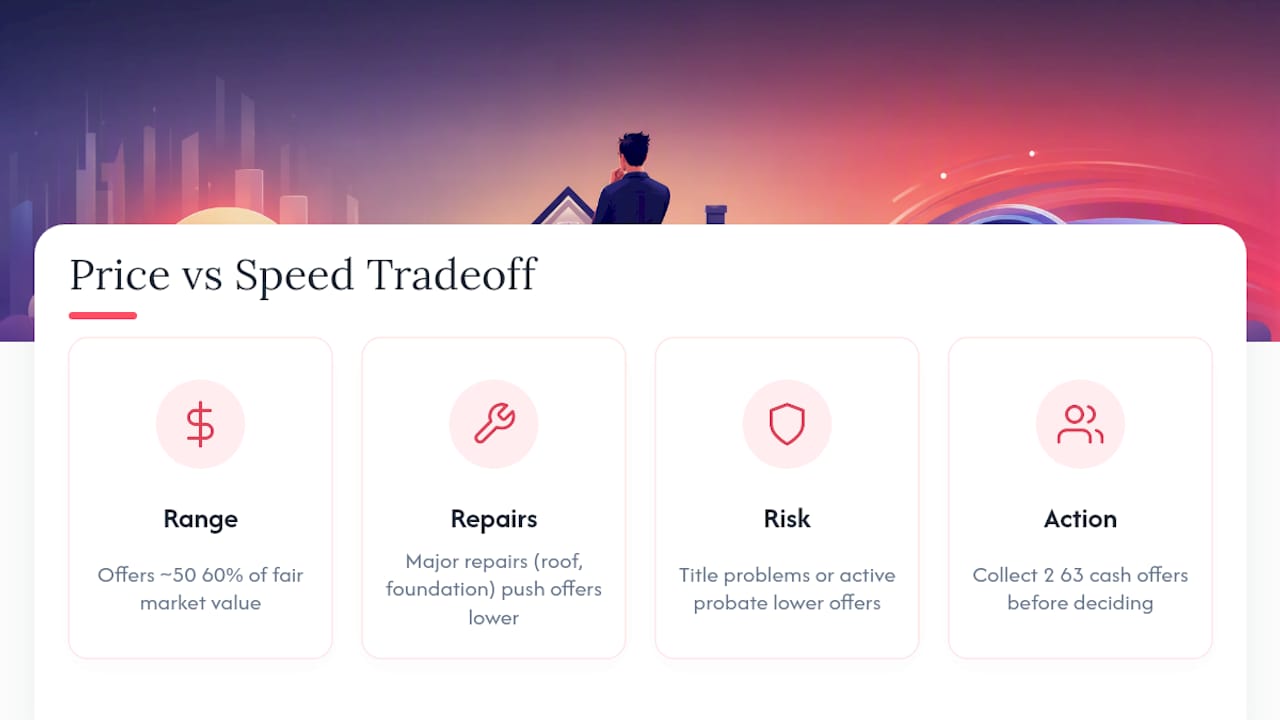
Cash buyers pay for convenience, and that convenience shows up in the offer. Direct buyers and iBuyers commonly offer somewhere in the range of 50% to 80% of fair market value, depending heavily on the property’s condition and which type of buyer you’re dealing with.
That gap exists for a reason, not because you’re being cheated by default. Investors build in room for repairs, holding costs, resale commissions, and their own profit margin, since they’re taking on all of that risk the moment they close. A house that needs a new roof and foundation work will land at the lower end of that range. A move-in-ready property in a strong neighborhood negotiates much closer to the top.
Title problems, an active probate process, and genuine urgency on your end all push offers lower, since buyers price in the extra work and risk those situations create. The single best defense against underpricing isn’t refusing a cash offer. It’s collecting two or three of them before you decide, so you actually know what “fair” looks like for your specific property.
How the Cash Sale Process Actually Works
A legitimate cash transaction follows a predictable rhythm, and knowing that rhythm helps you spot a timeline that’s either suspiciously fast or unreasonably slow.
- Initial offer. A vetted buyer who has already seen photos or done a quick walkthrough typically sends a written offer within 24 to 72 hours of your inquiry.
- Due diligence period. Expect a short inspection window, often 7 to 14 days, where the buyer confirms condition and finalizes their number. A buyer skipping this entirely can be a red flag just as much as one dragging it out for months.
- Title and escrow. Funds and documents route through a licensed title or escrow company, never directly between you and the buyer. This is the single strongest protection you have against fraud, and it’s worth reviewing how wire fraud typically targets closings so you know what unusual instructions look like.
- Closing. A realistic timeline runs 7 to 30 days from signed contract to funds in your account. Delays beyond that usually trace back to title defects, probate court scheduling, or a buyer who wasn’t as funded as they claimed.
Should You Sell to a Cash Buyer? A Quick Decision Check
Cash sales make the most sense when time or condition takes options off the table. Foreclosure deadlines, a probate process that needs resolution, a sudden relocation, or a property too damaged to finance conventionally all point toward a cash sale being the practical choice.
Listing traditionally tends to win when the opposite is true.
- Your local market is strong and buyers are competing for inventory.
- You have weeks or months to make repairs before listing.
- Maximizing sale price matters more to you than closing speed.
- The property has no legal complications like liens, unresolved probate, or title disputes.
A rough way to weigh it: high urgency plus a straightforward title usually means cash makes sense despite the discount. Low urgency plus a clean, updated property usually means listing nets you more. Legal complexity, an estate sale with multiple heirs, or unresolved liens, tips the scale toward cash regardless of urgency, since a traditional buyer’s lender often won’t touch those complications anyway. If you’re still unsure which path fits, comparing a cash offer against what a local agent thinks the property could list for costs you nothing and gives you a real number to weigh against any cash offer on the table.
How Comparespot Vets Cash Buyers Before They Make Our Lists
Local rankings are built by checking transaction history, cross-referencing independent review platforms, and tracking complaint patterns over time rather than a single snapshot.
A Comparespot list doesn’t replace your own diligence. It shortens it. Instead of starting from a cold internet search, you start from a pool of buyers that already cleared a first round of scrutiny, then you still run the proof-of-funds call and the title-company check yourself. Comparespot’s Metro Detroit cash home buyer rankings and Royal Oak, MI list are built for exactly that starting point.
An Editor’s Take on Moving Fast Without Getting Burned
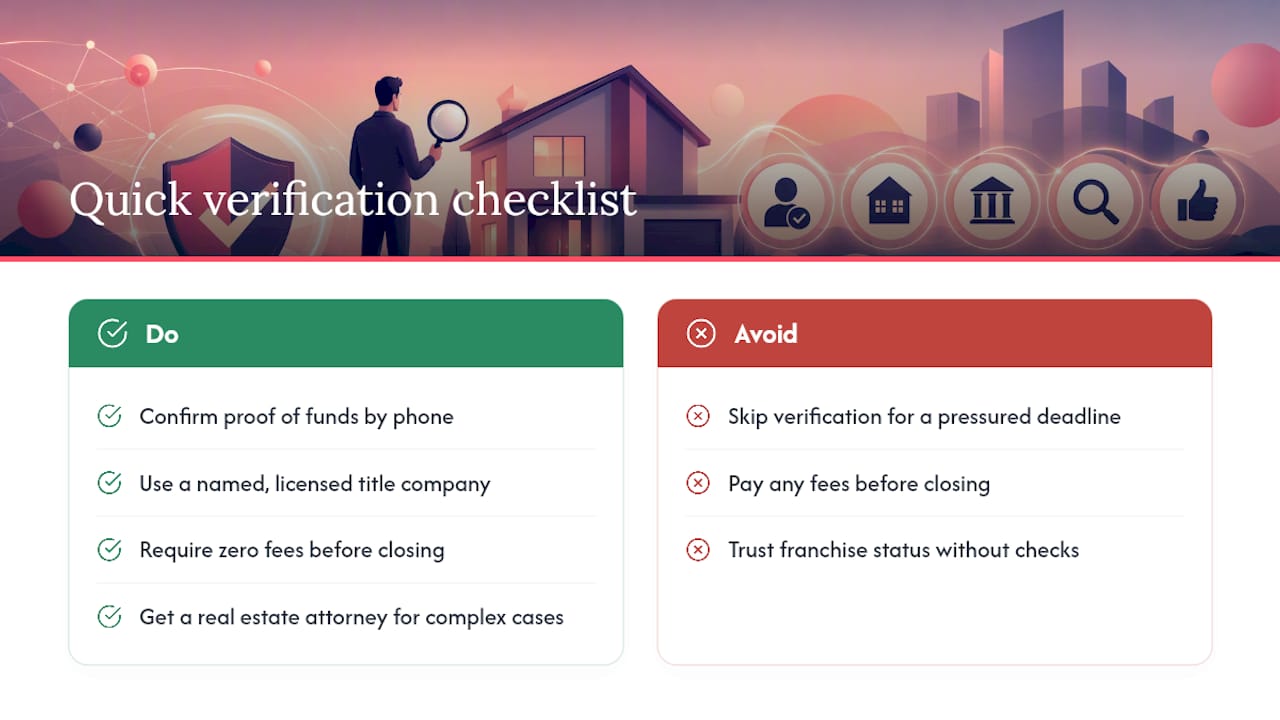
The sellers who get burned in this market aren’t usually the ones who move too slowly. They’re the ones who skip verification because a deadline feels real when it isn’t. A legitimate buyer with actual funds has no reason to rush you past a proof-of-funds check or a title company confirmation, because those steps cost them nothing and cost you everything if skipped.
My honest read: treat every cash offer, from a national franchise or a local investor, with the same three checks. Proof of funds you confirm by phone. A named, licensed title company. Zero fees paid by you before closing. If a situation involves probate, liens, or multiple heirs, get a real estate attorney to look at the contract before you sign, and always collect a second offer for comparison. Verification isn’t a sign you distrust the buyer. It’s just what a normal transaction looks like when it’s done right.
— Bryan
Find a Vetted Cash Home Buyer Without Starting From Zero
This platform exists so you don’t have to run the entire verification process on a stranger who cold-called you. Instead of googling a company name and hoping the first page of results tells you the truth, you start from a list that’s already been checked against transaction history, live review data, and complaint patterns.

Comparespot ranks local providers across Metro Detroit, including cash home buyers in Madison Heights and the broader Metro Detroit market, based on independent research rather than paid placement. That distinction matters when you’re deciding who gets a call back and who gets your proof-of-funds request in return. If a cash sale doesn’t end up being the right fit once you compare numbers, Comparespot’s mortgage lender rankings and agent lists cover the traditional path too. Start by browsing the local rankings at Comparespot and shortlist two or three buyers before you make a single call.
Sources
- The share of all-cash buyers highest since 2014 at 32% of all buyers
- We buy homes scams - North Carolina Department of Justice
- Are ‘we buy houses’ offers a rip-off? How to know if you’re getting scammed
FAQ
How do you know if a cash buyer is legit?
Confirm proof of funds dated within 30 days by calling the issuing bank directly, verify the contract names a licensed title or escrow company, and make sure they charge zero upfront fees.
Is selling your house for cash a good idea?
It’s a good idea when speed or property condition rules out a traditional listing, such as foreclosure, probate, or unrepairable damage. If your market is strong and you have time, listing with an agent usually nets more.
What is the best company that buys houses for cash?
There’s no single best national company. The strongest choice is a locally vetted buyer with verifiable proof of funds and independent reviews. Comparespot’s local rankings, including its Metro Detroit and Royal Oak lists, screen for exactly that before publishing.