

TL;DR
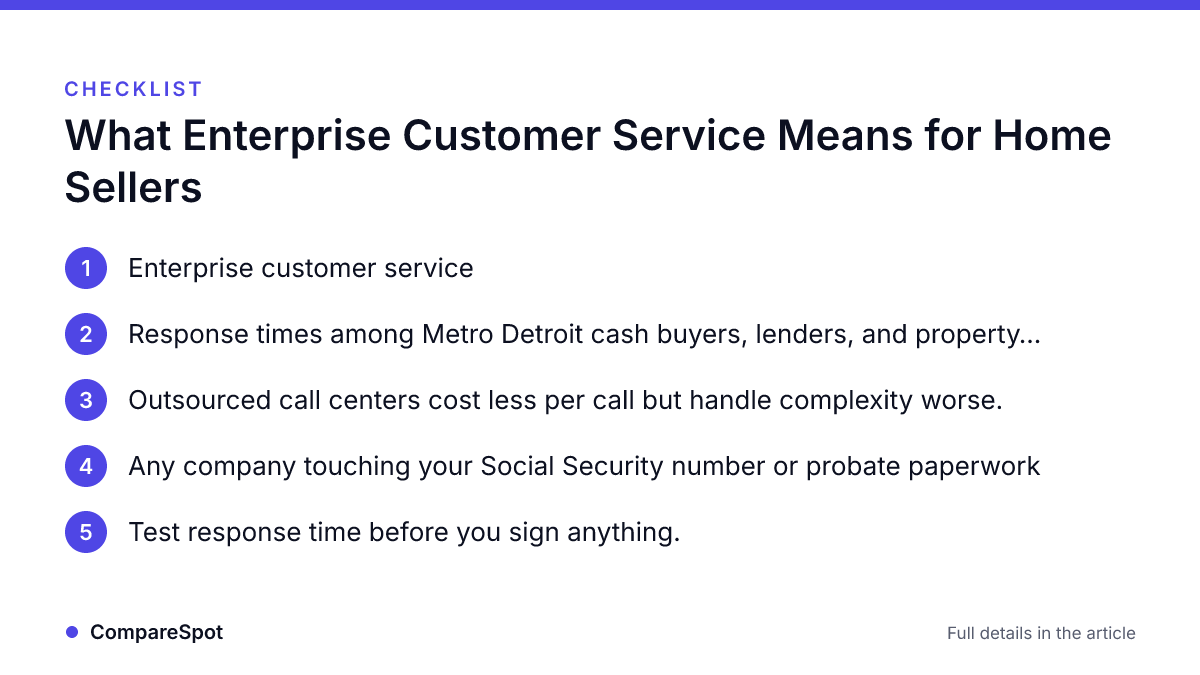
- Enterprise customer service means standardized, SLA-driven support across phone, email, and chat. Look for a company that will commit in writing to a response window, not a vague "we'll get back to you."
- Response times among Metro Detroit cash buyers, lenders, and property managers vary wildly. When we've called them ourselves, the best ring back inside ten minutes and the worst never return the voicemail at all.
- Outsourced call centers cost less per call but handle complexity worse. In-house teams cost more and, in our experience, close distressed sales faster because they know local permit offices, inspection timelines, and title quirks.
- Any company touching your Social Security number or probate paperwork should be able to tell you how long they keep it and who on staff can open the file.
- Test response time before you sign anything. Call at 7 p.m. on a Tuesday and again on a Saturday morning. Two data points beat fifty five-star reviews.
Dana's 1928 bungalow in Detroit's University District lost its furnace during a January cold snap, which in that house meant frozen pipes were suddenly a bigger worry than the mortgage. She was three months behind on payments, had no cash for repairs, and needed out. So she did what a lot of Metro Detroit homeowners do when they're drowning: she opened her laptop and called four "we buy houses" companies back to back in one afternoon.
What she learned had almost nothing to do with price and everything to do with what happens after the phone rings.
Table of Contents
- What is enterprise customer service for a Metro Detroit homeowner?
- What happened when Dana called four cash buyers in one afternoon?
- What response-time standards should you expect from local providers?
- Why do some companies answer in 10 minutes and others take a week?
- What compliance rules protect your information when you call these companies?
- How did Dana pick her buyer, and how should you?
- Frequently asked questions
What is enterprise customer service for a Metro Detroit homeowner?
It's the structured, multi-channel support system a company uses to handle customers at scale across phone, email, text, live chat, and in person, governed by written service level agreements that spell out exact response windows.
A real SLA sounds concrete. Answer inbound calls within 60 seconds. Respond to emails within one business hour. Resolve a routine request in 24 to 48 hours. Escalate anything stuck past three business days to a supervisor.
Ask a company what its own response-time standard is. If nobody can tell you, there isn't one, and you're not a customer yet. You're a lead they'll get to eventually.
For Dana that mattered more than any offer number. A cash buyer who can't return a call within a few hours during an active foreclosure timeline will not move fast enough to close before the sheriff's sale date.

What happened when Dana called four cash buyers in one afternoon?
She got four completely different experiences, and the spread was almost comic.
The first rep picked up on the second ring, asked three qualifying questions, and texted an offer range within 20 minutes with a promise of a formal written offer by the next morning. The second sent her to a voicemail box that was full. The third routed her through an automated menu that looped back to the main menu twice, then dropped the call.
The fourth answered fast but had clearly never worked in her neighborhood. He kept asking about HOA fees that don't exist in the University District, a historic pocket of pre-war homes on the city's northwest side.
That's the underrated piece of enterprise customer service in local real estate. A polished national script means nothing if the rep doesn't understand Detroit's neighborhoods, its Department of Neighborhoods service districts, or how permitting actually works here.
Pro tip: Ask one specific local question you already know the answer to. "If I need emergency furnace work before closing, what's the permit path?" A rep who's done this work here will point you toward a mechanical permit through BSEED and tell you a licensed contractor has to pull it, not you. A rep who guesses, or who tells you no permit is needed, just told you how thin their training is.
What response-time standards should you expect from local providers?
At minimum: a first response within one business hour on weekdays, and a same-day callback if you leave a message in the evening or on a weekend. Anyone asking to handle a six-figure transaction tied to your home should clear that bar.
What follows isn't a survey. It's the range we've personally run into calling these outfits at odd hours without saying we're reviewers — your own calls may land anywhere inside it.
| Provider type | Phone answer times we've run into | Email/quote turnaround we've seen | After-hours coverage |
|---|---|---|---|
| Cash home buyers | Under 10 minutes at the best, several days at the worst | Same day to 48 hours | Usually an answering service that only takes a message |
| Listing agents | Minutes to one business day | Same day | Depends entirely on the individual agent, not the brokerage |
| Mortgage lenders | A couple of hours, sometimes the next morning | A day or two for pre-approval docs | Rare outside the big national banks |
| Property managers | One business day for owners, minutes for tenant emergencies | Two to three business days | Staffed, because burst pipes don't wait |
National banks skew the curve. Call a big bank's business line — Chase business customer service is the one we've dealt with most — and the script sounds the same no matter which rep answers. That sameness is what a giant training department buys you. A three-person local lender can't match the infrastructure. The good ones compensate with escalation: you reach a decision-maker on call two, not call six. Our breakdown of mortgage refinance calculator math Detroit lenders skip covers how to tell the difference before you lock a rate.
One tell that costs you nothing to check: send an email at 4:55 p.m. on a Friday. An outfit with real workflow routing sends an acknowledgment with a ticket number or a named owner. An outfit without one goes silent until Monday afternoon.
Why do some companies answer in 10 minutes and others take a week?
It usually comes down to whether support is in-house or outsourced to a third-party call center, and the economics of that choice explain most bad experiences.
Run the arithmetic with your own quotes. For the sake of a worked example, pretend an answering service charges a flat $1.25 per handled call and a nighttime hire costs $19 an hour all in. Both figures are invented. The structure of the calculation isn't.
- Monthly cost of the in-house rep: $19 × 40 hours × 4.33 weeks = $3,291
- Break-even call volume: $3,291 ÷ $1.25 = about 2,633 calls a month, roughly 88 calls a day
Below that volume, outsourcing is cheaper and the company will outsource. Above it, a staffed rep pays for herself. Swap in the real rate a service quotes you and the real wage in your market, and you'll see immediately which side of the line a given company sits on. That's why a property manager with a dozen rentals in Sterling Heights routes nights to an answering service, and one running 200 doors in Oakland County keeps a person on the overnight shift.
The homeowner's problem is what that cheaper option can't do. An outsourced rep is trained on a script, not on your file. They can't waive a fee, move a closing date, or decide anything. They take a message and route it, and the person who can actually decide may not call until Monday. Our review of customer service outsourcing models matches what we see locally: outsourcing wins on cost, in-house wins on anything time-sensitive, which is exactly what foreclosure prevention is.
Pro tip: When a rep says "let me check with my manager and call you back," ask for a time, then write it down and say it back to them. A company with real service standards will name a window. One without will say "soon."
What compliance rules protect your information when you call these companies?
Real estate isn't regulated the way banking or healthcare is, which means the floor is set by the company's own habits rather than a federal examiner. Three questions sort the serious operators from the rest.
- Where do my documents live? "Encrypted document portal" is the right answer. "Just email me a photo of your driver's license and the deed" is how your identity ends up in a rep's personal inbox, synced to a phone, forever.
- Who on staff can open my file? Smaller shops often give every employee access to everything. Ask whether access is limited by role.
- How long do you keep signed offers and disclosures? You want them held for years, not months, because a title dispute two years out is exactly when that paperwork saves you.
Also worth checking: whether the company can actually serve someone who can't use a standard phone tree. TTY support and a website that works with a screen reader are not exotic requirements. The service management frameworks built for big organizations, like those in OTRS's enterprise service management best practices, scale down fine to a 15-person brokerage. The obligation doesn't shrink with the headcount.
This gets sharpest for heirs selling an inherited house as-is in Pontiac or anywhere else in Oakland County. In a probate sale, one buyer or title company ends up holding Social Security numbers for multiple siblings, letters of authority, and a power of attorney for a parent who may have died months earlier. That's a bigger data footprint than a normal sale, handled by people who may be doing probate for the third time ever. Ask the retention and access questions before you send the first PDF.
How did Dana pick her buyer, and how should you?
She went with the company that answered fast, sent a written offer the next morning, and knew the neighborhood without being coached. She did not go with the highest number, which arrived with $4,000 in "repair credit" deductions nobody had mentioned on the phone.
A few things separate a well-run operation from one that's winging it:
- A written response-time commitment, even an informal one in an email. Verbal promises evaporate.
- A rep who can answer a specific local question about permits, service districts, or title quirks without stalling or transferring you.
- Consistent answers across multiple calls. Call back two days later with the same question. If the answer changes, their process is one person's memory.
- A named escalation path, so you know who to call when your first contact goes dark.
- No pressure to sign same-day. Urgency is a tactic, and a company with a real pipeline doesn't need it.
Still deciding whether a cash sale, a traditional listing, or a refinance fits your situation? Our guide on 5 signals shaping Detroit's housing market in 2026 breaks down when each path makes financial sense, and what $200K buys you in Detroit right now is a good gut-check before you start fielding offers.
We don't rank these companies on price alone. We mystery-shop their customer service the way Dana did, calling at odd hours and logging what actually happens, and we explain the whole method on our about page. We apply the same test outside real estate too. Our RoenRx review tracks response times the same way, because an SLA is an SLA whether you're selling a house or refilling a prescription.
Frequently asked questions
What's a reasonable response time for a mortgage lender compared to a cash home buyer?
In our calls, lenders tend to return a message in a couple of hours during business days, since loan officers are juggling files at different stages. A well-run cash buyer should ring back inside ten to thirty minutes, because speed is the entire product. If a lender sits on a simple pre-approval question for more than a day, escalate or shop elsewhere.
Do I need to worry about customer service quality if I'm just browsing and not ready to buy?
Not urgently, but test an agent's responsiveness before you agree to work with them exclusively. Browsing listings costs you nothing. Once you're under contract, a slow agent or lender can blow a closing date or an earnest money deadline, and that costs real money.
Does a company's size guarantee better customer service?
No. Big brands like Enterprise's standardized branch model feel the same from one counter to the next because everyone's working off one playbook — that's been our experience with them, anyway. But a small local team with two layers between you and the decision-maker often moves faster on a distressed timeline than a national call center can.
Before you sign with any cash buyer, lender, or agent, call them twice on two different days and time how long it takes to reach a human. Write both numbers down. That pair of numbers predicts your closing better than anything on their website.