
TL;DR
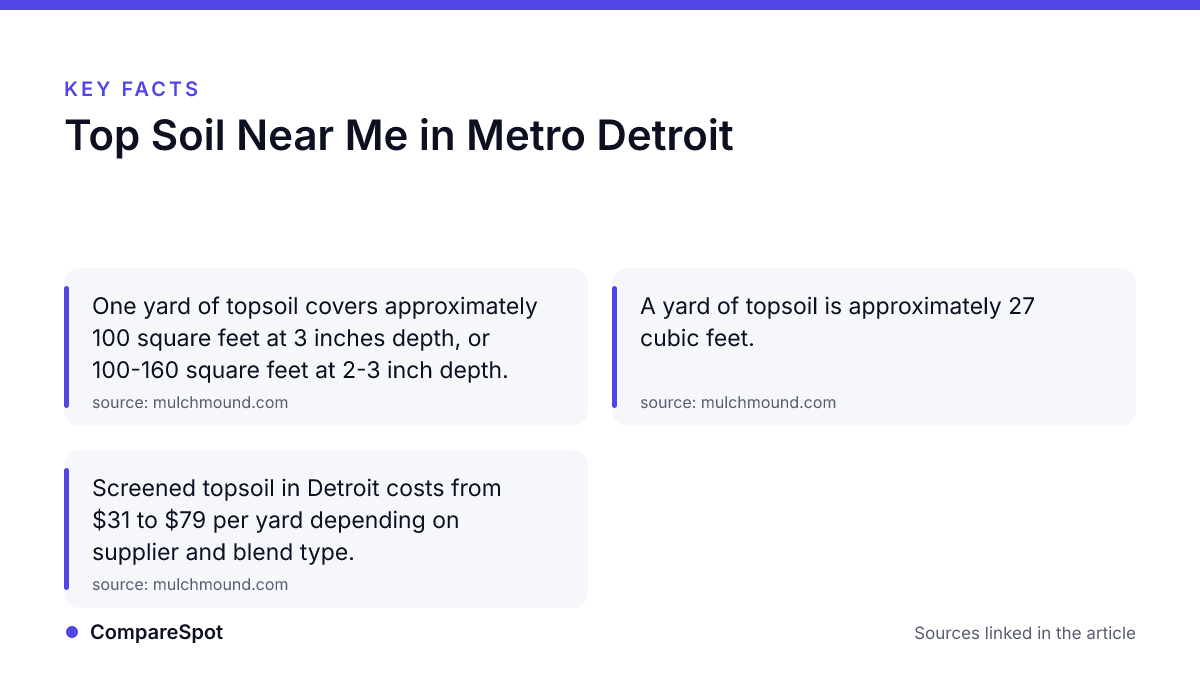
- Screened topsoil in Detroit runs $31 to $79 per yard depending on the supplier and blend (Mulch Mound).
- One yard of topsoil covers roughly 100 square feet at 3 inches deep, or up to 160 square feet at 2 inches (Mulch Mound).
- Bulk delivery beats bagged topsoil once you need more than 3 or 4 yards. Bags only win for raised beds, containers, and patching a few bare spots.
- Test drainage and pH before you order. A truckload of soil won't fix compacted clay, and most Detroit-area yards are sitting on clay.
- Order 10 to 15% more than your math says. Low spots always eat more than you planned for.
Search "top soil near me" in Metro Detroit and you'll get landscaping supply yards, Menards, and a stack of directory sites that never answer the question you actually asked. So here's the number: screened topsoil in the Detroit area runs $31 to $79 per yard, and one yard spreads across about 100 square feet at a 3-inch depth. Everything else gets simpler once you know that.
Table of Contents
- How much does a load of topsoil cost in Detroit?
- Is it cheaper to buy topsoil in bags or bulk?
- How much topsoil do you actually need?
- Should you test your soil before you buy a truckload?
- Which Detroit-area topsoil suppliers should you call first?
- Does fixing up the yard actually help you sell a Detroit house?
- What's the fastest way to get topsoil delivered this week?
- Frequently asked questions
How much does a load of topsoil cost in Detroit?
Bulk topsoil in Metro Detroit typically runs $31 to $79 per yard. The spread depends on whether you're buying plain screened fill or a richer blend with compost worked in (Mulch Mound). That's the material price, not the delivered price. Suppliers across Wayne, Oakland, and Macomb counties add a trip charge based on distance and whether they're dumping curbside or spreading for you.
What moves the number:
- Blend type. Plain screened topsoil sits at the bottom of the range. "Garden blend" or "planting mix" costs more because you're paying for amended soil, not dirt.
- Order size. Half-yard orders rarely pencil out once the trip charge lands, which is why most homeowners round up to 2 or 3 yards even for small jobs.
- Access. A truck that can back down your driveway costs less than a crew wheelbarrowing forty loads around the side of the house to a fenced backyard.
- Timing. The first warm Saturday in April is the worst day to call. Yards are slammed, delivery windows stretch, and nobody's negotiating.
Pro tip: Ask for the total delivered price, not the per-yard rate. A $31/yard quote with a $75 delivery charge on a 2-yard order works out to about $68 a yard. A $45/yard supplier who delivers free over 3 yards beats it outright.
Is it cheaper to buy topsoil in bags or bulk?
Bulk is cheaper per cubic foot, full stop. A yard of topsoil is roughly 27 cubic feet (Mulch Mound), and the bags on the pallet at a Detroit-area Menards hold a fraction of a cubic foot each. Buying a yard's worth of bags means buying dozens of them, loading them, hauling them, and cutting them open. You're paying for portion control and a trunk you can close.
Bags still make sense sometimes. Raised beds, container gardens, two or three bare spots near the mailbox. The moment you're filling something the size of a kiddie pool, bulk wins.
| Project size (3" depth) | Yards needed | Estimated bulk material cost ($31–$79/yd) | Better option |
|---|---|---|---|
| 100 sq ft (small garden bed) | 1 yard | $31–$79 | Bags, if a supplier's delivery minimum pushes you higher |
| 300 sq ft (large flower bed or yard corner) | 3 yards | $93–$237 | Bulk delivery |
| 500 sq ft (backyard patch and level) | 5 yards | $155–$395 | Bulk delivery |
| 1,000 sq ft (regrading before sod or seed) | 10 yards | $310–$790 | Bulk delivery, compare 3 quotes |
Pro tip: A yard of damp topsoil weighs well over a ton. Half-ton pickup owners regularly try to haul two yards and end up with blown rear shocks. One yard, maybe a yard and a half in a full-size truck, and go back for the rest.
How much topsoil do you actually need?
Measure the area, pick your depth, divide by the coverage rate. One yard covers about 100 square feet at 3 inches, or up to 160 square feet at 2 inches (Mulch Mound).
Square footage ÷ coverage per yard at your depth = yards needed.
Say you've got a 500-square-foot stretch of backyard that's bare and uneven, which describes about half the older lots in Detroit where the original grading settled decades ago. You want a solid 3 inches before reseeding.
500 sq ft ÷ 100 sq ft per yard = 5 yards.
At $31 to $79 per yard, that's $155 to $395 in material before delivery.
Now run it at 2 inches instead, which is enough where the ground isn't badly sunken:
500 sq ft ÷ 160 sq ft per yard = 3.1 yards, or roughly $97 to $245.
That's a meaningful difference on a job this small, and it's the calculation most people skip. Go 3 inches where you're filling and leveling, 2 inches where you're just covering bare dirt before seed.
Rule of thumb: add 10 to 15% to whatever the math says. On that 5-yard job, order 5.5 or 6. Spreading never consumes exactly what you calculated, low spots swallow more than they look like they will, and you'll want material left over after the first good rain settles everything into new dips.
Should you test your soil before you buy a truckload?
Yes, and this is the step nearly every "topsoil near me" page ignores. If your yard's real problem is compaction, drainage, or depleted nutrients, dumping new dirt on top of it is expensive landscaping that fails in one season. Big chunks of Metro Detroit sit on heavy clay. Clay doesn't care that you put six inches of nice screened loam over it.
Before you order:
- Run a drainage test. Dig a hole about a foot deep, fill it with water, let it drain, fill it again. If the second fill is still standing after four hours, you have a compaction problem. New topsoil on top of that creates a bathtub, and your new grass drowns in May.
- Test pH. A home kit from any garden center tells you whether you're too acidic or alkaline. Most lawn grasses and vegetables want roughly 6.0 to 7.0.
- Read the grass you already have. Thin, yellow turf in full sun usually means depleted nutrients, not missing volume. A compost-amended blend solves that. Plain screened topsoil doesn't.
- Match the blend to the goal. Leveling a yard for listing photos calls for basic screened topsoil. A vegetable bed calls for organic matter and costs more per yard for good reason.
Pro tip: If the soil you're ordering is for curb appeal before a sale, skip the premium planting blend entirely. Basic screened topsoil takes seed fine, looks uniform in photos, and sits at the low end of the price range. Nobody's digging a core sample at the open house.
Which Detroit-area topsoil suppliers should you call first?
Call a direct delivery service, a bulk materials yard, and a quote directory so you're comparing at least three numbers instead of accepting the first one.
| Resource | What they offer | Best for |
|---|---|---|
| Mulch Mound | Screened topsoil and compost delivered to Detroit addresses | Homeowners who want one straightforward delivery quote |
| Soulliere Gardens | Bulk soils, sands, mulches, and stone sold by the yard | Projects needing several materials on one trip |
| HomeGuide | Directory comparing roughly 10 Detroit topsoil delivery companies with free quotes | Collecting multiple quotes fast |
Ask all three the same questions: per-yard price, delivery minimum, and whether the quote covers a curbside dump or spreading on site. Those three answers tell you more than any star rating.
Pro tip: Confirm the soil is screened, and ask what size screen. Unscreened fill is cheaper and comes loaded with rocks, root chunks, and old construction debris. That's fine under a shed pad. Under new sod it's a nightmare, because every rock you missed shows up as a bump your mower finds in July.
Does fixing up the yard actually help you sell a Detroit house?
A leveled yard with even grass is one of the cheapest improvements that reliably moves curb appeal, and curb appeal still decides whether a buyer gets out of the car. You don't need a landscape designer. Fill the sunken spots, top the bare patches, reseed. On a typical city lot that's a few hundred dollars in soil and seed against the much larger discount a buyer takes off in their head when the front yard looks abandoned.
It matters more on as-is and inherited properties. If you've inherited a house in Oakland or Macomb County and the lawn has gone five years without attention, one weekend of topsoil and seed changes the listing photos completely without you touching the interior. Our guide on who buys an inherited house as-is in Pontiac covers what those buyers expect to handle themselves versus what sellers should fix first.
Before you spend anything, it's worth knowing what the local market is rewarding. Our breakdown of the signals shaping Detroit's housing market in 2026 and our piece on what $200K buys you in Detroit right now both get into buyer expectations across different price bands.
Where the yard work pays, and where it doesn't:
- Move-in-ready house in Royal Oak or Sterling Heights: do it. Buyers tour four houses in an afternoon in these neighborhoods, and a patchy lawn next to well-kept neighbors is the detail they remember.
- Selling to a cash buyer or investor: skip it. They price the lot, not the lawn, and you won't see the topsoil money come back in the offer.
- Long-neglected or hoarder property: fix drainage and the worst bare spots, then stop. Our guide on selling a hoarder house covers which exterior fixes buyers actually weigh.
- Divorce sale: keep spending minimal and keep receipts, because cosmetic improvements turn into arguments. Our piece on selling a house during divorce walks through that balance.
If you're comparing real estate agents near me before listing, a clean yard gives your agent better photos and a better first thirty seconds at every showing. Small thing, real effect on days on market.
What's the fastest way to get topsoil delivered this week?
Call a direct delivery supplier. Bulk yards and dedicated delivery services schedule faster than a big-box store where you're the labor. Most Detroit-area suppliers can get you on the calendar within a few days to a week, though that stretches in peak season. If your project is set for May or June, book in March or April. April callers routinely wait two weeks.
Need soil today? Bagged topsoil from a hardware store, loaded into a pickup, is your only same-day answer. Above 2 or 3 yards, wait for the bulk delivery. Your wallet and your back will both come out ahead.
Frequently asked questions
Can you put topsoil directly over an existing lawn?
You can topdress healthy grass with a thin layer, generally no more than half an inch, to smooth out minor dips. Thicker than that and you smother the turf. For bare patches or real low spots, rake back what's there, add your topsoil, then seed.
What's the difference between topsoil, garden soil, and compost?
Topsoil is the basic mineral layer used for filling, leveling, and starting new lawns. Garden soil is topsoil blended with organic matter for planting beds. Compost is fully decomposed organic material meant to be mixed into existing soil as an amendment, not used as standalone fill. Compost improves nutrients and structure but won't change your grade the way topsoil does.
How soon can you plant or reseed after adding new topsoil?
Grass seed can go down as soon as you've spread and lightly raked the new soil, provided it isn't soaked from rain or a wet delivery. For vegetable beds, give a compost-amended blend a week or two to settle so nutrients spread evenly before you plant.
Measure your square footage, run it against the $31 to $79 per-yard range, add 15%, and call three suppliers for the delivered total. That round of phone calls is worth more than any review you'll read. And if this yard project is really step one toward listing, start lining up your real estate agent or reviewing your FSBO options while the seed is coming in.