

TL;DR
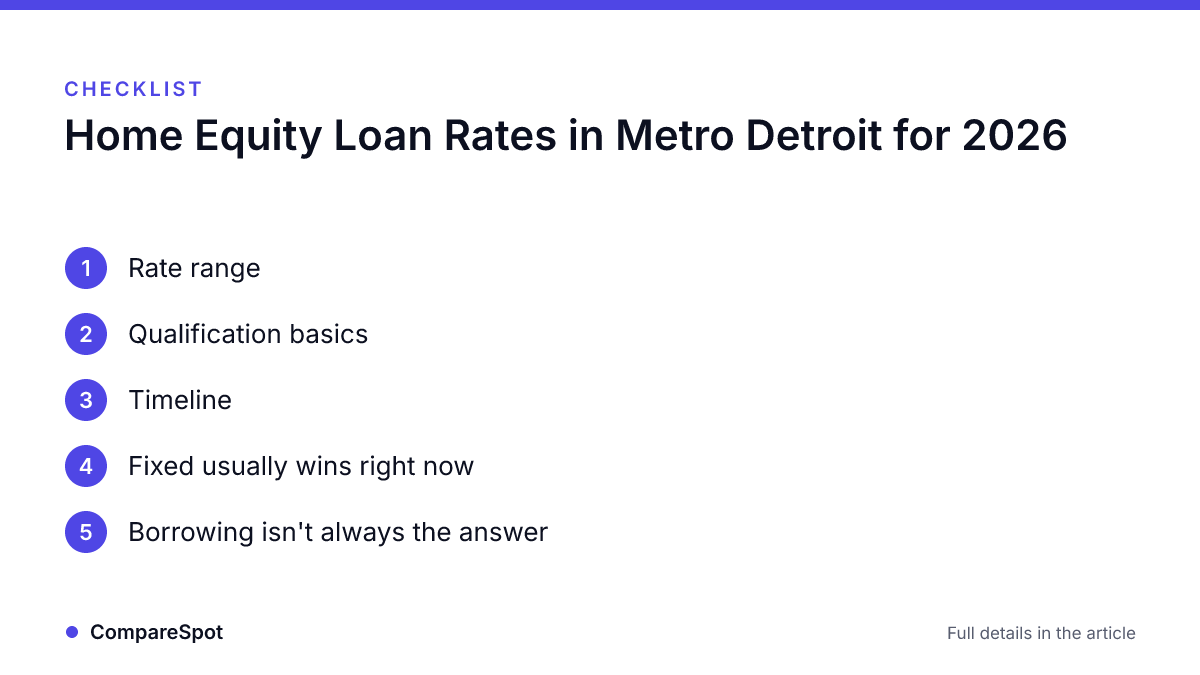
- Rate range: The fixed-rate home equity loan quotes we see most often around Metro Detroit land somewhere between the high 6s and low 9s, and local credit unions usually come in under the big national banks.
- Qualification basics: Plan on a credit score near 680, combined loan-to-value (your mortgage plus the new loan) capped around 80–85%, and total monthly debts under roughly 43% of gross income.
- Timeline: Two to six weeks is normal in Michigan. Faster than a purchase mortgage, slower than a personal loan.
- Fixed usually wins right now: when you need one lump sum and a payment you can predict, a fixed home equity loan beats a variable HELOC for most borrowers.
- Borrowing isn't always the answer: if you're behind on payments, inherited a house that needs more work than you can fund, or need cash before any loan could close, selling for cash often beats adding a second lien.
Home equity loan rates in Metro Detroit generally run from the high 6% range into the low 9s for well-qualified borrowers. Your actual number comes down to three things: your credit score, your combined loan-to-value, and which lender's door you walk through. Credit unions and community banks across Wayne, Oakland, and Macomb counties tend to undercut the national banks, especially on loan amounts under $75,000. A mid-700s score plus real equity puts you in a strong negotiating spot. Closer to 650? Shop three lenders minimum before you sign anything.

Table of Contents
- What Is a Home Equity Loan?
- How Does a Home Equity Loan Actually Work in Michigan?
- How Do Home Equity Loan Rates Compare to a HELOC or Cash-Out Refinance?
- What Do You Need to Qualify for a Home Equity Loan in Michigan?
- How Much Does a Home Equity Loan Actually Cost? (Real Math)
- What If You're Behind on Payments or Can't Afford to Borrow More?
- How Long Does It Take to Close a Home Equity Loan in Michigan?
- Are VA Home Loan Rates Different From Home Equity Loan Rates?
- What Should You Do Next?
- Frequently asked questions
What Is a Home Equity Loan?
It's a fixed-rate, lump-sum loan secured by the gap between what your house is worth and what you still owe. You get the full amount at closing, then repay it in equal monthly installments, usually over 5 to 20 years. No drawing more later. One check, one rate, one payment. As a recent explainer on how home equity loans work puts it, the loan functions as a second mortgage. Your first mortgage doesn't change at all, and the new loan sits behind it in lien position.
That lien position has a consequence almost nobody mentions at the closing table. If rates drop in a few years and you want to refinance your first mortgage, the home equity lender has to agree to stay in second position. That's called a subordination request. It's routine, but it's also paperwork, a fee at some lenders, and often two to four weeks of waiting while your refinance rate lock burns down. Ask your loan officer what their subordination process looks like before you close, not after.
How Does a Home Equity Loan Actually Work in Michigan?
The lender orders an appraisal (or runs an automated valuation for smaller amounts), calculates your combined loan-to-value, and lends you a slice of your equity based on that figure. Most Metro Detroit lenders stop between 80% and 85% CLTV. A few credit unions will push to 90% for borrowers with excellent credit and clean income.
The plain-language formula: appraised value × the lender's max CLTV, minus your mortgage balance. What's left is your ceiling.
- Home value: $280,000 (reasonable for a solid Royal Oak or Sterling Heights bungalow)
- Max CLTV at 80%: $280,000 × 0.80 = $224,000
- Current mortgage balance: $160,000
- Available equity to borrow: $224,000 − $160,000 = $64,000
That $64,000 is the ceiling, not a recommendation. Debt-to-income, payment history, and sometimes cash reserves all get checked before anyone approves the full number.
One Detroit-specific wrinkle: appraisals behave very differently depending on the ZIP code. In Royal Oak or Grosse Pointe Park, there are plenty of recent arm's-length sales to compare against. In pockets of Detroit proper where half the recent transactions were cash investor deals or land contracts, the appraiser may throw those out and reach for comps a mile away. Values can land lower than Zillow led you to believe. If your whole plan depends on a specific appraised number, ask the lender whether they'll consider an automated valuation first, and find out what the appraisal costs if it comes in short.
Pro tip: Pull your credit report and request an actual mortgage payoff statement before you call a single lender. Plenty of homeowners misremember their balance by five figures, which means they either apply for the wrong loan size or talk themselves out of applying at all.
How Do Home Equity Loan Rates Compare to a HELOC or Cash-Out Refinance?
Home equity loan rates are locked. HELOC rates float with prime, which matters enormously once you stretch the balance across five or ten years. A cash-out refinance wipes out your existing first mortgage and replaces it, so it only pencils if the new rate is close to what you're already paying.
| Factor | Home Equity Loan | HELOC | Cash-Out Refinance |
|---|---|---|---|
| Rate structure | Fixed for the full term | Variable, tied to prime | Fixed or adjustable |
| How you get funds | Lump sum at closing | Draw as needed, revolving | Lump sum, replaces 1st mortgage |
| Best for | One-time expense or debt payoff | Phased projects, uncertain timing | When your current mortgage rate is already high |
| Closing costs | Low to moderate | Low, sometimes waived | Highest, it's a full new mortgage |
| If rates rise | Payment never changes | Payment climbs with prime | Payment never changes |
| Effect on 1st mortgage | Untouched | Untouched | Gone, replaced at today's rate |
Sitting on a 3.5% or 4% first mortgage? A cash-out refi is almost always the wrong move. You'd be repricing your entire balance at today's rates just to pull out a slice of equity. The second-lien products let you keep that cheap money exactly where it is.
What Do You Need to Qualify for a Home Equity Loan in Michigan?
Most Michigan lenders want a 680 credit score, combined loan-to-value under 80–85%, and total monthly debts below roughly 43% of gross income. Some credit unions will go into the mid-600s when the equity cushion is deep and the income is stable, but price the higher rate into your math.
- Credit score: 680 and up gets the best pricing. 620–679 is workable at most local credit unions at a higher rate.
- Equity cushion: Lenders want 15–20% of the home's value left untouched after your new loan funds.
- Income documentation: Two years of returns or W-2s, recent pay stubs, bank statements. Standard stuff, but self-employed borrowers should expect closer scrutiny of business deposits.
- Debt-to-income ratio: Keep everything, including the new payment, under about 43% of gross income.
- Property type: Owner-occupied is easiest. Rentals and 2-to-4-unit buildings face tighter LTV caps and higher pricing.
- Minimum loan size: Many lenders won't write a second lien under $10,000 or $15,000 because the fixed costs don't justify it. Worth asking before you fill out an application for $8,000.
Pro tip: Landlords, run the rental's actual net income before you borrow against it. Our guide on property management companies in Metro Detroit is a reasonable place to sanity-check whether the unit genuinely supports another monthly payment, or whether you're just converting equity into a liability.
How Much Does a Home Equity Loan Actually Cost? (Real Math)
Let's run it. You borrow $30,000 at a fixed 8.5% over 10 years, which is a common ticket for a roof, a kitchen update, or wiping out credit card balances.
The payment formula: loan amount × monthly rate ÷ (1 − (1 + monthly rate)^−number of payments).
8.5% annually is about 0.708% monthly. Over 120 payments:
- $30,000 × 0.00708 = $212.50
- Divide by 0.5713 (the result of 1 − 1.00708^−120)
- = $372 per month
- $372 × 120 payments = $44,640 total
- $14,640 of that is interest
Now re-run it at 8.0%. The payment drops to about $364, total repayment lands near $43,680, and your interest falls to roughly $13,680. That half-point is worth about $960 to you on a $30,000 loan. Double the loan size and you double the gap.
Here's the threshold we'd use: if a second lender's quote is a quarter point better and the fee structure is similar, it's worth the hour it takes to apply. Below a quarter point, the paperwork probably isn't worth your Saturday. And always compare APR, not just rate, because an origination fee or a $550 appraisal can erase a quarter-point advantage entirely.
What If You're Behind on Payments or Can't Afford to Borrow More?
A home equity loan works only if you can absorb another payment without flinching. It is not a rescue line. If you're a Wayne County homeowner facing foreclosure, an heir in Oakland or Macomb who just inherited a house needing $40,000 of work you don't have, or a landlord bleeding money on a unit you can't maintain, stacking debt on the house usually deepens the hole.
In those cases a cash sale is the more honest math. Comparing vetted local cash buyers side by side is the right first step. For homeowners facing repairs they can't fund, a company like cash home buyer in Metro Detroit will take the property as-is, which removes the financing question entirely. If the house is packed with forty years of belongings and can't even be shown yet, a crew like Trash Mouth Junk Removal can clear it in days instead of weeks. Unsure what an inherited house is worth today? Our piece on what $200K buys you in Detroit right now is a solid gut-check on price points across the metro.
Heirs working through probate should start with our probate house guide for Detroit, because no lender will write a loan against a house whose title isn't settled yet.
How Long Does It Take to Close a Home Equity Loan in Michigan?
Two to six weeks covers most of them. Credit unions that underwrite in-house move fastest, sometimes inside 10 business days on smaller loans that qualify for an automated valuation rather than a full appraisal.
- Application and documents: one to three days to get income, asset, and property information submitted.
- Appraisal or valuation: one to two weeks, longer in spring when appraisers across the metro are backed up with purchase business.
- Underwriting: one to two weeks to verify everything and issue final approval.
- Closing and funding: on a loan secured by your primary residence, you get a three-business-day right to cancel after signing. The money doesn't hit your account until that window closes, so build it into your timeline.
Pro tip: If the money is for something urgent, like a furnace that died in January, say so on the first call. Lenders can often push the appraisal to the front of the queue, and credit unions where you already bank are the most likely to do it.
Are VA Home Loan Rates Different From Home Equity Loan Rates?
Yes, and the difference trips people up constantly. VA rates apply to purchase and refinance loans guaranteed by the Department of Veterans Affairs. There is no such thing as a VA home equity loan. If you're a veteran sitting on equity, the comparable product is a VA cash-out refinance, which sometimes prices better than a conventional second lien because of the government guarantee, but it replaces your entire first mortgage instead of sitting behind it.
Two things to weigh before you go that route. A VA cash-out carries a funding fee unless you're exempt, and that fee gets rolled into the loan, so you're paying interest on it for 30 years. And if your current first mortgage is a low-rate VA loan from a few years back, refinancing it away to grab $30,000 is usually a bad trade. A conventional home equity loan at a higher rate on a smaller balance frequently costs less overall. Price both before you commit, and don't assume your 2021 purchase rate carries over to anything.
What Should You Do Next?
Get quotes from two credit unions and one bank before you sign. In our experience the spread between the best and worst offer for the identical borrower can run close to a full percentage point, which on a $50,000 loan is real money every single month. Buying your first home rather than borrowing against one? Our first-time home buyer programs guide for Michigan covers down payment assistance worth checking before you lock a rate. And if closing costs or title fees are the sticking point on a future purchase, our breakdowns of buyer closing costs and title company fees will spare you some surprise line items.
Frequently asked questions
Can you deduct home equity loan interest on your taxes?
Only when you use the money to buy, build, or substantially improve the home securing the loan, under current IRS rules. Spend it on debt consolidation, tuition, or a car and the interest generally isn't deductible. Confirm with a tax preparer before you plan around the deduction.
Does a home equity loan hurt your credit score?
The application triggers a hard inquiry that usually knocks off a few points temporarily, and the new balance adds to your total debt. On-time payments typically rebuild the score within months and strengthen your payment history over time.
Can you get a home equity loan with bad credit in Michigan?
Harder, not impossible. Some Michigan credit unions will approve low-600s scores when the equity cushion is large and the income is thoroughly documented, though the rate will sit well above what a 740 borrower gets. Start with local credit unions rather than national banks, and apply where you already hold a checking account.