

TL;DR
- FHA lets you buy with 3.5% down at a 580 credit score, or 10% down with a score as low as 500, but most Metro Detroit lenders add their own overlay and want to see 620.
- FHA loan limits for Wayne, Oakland, and Macomb counties sit in the mid-$500,000s for a single-family home, which is far more than almost any first-time buyer here needs (lenders publish the current figure every year).
- On a $120,000 Detroit bungalow, 3.5% down is $4,200 and closing costs run roughly $3,600, so you're looking at about $7,800 before assistance.
- Stack an FHA loan with Michigan's MI Home Loan and MI 10K DPA and most of our clients get to the table with roughly $4,000 to $8,000 of their own money, sometimes less.
- Detroit's city Down Payment Assistance Program adds five-figure grant money for income-eligible buyers inside city limits, and it stacks on top of FHA.
A buyer walked into our office last spring convinced she needed $30,000 saved to buy anything in Detroit. She closed four months later on a brick bungalow near Rouge Park with about $5,000 of her own cash. That gap, between what people think they need and what FHA financing plus Michigan assistance actually requires, is the single most expensive misconception in this market.
FHA loans are government-insured mortgages built for buyers with thin savings or a credit history that has a few scars on it. The Federal Housing Administration doesn't lend you the money. It insures the lender against your default, which is why a bank will accept 3.5% down from you instead of 20%.

Table of Contents
- What credit score and debt-to-income ratio do you need to qualify?
- What does an FHA loan cost in rates, fees, and mortgage insurance?
- Can you get an FHA loan if it's not your first home?
- What are the key differences between FHA and conventional mortgages?
- How do you apply for an FHA loan, step by step?
- What do most first-time buyers miss about FHA financing?
- Which Metro Detroit neighborhoods work best for FHA budgets?
- Frequently asked questions
What credit score and debt-to-income ratio do you need to qualify?
FHA's published floor is 580 for the 3.5%-down program and 500 if you can put 10% down. Reality is tighter. Most Metro Detroit lenders set an internal minimum around 620 because they hold the loan until it sells, insurance or not. Those internal rules are called overlays, and they vary wildly between banks, credit unions, and mortgage brokers.
So a 592 score doesn't mean no. It means you'll call more lenders and probably pay a slightly higher rate.
Debt-to-income carries just as much weight. FHA generally wants your total monthly debt, mortgage included, to stay around 43% of gross monthly income. Automated underwriting will sometimes approve higher when you've got compensating factors: real cash reserves, five years at the same employer, a credit score well above the minimum. We've seen approvals in the high 40s. We've also seen a 38% DTI get kicked back because the borrower had three recent credit inquiries and no reserves.
Pro tip: Pay down revolving balances at least 90 days before you apply, and don't close the cards afterward. FHA underwriting reads your current balance, not your good intentions. Dropping a card from 80% utilization to under 30% is the fastest legitimate score bump available to most buyers, and a few points can move you into a better rate tier.
What does an FHA loan cost in rates, fees, and mortgage insurance?
FHA rates usually track conventional rates closely and occasionally come in a touch lower. The real cost difference is insurance.
Every FHA loan carries two mortgage insurance premiums. One is charged upfront and almost always rolled into your loan balance rather than paid in cash. The other is annual, split across twelve monthly payments, and it rides along for as long as you hold the loan. Conventional PMI falls off automatically once you hit 20% equity. FHA insurance on a loan with less than 10% down generally does not. You refinance out of it or you keep paying it.
That single difference is why we tell buyers with a 740 score and 5% saved to price out both options before committing.
Closing costs are separate from all of that and typically land somewhere in the 2% to 4% range of purchase price on a Metro Detroit closing. Title work, appraisal, recording fees, and prepaid escrow make up the bulk. Our guide to buyer closing costs covers what's genuinely negotiable and what isn't, and our breakdown of title company fees covers the line item buyers underestimate most.
Can you get an FHA loan if it's not your first home?
Yes. FHA isn't a first-time buyer program, which surprises a lot of people. Anyone buying a primary residence they'll actually live in can use it, and HUD's definition of "first-time buyer" covers anyone who hasn't owned a home in the past three years.
The first-time label matters for the assistance stacked on top, not the mortgage itself. MI 10K DPA and Detroit's city grant both apply a genuine first-time requirement or that three-year lookback.
Two practical wrinkles worth knowing:
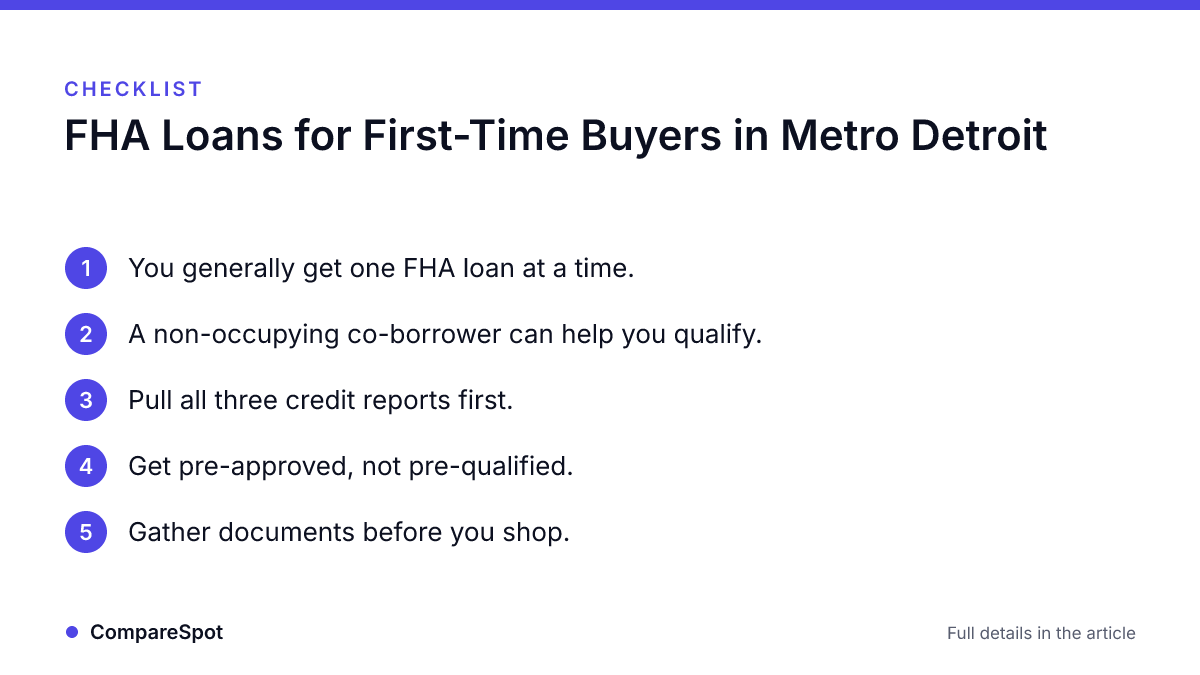
- You generally get one FHA loan at a time. It's for owner-occupied property, not rentals. There are exceptions, including job relocations far enough away that commuting isn't reasonable and documented family size increases, but you'll need to prove the circumstance in writing.
- A non-occupying co-borrower can help you qualify. A parent who won't live in the home can co-sign and have their income counted. Their debts count too, which trips up more applications than people expect.
What are the key differences between FHA and conventional mortgages?
It comes down to who absorbs the risk and what that protection costs you over time.
| Factor | FHA loan | Conventional loan |
|---|---|---|
| Minimum credit score | 580 with 3.5% down, 500 with 10% down | Typically 620 and up |
| Typical lender overlay | Most Metro Detroit lenders want 620 | Rate pricing tightens below 680 |
| Mortgage insurance | Required, usually for the life of the loan | Cancels around 20% equity |
| Debt-to-income | Around 43%, higher with strong reserves | Tighter, varies by lender |
| Property condition | Must pass FHA minimum property standards | Appraiser is more flexible |
| Metro Detroit loan limit | Mid-$500,000s for a single unit | Conforming limit, generally higher |
| Best fit | Thin credit file, small down payment | Strong credit, more cash available |
How do you apply for an FHA loan, step by step?
- Pull all three credit reports first. Dispute errors before a lender sees them. Fixing a stale collection after you're under contract is miserable.
- Get pre-approved, not pre-qualified. Pre-qualification is a conversation. Pre-approval means a lender pulled credit and read your income documents. Listing agents in Royal Oak and Ferndale will not present your offer seriously without one.
- Gather documents before you shop. Two years of W-2s or returns, two months of bank statements, recent pay stubs, photo ID. Self-employed buyers need two years of business returns plus a year-to-date profit and loss. Start this now, not after you find the house.
- Line up down payment assistance. MI Home Loan, MI 10K DPA, and Detroit's city grant all stack with FHA. Our guide to Michigan's first-time buyer programs breaks down the income limits and how the layering works. Grant funds also run out mid-year, so apply early in the cycle when you can.
- Shop at least three lenders. Compare the Loan Estimates side by side, specifically the origination and discount point lines. Rate alone hides a lot.
- Make your offer with the pre-approval attached. If the house needs work, and plenty under $120,000 here do, ask about an FHA 203(k) renovation loan before you write the offer. Adding it later restarts your timeline.
- Order the appraisal and hire your own inspector. These are not the same thing. More on that below.
- Clear conditions fast. Underwriters will come back asking for an updated pay stub, a letter explaining a $3,000 deposit, or proof of insurance. Turn those around in 24 to 48 hours. Slow responses blow more closing dates than any other single cause.
What do most first-time buyers miss about FHA financing?
- The appraisal is not an inspection. An FHA appraiser checks the home against HUD's minimum property standards and estimates value. He is not looking under the sink. Pay for a real inspection on every Detroit purchase, no exceptions.
- Peeling paint will stop your closing. On homes built before 1978, FHA appraisers flag chipping or peeling paint as a lead hazard. We've watched deals sit for two weeks over a porch column and a garage door. Catch it at the showing and negotiate the repair into the contract.
- Gift funds need a paper trail. A signed gift letter plus proof of where the money came from. A cash deposit with no source documentation will freeze underwriting cold.
- Condos need their own FHA approval. Not every building in Metro Detroit is on the approved list. Check before you tour, not after you've picked out furniture.
- Seller concessions are capped. FHA limits how much a seller can contribute toward your costs, which matters when you're structuring an offer against competition.
- Your DTI counts everything. Car payments, student loans, even a Buy Now Pay Later plan showing on your report. Clear the small ones first.
- Rate locks expire. A 30 or 45-day lock can run out if your closing slips. Extending costs money you didn't budget.
Pro tip: Before you call a lender, read through questions to ask before buying a house for the first time. Most of the frustration first-time buyers feel traces back to not knowing what to ask until after they've signed.
Which Metro Detroit neighborhoods work best for FHA budgets?
Warrendale, Brightmoor, and Southwest Detroit regularly list homes between roughly $50,000 and $120,000. That's a fraction of the FHA ceiling, which means your limiting factor is your income and credit, not the loan program. Many of these houses need a furnace, a roof, or a kitchen. That's exactly where an FHA 203(k) renovation loan earns its place, since it finances the purchase and the repairs in one mortgage instead of leaving you hunting for a second loan after closing (Houzeo).
One thing we tell every 203(k) buyer: pick your contractor before you write the offer. The lender needs licensed bids and a written scope of work before closing, and contractor availability, not underwriting, is usually what stretches the timeline.
If your budget reaches further, Warren is the first suburb we point budget-conscious buyers toward, with medians running well above Detroit's but still under most of Oakland County (Top Agent Realty). Michigan's statewide assistance programs apply in both places (The Mortgage Reports). For a block-by-block sense of what your money buys at different price points, see our cornerstone guide on what $200K buys in Detroit.
Run the math on a real Detroit purchase
Take a $120,000 Warrendale bungalow with an FHA loan at 3.5% down.
- Down payment: $120,000 × 0.035 = $4,200
- Closing costs at 3%: $120,000 × 0.03 = $3,600
- Total cash before assistance: $4,200 + $3,600 = $7,800
Now apply MI 10K Down Payment Assistance. Ten thousand dollars covers the full $4,200 down payment and leaves roughly $5,800 toward closing costs, which in this scenario wipes out the $3,600 entirely. What you're actually writing checks for is earnest money, the appraisal, and the inspection, usually a few hundred to a couple thousand dollars depending on timing and what the seller agrees to cover.
Swap in your own purchase price and rerun it: price × 0.035 for the down payment, price × 0.03 for costs, add them, subtract your assistance. Our rule of thumb from closings we've worked is that stacked FHA-plus-DPA buyers in this market need $4,000 to $8,000 liquid, and the upper end usually means they bought in a suburb rather than the city.
Frequently asked questions
How long does it take to close on an FHA loan in Michigan?
Plan on 30 to 45 days from accepted offer to keys, assuming the appraisal lands on schedule and you answer underwriting requests quickly. A 203(k) renovation loan typically adds one to two weeks because the lender needs contractor bids and an approved scope of work before closing.
Can you use an FHA loan on a multi-family property?
Yes, up to four units, as long as you occupy one of them as your primary residence. FHA limits scale up with unit count and reach well into the high six figures for duplexes and triplexes in this market, which makes house hacking a real strategy here. Just understand you're becoming a landlord on day one, tenant screening and 2 a.m. plumbing calls included.
What happens to your FHA mortgage insurance if home values rise?
Nothing automatic. Removal depends on your original down payment and loan term, not your home's current value, so appreciation alone won't cancel it the way it can with conventional PMI. Most buyers who put down less than 10% eventually refinance into a conventional loan once they've built equity and their credit has improved.
Pull your three credit reports this week, add up every monthly debt payment, and divide by your gross monthly income. That one number tells you more about your approval odds than any calculator online. Then call three lenders, not one, and ask each what their FHA credit overlay is before you give them a single document.