

Pre-foreclosure is a warning stage where the homeowner still owns the property and still has options on the table. Foreclosure is what happens when that window closes: a completed legal process that transfers ownership away from the homeowner, usually through auction or straight to the lender. The gap between those two words is the gap between “I can still fix this” and “the decision has already been made for me.”
TL;DR:
- Homeowners typically have several months to resolve default, but exact timelines depend on state laws and lender practices.
- During pre-foreclosure, options include reinstatement, loan modification, short sale, or deed in lieu before the legal transfer of ownership.
- Buyers should verify current ownership, run title searches, and be prepared for no interior access at auction or REO sale.
- Foreclosure can last from six months to over two years, with judicial processes taking longer and affecting the legal chances to contest.
- Completed foreclosures stay on credit reports for about seven years, causing lasting credit damage, especially if not addressed quickly.
Table of Contents
- Pre-Foreclosure vs. Foreclosure: What Is Pre-Foreclosure?
- Pre-Foreclosure vs. Foreclosure: What Actually Is Foreclosure?
- Quick Comparison: Ownership, Timeline, Sale Process, and Credit
- What Homeowners Can Still Do During Pre-Foreclosure
- Buying Pre-Foreclosure Properties vs. Buying at Auction
- Judicial vs. Non-Judicial Foreclosure: Why Timelines Vary So Much
- How Much Credit Damage Are We Talking About?
- Action Checklist: What to Do Right Now
- What Happens to Tenants and Occupants
- Tax Differences Between a Pre-Foreclosure Sale and a Completed Foreclosure
- Legal Protections and Assistance Programs Worth Checking
- Comparespot’s Take on Timing and Local Help
- Where to Find Vetted Local Help Fast
- Sources
- FAQ
Pre-Foreclosure vs. Foreclosure: What Is Pre-Foreclosure?
Pre-foreclosure kicks in after a borrower falls behind, typically around three missed payments, or roughly 90 days past due. At that point the lender files a Notice of Default, a public record that starts the countdown clock. The homeowner still holds the deed and still lives in the house. Nothing about ownership has changed yet.
What makes this stage different from foreclosure is leverage. The Notice of Default doesn’t force a sale; it forces a decision. During this window, homeowners typically have room to:
- Catch up on missed payments through reinstatement
- Negotiate a modified loan or a temporary forbearance
- List the home for a private sale before the process advances
- Pursue a deed in lieu of foreclosure if selling isn’t realistic
Timelines vary widely by state and by lender, but the pre-foreclosure period commonly runs anywhere from a few weeks to several months.
Pre-Foreclosure vs. Foreclosure: What Actually Is Foreclosure?
Foreclosure is the legal mechanism a lender uses to take mortgaged property after a default goes uncured, and state law dictates exactly how that happens. Once it completes, the deed no longer belongs to the homeowner.
The CFPB lays out the general sequence: notice, a court or non-judicial process depending on the state, then a public auction. If nobody outbids the lender, the property becomes real estate owned, or REO, and sits on the bank’s books until it’s resold. Practical consequences of this stage include:
- Eviction proceedings if the former owner or tenants remain
- A public auction where third-party buyers can outbid the lender
- Very limited legal remedies once the sale is confirmed
- A permanent transfer of title, with no path back to the original owner
Once the sale completes, legal options to negotiate typically end.
Quick Comparison: Ownership, Timeline, Sale Process, and Credit
| Factor | Pre-Foreclosure | Foreclosure |
|---|---|---|
| Ownership status | Homeowner retains the deed | Lender or auction buyer holds title |
| Typical timeline | Varies by state, generally lasting several weeks to several months | Days for the auction itself, but total process can run 6 months to 2+ years depending on the state |
| Sale process | Private sale, short sale, or cure | Public auction or lender REO sale |
| Buyer access/inspection | Owner-mediated showings possible | Limited or no inspection; sold as-is |
| Credit impact | Missed payments already hurting score | Foreclosure entry, significant and longer-lasting damage |
The biggest practical difference for buyers is access. A pre-foreclosure sale still involves a cooperative seller who wants to close. An auction buyer is often bidding blind on a property they’ve never walked through.
What Homeowners Can Still Do During Pre-Foreclosure
Acting fast in pre-foreclosure matters more than acting perfectly. Here’s the rough order most housing counselors recommend:
- Call the loan servicer first. Servicers generally prefer a workout over foreclosure because foreclosure is expensive and slow for them too.
- Ask about reinstatement or a repayment plan if the shortfall is temporary and recoverable.
- Request forbearance or a loan modification if income has dropped longer term.
- Explore a short sale if the home is worth less than what’s owed and keeping it isn’t realistic; this requires lender approval but can soften the credit hit.
- Consider a deed in lieu of foreclosure or, as a last resort, bankruptcy protection to buy time.
- Contact a HUD-approved housing counselor for a free second opinion before signing anything with the lender.
Pro Tip: Keep a written log of every call with your servicer: date, time, name of the representative, and what was promised. This can help resolve stalled files.
Buying Pre-Foreclosure Properties vs. Buying at Auction
Buying in pre-foreclosure means working with a motivated owner who still holds title, often involving more paperwork and negotiation, but allowing inspections and a more controlled sale process. Redfin notes that pre-foreclosure homes can offer better condition and more negotiating room, though the owner can cure the default and pull the listing at any point before closing.
Auction and REO purchases work differently. You’re bidding on a property sold as-is, often with no interior access beforehand, and cash or proof of funds is usually required within hours of winning. Before pursuing either route, run through this checklist:
- Pull a full title search to check for liens, judgments, or a second mortgage
- Confirm who legally owns the property right now, not who used to
- Line up financing or cash before you bid, not after
- Budget for occupant issues; someone may still be living there
- Never skip title insurance on an as-is purchase, even at a discount
Judicial vs. Non-Judicial Foreclosure: Why Timelines Vary So Much
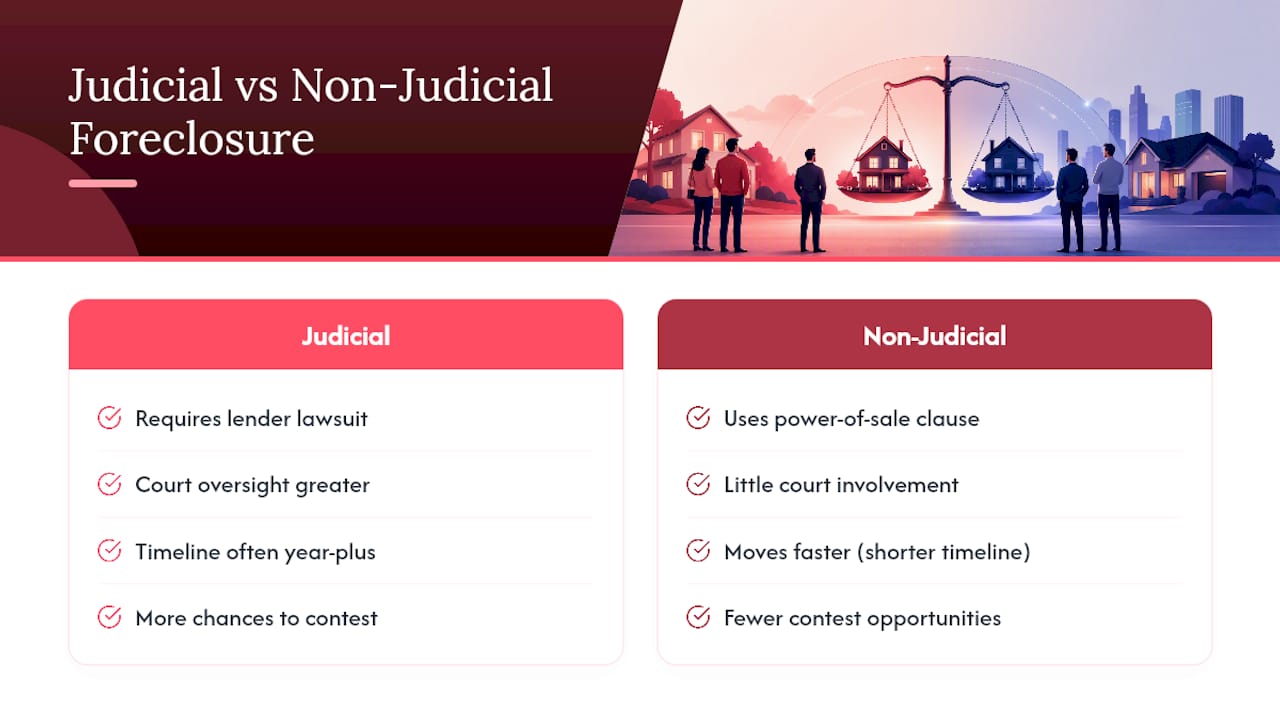
Whether a foreclosure runs through the courts or bypasses them entirely depends on the state, and that single fact changes almost everything about the timeline. Judicial foreclosure requires the lender to sue in court, which can stretch the process out for a year or more but gives homeowners more chances to contest it. Non-judicial foreclosure relies on a power-of-sale clause already in the mortgage, moving much faster with far less court oversight.
Because the rules differ county by county as much as state by state, check the actual filing at your county recorder’s office or clerk of court rather than relying on a generic estimate. State housing finance agency websites usually publish the specific notice periods and redemption rights that apply locally.
Pro Tip: Hire local counsel or talk to a HUD-approved counselor before you assume you know your state’s rules. A friend’s foreclosure timeline in another state tells you nothing useful about yours.
How Much Credit Damage Are We Talking About?
Missed payments start dragging your credit score down long before the word “foreclosure” ever appears on a report. A completed foreclosure, though, is its own separate mark, and it can stay on a credit report for about seven years from the date of the first missed payment.
That seven-year window is the number that surprises most homeowners. It’s not seven years from the foreclosure sale; it’s seven years from the first missed payment that triggered the whole chain.
Practical fallout and recovery steps:
- Mortgage eligibility typically returns faster after a short sale than after a completed foreclosure
- Some loan programs allow re-application after a set waiting period post-foreclosure, often several years
- Keep every settlement letter, deed transfer document, and payoff statement; lenders will ask for them later
- Rebuilding credit starts with on-time payments on whatever accounts remain open, not with disputing the foreclosure entry itself
Action Checklist: What to Do Right Now
If you’re the homeowner:
- Call your loan servicer within the first week of missing a payment, not after the third one.
- Gather your mortgage statement, escrow breakdown, and proof of income.
- Formally request loss mitigation options in writing.
- Contact a HUD-approved counselor for a free consultation.
- Decide within 30 days whether reinstatement, modification, or sale is realistic.
If you’re a buyer or investor:
- Search county records to confirm the Notice of Default and current owner.
- Order a title search before making contact with the owner.
- Line up financing or cash reserves before you make an offer.
- Schedule an inspection if it’s still a private-sale property; assume none is possible at auction.
- Treat any occupant on-site as a legal issue to resolve, not a formality.
Red flag: if a servicer stops returning calls or a sale date gets posted publicly, escalate immediately. That’s the sign the timeline is compressing.
What Happens to Tenants and Occupants
Renters living in a home that enters pre-foreclosure often don’t find out until the process is already underway, since the Notice of Default gets filed against the owner, not disclosed to tenants directly. During pre-foreclosure, leases generally stay valid. The landlord is still the legal owner and still collects rent, and tenants have no obligation to move.
Foreclosure changes that picture. Once the sale completes and ownership transfers, federal protections under the Protecting Tenants at Foreclosure Act generally require the new owner to honor an existing lease through its term, with month-to-month tenants typically owed at least 90 days’ notice before having to vacate. That protection doesn’t disappear, but plenty of tenants don’t know it exists, and new owners occasionally push for faster move-outs than the law allows.
For homeowners who are also landlords, the responsible move is disclosure. Notifying tenants once a Notice of Default is filed avoids putting renters in the position of paying rent to a landlord who may lose the property days later. For tenants themselves, the smartest move is checking county property records directly if rent payments stop being acknowledged, mail starts arriving addressed to an unfamiliar name, or a real estate sign appears in the yard without warning. None of that guarantees an immediate eviction, but it’s a signal worth investigating rather than ignoring.
Tax Differences Between a Pre-Foreclosure Sale and a Completed Foreclosure
A short sale during pre-foreclosure and a completed foreclosure can trigger very different tax situations, mainly around forgiven debt. When a lender agrees to a short sale for less than the balance owed, that forgiven amount can be treated as taxable income unless an exclusion applies, such as insolvency or the qualifying rules that have historically covered principal residence debt. The same logic applies when a foreclosure sale leaves a deficiency the lender chooses to forgive rather than pursue.
The paperwork differs too. A short sale generally produces a 1099 for canceled debt tied to a negotiated agreement, with terms the homeowner at least saw coming. A foreclosure can generate a similar 1099 with no negotiation at all, just a notice after the fact. Homeowners in either situation should talk to a tax professional before filing, since the rules around debt forgiveness exclusions change periodically and depend heavily on individual circumstances like bankruptcy status or whether the property was a primary residence versus an investment.
One more wrinkle worth knowing: a completed foreclosure is treated, for tax purposes, as a deemed sale of the property. That can create capital gains exposure in some cases even when the homeowner walked away with nothing in hand. It’s counterintuitive, and it’s exactly the kind of detail that gets missed until a tax bill arrives the following spring.
Legal Protections and Assistance Programs Worth Checking
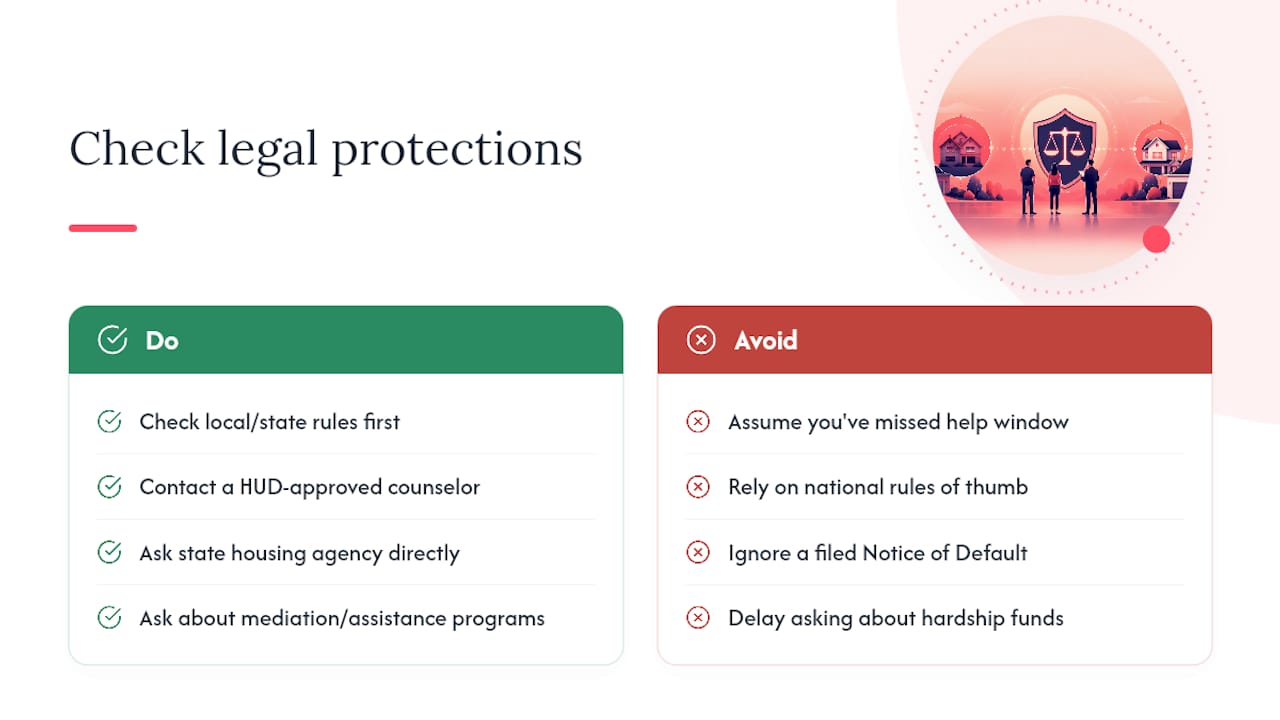
State governments and housing agencies routinely run programs aimed squarely at the pre-foreclosure window, because that’s the point where intervention still works. Many states require lenders to send a separate pre-foreclosure notice with information about housing counseling before a formal foreclosure filing can proceed, and some mandate a mediation period where homeowner and lender must at least attempt to negotiate before the case advances.
Protections and resources vary significantly by state, which is exactly why checking local rules matters more than trusting a national rule of thumb. A HUD-approved housing counselor can usually identify which state or local programs apply to a specific address, including deferred payment plans, one-time hardship grants, or mortgage assistance funds that don’t require repayment. Some states also run their own emergency mortgage assistance programs, often funded through federal housing dollars, aimed at homeowners who fell behind due to a documented hardship like job loss or medical expenses.
The mistake homeowners make most often here is assuming they’ve missed the window for help simply because a Notice of Default has already been filed. In most states, that filing is the beginning of the assistance window, not the end of it. Programs, notice periods, and mediation requirements differ enough state to state that the only reliable move is checking directly with the state housing finance agency or a local HUD counselor rather than assuming national coverage.
Comparespot’s Take on Timing and Local Help
Local decisions regarding pre-foreclosure can be time sensitive and vary based on local rules. Rankings of agents, lenders, and cash buyers can be based on research and customer sentiment rather than paid placement. If you’re weighing options during pre-foreclosure, comparing vetted local providers beats guessing. For state-specific timelines, see our Michigan foreclosure timeline guide.
— Bryan
Where to Find Vetted Local Help Fast
If a Notice of Default has already landed in your mailbox, speed matters more than perfection, and guessing which agent or lender to call wastes time you don’t have. Comparespot publishes independently researched rankings of the top real estate agents in Metro Detroit and the best mortgage lenders in the area, covering Wayne, Oakland, and Macomb counties specifically.
The rankings exist so you’re not cold-calling names off a search results page during the worst month of your year. If you’re on a clock, pull up the top three agents or lenders in your category, call all three the same day, and pick based on who responds fastest and gives you a straight answer about your timeline. For homeowners exploring a short sale, our Michigan short sale guide walks through what a listing agent will need from you before that first showing. Start with Comparespot’s Metro Detroit rankings and go from there.
Sources
For deeper reading, the CFPB’s foreclosure guidance covers homeowner rights and process steps directly. Experian and Bankrate explain pre-foreclosure mechanics in plain language, while Cornell Law’s Wex breaks down how state law shapes the legal process.
This article is general information, not a substitute for advice from a qualified financial advisor. Consult a qualified financial professional about your own circumstances before acting on anything here.
- What Is a Pre-Foreclosure? | Experian
- How does foreclosure work? | Consumer Financial Protection Bureau (CFPB)
- Foreclosure sale — Cornell Law School Wex
- What is preforeclosure? | Bankrate
- Pre-foreclosure — Investopedia
FAQ
How long can a house be in pre-foreclosure?
There’s no fixed limit; pre-foreclosure can last anywhere from a few weeks to well over a year depending on state law, the lender’s timeline, and whether the homeowner is actively negotiating options.
Is buying pre-foreclosure a good idea?
It can be, since you often get a real inspection and a motivated seller, but the owner can cure the default and cancel the sale at any point before closing, so patience and title diligence matter.
Can you get your house out of pre-foreclosure?
Yes. Reinstating the loan, securing a modification, arranging forbearance, or completing a short sale can all stop the process before it advances to a completed foreclosure.
Is pre-foreclosure considered foreclosure?
No. Pre-foreclosure is a warning period where the homeowner still holds the deed; foreclosure is the completed legal process where ownership transfers away from that homeowner.