
A typical foreclosure by advertisement on an owner-occupied Michigan home runs about 11 to 13 months from the first missed payment to the end of the redemption period, assuming the standard six-month redemption applies. If your loan balance qualifies for the one-year redemption instead, the full michigan foreclosure timeline stretches to roughly 17 to 19 months. Judicial foreclosures, which go through circuit court, usually take over a year and may take significantly longer if contested.
Whatever stage you’re in, one move matters more than any other right now:
- Call your loan servicer today and write down the date and who you spoke with.
- Call a HUD-approved housing counselor before your next payment is due.
- Mark Day 45 and Day 121 on a calendar. That window is your best shot at stopping the process before it becomes irreversible.
Key Takeaways
Michigan’s foreclosure timeline runs roughly 11 to 19 months depending on redemption length and procedure type, with Day 45 to Day 121 as the decisive window to act.
| Point | Details |
|---|---|
| Typical timeline | Foreclosure by advertisement runs about 11–13 months with a six-month redemption, 17–19 months with a one-year redemption. |
| Critical action window | Between Day 45 and Day 121, servicers must assign a contact person and accept loss mitigation applications. |
| Redemption length varies | Six months is standard; one year applies if claimed debt is under two-thirds of the original balance or for farmland; 30 days applies to abandoned homes. |
| Publication and posting rules | Notice must run weekly for four consecutive weeks and be posted on the property within 15 days of first publication. |
| Get vetted help fast | Comparespot ranks local cash buyers, agents, and lenders across Metro Detroit so homeowners can move quickly without guessing on a provider. |
This article is general information, not a substitute for advice from a qualified financial advisor. Consult a qualified financial professional about your own circumstances before acting on anything here.
Table of Contents
- What Is the Step-by-Step Foreclosure Process in Michigan?
- How Long Is the Redemption Period After a Foreclosure Sale in Michigan?
- Judicial vs. Foreclosure by Advertisement: Which Path Are You On?
- What Are Your Options and Deadlines Once Foreclosure Starts?
- What Happens at the Sheriff’s Sale and After?
- Where Can You Get Free Help With Michigan Foreclosure?
- Sources
- FAQ
What Is the Step-by-Step Foreclosure Process in Michigan?
The clock starts the day you miss a payment, not the day you get a scary letter. Federal servicing rules require your lender to attempt live contact with you several weeks after a missed payment, then send written notice of your loss mitigation options shortly afterward, according to MSHDA’s foreclosure timeline breakdown. That written notice has to name a single point of contact at the servicer, someone whose job is to walk you through options like repayment plans or modification.
Pro Tip: Save every letter your servicer sends after Day 45. If they later claim you never submitted a complete loss mitigation application, those dates and names become your evidence.
Here’s the sequence most Michigan foreclosures by advertisement follow:
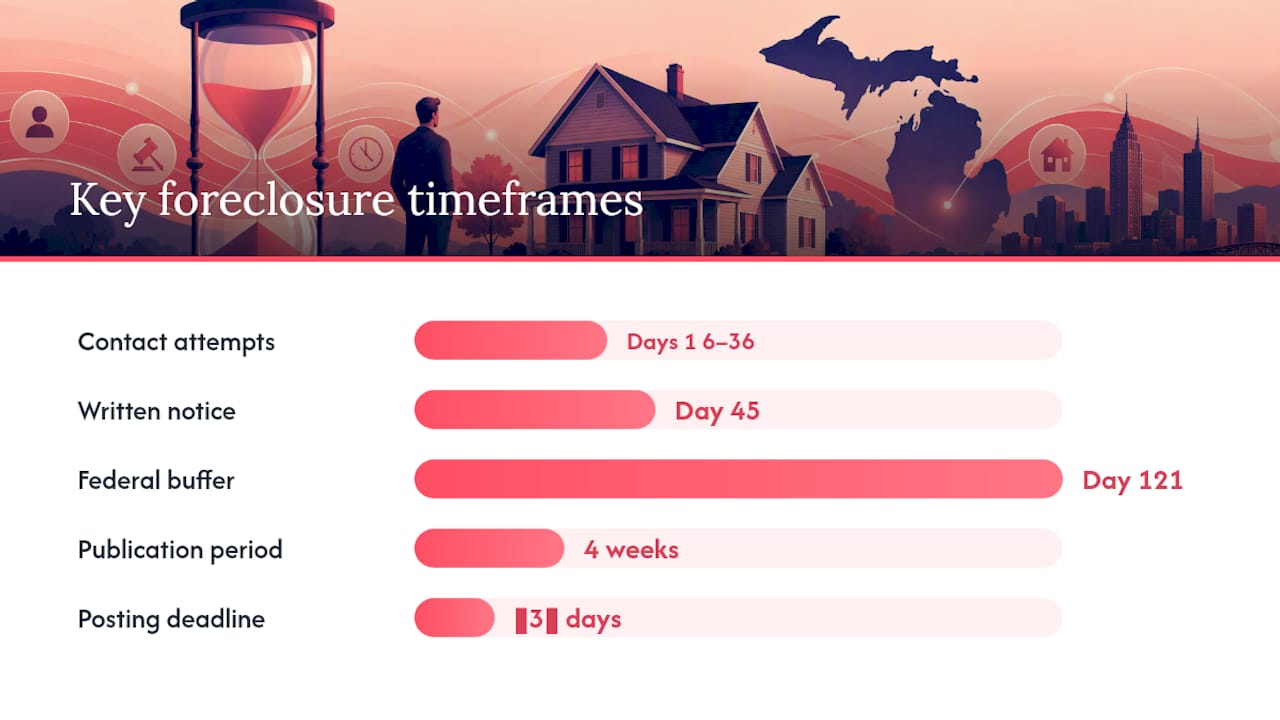
- Day 1 to 36: Miss a payment; servicer attempts phone or in-person contact.
- Day 45: Servicer sends written notice and assigns a single point of contact.
- Day 121: Federal rules generally bar the servicer from starting formal foreclosure before this point, per CFPB early-intervention requirements.
- Notice recorded and published: Once foreclosure starts, the notice must run once a week for four consecutive weeks in a local newspaper.
- Posting on the property: A copy of the notice must be posted at the home within 15 days of the first publication, as required under Michigan Compiled Laws 600.3208.
- Sheriff’s sale: The county sheriff auctions the property, usually on a Wednesday, and issues a certificate of sale showing the winning bid and the redemption deadline.
Why the 120-day federal buffer matters: it exists specifically to force servicers to talk with you before they can legally begin foreclosure. Homeowners who ignore calls during this window lose real leverage, because once the case moves past Day 121, options narrow fast.
How Long Is the Redemption Period After a Foreclosure Sale in Michigan?
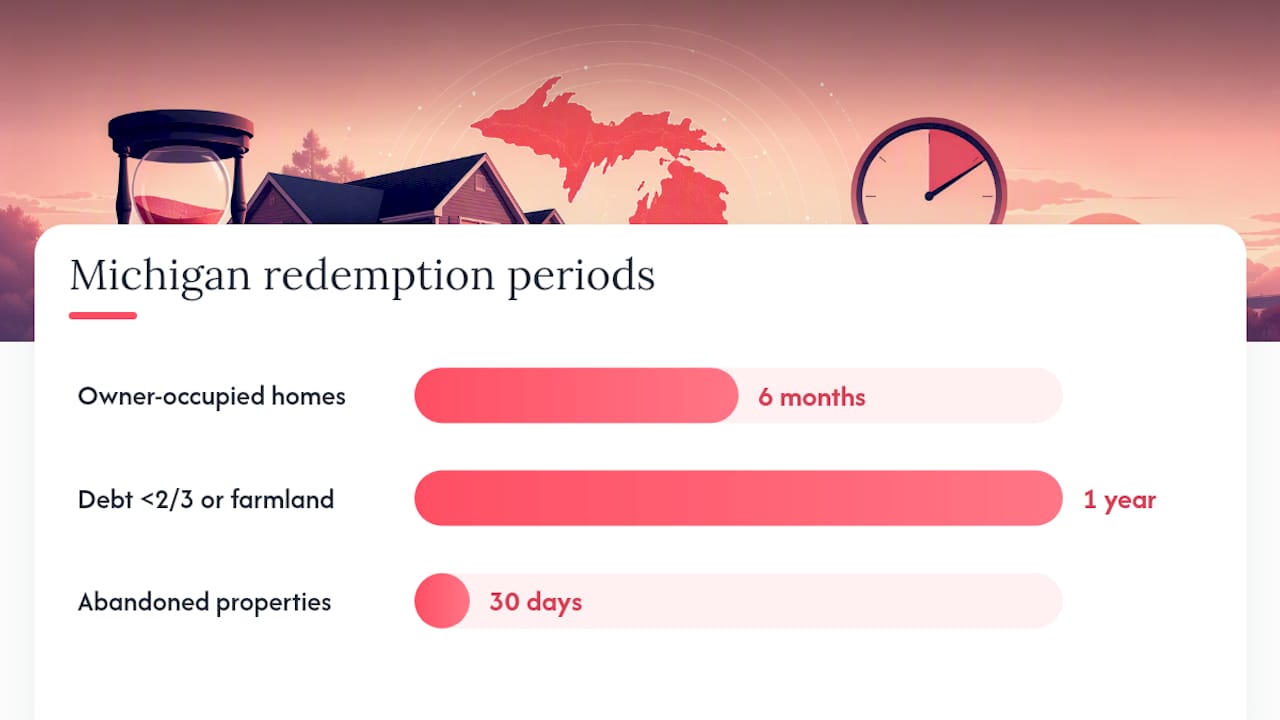
Redemption length depends almost entirely on how much debt the lender claims at the sale, not on how sympathetic your situation is. Michigan’s default rule gives most owner-occupied residential borrowers six months to redeem when the amount claimed exceeds two-thirds of the original loan balance, under MCL 600.3240.
Three situations change that window:
- One-year redemption: applies if the claimed debt is less than two-thirds of the original amount owed, or if the property qualifies as agricultural land used for farming.
- 30-day abandoned property rule: if the lender proves the home sits abandoned (no one living there, utilities off, unkempt), the redemption period shrinks to just 30 days.
- Redeeming the property: you pay the sale bid price plus interest and allowable fees, with the exact figure and deadline confirmed through the certificate of sale filed at your county Register of Deeds.
Miss that deadline by even a day, and the right to redeem is gone permanently.
Judicial vs. Foreclosure by Advertisement: Which Path Are You On?
Most Michigan foreclosures happen by advertisement, a nonjudicial process built into the mortgage itself through a power-of-sale clause. It’s faster and cheaper for lenders, and it skips a courtroom entirely unless you fight it. Legal guides note that judicial foreclosure still exists in Michigan but shows up far less often, mainly when a mortgage lacks a power-of-sale clause or a lender wants a deficiency judgment through the courts.
The timing gap between the two is significant:
- Foreclosure by advertisement: roughly 8 to 13 months start to finish with a six-month redemption.
- Judicial foreclosure: typically 14 to 18 months, sometimes well past two years if you file an answer and contest the claim.
- Filing bankruptcy or raising a legitimate defect in the notice can add months to either path, but both come with real costs and no guarantee of a better outcome.
Contesting a case you can’t ultimately win rarely helps. Contesting one with a genuine defect, like a missing notice or wrong amount claimed, can be worth the delay.
What Are Your Options and Deadlines Once Foreclosure Starts?
Your options shrink as the calendar moves forward, so timing which move you make matters as much as making one at all.
- Submit a complete loss mitigation application the moment your servicer sends written notice around Day 45. A complete package (income documents, hardship letter, tax returns) triggers federal protections that an incomplete one does not.
- File bankruptcy before the sheriff’s sale if you need more time. A Chapter 13 filing creates an automatic stay that can pause the sale while you repay arrears over a multi-year plan, and a confirmed Chapter 13 plan can stop foreclosure outright. Chapter 7 delays things only briefly since it doesn’t address ongoing mortgage payments.
- Consider a short sale or deed in lieu of foreclosure if you owe more than the home is worth and don’t want to wait out redemption. Both require lender sign-off and take weeks to negotiate, so start before the sale date, not after.
- Negotiate cash-for-keys during redemption, not after eviction papers arrive. Michigan Legal Help notes that starting this conversation early, while you still control the property, gets meaningfully better offers than waiting until a court date is already set.
Pro Tip: Foreclosure-rescue scams target homeowners in exactly this window. If someone asks for an upfront fee to “save your home” or wants you to sign over the deed to a stranger, walk away and call an MSHDA- or HUD-approved counselor instead.
What Happens at the Sheriff’s Sale and After?
The sheriff’s sale itself is often anticlimactic: the property usually goes back to the lender for the amount owed, since third-party bidders are rare on residential homes. The certificate of sale that follows records the winning bid, the buyer, and your redemption deadline.
- During redemption, you keep possession, but the purchaser can inspect the property and generally must give 72-hour notice before entering.
- Keep paying homeowner’s insurance and utilities. An abandoned-looking home can trigger the 30-day redemption rule.
- If redemption expires without a payoff, the new owner files for eviction through a summons and complaint, then a hearing, then a court order if you haven’t left.
- Photograph and inventory your belongings before that hearing date so nothing gets disputed during a rushed move-out.
Where Can You Get Free Help With Michigan Foreclosure?
You don’t have to figure this out alone, and the best help is free.
- The HUD housing counselor search tool for free, approved counseling near you.
- Michigan Legal Help for plain-language guides on redemption and eviction.
- Your county Register of Deeds and sheriff’s office for the exact sale date, certificate details, and local publication schedule.
- An attorney, once you’re contesting anything, bring your mortgage, notice of foreclosure, and every servicer letter you’ve received.
Why Acting Between Day 45 and Day 121 Changes Everything
Homeowners who wait until the sheriff sale is scheduled have already burned the window when servicers are required to talk to you. The mistake I see constantly: people avoid the servicer’s calls out of embarrassment, then panic once a notice gets posted on the door. Call back. Submit paperwork early. Comparespot has heard from enough Metro Detroit homeowners scrambling in month eleven to know that month two is when your options are actually good.
Find a Vetted Local Option Before the Clock Runs Out
Comparespot is the practical shortcut for Metro Detroit homeowners who don’t have months to vet a cash buyer, agent, or lender on their own. Instead of cold-calling companies you found in a mailer, you get independently researched rankings built from real customer sentiment across Wayne, Oakland, and Macomb counties.

If a fast, clean sale beats waiting out a redemption period, browse Comparespot’s ranked cash home buyers in Metro Detroit to compare offers without guessing who’s reputable. If selling on the open market with an agent who knows short sales is a better fit, the top-rated real estate agents list narrows that search too. Either way, talk to a HUD-approved counselor first, then use Comparespot’s full Metro Detroit rankings to line up your next move before your redemption deadline arrives.
Sources
- Foreclosure and Eviction for Homeowners (Michigan Legal Help)
- Consumer Financial Protection Bureau (CFPB)
FAQ
How long does a foreclosure take in Michigan?
Most foreclosures by advertisement take about 11 to 13 months with a six-month redemption period, or 17 to 19 months if the one-year redemption applies. Judicial foreclosures typically run 14 to 18 months or longer.
What is the typical redemption period for a foreclosure in Michigan?
Six months is standard for most owner-occupied homes, extending to one year if the claimed debt is under two-thirds of the original balance or the property is qualifying farmland, and shrinking to 30 days for abandoned properties.
What is the 120-day rule for foreclosure?
Federal servicing rules generally prevent a mortgage servicer from starting formal foreclosure until 120 days after a borrower’s first missed payment, giving homeowners a window to apply for loss mitigation.
What state has the quickest foreclosure process?
Foreclosure speed varies widely by state law; Michigan’s advertisement process is faster than many judicial-only states, but nonjudicial states with shorter redemption periods can complete foreclosures in a few months.
Where can I find vetted local help if I need to sell fast?
Comparespot publishes ranked, independently researched lists of cash home buyers and real estate agents across Metro Detroit for homeowners who need a fast, reliable sale during foreclosure.