

TL;DR
- A home equity line of credit (HELOC) lets you borrow against your equity, usually up to 80–85% of your home's value minus what you still owe, and interest only accrues on what you actually draw.
- On a $100,000 balance at an illustrative 8% rate, the interest-only draw-period payment is about $667 a month. The same balance amortized over 15 years runs roughly $956, and that jump is what catches people off guard.
- In our experience, Metro Detroit HELOCs close in about two to six weeks, faster than a cash-out refinance because your first mortgage stays untouched.
- A HELOC is a revolving line with a variable rate. A home equity loan is a fixed lump sum with a fixed payment. Same collateral, very different products.
- If you're planning to sell anyway, borrowing against the house first just adds a lien to pay off at closing. Comparing cash home buyers in Metro Detroit is usually the cheaper first move.
Say your Royal Oak bungalow appraises at $320,000 and you still owe $180,000. A lender capping you at 80% combined loan-to-value does the math like this: $320,000 × 0.80 = $256,000, minus the $180,000 mortgage, leaves about $76,000 of accessible equity. That's the whole concept. A home equity line of credit is a revolving credit line secured by your house, and you draw on it like a credit card instead of taking the money all at once.
Table of Contents
- What is a home equity line of credit and how does it work?
- How much is the monthly payment on a $100,000 HELOC?
- How do I get a HELOC?
- How long does it take to get a HELOC?
- Is a home equity line of credit a good idea right now?
- Does a home equity line of credit work the same as a home equity loan?
- Does tapping your equity hurt your chances of selling later?
- What should Detroit homeowners do before applying?
- Frequently asked questions
What is a home equity line of credit and how does it work?
A HELOC is a revolving loan secured by your home's equity, split into two phases. First comes the draw period, typically five to ten years, when you borrow as needed and usually pay interest only. Then the repayment period, often ten to twenty years, when you pay back principal plus interest on whatever balance is left.
Your credit limit comes from the appraised value minus your current mortgage balance, with most banks and credit unions capping total borrowing around 80% to 85% combined loan-to-value. Nobody hands you a check at closing. You pull money through transfers, a card, or paper drafts, and interest starts only on the dollars you've actually used.
That structure matters more in Detroit than in a lot of metros, because so much of our housing stock sits under $200,000. A $150,000 house with a $110,000 mortgage leaves roughly $10,000 of borrowing room at 80% CLTV, which barely covers a furnace and a water heater. If you want to see what that price range actually buys across neighborhoods, our guide on what $200K buys you in Detroit breaks it down block by block. Useful context before you decide whether borrowing beats selling.

How much is the monthly payment on a $100,000 HELOC?
During the draw period, a $100,000 balance at an illustrative 8% variable rate costs about $667 a month. The formula is simple: balance × (annual rate ÷ 12). So $100,000 × (0.08 ÷ 12) = $666.67.
That's the floor, not the real cost. Interest-only payments mean your balance doesn't move. Pay $667 a month for seven years and you still owe $100,000 on day one of repayment.
Then the math changes. Amortize that same $100,000 over 15 years at 8% and the payment climbs to roughly $956 a month. The payment jumped $289, and nothing about your income changed. This is where homeowners get hurt. They budget around the draw-period number for years, treat it as the permanent cost, and then the conversion letter arrives.
Run your own version before you sign: take the balance you realistically expect to carry, multiply by the rate, divide by 12 for the draw payment, then look up the amortized payment at the same rate over the repayment term. If the second number scares you, borrow less.
Also remember HELOC rates float with prime. Your payment moves even when your balance doesn't.
Pro tip: Ask every lender for the payment at today's rate and at a rate two points higher. On that $100,000 line, 10% instead of 8% turns $667 into $833 during the draw period. If that number breaks your budget, the line is too big.
How do I get a HELOC?
You apply through a bank, credit union, or online lender, which verifies your equity, income, credit score, and debt-to-income ratio, then orders a valuation before setting your limit. Here's how it goes in practice:
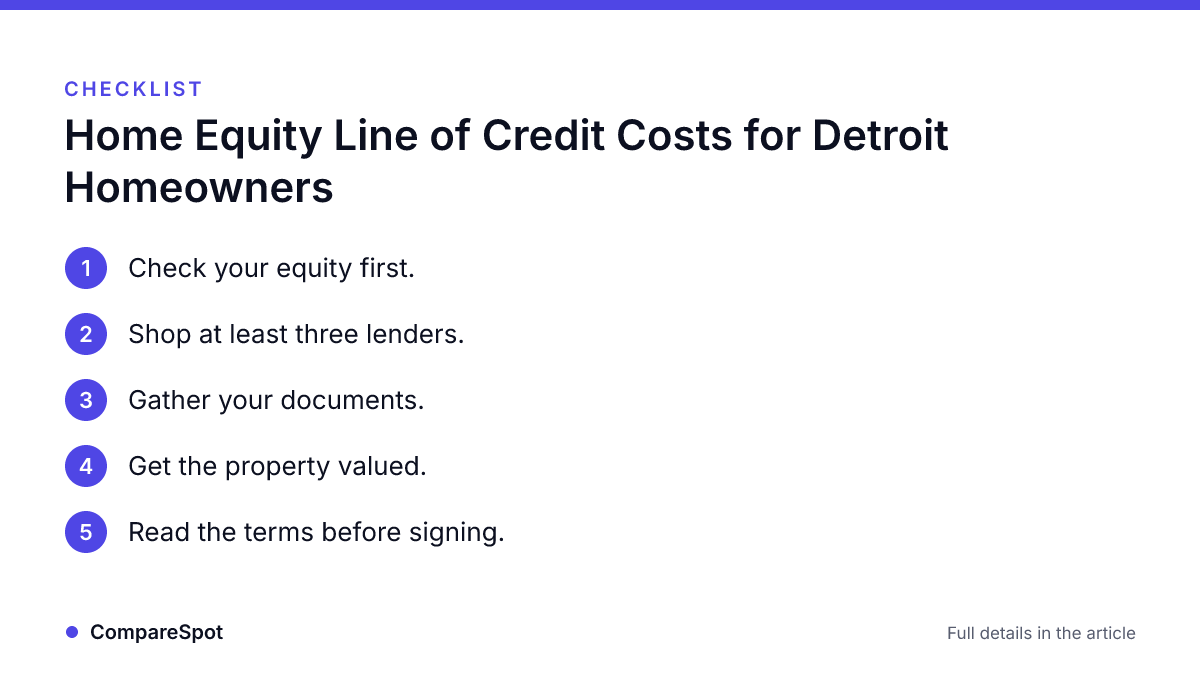
- Check your equity first. Pull your current mortgage statement and compare it to recent sales on your street. Walk in with your own number so a low valuation doesn't blindside you.
- Shop at least three lenders. Local credit unions and national banks price these very differently, especially the margin added over prime. Lenders like CU SoCal publish the eligibility standards most underwriters use, which is a decent sanity check before you apply.
- Gather your documents. Pay stubs, two years of tax returns, your mortgage statement, and proof of homeowners insurance with the lender listed. Self-employed borrowers should expect a request for business bank statements too.
- Get the property valued. Some lenders use an automated model and charge you nothing. Others order a full interior appraisal and pass the cost through. Ask which one you're getting, because it drives both your fee and your timeline.
- Read the terms before signing. The margin over prime, the annual fee, early closure penalties, minimum draw requirements, and the lifetime rate cap. That last one tells you the worst-case payment, and almost nobody reads it.
Pro tip: Under a 680 credit score, approvals get harder and the margin over prime gets ugly. Six months of paying down revolving balances and leaving old accounts open usually buys a better line than applying today and locking in a bad margin for a decade.
How long does it take to get a HELOC?
Two to six weeks from application to funding is normal, and the valuation plus underwriting review eats most of it. A credit union using an automated valuation on a cookie-cutter Warren ranch can fund in about ten business days. A full interior appraisal on an unusual property adds a week or more just in scheduling.
What actually causes delays around here, in order:
- Title problems. Detroit and Wayne County properties turn up old land contracts, unreleased liens from paid-off loans, and tax issues more often than suburban parcels. Clearing a lien release from a lender that no longer exists can take longer than the entire rest of the file.
- Self-employment income. Expect a request for a profit-and-loss statement and possibly a CPA letter, which puts the timeline in someone else's hands.
- Seasonal volume. Spring and early summer are the crunch. Appraisers in Oakland and Macomb book out, and a two-week file becomes four.
- Homeowners insurance mismatches. If your declarations page shows a dwelling coverage amount below what the lender wants, you're getting a new policy before closing.
Pull a copy of your deed and your most recent tax bill the same week you apply. If something's wrong on title, you want to know in week one, not week five.
Is a home equity line of credit a good idea right now?
A HELOC earns its keep when the money has a specific job: a kitchen remodel, consolidating credit card debt at double the rate, or bridging the gap between selling one house and closing on the next. It's a bad idea for covering monthly living expenses, for anyone already behind on their first mortgage, or for anyone who expects to sell within a year or two.
Every dollar you draw becomes a second lien that gets paid off at closing. If your equity is thin to begin with, the line quietly eats the proceeds you were counting on.
For Wayne County homeowners facing foreclosure or running behind on payments, this is the wrong tool entirely. Underwriters pull your mortgage payment history and a recent late payment is usually fatal to the application. Even if it isn't, adding debt to a house you might lose rarely improves the outcome. Understanding your real buyer closing costs in a sale, or getting competing offers from cash buyers who work across Metro Detroit, gets you to a resolution faster.
Does a home equity line of credit work the same as a home equity loan?
No. A HELOC is a revolving credit line with a variable rate. A home equity loan is a fixed lump sum with a fixed rate and a fixed monthly payment. Both sit as a second lien behind your primary mortgage and both borrow against the same equity, which is why people treat them as interchangeable.
They solve different problems. A home equity loan fits a one-time expense with a known price: $40,000 for roof and siding, quoted and signed. You get a payment that never moves. A HELOC fits a multi-phase renovation where the final number is a guess, or a line you want available and unused.
| Factor | HELOC | Home equity loan |
|---|---|---|
| How funds are disbursed | Revolving draws, as needed | One lump sum upfront |
| Interest rate | Usually variable, tied to prime | Usually fixed for the full term |
| Payment during first years | Interest-only is typical | Principal + interest from month one |
| Best for | Phased projects, uncertain costs | One quote, one known price |
| Payment predictability | Moves with rate and balance | Identical every month |
| Typical closing speed | 2–6 weeks | 2–6 weeks |
| Cost of leaving it unused | Possible annual fee only | Full interest from day one |
That last row is the real decision point. An untouched HELOC costs you almost nothing. An untouched home equity loan costs you interest on money sitting in checking. Run both through a calculator before you apply, because over ten years the total interest difference comes down almost entirely to how disciplined you are about paying a revolving balance back down.
Does tapping your equity hurt your chances of selling later?
Not by itself, but it changes your closing statement. A HELOC balance gets paid off from sale proceeds exactly like your first mortgage. The idea that a HELOC "locks you in" comes from the fact that it's secured debt, so you can't walk away from it the way you can with a credit card.
The real risk is drawing heavily and then watching values soften. Owe $180,000 on the first mortgage and $60,000 on the line, then sell at $265,000 with closing costs and commission, and the check you expected shrinks fast. That hits hardest for heirs selling an inherited house in Oakland or Macomb County who need to split proceeds several ways. Our breakdown of probate house sales in Detroit covers how liens, including home equity debt, get settled before anyone sees a dime.
Pro tip: Before you draw on a HELOC for resale-boosting repairs, check what actually pays back in your specific ZIP code. A cosmetic kitchen refresh returns far more in Royal Oak or Birmingham than in parts of Detroit where most buyers are investors pricing off rent, not finishes. In those areas, a sound roof and a working furnace move the offer. New quartz counters mostly don't.
What should Detroit homeowners do before applying?
Get a real value first, not an old appraisal and not an automated estimate. That number drives everything else. Pull three to five sales from within a half mile in the last six months, same style and roughly the same square footage, or ask a local agent for a quick comparative market analysis.
Then write down three numbers and look at them together:
- Your current payoff. Not the balance on your January statement. Call the servicer.
- Your realistic sale price. The low end of your comps, not the high end.
- The draw you actually need. Not the limit a lender will approve.
Subtract line one from 80% of line two. That's your honest borrowing room. If the draw you need is more than about two-thirds of it, you're cutting the cushion too close for a variable-rate product.
The bigger question is whether you're staying or going. Improving a house you'll live in for another decade and squeezing cash out of a house you'll list next spring are different financial paths, and confusing them is how people end up with second liens they never needed. If you're leaning toward selling, compare what a traditional listing nets after commission and closing costs against a direct cash offer. If you're buying on the other end, our guide to Michigan's first-time home buyer programs covers down payment assistance that reduces how much you'll ever need to borrow against equity later.
Frequently asked questions
Can I get a HELOC on a rental or investment property in Metro Detroit?
Yes, though fewer lenders offer it, they want more equity left in the property than they would on a primary residence, and the rate runs higher. Expect a tighter loan-to-value cap and a request for your lease agreements. If you own several rentals, compare property management companies in Metro Detroit before taking on more debt. A rental that bleeds money from vacancies and slow turns usually needs better management, not more capital.
What happens to my HELOC if I sell my house before paying it off?
It gets paid off from your sale proceeds at closing, just like your first mortgage, and whatever's left after both liens and closing costs is yours. If the HELOC balance is close to your available equity, you could have to bring money to closing instead of leaving with a check. Check the balance against a conservative sale price before you list, not after you accept an offer.
Does closing a HELOC early cost extra?
Often, yes. Many lenders charge an early termination or reimbursement fee if you close the account within the first two or three years, sometimes a flat amount and sometimes a percentage of the line. Some also claw back the appraisal and title costs they covered at origination. Ask for the exact figure and the exact window in writing, especially if there's any chance you'll sell or refinance soon.
Before you sign anything, do this: call your servicer for an exact payoff, pull five recent comps, and get written quotes from three lenders with the margin over prime and the lifetime cap on each one. Rate shopping is the only part of this process that's entirely in your control, which is why tools like LockMyRate exist. An hour of comparison shopping is worth more than any negotiation you'll have after the papers are signed.