

Earnest money is the good-faith deposit a buyer puts into escrow to show a seller they’re serious about a purchase. In Detroit and across Michigan, that deposit typically runs 1% to 3% of the purchase price, often landing between $1,000 and $5,000 depending on the home’s price tier. State law requires the broker to move that money into a protected escrow account within two banking days of accepted offer.
TL;DR:
- Most earnest money deposits in Detroit range from 1% to 3% of the purchase price, with flat amounts up to $3,000 for entry-level homes.
- Michigan law mandates brokers deposit earnest money into an escrow account within two banking days of offer acceptance, with strict recordkeeping.
- If all contingencies are met and deadlines are followed, earnest money is refunded if the deal falls through, but delays or disputes can freeze funds for months.
- Offering more earnest money can strengthen a bid in competitive markets or bidding wars, but keeping contingencies intact or using assistance programs may justify smaller deposits.
- Verifying escrow holder details and deadlines beforehand, maintaining proper documentation, and consulting experienced local agents can prevent common mistakes.
Table of Contents
- How Much Earnest Money Should You Offer in Detroit?
- Who Holds Earnest Money in Michigan, and What Protects It?
- When Can You Get Earnest Money Back?
- What Happens to Earnest Money at Closing?
- How to Protect Your Earnest Money in a Detroit Deal
- What Local Market Data Tells Detroit Buyers About Earnest Money
- What Experience Teaches About Earnest Money Mistakes
- Where to Find Vetted Agents and Lenders for Your Detroit Purchase
- Sources
- FAQ
How Much Earnest Money Should You Offer in Detroit?
Most Metro Detroit offers fall somewhere between 1% and 3% of the purchase price, and where you land in that range usually depends on the home’s price and how competitive the market is at the moment. Entry-level homes see smaller flat deposits, while pricier listings tend to track closer to a percentage.
Here’s how that breaks down by price tier:
- Entry-level homes (under $150,000): $1,000 to $3,000 is standard, often as a flat amount rather than a strict percentage.
- Mid-priced homes ($150,000 to $350,000): $2,000 to $5,000, roughly 1% of the price, is typical.
- Higher-end homes (above $350,000): Deposits usually climb to the full 1% to 3% range, sometimes higher in a bidding war.
You’ll want to offer more when you’re up against multiple bids, waiving contingencies to look stronger, or competing with an all-cash buyer who can close fast. A bigger deposit signals commitment in a way a preapproval letter alone doesn’t. On the flip side, a smaller deposit makes sense if you’re keeping strong contingencies intact, you’re a first-time buyer being cautious with cash, or you’re layering in assistance through a program like Detroit’s DPA, which asks for a minimum contribution of just $1,000. Talk with your agent before you decide. Local norms shift fast depending on the neighborhood and the season.
Who Holds Earnest Money in Michigan, and What Protects It?
Michigan doesn’t leave this to chance. Under MCL 339.2512, a real estate broker must deposit a buyer’s earnest money into a separate custodial trust or escrow account within two banking days of learning the offer was accepted.
The two-banking-day rule is not a suggestion. It’s a statutory requirement, and brokers who sit on funds longer than that risk professional discipline.
In practice, your deposit usually ends up in one of three places: a title company’s escrow account, the listing or cooperating broker’s trust account, or an attorney’s trust account if the deal involves legal representation. Michigan’s administrative rules require these accounts to be non-interest-bearing demand accounts, and the holder has to keep meticulous records tying every dollar to a specific transaction. That structure means your money sits with a regulated, neutral third party. Neither the buyer nor the seller can access it unilaterally, and the escrow holder can’t release it just because one side asks. If you want extra peace of mind, ask for written confirmation once your funds actually land in escrow. It costs you nothing and it closes the loop.
When Can You Get Earnest Money Back?
Your deposit stays protected as long as you’re operating inside your contract’s contingencies and deadlines. The five that matter most:
- Inspection contingency — lets you walk away or renegotiate if a home inspection turns up serious problems, usually within a 7 to 14 day window.
- Financing contingency — protects you if your lender denies the loan; commitment periods often run 21 to 30 days, a timeline the CFPB’s homebuying resources walk through in detail.
- Appraisal contingency — covers you if the home appraises below the agreed price.
- Title contingency — protects you if a title search uncovers liens or ownership disputes.
- Sale-of-home contingency — gives buyers who need to sell an existing property an exit if that sale falls through.
Each contingency comes with a window and a notice method spelled out in your purchase agreement, and many Michigan contracts include “time is of the essence” language that makes those deadlines strict. Send written notice, keep dated records of every email or letter to your lender, and never assume a verbal heads-up counts. Miss a deadline, and you risk forfeiting your deposit or triggering a liquidated-damages clause that lets the seller keep it outright. Reviewing your home offer contingencies before you sign is worth the extra twenty minutes.
What Happens to Earnest Money at Closing?
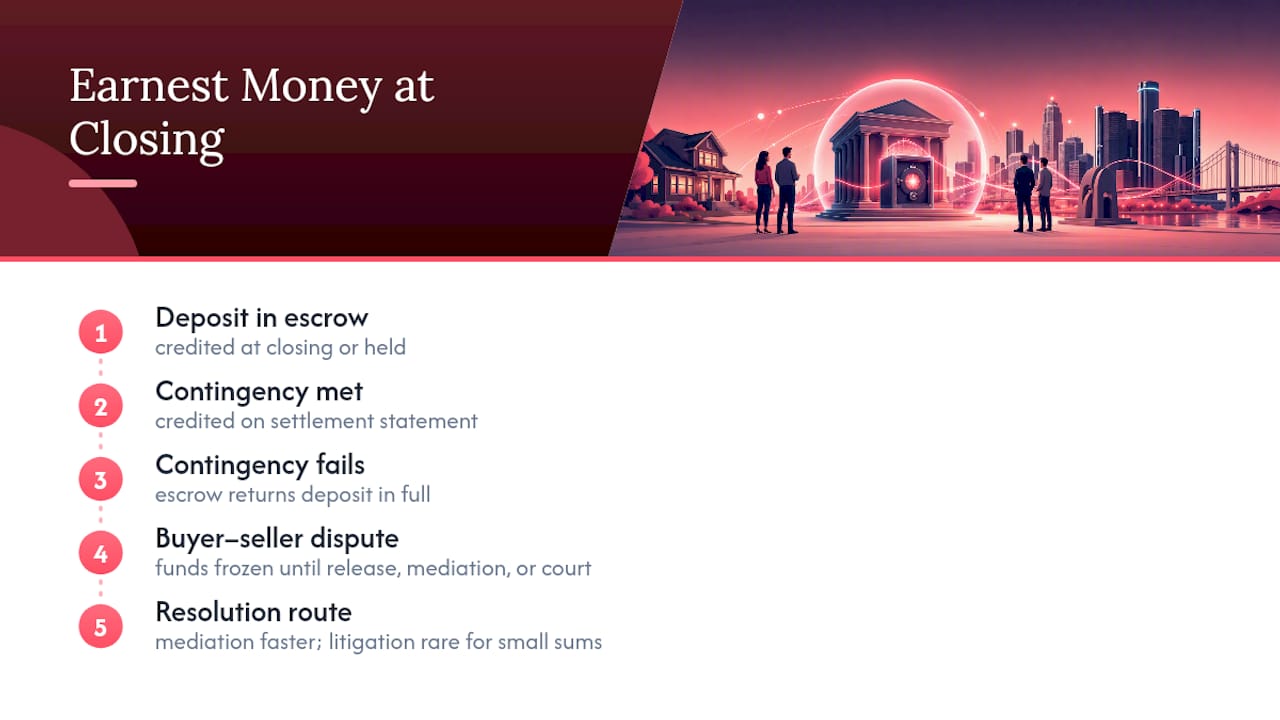
At closing, your deposit gets credited toward your down payment or closing costs. It shows up right on the settlement statement, reducing the amount you owe in certified funds. If the deal falls through under a valid contingency, escrow returns your money in full, no questions asked.
Disputes are where things get slower. If buyer and seller disagree about who’s entitled to the deposit, the escrow holder legally cannot release the funds without a mutual written release, a mediation outcome, or a court order. That neutrality protects both sides, but it also means a contested deposit can sit frozen for months while the parties sort it out. Mediation is almost always the faster, cheaper first step; litigation over a $3,000 deposit rarely makes financial sense for either party, though it does happen when larger sums are on the table.
How to Protect Your Earnest Money in a Detroit Deal
A few habits separate buyers who sail through closing from those who spend weeks arguing over a few thousand dollars.
- Spell out exactly who holds escrow, and when the deposit is due, directly in your purchase agreement.
- Set firm contingency windows and notice requirements, then follow them to the letter.
- Keep copies of every check, wire confirmation, inspection report, and lender email tied to the transaction.
- Favor a neutral title company for escrow when you have a choice, and confirm the account type before you wire anything.
- Don’t overcommit earnest money to win a bidding war. A shorter closing timeline or a rock-solid preapproval letter can strengthen your offer just as much.
Pro Tip: Before you wire a dollar, ask your agent or title company for the escrow account number and a written receipt policy. A five-minute confirmation call can save you weeks of dispute later.
What Local Market Data Tells Detroit Buyers About Earnest Money
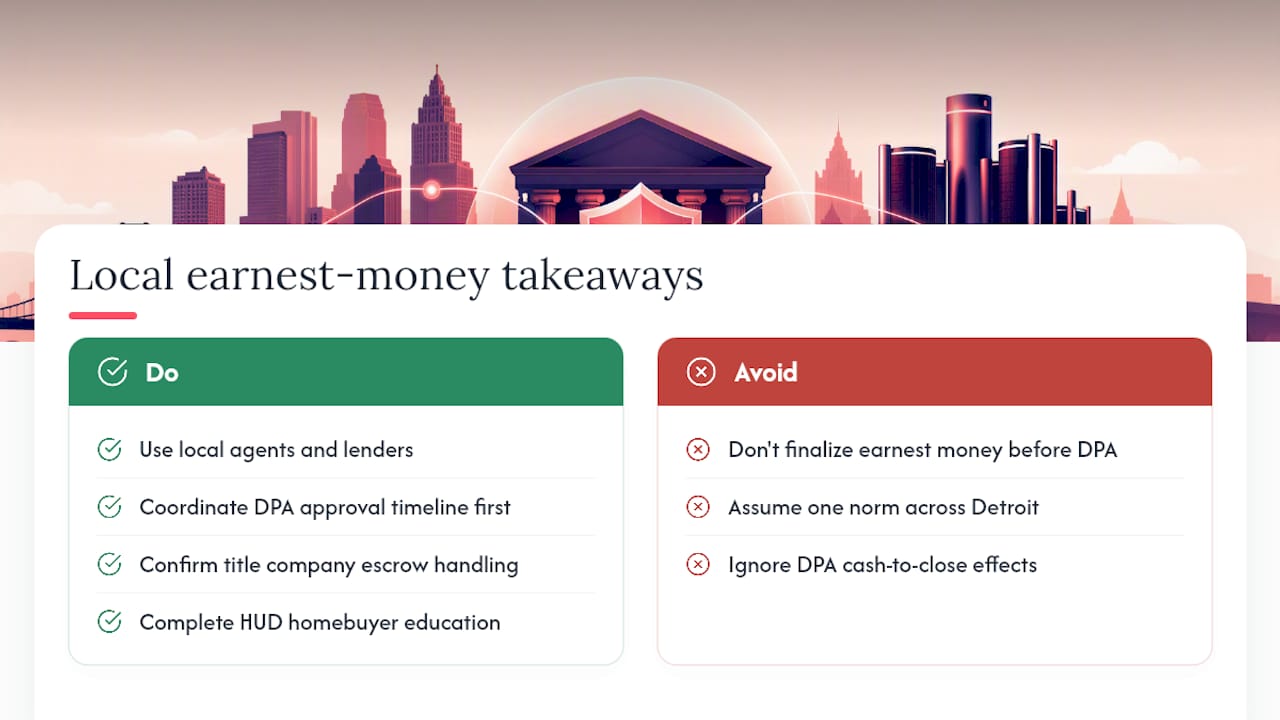
Earnest-money norms shift block by block across Metro Detroit. Local rankings connect buyers with agents and lenders who understand these county-by-county differences and how local title companies handle escrow.
That local knowledge matters most when you’re layering in the Detroit Down Payment Assistance Program, which offers up to $25,000 toward a qualifying purchase and requires a $1,000 minimum buyer contribution plus a HUD-approved homebuyer education course. Coordinate your DPA approval timeline before you finalize your earnest money amount. Cash-to-close math changes fast once assistance funds enter the picture.
What Experience Teaches About Earnest Money Mistakes
The buyers who lose sleep over earnest money almost always made one of three errors: they offered too much to seem competitive, missed a contingency deadline by a day or two, or never confirmed who actually held escrow. Preapproval, a written escrow confirmation, and a contingency calendar taped to your fridge solve most of it.
— Bryan
Where to Find Vetted Agents and Lenders for Your Detroit Purchase
This platform exists for exactly this moment. Instead of guessing which Metro Detroit agent or lender actually understands how local escrow and DPA timing work together, you get independently researched rankings built on customer sentiment, not paid placement.

If you’re weighing how much earnest money to offer, or trying to time a Detroit DPA application against your deposit deadline, the fastest path forward is talking to someone who’s handled this exact combination before. Rankings of Metro Detroit real estate agents and mortgage lenders let you compare two or three providers side by side and see how each one handles escrow, DPA coordination, and contingency deadlines before you commit a dollar. Reach out to a couple of ranked providers, ask directly how they manage escrow timing, and get your questions answered before you ever write a check.
Sources
- Detroit Down Payment Assistance Program — Apply now
- Michigan Earnest Money Deposit Law: Rules and Protections - LegalClarity
FAQ
Is $1,000 enough for earnest money?
It can be, especially on entry-level homes or when you’re using a program like Detroit’s DPA, which sets a $1,000 minimum contribution, but it may look weak in a competitive multiple-offer situation on a pricier home.
Where is earnest money held in a Detroit real estate transaction?
It’s held in a custodial escrow account, usually managed by a title company, the listing or cooperating broker’s trust account, or an attorney’s trust account, and Michigan law requires it deposited there within two banking days of accepted offer.
What happens to earnest money at closing?
It gets credited toward your down payment or closing costs and appears directly on your settlement statement, reducing the cash you need to bring to the table.
Can a seller keep my earnest money if I back out?
Only if you back out outside a valid contingency window or miss a required deadline; otherwise, escrow returns your deposit in full once the contingency is properly exercised.