

TL;DR
- No single site wins for everyone. Match and eHarmony skew serious and older, Hinge sits in the middle, Bumble and Tinder skew younger and faster, and Plenty of Fish and OkCupid are where budget-conscious daters land.
- Free tiers on Plenty of Fish, OkCupid, Bumble, Tinder and Hinge let you build a profile, match and message. Paid tiers mostly buy you filters, unlimited likes, and the ability to see who already liked you.
- A visible verification badge (live selfie matched to profile photos, phone confirmation, sometimes ID) is the fastest trust signal you get before meeting someone.
- Subscriptions we've seen run roughly $0 to $45 a month, and longer commitments cut the per-month rate by about a third. Dates cost more than the app does.
- Run two free tiers side by side for two weeks before paying for either. Judge by conversations, not matches.
Every "top 10 dating sites" list ranks the same five apps in a slightly different order, and almost none of them tell you which one fits your actual situation.
Denise hit that wall last spring. She'd spent eighteen months getting her life back in order after a divorce: sold her late aunt's place in Macomb County through probate using our probate house guide, budgeted a Royal Oak bungalow purchase down to the dollar with our closing cost breakdown, and furnished it from the shops in our best used furniture in Detroit guide. Eight months settled, she decided she was ready to date again. Then she Googled it and got a wall of listicles written by people who'd clearly never used any of them.
Table of Contents
- What's the best dating site in the United States right now?
- What are some free dating sites?
- Which site is safe for dating?
- How do you avoid catfishing and romance scams?
- How much should you budget for online dating each month?
- Which dating site fits your specific goal?
- What should Metro Detroit singles do next?
- Frequently asked questions
What's the best dating site in the United States right now?
The right answer depends on what you actually want, and anyone who gives you one name is selling something. Match and eHarmony pull users with serious intent, and in our experience they work better for people over 35 who are tired of ambiguity. Bumble and Tinder win on raw volume, which matters more than features if you live outside a major metro. Hinge and OkCupid land in between: enough structure to filter, not so much that you're filling out a questionnaire for forty minutes. Wikipedia keeps a running comparison of online dating services that's genuinely useful for a side-by-side look at features and target demographics before you commit.

What are some free dating sites?
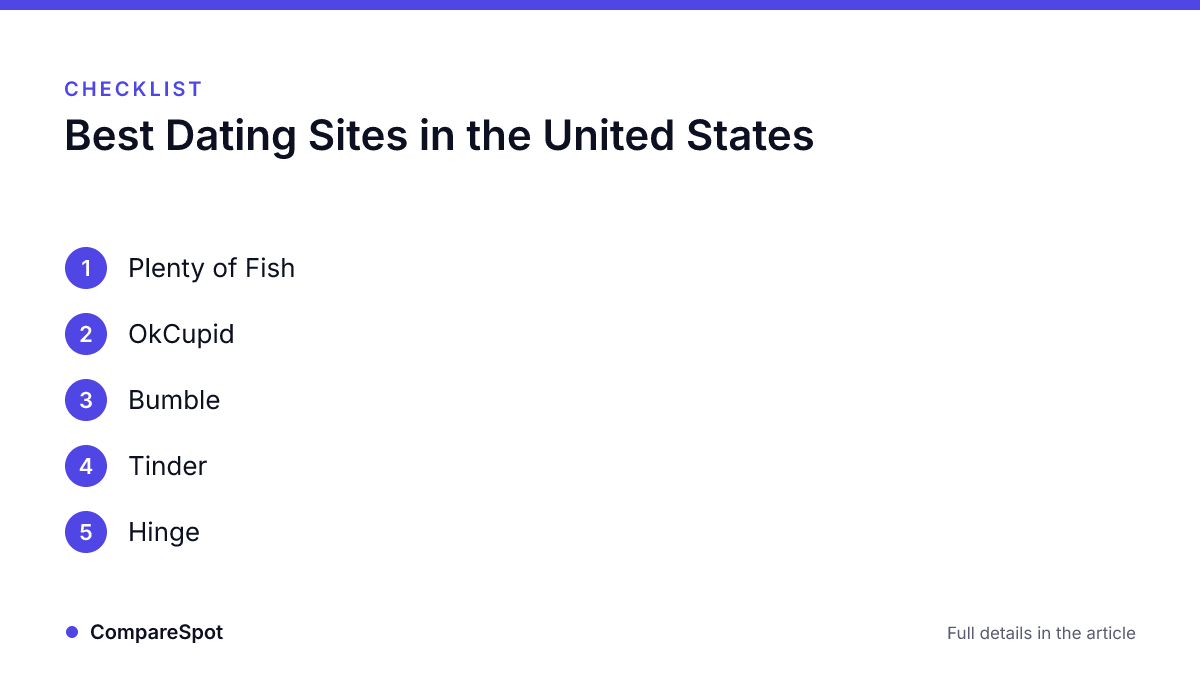
Plenty of Fish, OkCupid, Bumble, Tinder and Hinge all let you build a profile, match and send messages without a credit card. Free doesn't mean unlimited. Most cap daily likes, hide who's already liked you, and lock the filters that actually matter (distance radius, age range, kids, smoking) behind the paywall.
- Plenty of Fish — the most functional truly-free option, since messaging isn't gated. The interface looks like 2011 and that scares off some users, which also means less competition for replies.
- OkCupid — the compatibility questions give you something to open a conversation with besides "hey." Strong LGBTQ+ user base.
- Bumble — women message first, matches expire in 24 hours. The clock is the feature; it kills the dead-match graveyard other apps accumulate.
- Tinder — free swiping works, but your visibility quietly drops once you hit the daily like limit. Expect your reach to shrink by evening.
- Hinge — roughly eight free likes a day, built around prompts rather than photo-only profiles. Fewer matches, longer conversations.
Pro tip: Run two free apps at the same time for two weeks, then compare one number: how many matches turned into a back-and-forth of five or more messages. On the app that's working, that number is usually somewhere north of one in five. On the one that isn't, you'll already know.
Which site is safe for dating?
The safest platforms verify identity before someone can message you. Look for three things: photo verification where the app compares a live selfie to your uploaded pictures, phone number confirmation at signup, and optional ID verification that puts a visible badge on the profile. Tinder and Bumble both run badge programs. Match and eHarmony use the paid subscription itself as a filter, because scammers running volume operations rarely want a recurring charge on a card.
None of it is airtight. Fake profiles exist on every major platform, and verification standards swing wildly between the handful of apps everyone knows and the long tail of smaller dating services you've never heard of. If a site doesn't say anywhere how it verifies users, assume it doesn't.
| Platform | Verification method | Best for | Monthly cost we've seen |
|---|---|---|---|
| Match | Paid subscription + photo review | Long-term relationships, 35+ | $25–$40 |
| eHarmony | Compatibility questionnaire + paid gate | Marriage-minded users | $30–$45 |
| Hinge | Phone + photo verification | Relationship-focused, 25–40 | Free–$20 |
| Bumble | Photo verification, optional ID badge | Women-first matching, casual to serious | Free–$25 |
| OkCupid | Phone verification | Detailed compatibility, LGBTQ+ friendly | Free–$30 |
| Plenty of Fish | Phone verification | Budget-conscious, free messaging | Free |
Those are ranges, not sticker prices. Every one of these platforms discounts hard for three- and six-month plans, and they all run promos. Never pay the month-to-month rate in your first week.
How do you avoid catfishing and romance scams?
Refuse to move the conversation off the app too fast, and reverse image search the photos before you agree to meet. That's most of it.
Romance scammers run a script. Fast affection, a plausible reason they can't video chat, and eventually a financial emergency. Denise got the Match version in her second week: an "engineer on a job in Dubai" who pushed for her number inside a day and dodged a call for the next seven. She blocked him. The tell wasn't the story, it was the urgency about the phone number.
- Insist on a video call before meeting in person. A real person will do five minutes on camera. A scammer always has a reason they can't.
- Reverse image search any photo that looks professionally lit. Stolen and stock images surface fast.
- Never send money or gift cards. No exceptions, no matter how good the story is.
- Meet in public the first time and tell someone where you'll be, badge or no badge.
- Treat inconsistencies as data. A job title or age that doesn't match what the profile says isn't you overthinking it.
Pro tip: Watch the writing. If grammar, sentence length or backstory details shift noticeably between the first few conversations, you're probably talking to more than one person. End it there.
How much should you budget for online dating each month?
The subscription is the small number. The dates are the big one, and most people never run the math before they're three months in.
Here's the calculation. Take the month-to-month rate, compare it against the six-month rate, then add your real date spend:
- Match's mid-tier runs around $30 a month paid monthly, or about $25 a month on a six-month plan.
- Six months at $30 = $180. Six months at $25 = $150. The longer commitment saves you $30.
- Four first dates a month at $40 to $60 each (drinks, parking, dinner if it goes well) = $160 to $240 a month.
- Over six months: $960 to $1,440 in dates, plus $150 in subscription.
- Total: roughly $1,110 to $1,590.
Re-run it with your own numbers. The rule of thumb we use: if your date spend isn't at least ten times your subscription cost, you aren't actually dating, you're browsing. Paying for a premium tier while going on one date a quarter is the most common money leak in this category.
Denise ran two free tiers for a month, spent $0 on subscriptions, and set aside $150 for coffees. Once Hinge was clearly producing the better conversations, she upgraded there and nowhere else.
Which dating site fits your specific goal?
Pick on goal, not on advertising budget.
If you want a relationship inside a year or two: eHarmony or Hinge. eHarmony's questionnaire is long enough that people who aren't serious quit halfway through, which is the entire point of it. Hinge's prompts give you something real to respond to, so first messages don't die at "hey."
If you're freshly out of something long and want low pressure: Bumble. The 24-hour expiry forces a decision, and the women-message-first rule cuts the volume of lazy openers substantially.
If budget decides: OkCupid and Plenty of Fish. Both give you a usable experience free rather than a crippled demo of a paid product.
If you're over 50: OurTime and SilverSingles, both under the same parent network as Match. Narrower pools, but you stop getting matched with 32-year-olds who listed their age range wrong.
Denise landed on Hinge after her two-week test, paid for the $20 tier in month two, and had a second date by week six. Not a fairy tale. Just a process she ran the same way she ran the house hunt: compare the real options, test cheaply, then commit.
What should Metro Detroit singles do next?
Start two free tiers today, give each one two honest weeks, and track conversations rather than matches. Then pay for exactly one.
If you're still getting settled, that part tends to help the dating part rather than delay it. Worth a look: what $200K actually buys you in Detroit right now, the property management companies we've ranked across Metro Detroit, and the first-time buyer programs available in Michigan. Readers also tell us that getting back out there pushed health goals up the list, so we've reviewed GLP-1 telehealth providers including FitRx, Zealthy, AmRx and RoenRx, plus a full rundown of the best GLP-1 weight loss providers for 2026. How we vet and rank anything is on our about page, and more Metro Detroit comparisons live on the CompareSpot blog.
Frequently asked questions
Do dating apps verify identity with government ID?
Some do, opt-in only. Tinder and Bumble both offer voluntary ID verification that adds a badge to your profile. It isn't required to create an account on any major platform, so unverified profiles sit right alongside verified ones in your feed.
What's the real difference between a dating site and a dating app?
Sites like Match and eHarmony were built for desktop browsers around long questionnaires and detailed profiles. Apps like Tinder and Bumble were built mobile-first around swiping. Every major platform now does both, so in practice the difference is how much writing the profile asks of you.
Is it safe to share your address with a match before meeting in person?
No. Keep your home address private until you've met in person several times and feel genuinely comfortable. Do the first few meetings somewhere public, and arrange your own transportation there and back.