

The fastest reliable path is choosing between a vetted cash buyer or iBuyer for speed, or a quick agent listing when net proceeds matter more than timeline. Order your mortgage payoff and title search today, get a cash offer or a market net estimate from a local agent this week, and lock a closing window before you commit to a moving date. A relocation home sale in Detroit without that sequence usually ends with you paying two mortgages.
TL;DR:
- Cash buyers and iBuyers can close within 7 to 21 days, making them ideal options if your relocation date is less than a month away.
- Listing with an agent takes 30 to over 90 days but generally results in higher net proceeds, especially if you have six to eight weeks for sale preparation.
- Early steps should include ordering mortgage payoff statements and title searches within the first three days, then comparing offers or listing pricing in the first two weeks.
- When selling, consider closing costs like real estate commissions, transfer taxes, and title fees, and plan to cover repairs with a strong paper trail instead of costly cosmetic upgrades.
- Remote signing is widely supported, allowing out-of-state sellers to coordinate long-distance closings through mobile notaries and digital platforms.
Table of Contents
- What Are Your Options for a Relocation Home Sale in Detroit?
- Building a 6 to 8 Week Timeline Around Your Move Date
- What Will Selling Actually Cost You in Detroit?
- Getting Your Detroit Home Ready Without Overspending
- Coordinating Movers and Storage Around Your Closing Date
- How to Choose Between a Cash Offer and a Traditional Listing
- Legal Considerations for Selling in Detroit While You Relocate
- Managing Offers and Negotiations From Out of State
- Handling the Emotional Side of Selling and Relocating at Once
- CompareSpot’s Local Insight for Relocating Sellers
- Get Vetted Local Contacts Fast Through CompareSpot
- Authority Links and Tools for Selling Fast in Detroit
- Sources
- FAQ
What Are Your Options for a Relocation Home Sale in Detroit?
Every Detroit seller facing a job transfer or family move has four real paths, and they trade speed for money in predictable ways.
A cash buyer or investor purchases the house as-is, often closing in 7 to 21 days once the offer is signed. Services marketing to Detroit relocators, like Fair Offer, advertise offers within 24 to 48 hours specifically for people racing a start date in a new city. iBuyers work similarly but through an automated pricing engine. Opendoor generates a preliminary offer in as little as a day, then lets you pick your closing date, often with no showings and no repair negotiations.
A quick agent listing takes longer, typically 30 to 90-plus days from list to close, but usually nets more money because it opens the house to competing buyers rather than a single investor’s offer. FSBO (for sale by owner) can save on commission but shifts every task, from pricing to paperwork to buyer vetting, onto you, which is a lot to manage while also packing a moving truck.
- Cash buyer/investor: 7 to 21 days, lower offer, minimal effort
- iBuyer: offer in hours to days, flexible close, service fee built into the price
- Quick agent listing: 30 to 90-plus days, highest likely net, more coordination
- FSBO: variable timeline, saves commission, highest personal workload
If your relocation date is firm and less than a month out, cash or iBuyer options remove the guesswork. If you have six to eight weeks of flexibility, a well-priced agent listing usually earns back more than it costs in time.
Building a 6 to 8 Week Timeline Around Your Move Date
Work backward from your relocation date, not forward from today. A tight but realistic schedule looks like this:
- Days 0 to 3: Order your mortgage payoff statement and a preliminary title search. Request cash offers from two or three buyers, or ask a local agent for a market net estimate.
- Week 1 to 2: Compare offers or list the property. If you’re going the cash route, sign the purchase agreement and confirm the buyer’s proof of funds. If listing, finalize pricing and get photos scheduled.
- Weeks 2 to 3: Field offers, negotiate terms, and open escrow. Arrange remote or mobile notary signing if you’ve already relocated for work.
- Weeks 3 to 5: Handle inspections, address any repair requests, and confirm your earnest money is on deposit with the title company.
- Weeks 5 to 6: Book movers, schedule utility transfers, and confirm your closing date with the title company in writing.
- Week 6 to 8: Close, hand over keys, and finalize your move.
Cash and iBuyer sales compress steps 3 through 5 significantly since there’s often no inspection contingency. Agent-listed sales need the full runway, especially if your buyer needs mortgage financing, which generally adds about one to one and a half months for underwriting.
What Will Selling Actually Cost You in Detroit?
Net proceeds come down to a simple formula: sale price, minus payoff balance, minus closing costs, minus any repair credits. Get this number early so you’re not surprised at the closing table.
Typical seller-side closing costs in Michigan include:
- Real estate commission (if using an agent), usually the largest single cost
- Michigan Real Estate Transfer Tax, combining the state rate of $3.75 and the county rate of $0.55 per $500 of sale price in most Wayne County transactions
- Title insurance and closing/settlement fees
- Prorated property taxes and any outstanding water or utility liens common in the City of Detroit
Confirm your specific situation with a tax professional, since eligibility depends on how long you owned and lived in the home, per guidance highlighted by Fair Offer.
Cash offers typically come in below full market value, but they skip commissions, repair costs, and weeks of carrying a second mortgage while you wait for a buyer to close.
Getting Your Detroit Home Ready Without Overspending
You don’t need a renovation before you list. You need the right ten items handled well.
Curb appeal does more heavy lifting than most sellers expect. Redfin’s research on buyer behavior treats the exterior as a gatekeeper: if the lawn is overgrown or the entry looks neglected, a lot of prospective buyers never bother scheduling a tour of the inside. Before you spend money elsewhere, work through this list:
- Mow the lawn, trim shrubs, and clear leaves or debris from the walkway
- Replace a worn front door mat and touch up chipped paint on the door and trim
- Add or replace exterior light fixtures near the entrance
- Remove clutter from the porch, driveway, and yard
- Power-wash siding and the driveway if either looks dingy
Many older Detroit homes have aging boilers, roofs, and electrical panels, and buyers know it. Rather than pouring money into cosmetic upgrades that rarely return their cost, pull together maintenance records: boiler service history, roof repair receipts, and any electrical work. That paper trail reassures a buyer more than a fresh coat of paint in a room they’ll repaint anyway.
Pro Tip: Get your listing photos shot on a bright day and price the home against recent sales on your specific block, not the ZIP code average. Detroit’s block-by-block price swings are steep enough that a citywide comp can be off by tens of thousands.
Coordinating Movers and Storage Around Your Closing Date
Book your movers as soon as you have a target closing window, not after. Local Detroit movers recommend an in-person or video walkthrough to produce an accurate written estimate, and they suggest booking four to six weeks out for a local move, earlier during summer peak season. Companies like All My Sons Moving & Storage and Two Men and a Truck both note that familiarity with Detroit’s older housing stock and high-rise buildings helps crews plan for narrow staircases or tricky parking.
- Get at least two written estimates before booking
- Ask about short-term storage if your closing date lands after your move date
- Confirm the mover is licensed and insured, and get the estimate in writing
If your closing and move dates can’t align, a week of storage is far cheaper than a second mortgage payment.
How to Choose Between a Cash Offer and a Traditional Listing
Before signing anything, run through these checkpoints:
- Who pays closing costs, the buyer or seller?
- Is there an inspection contingency, and how many days does it allow?
- Can the buyer show proof of funds for a cash purchase?
- Does the buyer or their company have verifiable reviews from past Detroit sellers?
- Who selects the title company, and is it a company you can verify independently?
- How is your existing mortgage payoff or any lien handled at closing?
- Is the closing date flexible if your relocation timeline shifts by a few days?
- What happens to your earnest money if the deal falls through?
- Is the offer in writing, with a specific dollar amount and closing date?
- Does the timeline being offered feel rushed in a way that benefits the buyer more than you?
Pro Tip: A cash offer is useful even if you don’t take it. Having a real number in hand gives you a floor to negotiate against when comparing it to what an agent projects you’d net from a traditional sale.
Red flags worth walking away from: no written offer, pressure to sign within hours, vague answers about who covers closing costs, or a buyer who won’t produce proof of funds.
Legal Considerations for Selling in Detroit While You Relocate
Michigan law requires most sellers to complete a Seller’s Disclosure Statement (SDS) under MCL 565.957, covering known defects in the roof, foundation, plumbing, electrical, and past water intrusion. Skipping or falsifying this disclosure exposes you to legal liability even after you’ve moved out of state, so fill it out carefully before you leave, not from memory three states away.
Detroit properties also carry city-specific wrinkles. Outstanding water bills or unpaid municipal fees can attach to the property and surface during a title search, delaying closing if they aren’t resolved first. If your home is in a designated historic district, exterior alterations made before listing may need city approval, so check before you replace windows or siding for curb appeal.
If you’re selling while already living in another state, you’ll likely need a power of attorney so a trusted local person, often your agent or attorney, can sign documents on your behalf, or you’ll coordinate with a mobile notary for remote signing. Confirm with your title company early which option they support, since not every closing agent handles remote notarization the same way.
Finally, if the home has a tenant, land contract, or existing lien beyond the primary mortgage, get that resolved or clearly disclosed before you accept any offer. Cash buyers and iBuyers will run their own title search regardless of how fast they promise to close, and unresolved liens are the single most common reason a fast sale slips past its target date.
Managing Offers and Negotiations From Out of State
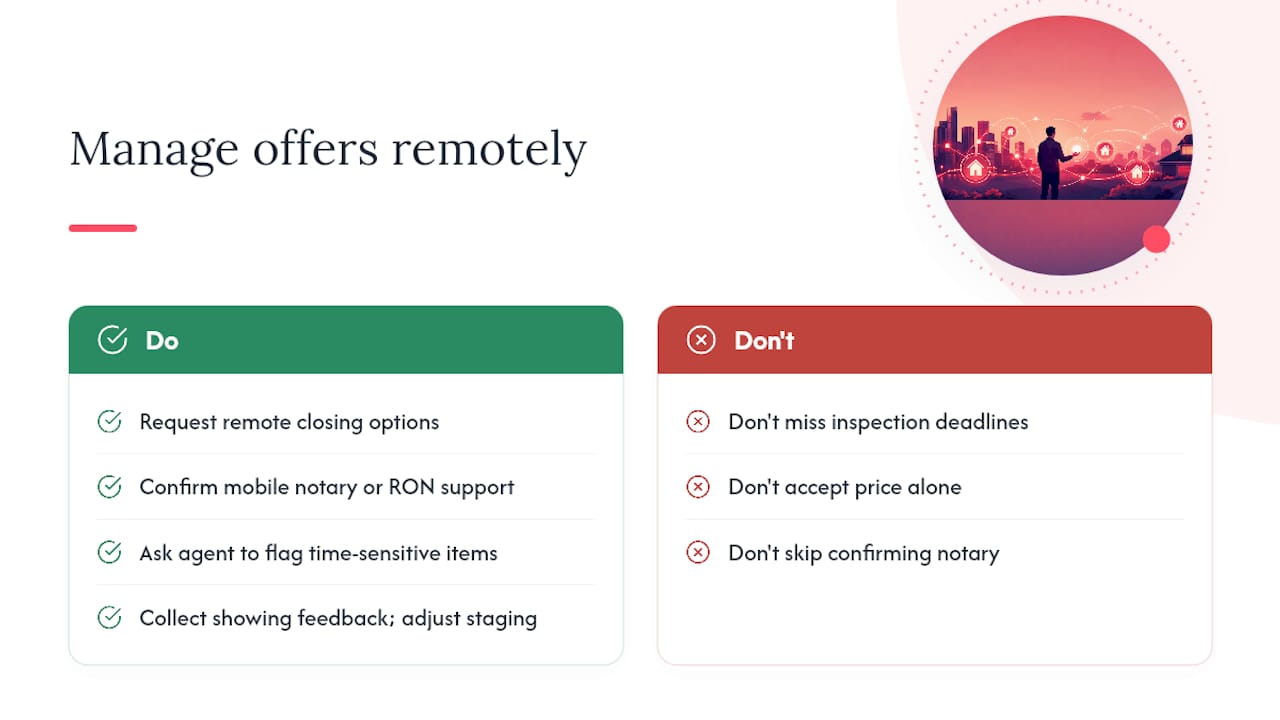
Relocating before your house sells doesn’t mean losing control of the negotiation. Most title companies and agents now handle offers, counteroffers, and disclosures entirely through email and e-signature platforms, so you can review and respond from a new city just as easily as from your old kitchen table.
Set expectations with your agent or buyer upfront: tell them you need remote closing options and confirm the title company supports a mobile notary or remote online notarization for your specific transaction. Ask your agent to flag time-sensitive items by phone or text rather than burying them in email, since a slow response on an inspection deadline can cost you the deal.
If you’re fielding multiple offers, compare more than price. Look at contingencies, proposed closing date, and how much earnest money the buyer is putting down, since a slightly lower offer with fewer contingencies and a faster path to closing often nets you more certainty than a higher bid that could unravel during financing.
For sellers using a showing service or lockbox system while out of state, ask whether feedback from each showing gets collected and shared. Buyer feedback after a tour, even something as simple as “the kitchen felt dark,” gives you a chance to adjust pricing or staging before the listing goes stale, without you ever setting foot back in the house.
Handling the Emotional Side of Selling and Relocating at Once
Selling a house you’ve lived in while simultaneously packing for a new city is genuinely one of the more stressful life transitions, and it’s worth naming that directly instead of pretending it’s purely a logistics problem.

Give yourself permission to grieve the house a little, especially if you’ve raised a family there or renovated it yourself. That emotional weight is real, and it can slow down decisions like accepting a fair cash offer because it feels like settling. Separate the emotional decision (how you feel about leaving) from the financial one (whether the number on the offer makes sense for your situation).
Practically, reduce decision fatigue by delegating what you can. If you’re not local anymore, ask your agent or a trusted family member to handle in-person tasks like meeting appraisers or letting in repair contractors. Build slack into your moving timeline wherever your budget allows. A week of buffer between your projected closing and your first day at a new job absorbs almost any delay without turning into a crisis.
Keep a simple written checklist of what’s done and what’s pending. When you’re juggling a cross-country move with a home sale, a short list you can glance at beats trying to hold every deadline in your head.
CompareSpot’s Local Insight for Relocating Sellers
Comparespot ranks cash home buyers, real estate agents, and mortgage lenders across Wayne, Oakland, and Macomb counties using independent research and customer sentiment rather than paid placements. For a relocation seller, that distinction matters: you’re choosing a provider under time pressure, and a ranked list built on verified reviews and response times cuts the research phase from days to minutes.
Use the lists to compare how quickly providers respond to inquiries, how their past customers describe the closing process, and what timeline they typically deliver against. If speed is your priority, cross-reference the cash home buyers ranked for Metro Detroit against the agents ranked for the region to see which route fits your actual deadline, not just the one that sounds fastest in an ad.
— Bryan
Get Vetted Local Contacts Fast Through CompareSpot
Comparespot gives you a shortcut past the research most relocating sellers don’t have time for: vetted, ranked local providers instead of a blind search through ads promising instant offers.

Instead of cold-calling investors or interviewing agents one by one while you’re also packing boxes, pull up Comparespot’s ranked list of cash home buyers in Metro Detroit to compare real offers and closing timelines side by side. If a traditional listing fits your timeline better, the ranked agent list for Metro Detroit shortlists local professionals with track records for fast, well-priced sales. Start with Comparespot to see current rankings across Wayne, Oakland, and Macomb counties, then reach out to two or three providers today so you have real numbers in hand before your relocation date locks in.
Authority Links and Tools for Selling Fast in Detroit
- Opendoor’s Detroit cash-offer page
- Fair Offer’s Detroit relocation guide
- Redfin’s guide to curb appeal
- Professionalmovers
- Home staging guide for sellers
Sources
- What is curb appeal? — Redfin
- Sell your house fast for cash in Detroit | Opendoor
- Job Relocation in Detroit, MI? Sell Fast for Cash | Fair Offer
- Professionalmovers
FAQ
How Fast Can I Sell My Detroit Home for Relocation?
A cash buyer or iBuyer can close in as little as 7 to 21 days, while a well-priced agent listing typically takes 30 to 90-plus days from list to closing.
Do I Need a Seller’s Disclosure Statement in Michigan?
Yes. Michigan law under MCL 565.957 requires a Seller’s Disclosure Statement covering known defects, and skipping it can create legal liability even after you’ve relocated.
How Do I Estimate My Net Proceeds Before Accepting an Offer?
Subtract your mortgage payoff, closing costs, the Michigan Real Estate Transfer Tax, and any repair credits from the sale price; cash offers tend to be lower but skip commissions and carrying costs.
Can I Close on My Detroit Home if I’ve Already Moved Out of State?
Yes, most title companies support remote or mobile notary signing, and Comparespot’s ranked agents and cash buyers can walk you through which providers offer this option.
Should I Choose a Cash Buyer or List With an Agent?
Choose a cash buyer or iBuyer if your relocation date is under a month away and certainty matters more than price; choose an agent listing if you have six or more weeks and want the higher likely net.