

Detroit’s proposed ordinance would require a pre-sale inspection report for one- and two-family dwellings, and cash sales are not automatically exempt just because no lender is involved. If you’re selling for cash, your first move is checking whether your closing date falls after the ordinance’s effective date and whether your transfer type qualifies for an exemption. If it doesn’t, you or your buyer will need a certified inspector’s report before the sale closes. Local provider rankings can point you toward vetted inspectors and cash buyers who already understand this requirement.
TL;DR:
- A pre-sale inspection report must be submitted to the city before closing unless the sale qualifies for specific exemptions, such as government transfers or pre-Effective date agreements.
- Inspectors must be certified by recognized organizations like InterNACHI or ASHI, and the report must cover key home systems, with optional add-ons like radon and sewer scope inspections.
- Sellers can choose to organize the inspection before marketing or after an offer, with early ordering giving better control over repairs and negotiation leverage.
- Inspection reports are commonly delivered within 24 to 48 hours, with costs typically ranging from $300 to $500 depending on the home’s size and added services.
- Verifying certification and ensuring timely report submission help sellers avoid last-minute surprises and strengthen their negotiating position in cash deals.
Table of Contents
- What Detroit’s Proposed Pre-Sale Inspection Ordinance Actually Requires
- Who Orders and Pays for the Inspection in a Cash Sale?
- What Inspectors Check, What Costs to Expect, and How Fast Reports Come Back
- Get Your Detroit House Ready for a Cash-Sale Inspection
- How to Verify a Certified Home Inspector in Detroit
- CompareSpot’s Perspective: Speed and Safety Aren’t Opposites
- Compare Vetted Detroit Inspectors and Cash Buyers With CompareSpot
- Sources
- FAQ
What Detroit’s Proposed Pre-Sale Inspection Ordinance Actually Requires
Detroit’s proposed ordinance amendment treats the pre-sale inspection as a condition precedent to transfer for one- and two-family dwellings. Under Sec. 22-11-2, a valid inspection report has to be tendered to the purchaser at or before the time of sale, and a copy gets submitted to the city’s Department. That’s a real procedural step, not a suggestion buried in fine print.
Sec. 22-11-4 spells out what the inspection guidelines and report form need to cover, and Sec. 22-11-1 defines who counts as a “certified home inspector.” The ordinance doesn’t leave that term vague. It names specific credentialing organizations, including InterNACHI and ASHI, as acceptable certifiers. If your inspector can’t point to one of those credentials, the report likely won’t satisfy the ordinance even if the inspection itself was thorough.
Exemptions exist, but they’re narrower than most sellers assume. Government-to-government transfers are excluded, and sales with purchase agreements signed before the ordinance’s effective date generally aren’t subject to it. Certain other transfer types carry exemptions too. The effective date matters more than most sellers realize, since a cash deal that’s been in the works for months might fall outside the requirement entirely, while a new listing started after the date won’t.
Who Orders and Pays for the Inspection in a Cash Sale?
The ordinance allows either the seller or the buyer to select the certified inspector, which leaves room for negotiation on both timing and cost. In practice, most Detroit cash sales work out one of two ways.
- A seller orders a pre-listing inspection before marketing the property, controlling the timeline and getting ahead of any surprises.
- A cash buyer’s team orders the inspection after an offer is accepted, which can slow the closing timeline by days if scheduling gets tight.
Ordering it yourself as the seller has a real advantage: it lets you address or document issues on your own terms instead of reacting to a buyer’s inspector mid-negotiation. Once the inspection is complete, the report needs to be submitted to the Department and a copy handed to the buyer before closing. Keep dated proof of that submission. If a buyer later claims they never received the report, a timestamped email or delivery confirmation settles the question fast.
Cash offers frequently waive financing and appraisal contingencies, but inspection contingencies often survive even in an all-cash deal. A buyer who still has an inspection contingency can use the report as leverage to renegotiate price after the fact, so a seller-ordered report you’ve already reviewed gives you a stronger footing at the table.
What Inspectors Check, What Costs to Expect, and How Fast Reports Come Back
A standard Detroit home inspection covers structure, roof, foundation, electrical, plumbing, and HVAC systems, along with basic safety items like smoke detectors and handrails. Detroit’s older housing stock brings its own recurring issues: knob-and-tube wiring in pre-1950s homes, aging boiler systems, and clay sewer laterals that have outlived their expected lifespan.
Add-ons worth considering before a cash sale:
- Radon testing, since Michigan radon levels frequently run above the national average, especially in basement-heavy Detroit homes.
- Sewer scope inspections, which catch root intrusion or collapsed clay pipe that a standard visual inspection can’t see.
- Wood-destroying insect (termite) inspections, particularly for homes with older wood framing or a history of moisture issues.
- Mold or indoor air quality testing if the property has had water intrusion or long vacancy.
Pro Tip: Order the sewer scope even if your buyer doesn’t ask for one. A collapsed lateral discovered after closing is one of the most common sources of post-sale disputes in older Detroit neighborhoods.
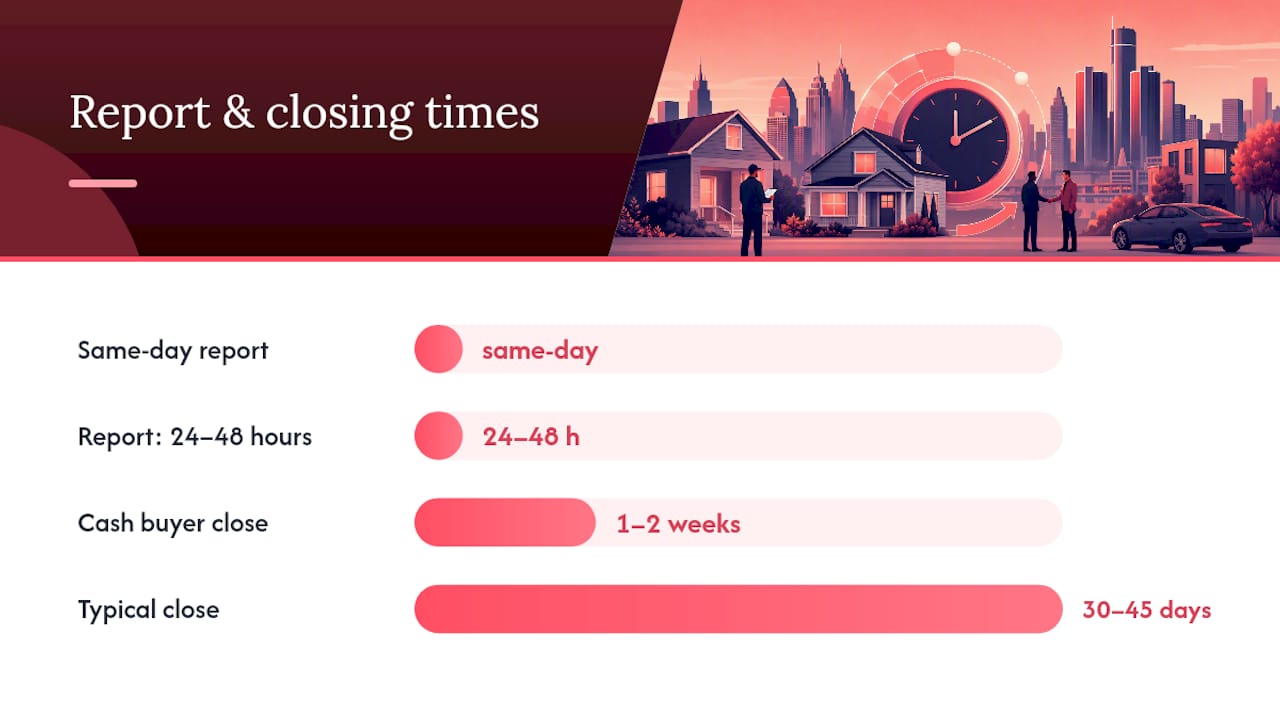
Typical inspection pricing in Detroit runs $300 to $500, depending on square footage and the home’s age, with add-ons pushing the total higher. Some local firms offer pay-at-closing or deferred payment options, which helps sellers who are cash-strapped ahead of a distressed sale. On turnaround, several Detroit inspectors advertise same-day or 24 to 48 hour report delivery with photo documentation, which matters enormously when a cash buyer wants to close in one to two weeks instead of the usual 30 to 45 days.
Get Your Detroit House Ready for a Cash-Sale Inspection
A little preparation before the inspector shows up can be the difference between a clean report and a buyer using every flagged item as a renegotiation tool.
- Walk through the house yourself first and fix the obvious safety issues: missing smoke detectors, loose handrails, exposed wiring, tripping hazards.
- Pull together permits, receipts, and repair records for anything major you’ve had done, including roof work, electrical upgrades, or plumbing repairs.
- Build a simple issues log with photos of anything you already know is wrong, so nothing catches you off guard in the inspector’s report.
- Get repair estimates for the items a cash buyer is most likely to use as leverage, like an aging roof or a failing water heater, rather than assuming you need to fix everything.
- Be present during the inspection when possible, and get your own copy of the report immediately so you’re not waiting on the buyer to share it.
Pro Tip: A $200 roof patch you handle yourself before listing often prevents a $3,000 “roof allowance” demand later. Small, targeted fixes upfront beat large concessions after an offer is signed.
If the house needs cosmetic work like door or closet repairs before showing it, a local service partner like One Day Doors & Closets can knock those out quickly without derailing your timeline.
How to Verify a Certified Home Inspector in Detroit
Since the ordinance names specific certifying bodies, don’t take a verbal claim of certification at face value.
- Ask directly whether the inspector holds InterNACHI or ASHI certification, and request documentation rather than a name-drop.
- Request a sample report so you can see how findings are documented, photographed, and organized before you’re locked into a contract.
- Confirm liability insurance and ask for a couple of recent local references, especially from sellers who went through a fast cash closing.
- Ask whether the inspector’s firm handles submission of the report to the Department directly, since that step is part of ordinance compliance.
- Confirm scheduling availability and report turnaround in writing. For a cash closing, 24 to 48 hours should be the expectation, not a best case.
Metro Detroit rankings shortlist inspectors and cash buyers who’ve already been vetted against these standards, which saves you the trial-and-error of calling around during a time crunch.
CompareSpot’s Perspective: Speed and Safety Aren’t Opposites
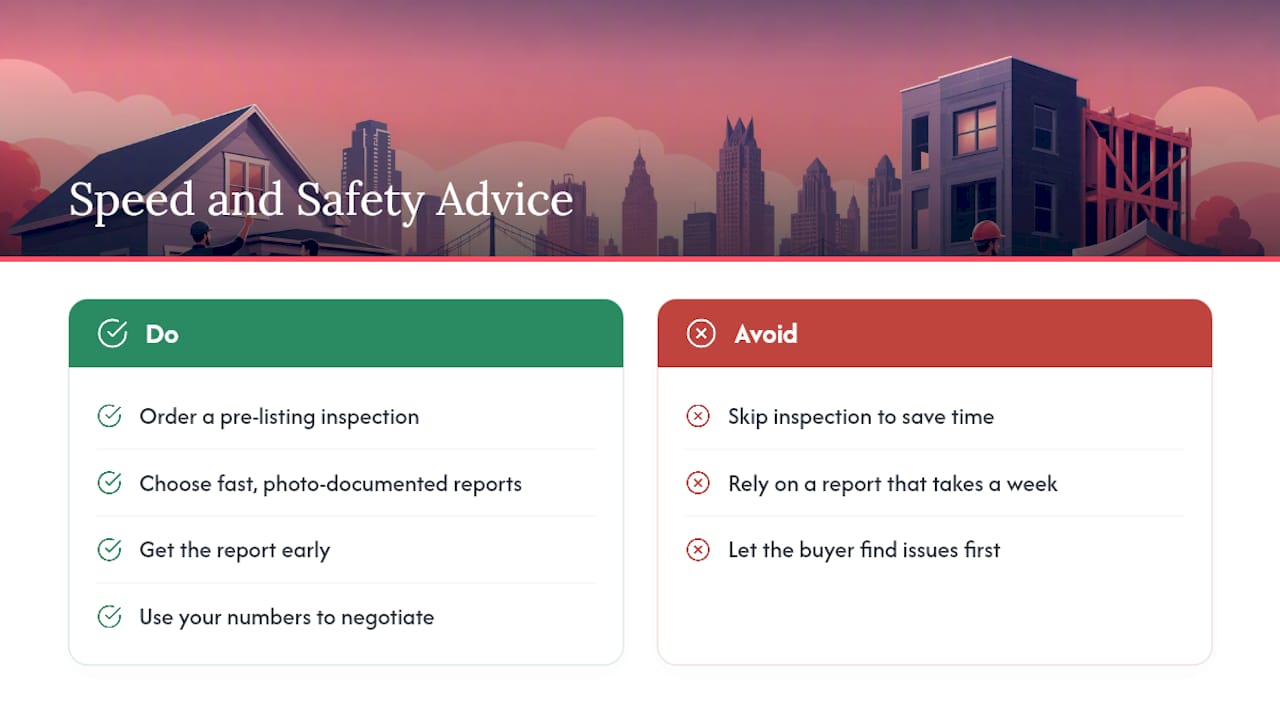
Most sellers who come to a cash sale are dealing with foreclosure timelines, an inherited property nobody wants to manage, or a relocation that can’t wait for a traditional listing. In those situations, skipping the inspection feels like the obvious way to save time. It usually isn’t. A seller-ordered pre-listing inspection gives you the leverage of knowing your own numbers before a buyer’s inspector finds something first and uses it to cut the offer by thousands.
The recommendation leans toward inspectors with fast, photo-documented turnaround because Metro Detroit cash deals live and die on the calendar. A report that takes a week defeats the purpose of selling for cash in the first place. Our recommendation is simple: get your report early, know your leverage, and let that work in your favor at the table.
Compare Vetted Detroit Inspectors and Cash Buyers With CompareSpot
This platform offers a faster route to a trustworthy inspector or cash buyer than cold-calling names off a search results page. Instead of vetting credentials and turnaround times yourself, users get local rankings built around InterNACHI and ASHI-certified inspectors, real pricing data, and cash buyers evaluated on how they treat Detroit sellers.

If you’re weighing whether a cash sale even makes sense for your situation, our guide on selling your house fast in Detroit breaks down vetted cash-buyer options side by side. Sellers juggling more than one offer can also check how multiple cash offers compare once inspection reports are in hand. Start with CompareSpot’s Metro Detroit rankings to see current top-rated providers and get moving on your timeline.
Sources
- Proposed Ordinance Amendment for Pre-sale Inspection (Detroit City)
- Home Inspection Detroit MI | PPT Inspections | Since 1994
- Home Inspection Detroit MI | InsideOut Inspections Plus
- Home Inspectors Detroit | Licensed Builder & Marine Veteran
FAQ
Does Detroit Require a Pre-Sale Inspection for Cash Sales?
Detroit’s proposed ordinance applies the pre-sale inspection requirement to one- and two-family dwellings regardless of how the sale is financed, so a cash sale is generally not exempt unless the transaction falls under a specific exemption or was signed before the effective date.
Who Pays for the Home Inspection in a Detroit Cash Sale?
Either the seller or the buyer can order and pay for the inspection under the ordinance, though sellers often order it themselves to control timing and avoid last-minute renegotiation.
How Much Does a Detroit Home Inspection Cost?
Typical pricing runs $300 to $500 depending on the home’s size and age, with add-ons like radon testing or a sewer scope adding to the total.
How Fast Can I Get an Inspection Report in Detroit?
Several local firms offer same-day or 24 to 48 hour report delivery with photo documentation, which fits the compressed timelines typical of cash closings.
What Certifications Should a Detroit Home Inspector Have?
The ordinance names InterNACHI and ASHI as acceptable certifying organizations, so verify one of those credentials directly rather than accepting a verbal claim.
Can a Cash Buyer Still Back Out After an Inspection?
Yes. Cash offers often waive financing contingencies, but inspection contingencies can remain in place, giving the buyer room to renegotiate price if the report turns up significant issues.