

If you need to close in two weeks and don’t have money for repairs, use a vetted local cash buyer. If you can wait 30 to 60 days and your house shows well, list it instead and keep more of the sale price. Everyone in between should collect two or three competing cash offers, run them through a proof-of-funds and title-company check, and compare net proceeds before signing anything.
TL;DR:
- Cash buyers in Detroit generally offer 10% to 20% less than market value, with larger discounts for properties needing extensive repairs or with title issues.
- Local investor buyers close within one to two weeks and accept homes in any condition, but their offers usually involve bigger discounts.
- Verifying proof of funds and working with a licensed Michigan title company are essential steps before accepting any cash offer to ensure a reliable closing.
- Comparing two to three offers across different buyer categories and negotiating flexible terms can maximize your net proceeds and reduce the sale timeline.
- Listing your home while securing a vetted cash fallback usually results in a higher eventual sale price if your house is move-in ready and you have 30 to 60 days to sell.
Table of Contents
- How Do You Choose a Cash Buyer in Detroit?
- What Should You Check Before Accepting a Cash Offer?
- How Do You Get Multiple Cash Offers and Negotiate the Best One?
- What’s the Real Price Gap Between Cash Offers and Market Value?
- How Does CompareSpot Vet Cash Buyers?
- What Legal and Tax Issues Come With a Cash Sale in Detroit?
- CompareSpot’s Local Perspective: Practical Combinations and Real-World Advice
- Get Matched With Vetted Cash Buyers in Detroit
- Sources
- FAQ
How Do You Choose a Cash Buyer in Detroit?
Choosing a cash buyer in Detroit comes down to matching the buyer type to your actual situation, not picking whoever calls first. There are four distinct categories of cash buyer working the Metro Detroit market, and they behave very differently once you sign a contract.
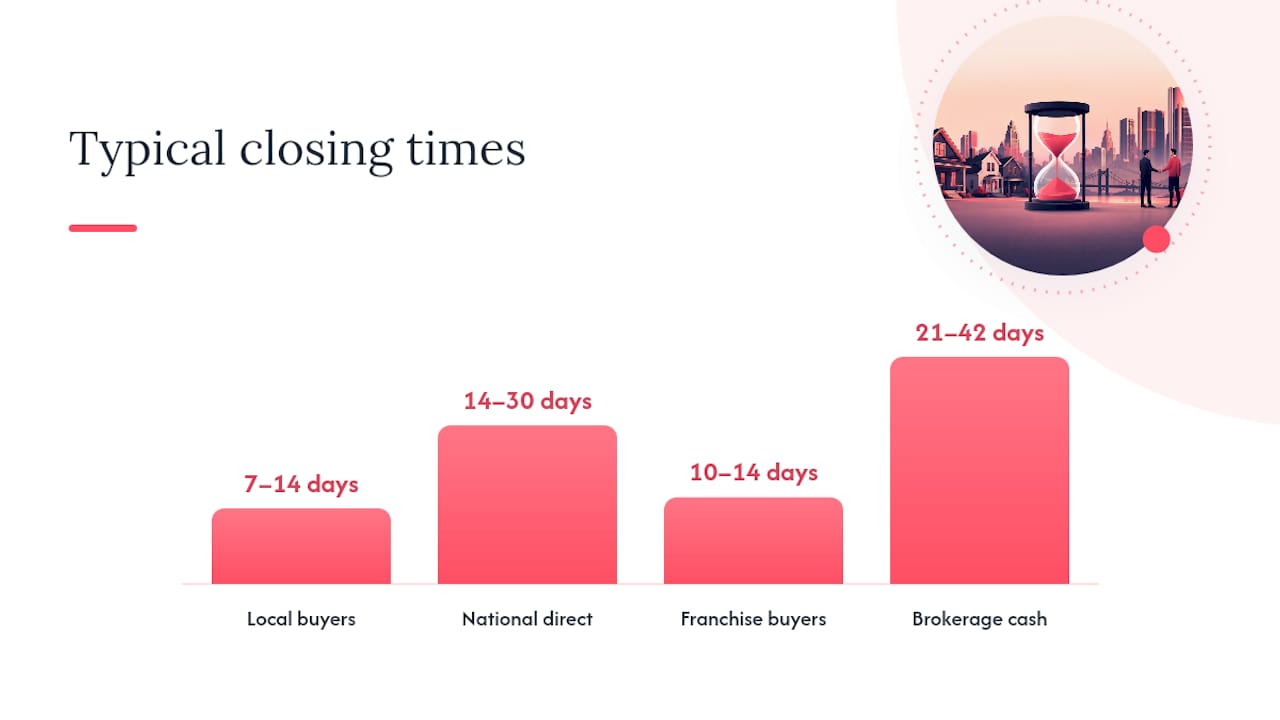
Local investor buyers tend to close fastest and flex the hardest on ugly properties. National direct buyers, often called iBuyer programs, run algorithm-driven pricing and want move-in-ready condition. Franchise and local network buyers operate under a recognizable brand but function like independent investors underneath. Brokerage cash-offer programs bolt a cash guarantee onto a traditional agent listing, giving sellers a backup if the open market stalls.
Here’s what separates them in practice:
- Local investor buyers often close in 7 to 14 days and accept homes in any condition, including fire damage or hoarding situations. However, their offers usually sit at the wider end of the discount range.
- National direct buyers close in a few weeks, prefer homes built after 1990 in stable condition, and often charge a service fee layered on top of their offer.
- Franchise buyers close in 1 to 3 weeks and vary in transparency depending on the local operator, since local investor buyers vary widely in legitimacy even under a recognizable brand name.
- Brokerage cash programs close in 3 to 6 weeks because they still involve marketing the home first, but they let you compare a real market offer against the cash fallback before committing.
| Buyer type | Best for | Typical close | Fees to expect |
|---|---|---|---|
| Local buyers | Fastest close or complex condition/title issues | 7 to 14 days | None to seller; buyer covers closing costs |
| National direct buyers (iBuyer-style) | Move-in-ready homes, sellers who want price certainty | 14 to 30 days | Service fee, typically 5% of offer |
| Franchise/local network buyers | Sellers who want brand recognition with local flexibility | 10 to 14 days | Varies by franchisee; confirm in writing |
| Brokerage cash-offer programs | Sellers who want a market test with a cash backstop | 21 to 42 days | Standard commission if it lists first |
County-specific lists instead of one flat statewide ranking are used because Wayne County’s older housing stock, Oakland County’s higher price points, and Macomb County’s mix of both create different buyer pools with different strengths. A buyer that dominates in Detroit proper may not even operate in Rochester Hills.
What Should You Check Before Accepting a Cash Offer?
Score every offer against the same grid, and anything that fails more than one row is a reason to walk.
| Dimension | Green flag | Red flag |
|---|---|---|
| Proof of funds | Bank letter or verified account statement provided unprompted | Buyer stalls or asks you to sign first |
| Title company | Named, licensed Michigan title company you can call directly | Buyer insists on their own unnamed “closer” |
| Contract terms | Clear inspection period, no vague repair credits | Assignment clause allowing the buyer to flip your contract |
| Timeline | Written closing date with penalty for delay | Vague “as soon as possible” language |
| Net proceeds | Written breakdown of offer minus costs | Offer price only, no cost disclosure |
A licensed title company is required for document prep and fund disbursement in most closings, since Michigan doesn’t require an attorney at closing the way some East Coast states do. That makes the title company your main safeguard, not a formality to skip.
Before you sign anything, ask these questions directly:
- “Can you send proof of funds from your bank or a verified account statement today?”
- “Which title company are you using, and can I call them directly?”
- “What’s my estimated net proceeds after your fees and standard closing costs?”
- “Can I see your last three closed transactions in Wayne, Oakland, or Macomb County?”
- “What happens if you can’t close by the date in the contract?”
Sellers should demand proof of funds and title-company confirmation before signing, because a buyer who can’t produce either one usually can’t close either. Combine that with a quick BBB or Trustpilot check, but don’t stop there. Review signals alone aren’t enough since a scam operation can generate fake reviews faster than a county can process a fraud complaint.
Pro Tip: Ask every buyer for the same three closed transactions in your zip code. A legitimate buyer answers in minutes; a bad actor gets vague or changes the subject.
How Do You Get Multiple Cash Offers and Negotiate the Best One?
- Request 2 to 3 offers from different buyer categories. Contact at least one local investor buyer and one national or brokerage option so you’re comparing across categories, not just within one. Getting multiple offers before committing is the single biggest lever sellers have.
- Score each offer against the comparison grid above. Convert every offer into a net-proceeds number by subtracting transfer taxes, title fees, and any repair credits, so you’re comparing apples to apples instead of headline prices.
- Negotiate the levers that actually move. Closing date flexibility, who pays transfer taxes, and whether you get an inspection allowance instead of a price cut are all negotiable even in a “as-is” cash deal.
- Choose your title company and prepare documents early. Have your deed, mortgage payoff statement, and any lien information ready before you accept an offer, since missing paperwork is the most common reason a 7-day close slips to 3 weeks.
A few things speed this process up more than people expect:
- Having your mortgage payoff amount ready in writing cuts a full day off most closings.
- Confirming utility shutoff dates in advance avoids a last-minute scramble that delays final walkthroughs.
- Asking the title company directly what they need from you, rather than waiting for the buyer to relay it, catches paperwork gaps earlier.
If you’re leaning toward a quick sale specifically because of timeline pressure, CompareSpot’s guide on closing in 7 to 14 days walks through what documentation actually needs to be ready on day one.
What’s the Real Price Gap Between Cash Offers and Market Value?
Cash offers in Southeast Michigan typically land 10% to 20% below what an open-market listing would likely fetch. That range isn’t arbitrary. It reflects the buyer’s cost of holding, renovating, and reselling the property, plus a margin for the risk they’re taking on an as-is purchase.
Several factors push that discount toward the higher or lower end:
- Property condition matters most. A home needing a new roof and full electrical update pushes toward 20%; a cosmetically dated but structurally sound home might land closer to 10%.
- Title complications (unresolved liens, probate issues, unclear ownership) widen the gap because buyers price in legal risk.
- Seller urgency affects negotiating leverage. A 7-day close for a pending foreclosure gets less room to negotiate than a seller with 60 days of flexibility.
- Neighborhood demand narrows the gap in hot pockets like Corktown or West Village, where investor competition drives offers closer to market value.
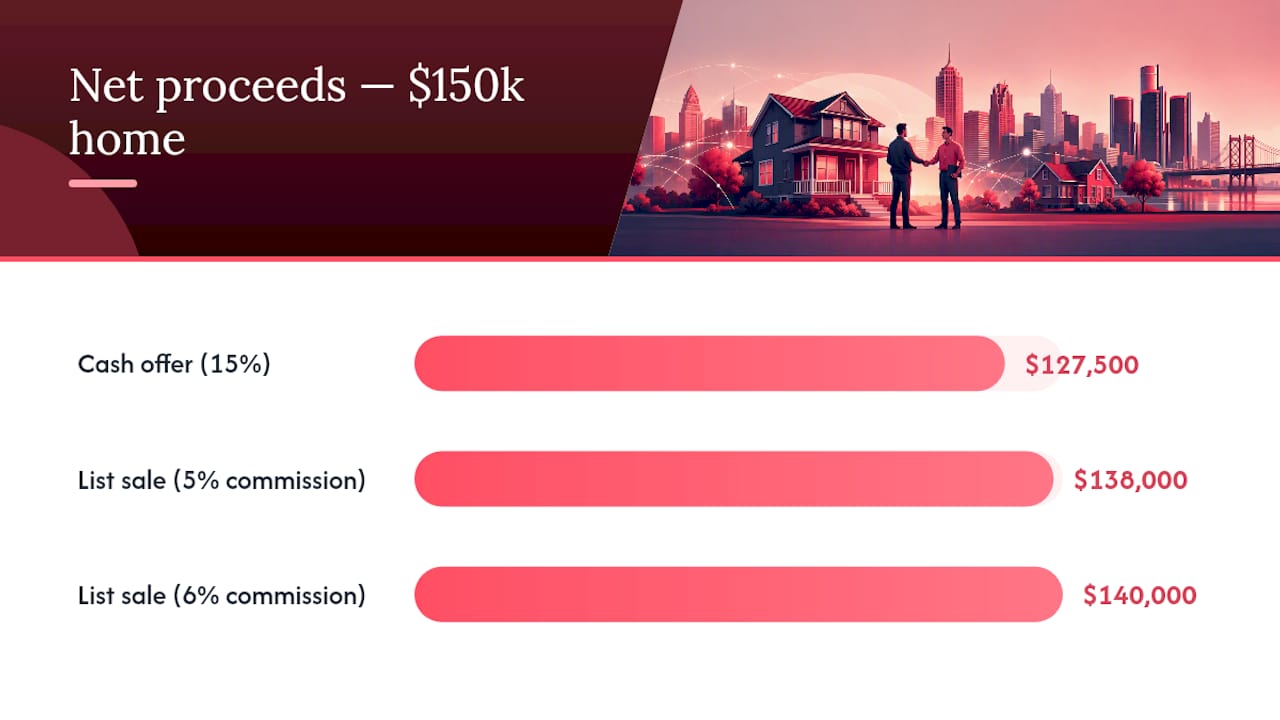
Here’s the math on two realistic scenarios. A Detroit home worth $150,000 on the open market, sold at a 15% cash discount, nets roughly $127,500 before closing costs. Since most local investor buyers cover closing costs and there’s no agent commission, that $127,500 is close to your actual take-home. Compare that to listing the same home for $150,000: after a typical 5 to 6% commission and standard seller-side closing costs, you might net around $138,000 to $140,000, but only after 30 to 60 days on market and the risk of buyer financing falling through.
A second scenario: a distressed property worth $80,000 as-is that would need $25,000 in repairs to list competitively. Listing it “as-is” on the open market often means sitting for months with heavy price cuts, since selling as-is trades some proceeds for speed and certainty regardless of which route you choose.
How Does CompareSpot Vet Cash Buyers?
CompareSpot doesn’t accept paid placement from any buyer on its lists. Every ranking is built from editorial research, not advertising dollars, which is the main reason its county-specific vetted lists look different from a paid directory.
The vetting process covers five areas before a buyer earns a spot on any Wayne, Oakland, or Macomb County list:
- Transaction history. How many closings has this buyer completed locally, and can that be verified against county records?
- Proof of funds. Does the buyer readily provide bank verification or proof of cash reserves without being pressed?
- Title-company partnership. Is there a named, licensed Michigan title company handling closings, and does that company confirm the relationship?
- Third-party review screening. What do BBB, Google, and Trustpilot patterns show over time, not just a snapshot?
- County record checks. Do past transactions actually show up in Wayne, Oakland, or Macomb County deed records at the prices claimed?
Local investor buyers vary widely in legitimacy, which is exactly why county-level record checks matter more than a slick website. A buyer with three verified closings in Redford means more than a buyer with a polished landing page and no traceable history.
Pro Tip: When any buyer sends a contract, run this exact script: “Send proof of funds, name your title company, and give me two references from closings in the last six months.” A legitimate buyer answers all three within a day.
If you want a second layer of verification beyond what any buyer or platform tells you, DeCosta Buys Homes’ guide on proof of funds breaks down exactly what a legitimate funds letter should include.
What Legal and Tax Issues Come With a Cash Sale in Detroit?
A cash sale in Michigan still goes through a licensed title company, and Michigan doesn’t require a real estate attorney at closing the way some states do. That title company handles the deed transfer, payoff of any existing mortgage, and disbursement of funds, so choosing one you can call directly matters more in a cash deal than in a financed one.
Capital gains tax applies the same way it would in a traditional sale. If the home was your primary residence for at least two of the last five years, you likely qualify for the federal capital gains exclusion (up to $250,000 for single filers, $500,000 for married couples filing jointly), regardless of whether the buyer paid cash or used a mortgage. Investment or inherited properties without that primary-residence status don’t get the same exclusion, and heirs selling an inherited Detroit property should check the stepped-up basis rules with a tax professional before closing.
Michigan also charges a real estate transfer tax on most sales, split between county and state portions, and who pays it is negotiable in a cash deal. Some local investor buyers absorb the entire transfer tax as part of their pitch; others don’t, so confirm this in writing before you sign. None of this replaces advice from a licensed tax professional, especially if you’re selling an inherited property, a home in foreclosure, or one with unresolved liens.
CompareSpot’s Local Perspective: Practical Combinations and Real-World Advice
Most Detroit sellers don’t need a pure cash sale or a pure listing. They need a hybrid, and the data backs that up. Listing for 2 to 3 weeks while holding a vetted cash offer as a fallback lets you test real market demand without losing your safety net if buyers don’t materialize.
Detroit’s housing stock skews older than most metro markets, and that changes the math. A lot of homes in Wayne County carry deferred maintenance that scares off financed buyers before an inspection even happens. If your home needs a new furnace, roof work, or electrical updates, a short market test often just confirms what you already suspect: buyers using conventional financing will lowball or walk once the inspection report lands. That’s when the cash fallback earns its keep.
But listing almost always nets more when your home is move-in ready, sits in a neighborhood with quick pending times, and you genuinely have 30 to 60 days of runway. Testing the market briefly before committing to cash gives you real data instead of a guess, and in stronger Detroit-area submarkets that test alone can add thousands to your final number.
The mistake I see sellers make most often isn’t choosing cash or choosing to list. It’s picking one path emotionally, out of stress or urgency, without ever running the comparison. A hoarder-condition property with a foreclosure deadline in 10 days doesn’t have a real choice to make. A well-maintained brick colonial with no time pressure does, and that seller owes it to themselves to at least run the 2 to 3 week test before locking into a discount they didn’t need to take.
— Bryan
Get Matched With Vetted Cash Buyers in Detroit
This platform is the alternative to cold-calling random “we buy houses” signs around Metro Detroit. Instead of guessing which buyer is legitimate, you get a county-specific shortlist built from transaction history, proof-of-funds checks, and title-company verification, already done before you make a single call.
Getting matched takes three steps. Enter your property address and general condition, review the vetted checks already run on each buyer serving Wayne, Oakland, or Macomb County, and request offers from the ones that fit your timeline. Every buyer on Comparespot’s Metro Detroit cash home buyer rankings has already cleared the verification steps covered above, so you’re starting from a shortlist instead of a cold search. If speed matters more than anything else right now, the 7 to 14 day closing guide walks through exactly what to have ready. Start by pulling up the vetted list for your county and running two or three offers through the comparison checklist before you commit to anything.
Sources
Beyond Comparespot’s own vetted lists, a few independent resources are worth bookmarking before you sign anything. DeCosta Buys Homes’ guide to proof of funds breaks down exactly what documentation a legitimate cash buyer should provide. Their companion piece on selling as-is for cash covers the trade-offs in plain terms if you’re weighing condition against speed.
For local pricing context specific to Southeast Michigan, The Patrick Group’s analysis on when a cash offer makes sense is worth reading in full. And if you haven’t yet, check Comparespot’s guide on requesting proof of funds before you accept any offer, cash or otherwise.
- Is a Cash Offer Right for Your Situation? What Michigan Sellers Should Know | The Patrick Group
- Detroit Real Estate Investors vs. Cash Buyers: Which Should You Choose? - Urban Splatter
- Cash Offer Proof Of Funds: What Sellers And Investors Need | DeCosta Buys Homes
FAQ
What Is the Best Company to Buy My House for Cash in Detroit?
There’s no single best company for every seller. The right choice depends on your timeline and property condition, which is why buyers are ranked by county and use case rather than naming one universal winner.
What Is the $25,000 Grant for Detroit Residents?
Detroit has run down-payment and home-repair assistance programs in this range for qualifying residents, but eligibility and funding change year to year. Check the City of Detroit’s housing department directly for current program status before assuming you qualify.
Who Is the Best Cash Home Buyer?
The best cash buyer is the one that passes proof-of-funds and title-company verification and matches your specific situation, whether that’s speed, property condition, or price. CompareSpot’s vetted Metro Detroit list screens for exactly these factors so you’re not guessing.
How Do You Find Reliable Cash Buyers in Your Area?
Start with a vetted local list rather than random signage or cold calls, then confirm proof of funds, a named title company, and recent closed transactions before signing anything. Reviews alone aren’t sufficient verification; pair them with county record checks.
How Much Below Market Value Do Cash Buyers Typically Offer?
Cash offers in Southeast Michigan typically run 10% to 20% below open-market value, with the exact discount depending on property condition, title issues, and how urgently you need to close.